June 6, 2026
The Patience Premium: How Buffett's Investment DNA Maps Onto Gold and Silver
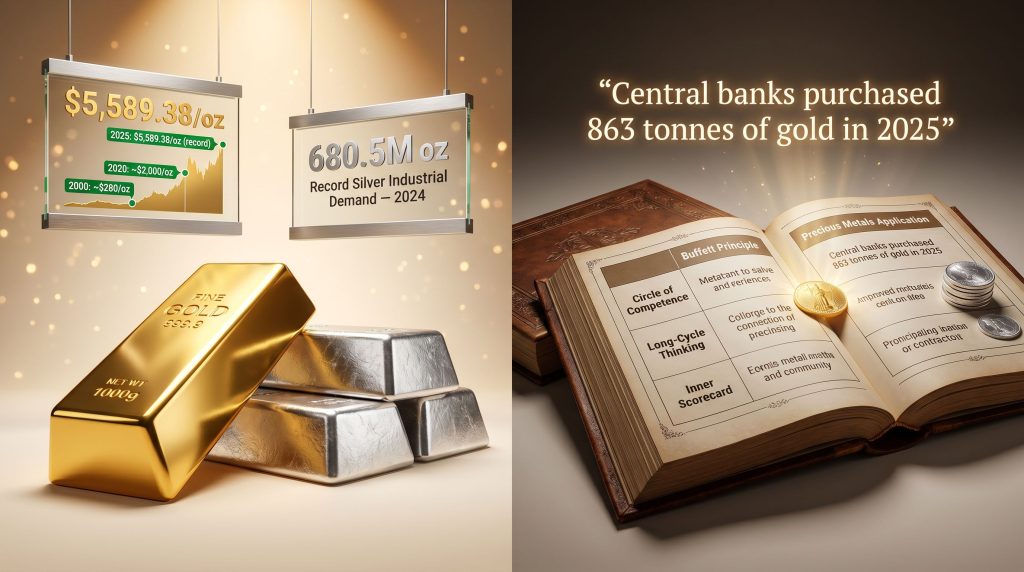
Every major bull market in precious metals eventually arrives at the same uncomfortable question: why did so few investors actually capture the full move? Gold set 53 new all-time highs during 2025, climbed past $4,000 per ounce for the first time in history, and ultimately reached a record $5,589.38/oz on January 28, 2026 (World Gold Council). Silver recorded its fifth consecutive year of structural supply deficit in 2025, with global industrial demand hitting a record 680.5 million ounces in 2024 alone (Silver Institute, World Silver Survey 2025). The structural case was visible. The data was publicly available. Yet the majority of retail investors either missed the move, sold early, or entered late.
The answer to that question almost always comes back to behaviour, not information. And for over six decades, one investor has articulated the behavioural requirements for long-term wealth accumulation more precisely than almost anyone else. Applying the Warren Buffett rules for gold and silver investors is not a contradiction. It is one of the most instructive frameworks available for understanding what separates durable precious metals holders from noise traders.
When big ASX news breaks, our subscribers know first
Why the Distinction Between What Buffett Buys and How He Thinks Matters
Buffett's personal aversion to gold is well-documented and intellectually consistent. His objection has always centred on productivity: gold generates no earnings, pays no dividends, and produces no output. A productive business, by contrast, compounds capital through retained earnings and operational reinvestment. That preference is rational, specific to his objectives, and entirely his own.
However, his decision-making architecture is a different matter entirely. The principles Buffett has built across sixty-plus years of capital allocation — including how to assess competence boundaries, how to hold conviction under social pressure, when to say no to opportunities, and how to sit with discomfort without reacting — are frameworks that apply to any asset class where patience, independent analysis, and discipline determine outcomes.
Precious metals are precisely that kind of asset class. Understanding the Warren Buffett rules for gold and silver investors begins with recognising this separation: what he holds is not the lesson. How he holds it is.
Understanding Your Circle of Competence in Hard Asset Terms
Defining the Boundary That Protects Capital
Buffett's foundational principle is deceptively simple: invest only in what you can explain clearly and act on with conviction. Anything beyond that boundary goes into what he calls the "too hard" pile — not because it lacks merit, but because competence, not opportunity, is the limiting factor.
For gold and silver investors, genuine competence requires mastery of three specific domains:
-
Monetary mechanics and debasement history — Understanding how fiat currency systems expand money supply through deficit financing, how purchasing power erodes over time, and what historical precedents exist for currency devaluation and collapse.
-
Physical supply-demand dynamics — Recognising how structural imbalances form in commodity markets, why supply response in mining is inherently slow and inelastic, and what distinguishes a cyclical price move from a long-duration structural shift.
-
Counterparty-free asset behaviour — Understanding why physical precious metals in direct ownership behave fundamentally differently from equities, bonds, or derivatives. There is no earnings risk, no management risk, no balance sheet to monitor.
Gold has served as a monetary store of value across ancient Egypt, the Roman Empire, the Bretton Woods system, and into the modern era of central bank reserve management. Furthermore, silver has operated as a medium of exchange across every major civilisation and now functions simultaneously as a monetary metal and a critical industrial input. This dual role is genuinely rare in commodity markets and represents a specific area of knowledge worth building. The gold safe-haven role in times of monetary stress reinforces why competence in this domain matters so deeply.
What Belongs in the Too Hard Pile
The same principle that defines competence also defines its limits. Several common vehicles in the precious metals space fall outside the competence circle for most retail investors:
-
Speculative junior mining companies require geological expertise, permitting timeline assessment, management quality evaluation, and capital structure analysis. Junior mining risks span multiple disciplines that few investors genuinely possess.
-
Leveraged derivatives and complex ETF structures introduce counterparty risk, roll costs, and mathematical mechanics that most participants cannot fully assess under stress conditions.
-
Unaudited storage schemes transfer custody of physical assets into arrangements where the investor cannot independently verify the integrity of the holding.
The boundary of your competence is not a limitation. It is the most important risk management tool available to any investor.
Long-Cycle Thinking and the Central Bank Signal
Why Reserve Managers Are the Most Important Illustration of Patient Capital
Central bank gold demand reached 863 tonnes in 2025 alone, representing nearly double the annual average of 473 tonnes recorded across 2010 to 2021 (World Gold Council, Gold Demand Trends Full Year 2025). These institutions are not retail traders responding to price screens. They are reserve managers executing multi-decade monetary diversification strategies developed over years of analysis, committee deliberation, and formal policy review.
That is precisely what long-cycle thinking looks like at scale. The individual investor who performs the same analytical work — studying persistent fiscal deficits, currency debasement trajectories, and central bank reserve composition shifts — and then holds with equivalent patience, is applying Buffett's methodology to the same structural thesis.
The Gold Price Trajectory That Required No Active Management
| Period | Approximate Gold Price | Primary Structural Driver |
|---|---|---|
| 2000 | ~$280/oz | Post-dot-com monetary uncertainty |
| 2008-2009 | ~$900-$1,200/oz | Global financial crisis and quantitative easing |
| 2020 | ~$2,000/oz | Pandemic-era monetary expansion |
| 2025 | $5,589.38/oz (record) | Central bank accumulation and dollar diversification |
Gold's appreciation from approximately $280 per ounce in 2000 to its current record highs required no tactical trading, no active management, and no timing skill. It required only the discipline to remain positioned through multiple periods when the structural case was questioned by mainstream financial commentary. That is the compounding patience premium, and it is the most direct expression of Buffett's long-cycle methodology applied to a hard asset.
Conviction Without External Validation
The Inner Scorecard Test
Buffett judges his investment decisions against his own analytical standards rather than market consensus. He calls this the inner scorecard. The practical application is that conviction must be grounded in independent analysis, not in whether the crowd currently agrees.
This principle is tested most aggressively in precious metals during equity bull markets, when mainstream financial media routinely characterises gold as unproductive or irrelevant. The investor whose thesis is built on monetary mechanics, supply-demand fundamentals, and central bank behaviour does not require external agreement. The structural case either holds or it does not, independent of whether the prevailing commentary validates it.
Gold delivered approximately 65% annual gains across 2025, its strongest calendar-year performance since 1979 (World Gold Council). The investors who captured that full move had formed their thesis well before institutional consensus acknowledged it. By the time media coverage turned broadly positive, the majority of the structural return had already been realised. That is the practical consequence of an inner scorecard: acting on independent analysis before consensus forms.
Berkshire Hathaway's Silver Position: A Masterclass in Thesis-First Investing
The most instructive case study for applying the Warren Buffett rules for gold and silver investors is Berkshire Hathaway's silver accumulation between July 1997 and January 1998. According to the Berkshire Hathaway 1997 Letter to Shareholders, Buffett identified that global silver demand was outpacing supply by approximately 100 million ounces annually, driven by accelerating industrial consumption and the inelastic nature of byproduct silver supply from copper, lead, and zinc mining operations.
The position mechanics reveal the depth of the analysis:
| Parameter | Detail |
|---|---|
| Accumulation period | July 1997 to January 1998 |
| Total position size | ~129.7 million ounces |
| Volume in 1997 alone | ~111.2 million ounces |
| Estimated average cost | ~$5.25/oz |
| Portfolio weighting | Less than 2% of Berkshire's total investment portfolio |
| Approximate hold period | ~8 years (divested by 2006) |
| Outcome | ~3x return; $97.4M pre-tax gain in 1997 alone |
Several aspects of this trade are particularly instructive. Buffett deliberately spread purchases across tranches of approximately 20 million ounces specifically to avoid disrupting the market — a level of analytical sophistication that most retail commentators overlook. He had also studied the aftermath of the Hunt Brothers' 1980 silver squeeze, which had driven a demand-destruction event as consumers melted silverware and coins in response to artificially elevated prices.
His explicit concern was to avoid replicating a dynamic that would undermine the very supply-demand thesis underpinning the position. The position was sized as a hedge, not a conviction overweight, which is consistent with Buffett's view that precious metals, however analytically compelling in specific circumstances, remain speculative relative to productive businesses. The analytical edge came from tracking inventory depletion across decades of data, not from a macro forecast or momentum signal.
Buffett's silver trade was not a precious metals endorsement. It was a precision arbitrage on a quantifiable structural imbalance. The methodology is the lesson, not the asset.
Capital Discipline as a Competitive Advantage
The Strategic Value of Saying No
Every speculative cycle presents precious metals investors with the same test. Leveraged equity rallies, cryptocurrency manias, IPO waves, and thematic investment crazes all compete for capital that could otherwise remain concentrated in a high-conviction, well-understood position. Buffett's framework treats the ability to say no to these distractions not as passivity but as active capital protection.
Physical gold and silver require no active management decisions, no monitoring of quarterly earnings releases, and no assessment of executive team quality. They require only the discipline to remain positioned while the structural thesis resolves. That structural resolution, in both cases, is measured in years, not quarters.
Concentration Versus Diversification: A Hard Asset Framework
| Approach | Characteristics | Outcome |
|---|---|---|
| Concentrated conviction | One deeply understood physical metals position, sized appropriately | Captures full structural return; requires patience |
| Uninformed diversification | Multiple precious metals vehicles held without thesis clarity | Substitutes breadth for knowledge; produces average returns |
| Speculative diversification | Junior miners, leveraged ETFs, and paper positions without competence assessment | Introduces unassessable risk; breaks the circle of competence |
The next major ASX story will hit our subscribers first
Emotional Temperament and the Behavioural Traps That Destroy Returns
Why Sitting Still Is the Hardest Trade
The behavioural dimension of precious metals investing is where most participants underperform. Gold and silver are structurally slow assets. They do not produce earnings reports, management guidance, or dividend announcements that create natural pressure to act. This silence is an advantage for investors who can tolerate it, and a persistent source of anxiety for those who cannot.
The most common behavioural traps that erode precious metals returns include:
-
Exiting during equity bull markets before the monetary thesis has resolved, typically followed by re-entry at significantly higher prices once mainstream media validates the position.
-
Momentum-driven entry at cycle peaks, buying aggressively after material price appreciation rather than during accumulation phases, which compresses all forward return potential.
-
Misinterpreting corrections as thesis failure, exiting fundamentally sound positions during temporary price declines and missing the structural resolution.
J.P. Morgan Global Research forecasts gold averaging approximately $5,055/oz by Q4 2026, underpinned by continued central bank purchasing and institutional demand diversification (J.P. Morgan Global Research, Gold Price Predictions: A New High?). Investors who established positions at $2,000 per ounce and held through intervening volatility are positioned to realise that return trajectory. Those who exited during corrections forfeited it.
Information Quality as a Portfolio Variable
Evaluating Sources in the Precious Metals Space
Buffett credits intellectual partnerships that challenged his thinking — rather than simply affirming it — as transformative to his capital allocation evolution. The equivalent for precious metals investors is the quality of analytical sources they consume. The industry contains operators who benefit from investor anxiety rather than investor education, and distinguishing between them is itself a form of risk management.
Use the following framework to assess any precious metals information source:
| Quality Indicator | High-Quality Source | Low-Quality Source |
|---|---|---|
| Data sourcing | Cites primary data from World Gold Council, Silver Institute, central bank reports | Relies on price predictions without transparent methodology |
| Conflict of interest | Transparent about commercial relationships with readers | Promotes purchasing without disclosing sales incentives |
| Historical accuracy | Engages with periods when metals underperformed for years | Selectively highlights only bull market periods |
| Analytical depth | Explains supply-demand mechanics and monetary history | Focuses primarily on fear-based or urgency narratives |
| Counter-argument engagement | Acknowledges legitimate critiques, including Buffett's productivity objection | Ignores substantive critiques of the asset class |
Silver's Structural Supply Deficit: Why the Thesis Has Not Resolved
The Industrial Demand Transformation
Silver's market dynamics have undergone a structural transformation over the past two decades that distinguishes the current supply deficit from historical cyclical imbalances. Furthermore, industrial demand now accounts for the majority of total silver consumption, driven by three primary growth vectors:
-
Solar photovoltaic manufacturing consumes silver as a conductive paste in panel production. As global solar installation capacity continues expanding, this demand source has become structurally embedded in the energy transition buildout.
-
Electric vehicle power systems require silver in multiple components, including battery management systems, electrical contacts, and charging infrastructure.
-
AI semiconductor fabrication and advanced electronics rely on silver's unmatched electrical and thermal conductivity properties, creating demand growth linked to technology infrastructure investment.
Critically, approximately 70 to 80% of global silver mine supply arrives as a byproduct of copper, lead, and zinc mining operations (Silver Institute). This means silver supply is largely inelastic relative to silver prices. When silver prices rise, primary silver miners can expand output, but byproduct supply from base metal operations responds to base metal economics, not silver pricing.
This inelastic supply characteristic is what allows silver supply deficits to persist across multiple years — which is precisely the dynamic Buffett identified and acted on during 1997 and 1998. The fifth consecutive annual supply deficit recorded in 2025 is not a quarterly anomaly. It reflects a fundamental misalignment between demand growth trajectories and supply capacity that resolves over years, not months.
A Practical Holding Framework for Precious Metals Investors
Structuring Decisions Before You Need to Make Them
The most consistent error in precious metals investing is making holding decisions reactively — in response to price movements — rather than proactively, in response to thesis evaluation. The following framework structures the decision sequence correctly:
-
Define the thesis before the purchase — articulate specifically why you are holding gold or silver, referencing monetary mechanics, supply-demand data, and portfolio role. A thesis of it is a hedge is not sufficient.
-
Establish a review cadence — reassess the structural case on an annual basis using primary data sources. Daily price monitoring introduces noise without adding analytical value.
-
Separate price volatility from thesis change — a 20% correction in gold does not constitute evidence that the central bank accumulation thesis has reversed. Evaluate the thesis against data, not price.
-
Avoid arbitrary price targets — if the supply-demand imbalance in silver persists, the case for holding persists. Exiting because a round number has been reached is a momentum decision dressed as fundamental analysis.
-
Update views with new data — central bank flow reports, Silver Institute annual surveys, and World Gold Council quarterly publications represent the primary data layer. These should inform thesis revision, not confirmation-seeking commentary.
The Complete Framework: Seven Principles Applied to Precious Metals
| Buffett Principle | Precious Metals Application | Key Question |
|---|---|---|
| Circle of Competence | Master monetary history, supply mechanics, and counterparty risk | Can I explain specifically why I hold this? |
| Long-Cycle Thinking | Study central bank flows and structural deficits, not daily price screens | Am I reacting or genuinely analysing? |
| Inner Scorecard | Hold conviction independent of media consensus | Does my thesis hold regardless of current price? |
| Capital Discipline | Resist speculative vehicles; concentrate in understood positions | What am I saying no to, and why? |
| Emotional Temperament | Sit with underperformance without abandoning sound analysis | Am I acting on data or discomfort? |
| Information Quality | Prioritise sources that challenge thinking over sources that validate it | Who benefits if I follow this advice? |
| Holding Discipline | Define exit conditions based on thesis integrity, not price targets | Has the structural case changed, or only the price? |
Frequently Asked Questions
Does Warren Buffett invest in gold?
Buffett has consistently avoided gold, characterising it as a non-productive asset incapable of generating earnings, dividends, or compounding returns. His objection is specific: gold cannot reinvest its own output to grow intrinsic value the way a productive business can. This is a principled preference, not a commentary on the validity of gold as a portfolio diversification tool. His methodology for evaluating, holding, and sizing positions applies directly to precious metals, even though his personal allocation does not.
Why did Berkshire Hathaway accumulate silver in 1997 if Buffett dislikes precious metals?
The 1997 to 1998 silver position was driven by a specific, quantifiable supply-demand analysis, not a general endorsement of precious metals. Buffett identified that global demand was outpacing supply by approximately 100 million ounces annually and that above-ground inventories were being steadily depleted. The position represented less than 2% of Berkshire's total portfolio, functioning as a targeted thesis trade rather than a strategic overweight. The position generated a $97.4 million pre-tax gain in 1997 alone (Berkshire Hathaway, 1997 Letter to Shareholders).
What is the circle of competence and how does it apply to gold investing?
The circle of competence means deploying capital exclusively into what you can genuinely understand and explain. For precious metals investors, this requires working knowledge of monetary debasement mechanics, physical supply-demand dynamics, and the structural difference between counterparty-free physical assets and financial instruments. Investing without this foundation — regardless of how compelling the price action appears — constitutes operating outside your competence.
How long should a gold or silver investor hold their position?
The correct holding period is determined by thesis integrity, not price targets. For gold, the core thesis involves central bank reserve diversification away from dollar concentration, persistent fiscal deficits, and monetary debasement. For silver, the thesis centres on a structural industrial supply deficit now in its fifth consecutive year. Neither dynamic resolves within a quarter. Both reward investors who hold to natural resolution rather than arbitrary price milestones. Monitoring the gold-silver ratio can additionally provide a useful signal for relative positioning between the two metals.
What are the most common behavioural mistakes gold investors make?
The most destructive patterns include exiting during equity bull markets before the monetary thesis resolves, entering aggressively at cycle peaks driven by momentum rather than fundamentals, misinterpreting short-term corrections as thesis failures, and relying on information sources that advocate accumulation without explaining the structural reasoning. Consequently, the Motley Fool's analysis of why Buffett distinguishes between gold and silver offers a useful reference point for grounding this behavioural assessment.
How much portfolio allocation is appropriate for precious metals?
Buffett's own silver position represented less than 2% of Berkshire's total portfolio, useful as a reference point for treating precious metals as a hedge within a broader allocation framework. Independent financial frameworks commonly suggest allocations between 5% and 15% for investors seeking monetary diversification. Individual circumstances vary considerably. This does not constitute financial advice. Consult a qualified financial adviser before making allocation decisions.
Is silver structurally different from gold as an investment today?
Gold functions primarily as a monetary store of value and reserve diversification asset, with central bank demand representing a dominant structural force. Silver combines those monetary characteristics with significant and growing industrial demand, particularly from solar energy, electric vehicles, and semiconductor manufacturing. Silver's supply is largely a byproduct of base metal mining and is therefore inelastic relative to silver price signals, which allows deficits to persist across multiple years. Both metals serve distinct portfolio roles, and neither is universally superior to the other in all conditions.
Disclaimer: This article is for informational and educational purposes only. It does not constitute financial or investment advice. All data cited references publicly available institutional sources including the World Gold Council, Silver Institute, Berkshire Hathaway shareholder letters, and J.P. Morgan Global Research. Past performance is not indicative of future results. Consult a qualified financial adviser before making any investment decisions.
Want To Know When The Next Major Mineral Discovery Hits The ASX?
Discovery Alert's proprietary Discovery IQ model delivers real-time alerts on significant ASX mineral discoveries, instantly transforming complex geological and market data into actionable investment insights — the kind of structural edge that separates informed investors from the crowd. Explore historic discoveries and their remarkable returns, then begin your 14-day free trial at Discovery Alert to position yourself ahead of the broader market.