
June 12, 2026
When Macro Forces Collide With Long-Term Strategy: The WDS Dilemma
Energy markets have always operated on two distinct timescales simultaneously. In the short term, prices gyrate in response to geopolitical signals, supply chain shifts, and sentiment swings. Over the long term, however, it is resource control, infrastructure positioning, and strategic optionality that determine which companies win. When those two timescales pull in opposite directions, as they are doing right now for Woodside Energy (ASX: WDS), investors face exactly the kind of analytical challenge that separates disciplined thinkers from reactive ones.
The Woodside Browse gas project shares falling narrative playing out across trading desks is a textbook case of conflated signals. A strategically rational acquisition met a deteriorating macro backdrop on the same day, and the resulting share price movement has been misread by many as a verdict on the deal itself. It is not.
When big ASX news breaks, our subscribers know first
What the Browse Gas Project Actually Represents
To understand why Woodside is willing to commit up to US$400 million to a project with no confirmed build date, you first need to appreciate what Browse actually is geologically and commercially.
Browse is widely regarded as Australia's largest undeveloped conventional offshore gas resource. The resource sits in the Browse Basin, located off the remote Kimberley coast of Western Australia, and holds recoverable gas reserves that industry analysts have estimated in the range of 15 to 16 trillion cubic feet across the joint venture's various fields, including Brecknock, Calliance, and Torosa.
What makes Browse disproportionately valuable relative to its undeveloped status is its proposed development pathway. The preferred concept involves floating LNG (FLNG) technology, which would process gas offshore and eliminate the need for costly onshore pipeline infrastructure to shore. However, a key element of Browse's commercial logic has always been its potential to backfill the North West Shelf (NWS) LNG facility near Karratha, which is already one of the world's largest LNG export terminals and is currently facing declining feed gas from its legacy reservoirs. The North West Shelf extension remains a critical piece of this broader supply puzzle.
"The infrastructure already exists. The challenge is regulatory clearance and the economics of linking Browse gas into that processing chain. For operators already embedded in the NWS supply network, Browse is not simply another gas field; it is a lifeline for existing sunk capital."
This is precisely why operator-level control of Browse carries strategic weight far beyond what a raw percentage ownership figure might imply.
How Woodside Acquired PetroChina's Browse Stake
The mechanism Woodside deployed to acquire PetroChina's 10.67% interest deserves close attention, because it reveals important information about competitive dynamics within the Browse joint venture.
PetroChina had negotiated a sale of its stake to Japan's Inpex Corporation. Inpex is itself already a major North West Shelf participant and an operator of the nearby Ichthys LNG project in Darwin, making its interest in Browse entirely logical. Woodside, however, held a pre-emption right over PetroChina's interest, meaning it could match the agreed sale terms and take the stake ahead of any third party.
The fact that Woodside chose to exercise that right rather than allow Inpex to enter the register is a strong signal of internal conviction. Companies do not spend A$320 million in immediate cash to block a transaction they view as irrelevant. You can review the full details of the Browse acquisition to understand the broader context of this move.
Deal Structure at a Glance
| Payment Component | Amount | Trigger Condition |
|---|---|---|
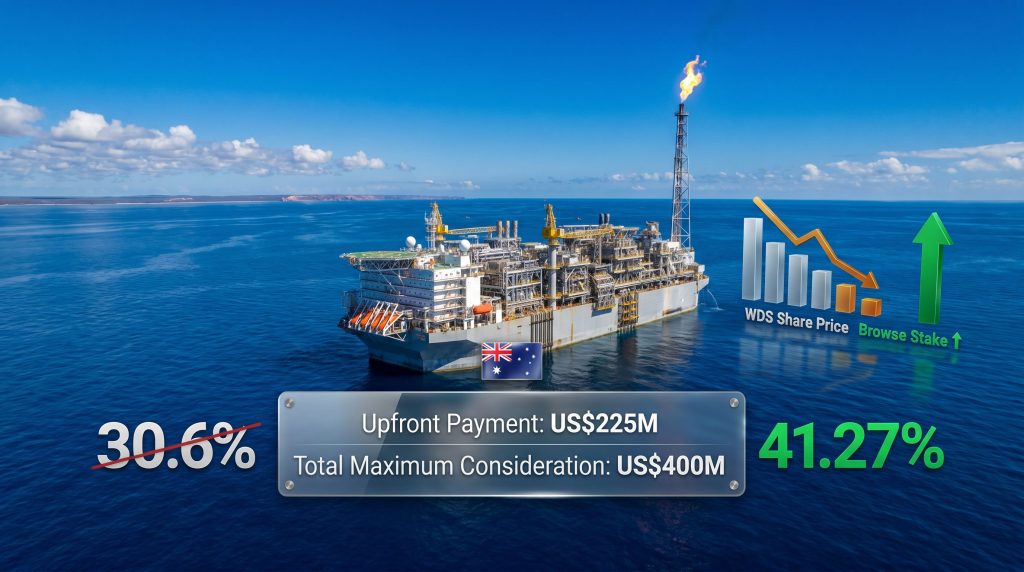
| Upfront cash consideration | US$225 million (~A$320 million) | Payable immediately upon completion |
| Contingent deferred payment | US$175 million | Only payable if FID is reached by June 2032 |
| Total maximum consideration | US$400 million | Subject to FID milestone |
This structure is notably investor-friendly in its design. The contingent payment component means that 44% of the total potential consideration is only triggered if the project clears the final investment decision threshold by mid-2032. Should Browse remain in regulatory limbo or fail to achieve commercial viability by that deadline, Woodside avoids the second tranche entirely.
The New Browse Ownership Hierarchy
Following BP's partial divestment to South Korea's GS Energy, which reduced BP's holding to approximately 39%, Woodside's acquisition of PetroChina's stake lifts its total Browse interest to roughly 41.27%, making it the project's single largest partner. As both the majority stakeholder and the project operator, Woodside now holds meaningful influence over development scheduling, capital allocation decisions, and the pace at which Browse moves toward any future investment decision.
Four Reasons Woodside Shares Are Under Pressure
The approximately 2% share price decline following the announcement reflected a convergence of pressures, not a single cause. Separating these forces is essential for accurate investment analysis.
1. Oil Price Correction Driven by Geopolitical De-escalation
Easing tensions between the United States and Iran triggered a meaningful pullback in crude oil prices. Energy stocks, including ASX-listed names like Woodside, trade with high correlation to oil benchmarks. When the broader energy sector sells off, individual company announcements are largely overwhelmed by that directional tide. This was a sector-wide repricing, not a company-specific penalty. Furthermore, oil price volatility of this nature has repeatedly demonstrated its capacity to distort short-term market readings of otherwise sound strategic decisions.
2. Increased Capital Commitment to an Undeveloped Asset
Markets generally apply a discount to capital deployed into pre-FID projects. Browse generates no cash flow today. The immediate outlay of US$225 million represents real money committed against a long-duration, uncertain payoff. For investors benchmarking Woodside against near-term yield metrics, that is a dilutive signal even when the strategic rationale is sound.
3. Environmental Approval Uncertainty Remains the Central Gating Risk
The Browse development concept requires approval under Australia's Environment Protection and Biodiversity Conservation Act 1999. The assessment process specifically includes evaluation of potential impacts on Scott Reef, a remote coral reef system in the Browse Basin that hosts significant biodiversity. The final determination rests with the Federal Environment Minister, and no timeline for a decision has been publicly confirmed.
4. No Final Investment Decision Has Been Made
Even if environmental approval is granted, the Browse joint venture partners would still need to align on a formal FID, which would involve finalising engineering design, securing long-term LNG offtake contracts, locking in financing, and satisfying individual partner board approvals. This process alone could extend well into the late 2020s or beyond, meaning first production from Browse, if approved, is realistically a post-2030 scenario.
Scenario Modelling: What Browse Means for WDS Investors
| Scenario | Key Dependency | Financial Implication for WDS |
|---|---|---|
| FID approved before June 2032 | Regulatory clearance and favourable LNG economics | Full US$400M outlay; significant long-term production uplift |
| FID delayed beyond June 2032 | Regulatory delays or weak gas pricing environment | US$175M contingent payment avoided; US$225M sunk cost remains |
| Project abandoned | Environmental rejection or commercial unviability | US$225M written down; zero production contribution |
The middle scenario is perhaps the most likely in the near term. Browse has been in development planning for over two decades. The project has previously come close to FID before retreating on gas price and cost concerns. Investors with long memories will recall that Browse was actively being progressed in the early 2010s before a combination of cost blowouts, falling gas prices, and regulatory complexity pushed it back into the queue.
"This historical pattern is important context. Browse is not a new idea struggling to find legs. It is a well-characterised resource with proven gas in place, battling a complex regulatory and commercial environment that has repeatedly deferred its development. That history does not make a positive outcome less likely, but it does calibrate realistic timelines."
The Regulatory Complexity of Scott Reef
Scott Reef sits at the centre of Browse's most sensitive approval challenge. Located approximately 270 kilometres west of the Kimberley coast, Scott Reef is one of Australia's most isolated and ecologically significant coral atoll systems. It supports populations of marine turtles, seabirds, and reef fish communities that fall under protected species frameworks.
The environmental assessment for Browse must address risks associated with potential gas flaring, marine noise during construction, seabed disturbance, and the long-term operational footprint of floating LNG infrastructure in close proximity to the reef system. Regulators have historically taken a precautionary approach in such assessments, and the Browse proponents have been required to provide extensive ecological baseline studies.
What makes this particularly complex from an investment standpoint is the absence of a defined approval timeline. Unlike mining projects that operate under statutory decision deadlines in some jurisdictions, the EPBC Act assessment process for a project of Browse's scale and sensitivity does not carry a fixed clock, meaning the regulatory overhang can persist indefinitely. Australia's energy exports more broadly face similar regulatory pressures that continue to weigh on long-term planning.
The next major ASX story will hit our subscribers first
Browse Within Woodside's Broader Capital Allocation Picture
Woodside is not approaching Browse as its sole major capital commitment. The company is simultaneously managing the Louisiana LNG project in the United States, a development carrying a price tag of approximately US$11.8 billion, representing one of the largest single capital commitments by an Australian energy company in recent history.
The juxtaposition of these two projects raises legitimate questions about capital bandwidth. Woodside is deploying significant funds into Louisiana LNG while also increasing its exposure to a pre-FID, pre-approval Australian project. For investors, the key question is whether management can execute both simultaneously without one undermining the other.
The strategic logic for accumulating Browse optionality now, even under capital pressure, likely relates to the asymmetric nature of operator control. As both the largest stakeholder and operator, Woodside has the ability to pace Browse's development on its own terms. If Louisiana LNG progresses smoothly and gas markets remain tight, Browse becomes the next logical growth lever. If conditions deteriorate, Woodside can moderate the pace of Browse development without ceding control to a less aligned partner.
Is the WDS Share Price Drop a Buying Opportunity?
The answer depends entirely on investment horizon and risk tolerance. Several frameworks are worth applying. In addition, ongoing market volatility and trade war oil prices remain important external variables that could influence how quickly sentiment around Woodside recovers.
For income-focused investors holding WDS for dividends and near-term cash generation:
- The Browse transaction does not alter Woodside's existing producing asset base
- Near-term cash flows from Pluto LNG, the North West Shelf, and other producing assets remain unchanged
- The upfront payment of US$225 million is material but not balance-sheet threatening for a company of Woodside's scale
- Dividend policy continuity is more closely tied to oil prices and operating performance than to Browse's development status
For growth-oriented investors seeking long-term LNG exposure:
- Browse optionality at the operator level represents asymmetric upside if the project achieves FID
- The contingent deal structure limits downside to US$225 million in a worst-case scenario
- Woodside's position as the largest partner gives it first-mover influence on development timing decisions
- The blocking of Inpex prevents a potentially competing LNG interest from gaining a foothold in Australia's most important undeveloped gas resource
Critical catalysts to monitor before reassessing the WDS investment thesis:
- Federal environmental approval determination for Browse, specifically the Scott Reef assessment outcome
- Any formal communication from the Browse joint venture regarding FID readiness or timeline
- Global LNG demand trajectory, particularly from North Asian buyers such as Japan, South Korea, and China
- Woodside's capital allocation guidance in upcoming earnings updates, particularly around Louisiana LNG progress milestones
- Oil and gas price movements, which will continue to dominate short-term WDS share price direction regardless of project-specific news
Frequently Asked Questions: Woodside Browse Gas Project
Why did Woodside shares fall after announcing the Browse stake acquisition?
The approximately 2% decline was driven primarily by a broader oil price correction following de-escalation in US-Iran tensions, which pulled the entire ASX energy sector lower. The Woodside Browse gas project shares falling announcement coincided with this macro sell-off, making it appear as though the deal itself was poorly received, when in fact the two events were largely unrelated. Furthermore, broader sector sentiment amplified the downward movement well beyond what the deal's fundamentals would have warranted in isolation.
What is a pre-emption right and how did Woodside use it?
A pre-emption right gives an existing joint venture partner the ability to match the terms of any proposed sale by another partner to a third party, effectively giving them first refusal. Woodside held this right over PetroChina's Browse interest and exercised it to block a previously agreed sale to Japan's Inpex Corporation. You can explore Woodside's Browse project page for additional background on the asset and its development history.
When could Browse receive a final investment decision?
No firm timeline has been confirmed by the Browse joint venture. The contingent payment structure in Woodside's acquisition deal uses June 2032 as a reference date, suggesting the partners consider that timeframe as the outer boundary for a realistic FID. However, FID is contingent on environmental approval first being granted, which itself has no confirmed timeline.
Does the share price drop mean the deal was a mistake?
Not based on the available evidence. The strategic logic of securing operator-level control of Australia's largest undeveloped conventional gas resource at a contingency-weighted price, while simultaneously blocking a competing interest from entering the register, is coherent. The deal's quality will ultimately be judged by whether Browse achieves FID and what gas prices look like at that time, neither of which can be assessed from a single day's share price movement.
Key Takeaways for WDS Investors
- The share price decline is macro-driven, not a market verdict on the Browse acquisition's strategic merit
- The deal structure is contingency-weighted, with US$175 million of the total US$400 million consideration only triggered by a successful FID before June 2032
- Browse holds an estimated 15 to 16 trillion cubic feet of recoverable gas, making it a resource of genuine long-term significance for Australian LNG supply
- Environmental approval for Scott Reef impacts is the critical near-term gating factor without which no development timeline can be confirmed
- Blocking Inpex's entry into the Browse register was a defensive move that reinforces Woodside's strategic dominance over the asset
- Long-term investors should monitor regulatory and FID milestones closely before incorporating Browse's production potential into intrinsic value calculations
- Income investors holding WDS for dividends are largely insulated from Browse's development uncertainty in the near term
This article is intended for informational purposes only and does not constitute financial advice. Past performance is not indicative of future results. Readers should conduct their own research and consult a licensed financial adviser before making any investment decisions. Forecasts and scenario projections referenced in this article are speculative in nature and may not reflect actual outcomes.
Want to Spot the Next Major ASX Energy or Resource Discovery Before the Market Does?
Discovery Alert's proprietary Discovery IQ model delivers real-time alerts on significant ASX mineral discoveries, instantly translating complex data across more than 30 commodities into clear, actionable insights for both short-term traders and long-term investors — explore historic discovery returns on Discovery Alert's discoveries page to understand the scale of opportunity, and begin your 14-day free trial today to position yourself ahead of the broader market.