Western Yilgarn NL
Western Yilgarn Uncovers High-Grade Gallium Across Cardea 1, Reinforcing a Large-Scale Critical Minerals Opportunity in Western Australia
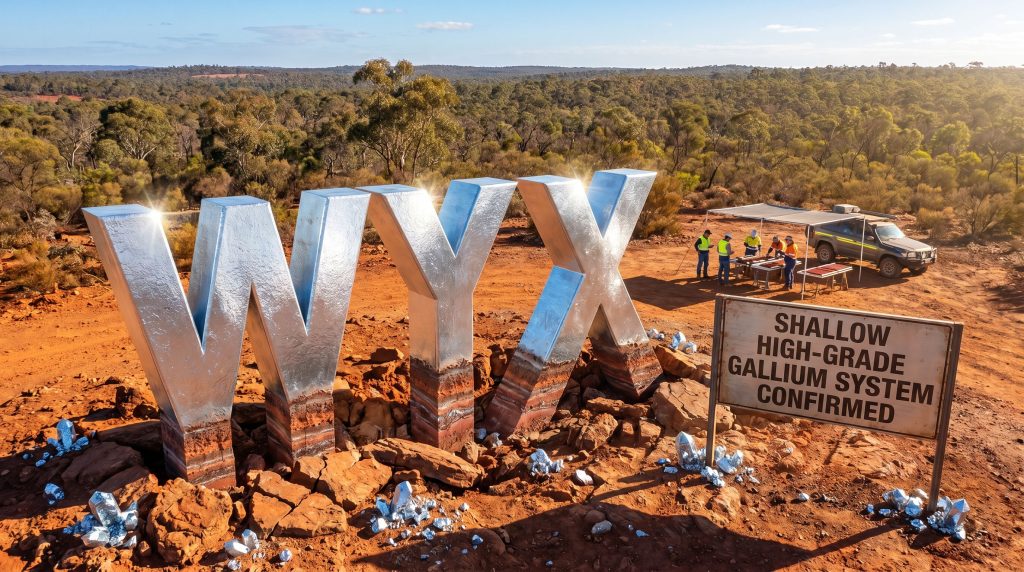
Western Yilgarn (ASX: WYX) has delivered a significant exploration update from its Cardea 1 Project in the Darling Range of Western Australia, announcing the results of a comprehensive re-assay program across 161 vacuum drillholes. The findings confirm a broad, shallow, and consistently mineralised gallium system — a result that materially advances the Western Yilgarn Cardea 1 high grade gallium discovery in Western Australia and sets the stage for systematic resource definition.
When big ASX news breaks, our subscribers know first
What Has Been Discovered — and Why It Matters
The re-assay program targeted historical drill pulps collected by Bauxite Alumina Joint Venture during bauxite exploration conducted in the early 2010s. Rather than conducting new drilling, Western Yilgarn applied modern geochemical analysis to existing sample material — an efficient and cost-effective approach that has returned some striking results.
Across 161 vacuum drillholes totalling 732 metres, the program identified widespread gallium enrichment hosted within a shallow lateritic profile. Mineralisation commonly commences from surface and extends to just 7 metres depth. The overall average grade across the programme sits at approximately 63 ppm Ga, with peak values reaching 106 ppm Ga (equivalent to over 140 ppm Ga₂O₃).
Standout Intersections From the Re-Assay Programme
The standout intersections from the re-assay programme are summarised in the table below:
| Drillhole | Interval (m) | From (m) | Ga₂O₃ Grade (ppm) |
|---|---|---|---|
| JDV389 | 5.5m | 1.0m | 102.7 |
| JDV383 | 2.5m | 2.0m | 134.4 |
| JDV327 | 2.5m | 0.5m | 130.1 |
| JDV332 | 3.0m | Surface | 113.9 |
| JDV613 | 3.5m | 3.5m | 107.9 |
| JDV236 | 4.5m | 1.5m | 105.5 |
| JDV237 | 3.0m | 1.5m | 104.9 |
| JDV259 | 1.5m | 2.5m | 104.8 |
| JDV258 | 2.0m | 2.0m | 101.6 |
What elevates these results beyond a standard exploration update is the combination of three factors: the high grades, the shallow depth, and the lateral continuity demonstrated across multiple drill sections. Furthermore, the mineralised footprint remains open in several directions, indicating the system has not yet been fully defined.
"These latest vacuum re-assayed pulps from the Cardea 1 Gallium Project continue to reinforce our view that we are dealing with a large-scale, shallow and laterally extensive gallium system with strong continuity across multiple target zones. Importantly, the mineralised footprint remains open in several directions and many drillholes outside the highlighted results continue to demonstrate anomalous gallium values, providing confidence that there is considerable upside for future resource definition and expansion drilling." — Pedro Kastellorizos, Non-Executive Director, Western Yilgarn
Understanding Gallium in Laterite Systems — A Primer for Investors
What Is Gallium and Why Does It Occur in Bauxite?
Gallium is a soft, silvery metal classified globally as a critical mineral due to its role in semiconductors, LEDs, photovoltaic cells, and advanced defence technologies. It does not form its own mineral deposits — instead, it substitutes for aluminium within minerals such as gibbsite during the lateritic weathering process.
Because bauxite deposits are essentially the product of this same weathering, gallium naturally concentrates within the bauxite profile. In the Darling Range, this geological relationship is well-established. The region hosts one of the world's largest bauxite provinces, and the deeply weathered lateritic profiles — often exceeding 20 metres in thickness — represent ideal environments for gallium enrichment.
Historically, the region has been assessed almost exclusively for its aluminium content, meaning the gallium potential has been largely overlooked until recently.
Why Does Shallow Depth Matter?
Shallow mineralisation translates directly to lower mining costs. When ore sits within the upper few metres of surface, strip ratios — the volume of waste that must be moved to access the ore — are low. This is a meaningful economic consideration for any future development scenario.
The Western Yilgarn Cardea 1 high grade gallium discovery in Western Australia, with mineralisation commonly starting at or near surface and extending to just 7 metres, sits firmly within this favourable category.
Key Terms Glossary
- Ga₂O₃ (Gallium Oxide): The oxide form used to express gallium grades in lateritic systems; values are converted from elemental gallium using a standard factor.
- Laterite/Lateritic Profile: A deeply weathered soil horizon developed in tropical or subtropical environments; bauxite is a laterite enriched in aluminium minerals.
- Gibbsite: A primary aluminium hydroxide mineral found in bauxite and the host phase for gallium substitution.
- Strip Ratio: The ratio of waste material removed per tonne of ore extracted; lower ratios indicate more economically accessible mineralisation.
- ppm: Parts per million — the standard unit for trace element grades in exploration.
- Ga₂O₃ ppm: Equivalent oxide grade of gallium expressed in parts per million.
The Scale of the System — Spatial Continuity Across Multiple Sections
A key feature of the Cardea 1 results is not just the peak grades but the lateral consistency of mineralisation across the project area. Two cross sections highlighted in the announcement illustrate this point effectively.
Cross Section 6,511,160mN — covering drillholes JDV262 through to JDV269 — demonstrates strong grade continuity with several holes exceeding 100 ppm Ga₂O₃, including peak values of 139.8 ppm and 130.5 ppm. The mineralised horizon tracks the interpreted weathering profile across the section, confirming the geological coherence of the system.
Cross Section 6,508,900mN — shows increasing gallium tenor toward the eastern portion, with drillholes JDV613 and JDV614 returning multiple high-grade results including peak assays of 121.5 ppm, 116.7 ppm, and 115.5 ppm Ga₂O₃. Central holes in the section also intersect broad zones with numerous intervals above 80 ppm and multiple results exceeding the 100 ppm threshold.
The pattern across both sections supports the interpretation of a laterally continuous, coherent mineralised system — not isolated high-grade pods. This distinction is critical for investors assessing resource potential, as spatial continuity underpins confidence in tonnage estimates during resource definition.
Additional Notable Drillhole Results
In addition to the above, further notable intersections from the programme include:
| Drillhole | Interval (m) | From (m) | Ga₂O₃ Grade (ppm) |
|---|---|---|---|
| JDV312 | 0.5m | 1.5m | 142.5 (peak) |
| JDV289 | 3.0m | 1.0m | 118.9 |
| JDV268 | 2.0m | 1.0m | 108.9 |
| JDV315 | 1.5m | 2.0m | 108.7 |
| JDV585 | 1.5m | 0.5m | 124.2 |
| JDV580 | 2.0m | 2.0m | 126.5 |
| JDV572 | 1.0m | 2.5m | 114.8 |
Western Yilgarn's Broader Critical Minerals Platform
The Cardea 1 gallium results sit within a growing critical minerals portfolio that Western Yilgarn has been systematically assembling. The company currently holds a global JORC 2012 Inferred bauxite resource of 205 million tonnes across three projects, with the Western Yilgarn Cardea 1 high grade gallium discovery in Western Australia now adding a compelling new dimension of critical minerals exposure.
Global Bauxite Mineral Resource Summary (JORC 2012 Inferred)
| Project | Tonnes (Mt) | Total Al₂O₃ (%) | Total SiO₂ (%) |
|---|---|---|---|
| Julimar West | 168.3 | 36.1 | 14.7 |
| Cardea 2 | 20.1 | 32.1 | 26.3 |
| Cardea 3 | 16.6 | 34.2 | 30.2 |
| Total | 205.0 | 34.1 | 23.7 |
The Cardea 1 Project is situated approximately 110km north of Perth via the Great Northern Highway, with the Perth-Kalgoorlie Railway line located to the south of the project area — logistical attributes that support future development optionality. The project is held 100% by Western Yilgarn under Exploration Licence E70/6703, covering 11.71km² west of Toodyay township.
Forward Plan — Drilling to Define the Full Extent of the System
The Cardea 1 results have clearly identified a priority target warranting systematic follow-up. Western Yilgarn has outlined the following next steps:
- Expansion drilling to the south and west — planned drilling programmes will target portions of the gallium system that remain untested, particularly the southern and western extent of the current anomalous zone.
- First-pass exploration of bauxite zones in the western portion of E70/6703 — regional mapping by the Western Australia Geological Survey has delineated laterite and pisolitic gravel areas suitable for systematic first-pass exploration.
- Resource definition and metallurgical assessment — the company has flagged its intention to advance the project toward systematic resource evaluation and further metallurgical work to assess gallium recovery potential.
| Activity | Status | Location |
|---|---|---|
| Re-assay of 161 vacuum drillholes | Complete | Cardea 1 |
| Southern & western extension drilling | Planned | Cardea 1 |
| First-pass bauxite exploration | Planned | Western E70/6703 |
| Systematic resource evaluation | Next phase | Cardea 1 |
| Metallurgical assessment | Next phase | Cardea 1 |
The Investment Case — A Critical Mineral in a Tier-One Location
Several factors combine to make the Western Yilgarn Cardea 1 high grade gallium discovery in Western Australia a compelling one for investors to follow closely.
Why Does Gallium's Strategic Importance Matter?
Gallium is a key input across multiple high-growth technology sectors including semiconductors, defence electronics, LEDs, and photovoltaics. Supply concentration in a small number of producing nations has highlighted the need for diversified sources. Western Australia's established mining infrastructure and regulatory framework, however, provides a stable backdrop for development.
What Makes the Geology So Favourable?
With mineralisation starting from surface and sitting within the upper 7 metres, the Cardea 1 system offers the prospect of low-cost extraction relative to deep underground or hard-rock scenarios. The flat-lying geometry of the lateritic profile means vertical drill holes intersect true widths, providing reliable grade information without geometric correction.
Furthermore, the re-assay of 161 holes across a nominal 80m x 80m drill grid has confirmed that gallium enrichment forms a spatially coherent, laterally extensive system. With the mineralised footprint remaining open in multiple directions, the potential for resource expansion through further drilling is substantial.
What Does the Broader Portfolio Add?
Beyond gallium, Western Yilgarn holds a 205 million tonne bauxite resource base and has also reported high-grade gallium, cobalt, nickel, lead, scandium, and tellurium intersections at its Ida Holmes Project. The breadth of the portfolio provides multiple development pathways and reduces single-asset risk.
The next major ASX story will hit our subscribers first
Why Investors Should Watch Western Yilgarn
Western Yilgarn is in the process of transforming a historically overlooked bauxite province into a multi-commodity critical minerals platform. The Cardea 1 re-assay programme represents a low-cost, high-impact approach to unlocking gallium value from existing data — and the results have delivered.
With peak grades exceeding 140 ppm Ga₂O₃, an average system grade of approximately 63 ppm Ga, shallow depths, and demonstrated lateral continuity across a 100% owned tenement, the foundations for a systematic resource estimate are clearly being put in place. The next phase of drilling — targeting the untested southern and western extensions — has the potential to materially expand the known mineralised footprint.
"Western Yilgarn (ASX: WYX) has established Cardea 1 as a high-grade, shallow gallium system in one of Australia's most established bauxite provinces, with peak grades exceeding 140 ppm Ga₂O₃ and strong lateral continuity across 161 drillholes. Backed by a 205 million tonne bauxite resource base and an active exploration pipeline spanning gallium, cobalt, and gold, the company is rapidly building a critical minerals platform in Western Australia."
Want to Stay Ahead of the Next Major Critical Minerals Discovery on the ASX?
Discovery Alert's proprietary Discovery IQ model scans ASX announcements in real time, instantly identifying significant mineral discoveries — including critical minerals like gallium — and translating complex data into actionable investment insights for both new and experienced investors. Explore how historic ASX discoveries have generated substantial returns on Discovery Alert's dedicated discoveries page, and begin your 14-day free trial today to position yourself ahead of the broader market.