
July 7, 2026
The Workforce Crisis Quietly Reshaping How Mining Companies Spend Their Capital
Before a single gram of ore reaches a processing facility, years of human expertise must be assembled, trained, and retained. That reality sits at the heart of one of mining's most pressing structural challenges: the sector is consuming its experienced workforce faster than it can replace it. Retirement rates among senior engineers and geologists continue to outpace graduate intake across North America, and the critical minerals boom anticipated over the coming decade will only amplify this imbalance.
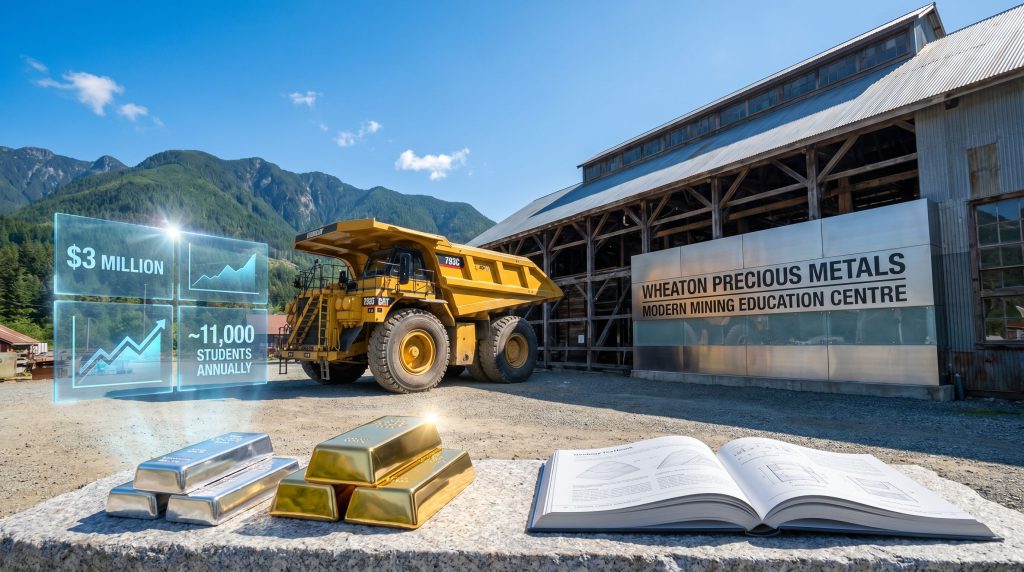
Against this backdrop, a growing number of resource companies are directing capital not just into the ground, but into the people who will eventually work it. The Wheaton donation to Britannia Mine Museum education centre, totalling $3 million over three years, is among the most tangible recent examples of this shift.
When big ASX news breaks, our subscribers know first
Understanding the Workforce Gap Driving Corporate Education Spend
The mining industry evolution has created a labour challenge that is not simply about numbers — it is about perception. Surveys of secondary school students in Canada consistently reveal that mining ranks near the bottom of aspirational career sectors, despite offering competitive salaries, internationally mobile careers, and increasing relevance to the clean energy transition. The minerals required to manufacture electric vehicle batteries, solar panels, and wind turbines all originate from extractive operations that demand highly trained professionals.
This perception gap creates a compounding problem. Universities producing mining engineers are reporting enrolment trends that fluctuate sharply with commodity cycles, meaning long-term workforce planning becomes extremely difficult. When copper prices fall, enrolments drop. By the time prices recover and industry demand returns, the cohort of graduates who should have been trained during the downturn simply does not exist.
Industry analysts have long noted that the mining sector's cyclical nature creates mismatched timing between workforce demand and educational supply, and that structural investment in foundational education pipelines is the most reliable counterweight to this volatility.
This is why corporate donations to institutions like the Britannia Mine Museum are not simply philanthropic gestures. They represent risk mitigation for an industry that cannot function without a continuous supply of skilled professionals.
What Makes the Britannia Mine Museum a Strategically Valuable Education Asset
Located along the Sea-to-Sky corridor in British Columbia, the Britannia Mine Museum occupies a site that was once one of the largest copper producers in the British Empire. From approximately 1904 through to 1974, the Britannia mine extracted millions of tonnes of ore, at its peak producing copper, zinc, lead, silver, and gold. The site's industrial heritage is not merely historical curiosity; it provides a physical, visceral context for understanding how mining shaped Canada's economic development.
What distinguishes the museum from many heritage institutions is its active role in curriculum delivery. Rather than functioning as a passive exhibition space, it operates as a working educational platform, integrating science, engineering, and earth sciences into structured programs for visiting school groups.
The current demand metrics speak for themselves:
- The museum's field trip programs reach approximately 11,000 students annually
- Bookings regularly sell out months in advance, indicating structural under-capacity rather than cyclical peaks
- Programs span elementary through post-secondary levels, covering a breadth of learning stages within a single institution
- An existing collaboration with the University of British Columbia's Norman B. Keevil Institute of Mining Engineering provides an established academic anchor for more advanced programming
| Metric | Current State | Post-Development Target |
|---|---|---|
| Annual student reach | ~11,000 | Significantly expanded |
| Educational floor space | Single-capacity layout | Doubled capacity |
| Public workshops and events | Limited by infrastructure | Broadened programming scope |
| UBC partnership | Active but constrained | Formalised with dedicated on-site classroom space |
The sellout dynamic is particularly important. In commercial terms, a product that sells out months in advance is not experiencing a demand problem; it is experiencing a supply problem. The new education centre directly addresses that supply constraint.
Inside the Wheaton Precious Metals Modern Mining Education Centre
What the $3 Million Will Build
The Wheaton Precious Metals Modern Mining Education Centre is a purpose-designed facility constructed to move mining education from passive observation toward active, hands-on engagement. The $3 million commitment, structured as a phased donation across three years, is designed to align funding with staged construction and fit-out milestones.
The centre's design priorities include:
- Experiential learning environments that allow students to engage with mining concepts through simulation, physical models, and interactive exhibits rather than textbook instruction alone
- Multi-level curriculum delivery serving learners from primary school through university, within a single facility designed to accommodate different knowledge depths
- Dedicated on-site classroom space formalising the museum's collaboration with UBC's Norman B. Keevil Institute, enabling mining engineering students to undertake field-based components of their studies at the site itself
- Doubled educational floor space unlocking capacity for a broader calendar of public workshops, community events, and professional development programming
The UBC Norman B. Keevil Institute Partnership
The Norman B. Keevil Institute of Mining Engineering is consistently ranked among Canada's leading programs in the discipline, producing graduates who work across every major mining jurisdiction globally. Co-locating formal academic instruction within a heritage mining site creates a learning dynamic that no campus facility can replicate.
Furthermore, students can observe geological formations, legacy equipment, and industrial-scale infrastructure while receiving instruction from qualified academics. This model of embedding post-secondary learning within authentic industrial environments reflects broader trends in technical education, where contextual, site-based learning has been shown to improve knowledge retention and career commitment compared with purely classroom-based delivery.
STEAM Programming and the Public Engagement Dimension
Beyond its student-facing programs, the new centre is designed to expand programming targeted at general public audiences. This distinction matters. Mining companies have long struggled with a social licence deficit, partly attributable to a public that encounters mining primarily through environmental controversies rather than through understanding what minerals actually enable in daily life.
The centre's STEAM curriculum expansion (Science, Technology, Engineering, Arts, and Mathematics) is designed to reframe that narrative. Consequently, it positions mining and clean energy as central to innovation, environmental stewardship, and the material foundations of modern life — including the clean energy technologies that are increasingly central to public and policy conversation.
The Caterpillar 793C Haul Truck: Industrial Scale as a Teaching Tool
Among the most immediately striking additions to the Britannia site is the Caterpillar 793C haul truck, donated by Finning Canada and now installed as a centrepiece exhibit. The 793C is not a small piece of equipment. With a payload capacity of approximately 240 tonnes and a gross vehicle weight approaching 400 tonnes when loaded, it represents the industrial scale that makes large open-pit mining operations economically viable.
For students and members of the public with no prior exposure to mining operations, standing adjacent to a machine of this scale produces a calibration effect that no photograph or video can replicate. Abstract concepts about mine productivity, ore movement economics, and operational logistics become immediately tangible. This is the pedagogical function of large-scale physical assets in museum-based learning environments.
Physical exhibits of industrial equipment serve as cognitive anchors that dramatically improve a visitor's ability to contextualise technical information presented elsewhere in the educational experience.
How This Investment Fits Wheaton Precious Metals' ESG Framework
The Streaming Model and Social Licence Obligations
Wheaton Precious Metals operates as a precious metals streaming company, a business model that is fundamentally different from a conventional mining operator. Under a streaming arrangement, Wheaton provides upfront capital to mine developers and operators in exchange for the right to purchase a fixed percentage of future gold, silver, or other metal production at predetermined prices. This structure means Wheaton does not directly operate mines, employ underground workers, or manage environmental rehabilitation programs.
What this model creates, however, is a question of social responsibility at one remove. Streaming companies benefit financially from mining operations without carrying the direct reputational exposure of operational decisions. Increasingly, institutional investors and ESG rating frameworks are scrutinising whether streaming entities exercise meaningful social responsibility or simply harvest financial returns while leaving social and environmental obligations to their operating partners.
The Wheaton donation to Britannia Mine Museum education centre can be read as a deliberate response to this scrutiny, demonstrating that the streaming model can generate tangible community benefit beyond its financial mechanisms.
Talent Pipeline as Long-Term Business Infrastructure
Wheaton's leadership has characterised the education investment as essential to developing the next generation of mining professionals. In addition, they have noted specifically that ensuring students gain visibility into the sector's career opportunities and acquire the relevant skills is a priority for the industry's long-term function.
This framing is commercially rational. A streaming company's revenue depends entirely on the continued operation of the mines to which it holds streaming rights. Those operations depend on a functioning workforce. An industry-wide skills shortage therefore represents a systemic risk to streaming company valuations, even if that risk is several steps removed from the company's direct operations.
Viewed through this lens, a $3 million education investment is not charity; it is infrastructure spending directed at reducing a long-term operational risk that flows directly to the bottom line.
Comparing Education Investment Models Across the Resource Sector
| Model Type | Funding Source | Primary Audience | Key Outcome |
|---|---|---|---|
| Museum-integrated education centre | Corporate donation and institutional partnership | K-12 and post-secondary students | Career awareness and foundational skills |
| University mining engineering faculty | Government and industry grants | Post-secondary students | Technical qualification |
| Site-based training facilities | Operator-funded | Existing workforce | Operational upskilling |
| Community information centres | Government-funded | General public | Social licence and transparency |
The museum-integrated model is arguably the most cost-effective for addressing early-stage career pipeline development. By engaging students before they make tertiary education decisions, it influences the supply of future mining engineering applicants upstream of university enrolment, where intervention costs are considerably lower per student than post-secondary scholarships or bursaries.
The next major ASX story will hit our subscribers first
British Columbia as a Case Study: Heritage Meets Workforce Strategy
British Columbia occupies a unique position in the Canadian mining landscape. It is simultaneously one of the country's most historically significant mining jurisdictions, home to legacy operations that shaped entire communities across the province, and a current exploration frontier for the critical minerals transition — including copper, cobalt, lithium, and rare earth elements that are central to global clean energy supply chains.
This duality makes B.C. an ideal setting for the kind of institution the Britannia Mine Museum represents. The site's heritage provides historical credibility and emotional resonance. Its location within commuting distance of Vancouver, home to a large concentration of mining finance and corporate headquarters, provides access to both student populations and industry professionals who can contribute to programming.
The province's critical minerals endowment also adds urgency. As global demand for the metals required in energy storage, electric mobility, and grid infrastructure continues to build, B.C.'s exploration and development pipeline will need qualified geologists, engineers, metallurgists, and environmental scientists in larger numbers than the current education system is producing.
Frequently Asked Questions: Wheaton Donation to Britannia Mine Museum Education Centre
What is the Wheaton Precious Metals Modern Mining Education Centre?
A purpose-built educational facility being constructed at the Britannia Mine Museum in British Columbia, funded through a $3 million, three-year donation from Wheaton Precious Metals. The centre will provide hands-on learning for students from elementary through post-secondary levels, alongside expanded programming for the general public.
How much did Wheaton Precious Metals donate, and how is it structured?
The total commitment is $3 million, delivered as a phased donation across three years to align with staged construction and program development milestones. For further details, the Squamish Reporter's coverage of the announcement provides additional context on the project timeline.
How many students does the Britannia Mine Museum currently serve?
Field trip programs currently reach approximately 11,000 students per year, with bookings regularly selling out months in advance, confirming that existing infrastructure cannot meet current demand.
Which university is partnering with the museum on this initiative?
The University of British Columbia's Norman B. Keevil Institute of Mining Engineering is the key academic partner, with the new centre providing dedicated on-site classroom space to support field-based components of UBC mining engineering studies.
What large equipment has been added to the Britannia site?
A Caterpillar 793C haul truck, donated by Finning Canada, has been installed on-site as a major exhibit, providing visitors with direct exposure to the industrial scale of modern open-pit mining operations.
Why is a streaming company investing in education infrastructure?
For a streaming entity like Wheaton, whose revenues depend on partner mine production, an industry-wide skills shortage represents a systemic financial risk. Investing in education pipelines addresses that risk while simultaneously fulfilling social responsibility commitments that institutional investors and ESG frameworks increasingly require of companies across the mining value chain.
The Broader Signal: What This Investment Tells the Industry
The Wheaton donation to Britannia Mine Museum education centre carries implications well beyond a single philanthropic transaction. It establishes a replicable model for how companies that do not directly operate mines can nonetheless generate measurable social value and contribute to the sector's long-term human capital base.
Moreover, broader conversations about women in mining and female leadership in mining demonstrate that diversifying the talent pipeline extends well beyond traditional recruitment — requiring early-stage educational intervention of precisely the kind this centre is designed to deliver.
For other streaming and royalty companies observing this move, the strategic logic is clear. Education investment:
- Addresses a sector-wide workforce shortage that threatens long-term production continuity
- Improves public literacy about mining's role in the materials economy, reducing social licence friction for the industry broadly
- Generates measurable ESG outcomes that can be reported against increasingly rigorous institutional investor frameworks
- Builds reputational capital in communities and among stakeholders who will make future decisions about mining's social acceptance
The compounding return on education investment in the mining sector flows in multiple directions simultaneously: students who understand mining become future employees, informed regulators, potential investors, and advocates for the industry's continued role in supplying the materials that underpin modern economic life.
British Columbia's Britannia Mine Museum, with its rare combination of industrial heritage, active academic partnerships, and documented unmet demand for educational programming, is arguably one of the highest-leverage sites in Canada for exactly this kind of investment. The three-year, $3 million commitment from Wheaton Precious Metals reflects an understanding that the sector's most pressing constraint in the decades ahead may not be ore in the ground, but people trained to extract it responsibly.
This article is intended for informational purposes only and does not constitute financial advice. Readers should conduct their own due diligence before making investment decisions related to any companies mentioned herein.
Want to Spot the Next Major ASX Mineral Discovery Before the Market Does?
Discovery Alert's proprietary Discovery IQ model delivers real-time alerts on significant ASX mineral discoveries, transforming complex mineral data into clear, actionable insights for investors at every experience level — explore historic discoveries and their returns to understand what early positioning can mean, then begin your 14-day free trial at Discovery Alert to secure your market-leading advantage.