White Cliff Minerals Ltd
- ASX Code: WCN
- Market Cap: $42,371,205
White Cliff Minerals Confirms District-Scale Copper System at Rae Project — First 2026 Assays Validate 1.5km Mineralised Footprint
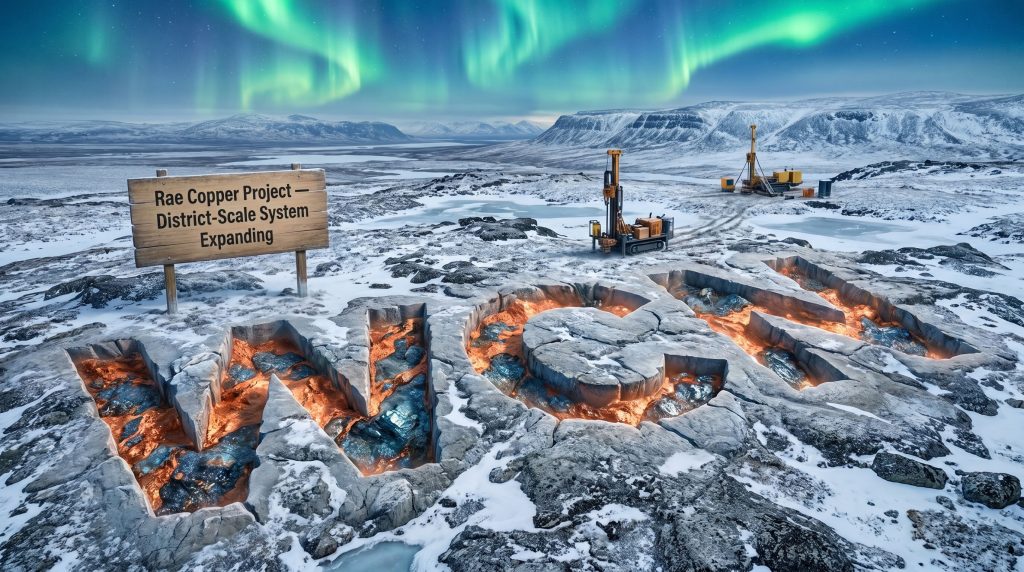
White Cliff Minerals (ASX: WCN; OTCQB: WCMLF) has delivered a landmark set of exploration results from its Rae Copper Project in Nunavut, Canada, with first assays from the 2026 regional drilling campaign confirming broad copper mineralisation across 1.5km of previously untested strike within the Teshierpi Fault Zone. Combined with earlier results from the Danvers 1 area, the total assayed and mineralised footprint has now grown to more than 5.4km, with visible copper sulphides observed across 2.6km of drilling from this year's campaign alone.
The White Cliff Minerals Rae Copper Project drill results in Nunavut Canada mark a significant step-change in the understood scale of the Danvers copper system, validating a district-level copper opportunity that remains open in multiple directions.
When big ASX news breaks, our subscribers know first
Key Highlights at a Glance
| Metric | Detail |
|---|---|
| 2026 Mineralised Strike Confirmed (Assay) | 1.5km (DAN26001 to DAN26005) |
| Total Assayed & Mineralised Footprint | >5.4km (including Danvers 1) |
| Visible Copper Sulphides (2026 Campaign) | 2.6km of drilling |
| Total Metres Drilled (2026 to date) | >2,600m |
| Best Intercept (DAN26004) | 15.24m @ 1.51% Cu from 225.55m incl. 1.52m @ 5.18% Cu & 41.8g/t Ag |
| Strongest Visual Mineralisation (DAN26012) | Up to 15% visible chalcocite from 154m downhole |
| Strike Rate | Every hole into the main fault zone returned visible copper sulphides |
| Remaining Planned Drilling (2026) | ~6,000m along Teshierpi Fault + ~4,000m expansion NE of Danvers 1 |
Breaking Down the First Assays: What the Drill Results Show
The first five holes of the 2026 regional campaign — DAN26001 through DAN26005 — have returned assay results that confirm the Teshierpi Fault Zone is carrying copper mineralisation well beyond what was previously defined. The spacing between holes averages 348 metres, with a gap of 583 metres between DAN26005 and DAN26008, which itself points to substantial upside for further discoveries between completed holes.
DAN26002 — Two Major New Zones, Open at Depth
Drillhole DAN26002 stands out for delivering two distinct broad copper zones, located more than 4.5km southwest of Danvers 1, representing a very significant extension to the known system:
- 39.62m @ 0.42% Cu from 82.3m, including 3.05m @ 1.35% Cu from 117.35m
- 36.58m @ 0.29% Cu from 190.5m, including 3.05m @ 1.14% Cu from 217.93m
- Both zones remain open at depth
DAN26003 — Mineralisation Strengthening at Depth
DAN26003 demonstrated a characteristic that geologists often look for as an encouraging sign — mineralisation intensifying toward the bottom of the hole:
- 44.19m @ 0.26% Cu from 181.36m (broad shallow zone)
- 9.15m @ 0.55% Cu from 240.79m, including 3.05m @ 1.34% Cu from 246.89m (at end of hole)
- The fact the hole ended in mineralisation means the full extent of this zone remains unknown
DAN26004 — Multiple High-Grade Intervals, Including Silver Credits
DAN26004 delivered the most significant result among the first assay batch, returning multiple stacked copper zones including a notable silver association:
- 9.14m @ 1.02% Cu from 36.58m, including 3.05m @ 2.40% Cu from 38.10m
- 18.29m @ 0.49% Cu from 94.49m, including 3.05m @ 1.38% Cu
- 15.24m @ 1.51% Cu from 225.55m, including 1.52m @ 5.18% Cu and 41.8g/t Ag
- Located 404m northeast of DAN25019 (which previously returned 30.5m @ 2.49% Cu) and 170m below it, confirming significant depth extension
DAN26005 — Ended Prematurely, Still Delivered Results
Despite the hole ending before its planned depth, DAN26005 still returned several meaningful intervals:
- 3.05m @ 1.50% Cu from 100.58m
- 3.05m @ 1.91% Cu from 114.3m
Significant Assay Results Summary
| Hole ID | From (m) | To (m) | Interval (m) | Cu % | Notable |
|---|---|---|---|---|---|
| DAN26002 | 82.3 | 121.92 | 39.62 | 0.42 | incl. 3.05m @ 1.35% |
| DAN26002 | 190.5 | 227.08 | 36.58 | 0.29 | incl. 3.05m @ 1.14% |
| DAN26003 | 181.36 | 225.55 | 44.19 | 0.26 | Broad zone |
| DAN26003 | 240.79 | 249.94 | 9.15 | 0.55 | incl. 3.05m @ 1.34% — ended in hole |
| DAN26004 | 36.58 | 45.72 | 9.14 | 1.02 | incl. 3.05m @ 2.40% |
| DAN26004 | 94.49 | 112.78 | 18.29 | 0.49 | incl. 3.05m @ 1.38% |
| DAN26004 | 225.55 | 240.79 | 15.24 | 1.51 | incl. 1.52m @ 5.18% Cu & 41.8g/t Ag |
| DAN26005 | 100.58 | 103.63 | 3.05 | 1.50 | — |
| DAN26005 | 114.3 | 117.35 | 3.05 | 1.91 | — |
Visual Observations From Ongoing Drilling: Is the Mineralisation Getting Stronger?
While assays for the more recently completed holes are still pending (expected within approximately four weeks), the geological observations being logged from drillholes DAN26009 through DAN26012 paint a compelling picture of a system that intensifies as drilling steps northeast toward the core of the major geophysical anomaly.
| Hole | Combined Cu Sulphide Intervals | Key Observation |
|---|---|---|
| DAN26009 | ~15m combined | Up to 5% bornite observed; confirms fault continuation |
| DAN26010 | ~26m combined | Ended in 3% chalcocite at ~170m vertical depth |
| DAN26011 | ~41m combined | Chalcocite in flow tops, amygdules and veinlets |
| DAN26012 | ~21m combined | Up to 15% chalcocite as breccia cement — strongest to date in 2026 |
DAN26012 is particularly notable. As the second hole to test the middle of the major geophysical conductivity anomaly (alongside DAN26008), it has returned the highest visual sulphide concentrations observed across the entire 2026 program — up to 15% chalcocite hosted as breccia cement within strongly hematite-altered basalt from 154m downhole. Critically, this zone aligns with the most conductive portions of the target that remain largely undrilled.
"The significance is not just the grade in individual holes, but the continuity of the system. Assays from the first regional holes and visual observations from continuing drilling show copper sulphides becoming stronger as we step to the northeast toward major conductivity anomalies — all areas that remain untested by drilling. Drilling has now extended the prospective copper-bearing structure to >2.6km, with every hole into the main fault zone intersecting visible copper sulphides." — Managing Director Troy Whittaker
What Is Chalcocite and Why Does It Matter?
Chalcocite is a copper sulphide mineral (chemical formula Cu₂S) and one of the most important ore minerals in copper mining. It contains approximately 79.8% copper by weight — making it one of the highest-grade copper minerals in existence. By comparison, chalcopyrite (the most common copper ore mineral globally) contains only around 34.6% copper by weight.
The presence of chalcocite — particularly in high concentrations such as the 15% chalcocite as breccia cement observed in DAN26012 — is significant for several reasons:
- It indicates high-grade mineralisation potential: High chalcocite concentrations often translate directly into elevated copper grades when assay results are received
- It is metallurgically favourable: White Cliff's own 2026 metallurgical testwork on Danvers material achieved up to 95.4% Cu recovery and 93.3% Ag recovery via conventional flotation, partly due to the chalcocite-dominant mineralogy
- It points toward primary enrichment zones: The presence of chalcocite as breccia cement (as seen in DAN26012) suggests the mineralising fluids were highly copper-enriched when they moved through these fault structures
Glossary of Terms Used in This Article
- Chalcocite (Cc): High-grade copper sulphide mineral (~79.8% Cu); favoured ore mineral
- Bornite (Bn): Copper iron sulphide (~63% Cu); also known as "peacock ore"
- Chalcopyrite (Cp): The most common copper ore mineral (~34.6% Cu)
- Teshierpi Fault Zone: The major NE/SW trending structural feature hosting the Danvers copper system; over 10km long through the property
- Breccia Cement: Mineralisation that fills and cements broken rock fragments; can indicate high-grade fluid flow
- EM/HeliTEM Anomaly: Electromagnetic geophysical response indicating electrically conductive material underground — often associated with sulphide mineralisation
- RC Drilling (Reverse Circulation): A fast, cost-effective drilling method that recovers rock chips for sampling and logging
What Comes Next: A Busy Drilling Schedule Into July
With over 2,600m drilled and first assays now validating the scale of the system, White Cliff is pressing forward with an accelerated programme designed to both expand the footprint and tighten understanding of high-grade controls.
Planned Activities
- ~6,000m of additional RC drilling along the Teshierpi Fault Zone — targeting strike extensions both northeast and southwest
- ~4,000m of expansion drilling to the northeast of the Danvers 1 area — closing the gap between the 2026 campaign and the original high-grade discovery
- Diamond drill programme commencing early June — delivering core samples for detailed geological interpretation, better definition of mineralisation geometry, and infill drilling to refine high-grade targets
- Ongoing sample dispatch to ALS Laboratories — assay results expected on a rolling basis approximately every four weeks
- Complete programme on target to be finished by end of July 2026
Upcoming Catalysts Timeline
| Timeframe | Activity |
|---|---|
| Within ~4 weeks | Assays from DAN26009–DAN26012 (including the high-grade chalcocite zones) |
| Early June | Diamond drill arrives on site |
| Ongoing through July | Regular assay releases as samples are processed |
| End of July (target) | Completion of ~10,600m remaining 2026 RC programme |
The Investment Thesis: A Copper System That Keeps Growing
What makes this announcement particularly compelling is not just the individual intercepts — it is what the spatial distribution of mineralisation is telling geologists about the overall system. Furthermore, the White Cliff Minerals Rae Copper Project drill results in Nunavut Canada continue to reinforce confidence in the broader exploration strategy.
Five Key Pillars Underpin the Investment Case
-
District-scale footprint confirmed: The total mineralised and assayed footprint now exceeds 5.4km, with first 2026 assays alone establishing 1.5km of new strike more than 5km from the original discovery. At wide drill spacings averaging 348m, the true extent of the system between holes has yet to be determined.
-
Mineralisation strengthening toward the core target: Both assay results and visual observations show copper concentration increasing as drilling moves northeast — directly toward the large untested conductivity anomalies identified in the 2025 HeliTEM geophysical survey. This directional vector toward the primary anomaly is a hallmark of systematic exploration closing in on a high-grade core.
-
Perfect strike rate: Every single drill hole to have intersected the main Teshierpi Fault Zone in the 2026 campaign has returned visible copper sulphides. This is not a system with inconsistent mineralisation — the fault zone appears to be consistently copper-endowed over its entire tested length.
-
Strong metallurgical credentials already established: Separately reported 2026 testwork achieved up to 95.4% Cu recovery and 93.3% Ag recovery via conventional flotation, producing concentrates of approximately 40% Cu and 150g/t Ag. With no deleterious elements identified, this is highly favourable metallurgy.
-
Established project foundation: The Rae project includes a historic (non-JORC) resource estimate at Danvers of 4.16 million tonnes at 2.96% Cu, along with historic maiden drilling results including 175m @ 2.5% Cu & 8.66g/t Ag and 90m @ 4% Cu & 7.5g/t Ag. While these are not JORC-compliant figures and cannot be relied upon as current resources, they provide geological context for the quality of mineralisation within the fault system.
The next major ASX story will hit our subscribers first
Why Investors Should Keep a Close Eye on White Cliff Minerals
White Cliff is at an inflection point. The company has moved from initial discovery validation to systematic regional confirmation of a copper system that appears to grow with every drill hole. With a diamond drill arriving in early June and approximately 10,600m of planned drilling still to be completed before end of July, the pace of newsflow is set to accelerate considerably.
The combination of widening strike extent, intensifying visual sulphide grades toward the major geophysical anomaly, and a confirmed record of strong copper intervals at depth positions the Rae project as one of the more active and high-potential copper exploration stories on the ASX right now. Consequently, the White Cliff Minerals Rae Copper Project drill results in Nunavut Canada deserve close attention from investors seeking exposure to emerging copper systems at an early stage of definition.
Key Differentiators at a Glance
| Factor | Detail |
|---|---|
| Project Location | Nunavut, Canada — established mining jurisdiction |
| Mineralised Footprint (Total) | >5.4km assayed and mineralised |
| 2026 Visual Sulphides | 2.6km strike, every hole positive |
| Metallurgical Results | Up to 95.4% Cu recovery, conventional flotation |
| Upcoming Catalysts | Diamond drill (June), rolling assay releases, ~10,600m remaining |
| Strike Rate (2026) | 100% — every hole into fault zone hit copper sulphides |
White Cliff Minerals has rapidly expanded the Rae Copper Project's known mineralised footprint to more than 5.4km, with every drill hole targeting the main fault structure returning copper sulphides. With visual chalcocite concentrations reaching 15% in the most recent holes — pointing directly toward the largest untested geophysical anomaly on the property — and a diamond drill programme set to begin in June, investors face a high-frequency news environment over the coming months as the full scale of this emerging copper system is progressively defined.
Want to Know More About White Cliff Minerals' Rae Copper Project?
With a mineralised footprint now exceeding 5.4km, a 100% strike rate across every hole targeting the Teshierpi Fault Zone, and a diamond drill programme set to commence in June, White Cliff Minerals (ASX: WCN) is generating significant momentum at the Rae Copper Project. Assay results from the high-grade chalcocite zones are expected within weeks, with approximately 10,600m of planned drilling still to be completed before the end of July. For investors seeking early-stage exposure to what is shaping up as a district-scale copper system in one of Canada's most established mining jurisdictions, head to the White Cliff Minerals website to stay across the latest developments.