White Cliff Minerals Ltd
- ASX Code: WCN
- Market Cap: $49,222,247
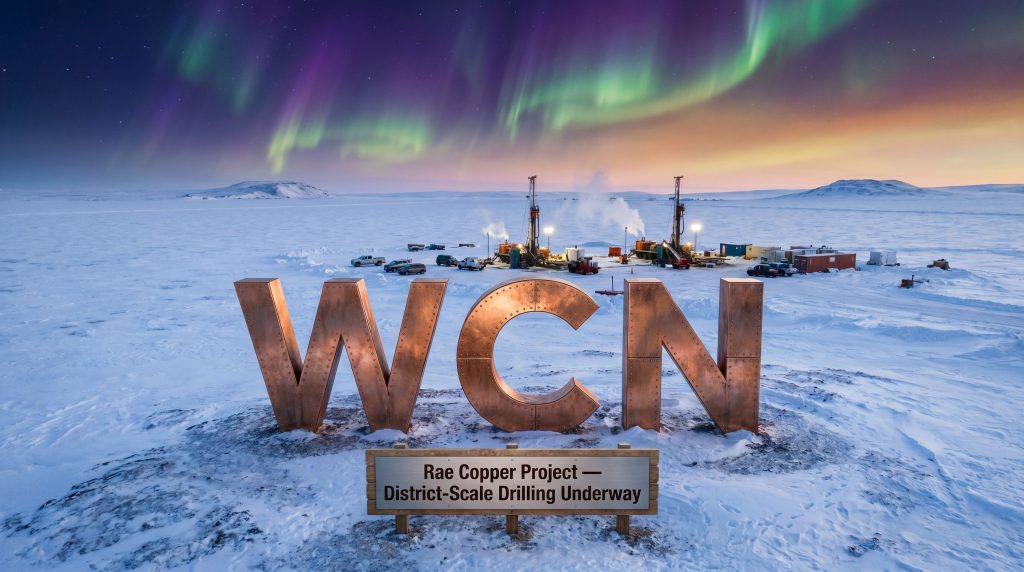
White Cliff Minerals Diamond Drilling Underway at Rae Copper Project in Nunavut
White Cliff Minerals (ASX: WCN; OTCQB: WCMLF) has mobilised diamond drilling rigs to its Rae Copper Project in Nunavut, Canada, marking a pivotal escalation in the company's effort to define the scale of what is shaping up as a significant sediment-hosted copper discovery. With two rigs now operational or imminent, the 2026 drill programme is designed to test extensions of high-grade copper intercepts across a 1.7km mineralised footprint identified during the 2025 season and to push that footprint considerably further east and north into largely untested basin terrain.
When big ASX news breaks, our subscribers know first
What Was Found in 2025 and Why It Matters
The foundation for the current drill campaign is a set of compelling results from the 2025 programme, which confirmed sediment-hosted copper mineralisation at the base of the Rae Group, concentrated at a redox boundary where reduced marine sediments sit atop oxidised sandstones of the underlying Husky Creek Formation.
The headline intercepts from that work include:
| Drillhole | Interval | Grade | Depth | Notes |
|---|---|---|---|---|
| STK25001 | 7m @ 0.41% Cu | Broad envelope | 177m | Base of Rae Group sediments |
| STK25001 | 3.5m @ 7.2% Cu | High-grade | 287m | Within 12m @ 2.45% Cu |
| STK25003 | 24.55m @ 0.56% Cu | Including 1m @ 5.7% Cu | 240m | Immediately below redox boundary |
Together, drillholes STK25001 through STK25004 traced 1.7km of strike length of copper mineralisation along the redox boundary between the Rae Group and Husky Creek Formation adjacent to the Herb Dixon Fault. Critically, this system remains entirely untested to the east and northeast, away from the basin margin where the company believes the system could grow substantially.
Understanding the Geology: What Is a Redox Boundary and Why Does It Matter?
One concept sits at the heart of this exploration story: the redox boundary.
In simple terms, a redox boundary is a geological contact where rock chemistry transitions from oxidising (oxygen-rich) conditions to reducing (oxygen-poor) conditions. When metal-rich fluids carrying dissolved copper migrate through rock sequences and encounter this chemical contrast, the change in chemistry causes copper to precipitate out of solution, essentially forming a natural trap that concentrates copper sulphide minerals.
At Rae, this boundary occurs where the reduced, pyrite-bearing mudstones of the basal Rae Group sit directly above the oxidised sandstones and basalts of the Husky Creek Formation. The 2025 drillholes confirmed copper mineralisation beginning immediately at this contact, with STK25003 intersecting copper mineralisation at 240m, just two metres below the transition at 238m.
Why does this matter for investors? Redox-boundary-hosted copper deposits, known as reduced-facies sediment-hosted deposits, are responsible for some of the largest and most economically significant copper mines on the planet, including those in the Central African Copperbelt and the Kupferschiefer district in Europe. The geometry tends to be sheet-like and laterally extensive, meaning that once confirmed, mineralisation can potentially be followed over many kilometres of strike.
Key Terms Defined
- Redox boundary: A geological contact separating oxidising and reducing chemical environments where copper can precipitate
- Reduced-facies deposit: A type of sediment-hosted copper deposit formed in oxygen-poor (reducing) sedimentary environments
- Chalcopyrite: A common copper iron sulphide mineral (CuFeS₂); the primary copper-bearing mineral in many deposits
- Stratiform: Layered or sheet-like mineralisation that follows sedimentary bedding
- HeliTEM: Helicopter-borne time-domain electromagnetic survey used to detect conductive bodies underground
- EM conductor: A subsurface feature that conducts electricity, often indicating the presence of sulphide mineralisation
The 2026 Drill Programme: Testing Scale
The current campaign is built around three distinct objectives, each designed to expand the known mineralised footprint and test the broader district potential.
Eastward Extension Along Strike
The first rig is now operational at the eastern margins of the inferred sub-basin. These holes are targeting structural features interpreted from 2024 magnetic data, features considered potential pathways for copper-bearing hydrothermal fluids. Drillhole STK25001, which returned the 3.5m @ 7.2% Cu intercept, sits on the western edge of an untested conductivity anomaly defined by the 2025 HeliTEM survey. The 2026 programme will drill directly into that anomaly.
EM Conductor Testing
High-priority electromagnetic responses from the 2025 HeliTEM survey, located to the east of the 2025 discovery holes, will be directly tested. Furthermore, these conductors represent untested subsurface targets with characteristics consistent with sulphide mineralisation.
Northern Sub-Basin Targets
Drilling will also extend further north within the priority sub-basin, where the company interprets deeper-water, more reduced basin conditions. These settings may have produced thicker intervals of reduced sedimentary host rocks, potentially translating to thicker and more continuous mineralised intervals.
Diamond drilling within the Rae Group sediments is being conducted on wide spacings across the >4.7km-wide basin, reflecting the district-scale ambition of the programme rather than infill drilling at known zones.
Managing Director Troy Whittaker commented:
"The commencement of diamond drilling at the Sediments marks an important step in advancing the sedimentary package at Rae. The first holes are designed to test key structures interpreted from magnetic data where they cross into the Rae Group stratigraphy. These structures may represent important pathways for copper-bearing fluids and provide a clear opportunity to extend the known mineralised footprint to the east and north from STK25001… this programme is focused on testing the scale potential of this emerging sediment-hosted copper system and targeting further high-grade zones within the priority sub-basins."
A Second Rig Targeting Danvers High-Grade Zones
While the first rig works the sedimentary targets, a second rig is expected to arrive imminently to work at Danvers, the project's separate copper-silver mineralisation system. Danvers is the site of some of the project's most eye-catching historic and recent drilling results, including intercepts of:
- 175m @ 2.5% Cu & 8.66g/t Ag
- 90m @ 4% Cu & 7.5g/t Ag
- 58m @ 3.08% Cu & 13.3g/t Ag
- Regional step-out at Danvers 2 (5km down strike): 15m @ 4.8% Cu
- Regional step-out at Danvers 3: 20m @ 6.64% Cu
The second rig will target and vector into high-grade zones at Danvers, running concurrently with the sedimentary drilling programme. This parallel approach means exploration momentum across the project is building on two fronts simultaneously.
How Rae Compares to the Global Sediment-Hosted Copper Universe
To contextualise what White Cliff may be building toward, it is instructive to compare Rae's characteristics against USGS data on the sediment-hosted copper deposit class, the deposit type responsible for approximately 20% of global copper production.
| Parameter | Global Average (Reduced-Facies) | Rae 2025 Results |
|---|---|---|
| Average grade | ~1.4% Cu | Up to 7.2% Cu (high-grade zones) |
| Average economic thickness | 2–30m | 3.5m to 24.55m intersected |
| Representative examples | White Pine: 1.14% Cu; Kupferschiefer: ~1.5–2% Cu | STK25001 broad: 7m @ 0.41%; STK25003: 24.55m @ 0.56% Cu |
| Lateral extent | Typically very large (tens of km) | >70km of prospective strike mapped at Rae |
The >70km of prospective strike identified across the Rae Project Area is a standout figure. The 2025 programme tested only a small portion of this corridor. Consequently, the 2026 campaign is the first systematic effort to understand how far the mineralised system actually extends.
Broader Project Context: A Multi-System Copper Opportunity
Rae is not a single-target story. White Cliff holds 1,228km² of mineral claims and leases in the Kitikmeot region of Nunavut, covering what the company describes as a district-scale copper opportunity. The project encompasses two distinct mineralisation styles:
- Sediment-hosted stratiform copper — the focus of the current drilling campaign, analogous to the Central African Copperbelt
- Epithermal vein-breccia copper-silver — represented by the Danvers system, with its exceptional drill intercepts noted above
Adding further confidence to the project's metallurgical credentials, testwork completed earlier in 2026 on material from Danvers demonstrated up to 95.4% copper recovery and 93.3% silver recovery via conventional flotation, producing concentrates of approximately 40% Cu and 150g/t Ag. No deleterious elements were identified in the concentrates.
The project also carries a historic (non-JORC compliant) resource estimate at Danvers of 4.16 million tonnes at 2.96% Cu, which White Cliff is working to validate and upgrade through its ongoing drilling programmes.
The next major ASX story will hit our subscribers first
Why Investors Should Watch This Closely
Several factors combine to make White Cliff's current programme worth tracking:
Exploration momentum on two fronts simultaneously: Two rigs targeting different mineralisation styles within the same project area represents an unusually active period for a company of this size.
The sedimentary system is at an early inflection point: The 1.7km footprint confirmed in 2025 is entirely open to the east and northeast. The 2026 programme is the first real test of how much larger this system could be. Initial holes targeting interpreted structural controls and EM conductors could rapidly expand the known footprint.
District scale with over 70km of prospective strike: The sheer size of the Rae tenure, combined with the confirmed geological model and validated mineralisation at the redox boundary, means there is substantial exploration runway ahead.
High-grade results set a strong benchmark: Intercepts of 3.5m @ 7.2% Cu and 1m @ 5.7% Cu within broader mineralised envelopes confirm the potential for high-grade shoots within the system, a characteristic that distinguishes the best sediment-hosted copper systems globally.
Strong metallurgical performance at Danvers: The confirmed processability of the copper-silver mineralisation at recoveries above 95% Cu removes a key technical uncertainty from the investment case for the Danvers system.
Favourable jurisdiction: Nunavut, Canada is an established mining jurisdiction with clear permitting pathways, and White Cliff holds a Type B water licence and Class A Land Use Permit, with consent from the Kitikmeot Inuit Association.
Key Takeaway:
White Cliff Minerals diamond drilling underway at Rae Copper Project in Nunavut signals the company's emergence as a serious player in district-scale copper exploration. With two operational drill rigs now testing a sediment-hosted copper system carrying more than 70km of prospective strike alongside one of the highest-grade new copper-silver discoveries in recent years at Danvers, investors should monitor developments closely as the company works to define the true scale of the Rae copper system.
Ready to Dig Deeper Into White Cliff Minerals' Rae Copper Project?
White Cliff Minerals (ASX: WCN) is advancing one of the most compelling district-scale copper opportunities in Canada, with two diamond drill rigs now targeting a sediment-hosted system carrying over 70km of prospective strike alongside high-grade copper-silver intercepts at Danvers. To learn more about the company, its projects, and how this emerging copper discovery is taking shape, visit the official White Cliff Minerals website at wcminerals.com.au.