June 3, 2026
Gallium's strategic importance in modern technology sectors continues to drive exploration efforts to identify widespread gallium enrichment zones beyond China's production dominance. Furthermore, understanding the geological processes that create these concentration mechanisms becomes essential as industries seek supply chain diversification. The integration of advanced exploration techniques with mineralogy and mining economics principles guides effective resource development strategies.
Geological Processes Behind Gallium Concentration Mechanisms
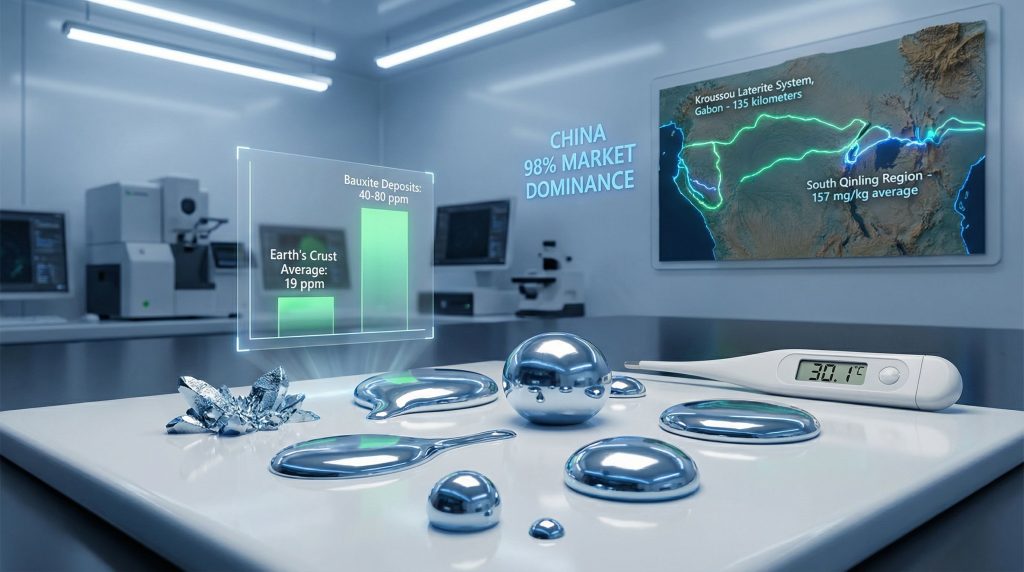
Gallium enrichment occurs through distinct geological pathways that concentrate this trace element far above Earth's crustal average of 19 parts per million (ppm). These processes operate across different timescales and environments, creating economically significant accumulations that represent potential alternative supply sources.
Table: Global Gallium Concentration Benchmarks
| Source Type | Average Concentration (ppm) | Enrichment Factor |
|---|---|---|
| Earth's Crust Average | 19 | 1.0x |
| Bauxite Deposits | 40-80 | 2.1-4.2x |
| Coal Ash (select sources) | 50-200 | 2.6-10.5x |
| Laterite Weathering Zones | 30-150 | 1.6-7.9x |
| Hydrothermal Alteration Zones | 60-120 | 3.2-6.3x |
Weathering-Driven Accumulation Systems
Tropical weathering environments create some of the most extensive gallium enrichment zones through selective mineral dissolution and residual concentration. During lateritic profile development, gallium preferentially substitutes for aluminum in octahedral coordination sites within clay minerals and hydroxides.
This substitution mechanism operates most effectively in:
• Kaolinite structures – accommodating several hundred ppm gallium in Al³⁺ sites
• Gibbsite formations – serving as primary gallium hosts in lateritic profiles
• Diaspore assemblages – acting as significant gallium acceptors in bauxitic horizons
The process requires specific environmental conditions including temperatures above 25°C, annual rainfall exceeding 1,500mm, and appropriate drainage characteristics. Under these conditions, lateritic weathering can extend to depths of 40-60 meters while maintaining gallium enrichment across extensive geographic areas.
Hydrothermal Transport and Precipitation
High-temperature hydrothermal systems concentrate gallium through fluid-mediated transport and subsequent precipitation during cooling or chemical changes. These systems typically operate at temperatures between 200-300°C, with gallium mobility enhanced in acidic chloride-bearing solutions.
Gallium precipitation occurs through several mechanisms:
• pH neutralization during fluid-rock interaction
• Temperature decrease in distal alteration zones
• Sulfidation state changes affecting gallium speciation
• Mixing with cooler groundwater systems
High-sulfidation epithermal environments demonstrate particularly strong gallium enrichment in alunite-kaolinite assemblages, creating 600-meter lateral extensions of mineralized zones in some documented cases.
Sedimentary Concentration Mechanisms
Organic-rich sedimentary environments accumulate gallium through biological uptake and subsequent preservation during diagenesis. Carbonaceous shales and coal seams represent significant gallium repositories where concentrations can exceed crustal averages by 20-40 times.
The concentration process involves:
• Organic matter sorption of dissolved gallium from seawater
• Authigenic mineral formation incorporating gallium during early diagenesis
• Fe-Mn oxide precipitation hosting gallium in reducing environments
• Clay mineral transformation concentrating gallium in specific structural sites
These mechanisms create laterally extensive gallium-enriched horizons that can maintain consistent grades across hundreds of square kilometers in appropriate depositional environments.
When big ASX news breaks, our subscribers know first
Global Distribution of Significant Gallium Enrichment Zones
West African Laterite Systems
The Kroussou laterite complex in Gabon represents one of the world's most extensive gallium enrichment systems, developed over weathered mafic-ultramafic basement rocks. The system demonstrates widespread gallium enrichment across multiple target zones spanning prospective geological contacts.
Kroussou System Characteristics:
• Doubaye zone – averaging 30-36 ppm gallium across weathered profiles
• Ngongui target – consistent gallium enrichment in lateritic clay horizons
• TP8 prospect – 700-meter lateral extensions of anomalous gallium concentrations
The lateritic weathering has concentrated gallium through aluminum-iron oxide formation, creating economically interesting grades as potential byproduct recovery from nickel-cobalt operations.
Chinese Carbonaceous Formations
The South Qinling region contains Cambrian-age carbonaceous shales representing some of the most gallium-enriched sedimentary rocks globally. These stone coal formations demonstrate remarkable gallium concentrations averaging 157 mg/kg with peak values reaching 747 mg/kg.
This enrichment represents 27.6 times the global hard coal average, making these formations among the most concentrated gallium resources outside traditional aluminum processing streams. The enrichment mechanism involves organic matter concentration during deposition in restricted marine environments.
Research by Seredin and Finkelman documented that Chinese stone coals contain gallium concentrations far exceeding typical coal deposits, with the South Qinling formations representing particularly significant accumulations tied to specific depositional environments and source rock characteristics.
Australian Lateritic Systems
The Yilgarn Craton hosts extensive laterized komatiite and dunite sequences with documented gallium enrichment typically ranging 20-50 ppm. These deposits represent significant gallium resource potential as byproduct recovery with nickel extraction operations.
The lateritic profiles developed over ultramafic rocks create favorable conditions for gallium concentration through:
• Serpentine alteration releasing gallium from primary silicate minerals
• Goethite formation incorporating gallium in iron oxide structures
• Clay mineral development concentrating gallium in aluminum-rich phases
Guinea Bauxite Provinces
Guinea hosts approximately 50% of global bauxite reserves with documented gallium enrichment in lateritic profiles averaging 40-70 ppm gallium. These massive bauxite deposits represent potential major gallium recovery sources through existing aluminum processing infrastructure.
The Boke and Sangaredi deposits demonstrate consistent gallium grades across hundreds of millions of tonnes of bauxite reserves, offering large-scale gallium recovery potential as byproduct from aluminum operations.
Mining and Recovery Technologies for Gallium Extraction
Primary Recovery from Aluminum Processing
Commercial gallium production occurs predominantly as byproduct from aluminum smelting operations using the Bayer process. Modern integrated aluminum smelters achieve 75-85% overall gallium recovery through optimized process modifications.
Bayer Process Gallium Recovery Stages:
- Liquor concentration optimization – gallium accumulation in pregnant solutions
- Solvent extraction using tri-butyl phosphate (TBP) or similar extractants
- pH adjustment for selective gallium precipitation
- Electrowinning to produce gallium metal or compounds
Recovery efficiency depends on several critical factors including liquor concentration management, solvent extraction parameters, and impurity removal effectiveness.
Secondary Recovery from Coal Combustion Products
Coal ash represents an underutilized gallium resource with documented concentrations ranging 50-500 ppm depending on parent coal characteristics and combustion conditions. Laboratory studies demonstrate gallium recoveries of 91-97% through acid leaching followed by solvent extraction.
Coal Ash Processing Pathway:
• Fly ash separation – higher gallium concentrations in finer fractions
• Concentrated sulfuric acid dissolution (6-8 M) of gallium-bearing phases
• Selective pH precipitation removing iron and aluminum impurities
• Ion exchange concentration achieving 50-100x concentration factors
• Electrochemical recovery producing gallium metal or compounds
Direct Extraction from Enriched Ores
Processing gallium-enriched ores requires tailored approaches based on ore mineralogy and gallium host phases. Several technological pathways show commercial potential:
Hydrometallurgical Processing:
• Acid leaching followed by solvent extraction achieving 70-85% recovery
• Ion exchange concentration using strong-base resins at pH 1-2
• Electrochemical reduction through optimised electrowinning
Integrated Multi-Metal Circuits:
• Combined gallium-aluminum processing streams
• Nickel-cobalt-gallium recovery from lateritic ores
• Tungsten-gallium extraction from polymetallic systems
China's Market Dominance and Supply Security Implications
Production Concentration Statistics
China produced approximately 265 metric tonnes of gallium in 2023, representing 98% of global output. This unprecedented market concentration creates significant supply chain vulnerabilities for technology sectors dependent on gallium-based semiconductors, solar panels, and defence applications.
The concentration stems from China's dominance in aluminum production combined with integrated gallium recovery infrastructure. Chinese aluminum smelters process vast tonnages of bauxite whilst simultaneously operating gallium extraction facilities.
Strategic Resource Classifications
Gallium's classification as a critical mineral by multiple governments reflects its essential role in developing a robust critical minerals strategy. Additionally, the element serves crucial functions in:
• 5G infrastructure – gallium arsenide components in base stations
• Electric vehicle systems – power electronics and charging infrastructure
• Renewable energy – solar panel efficiency improvements
• Defence applications – radar systems and electronic warfare capabilities
Supply Diversification Initiatives
Governments and industries invest in alternative supply development through:
• Strategic stockpile programmes building emergency reserves
• Alternative supply source development outside Chinese production
• Recycling technology advancement recovering gallium from electronic waste
• Substitute material research reducing gallium dependency
Economic Thresholds and Project Viability
Grade-Tonnage Requirements
Economically viable gallium projects typically require specific characteristics:
Minimum Grade Thresholds:
• 30-50 ppm gallium for direct extraction operations
• Large tonnage potential exceeding 10 million tonnes
• Favourable metallurgical response to processing techniques
• Infrastructure proximity reducing development costs
Byproduct Recovery Economics:
• Reduced commodity price risk through diversified revenue streams
• Existing processing infrastructure utilisation improving economics
• Additional revenue generation enhancing project returns
• Lower capital requirements compared to standalone gallium operations
Market Price Dynamics
Gallium pricing reflects supply concentration effects with significant volatility during geopolitical tensions. Historical price ranges vary from $150-800 per kilogram depending on supply disruption risks and technology demand cycles.
Project economics improve significantly when gallium serves as byproduct revenue, reducing sensitivity to gallium price fluctuations whilst providing upside exposure during supply tightness periods. Moreover, understanding how energy transition minerals influence market dynamics becomes essential for project planning.
Exploration Technologies for Gallium Enrichment Detection
Geochemical Survey Methodologies
Effective gallium exploration requires multi-element sampling programmes designed to identify enrichment signatures:
Surface Sampling Techniques:
• Multi-element soil sampling using standardised grid patterns
• Stream sediment reconnaissance targeting catchment-scale anomalies
• Rock chip systematic sampling defining geological controls
• Biogeochemical surveys in vegetation-covered terrain
Analytical Considerations:
• Mixed acid digestion essential for total gallium determination
• Detection limits below 5 ppm required for meaningful results
• Quality control protocols ensuring analytical accuracy
Geophysical Detection Methods
Indirect detection of gallium enrichment through associated geological features:
• Electromagnetic surveys identifying conductive alteration zones
• Radiometric surveys detecting associated trace elements
• Magnetic surveys mapping structural controls on mineralisation
• Induced polarisation targeting sulphide mineral associations
These methods identify geological environments favourable for gallium concentration rather than direct gallium detection. Consequently, the development of a critical raw materials facility could support advanced exploration technologies.
The next major ASX story will hit our subscribers first
Environmental and Regulatory Considerations
Processing Environmental Requirements
Gallium extraction operations must address several environmental considerations:
Acid Management Systems:
• Concentrated acid consumption requiring neutralisation infrastructure
• Tailings management for residual processing materials
• Water treatment circuits with recycling capabilities
• Atmospheric emissions control preventing acid vapour release
Waste Stream Handling:
• Residue stabilisation preventing long-term environmental impact
• Water quality protection through appropriate treatment systems
• Dust control measures during materials handling operations
Regulatory Framework Development
Emerging gallium projects navigate evolving regulatory landscapes:
• Critical minerals designation affecting permitting timelines
• Environmental impact assessment requirements for new operations
• Indigenous consultation protocols in affected jurisdictions
• International trade security regulations affecting market access
Future Outlook for Gallium Supply Diversification
Technology Demand Projections
Gallium demand growth drivers include several expanding technology sectors:
5G Infrastructure Expansion:
• Base station electronics requiring gallium arsenide components
• Network equipment utilising gallium-based semiconductors
• Satellite communication systems depending on gallium compounds
Electric Vehicle Integration:
• Power electronics improving energy conversion efficiency
• Charging infrastructure requiring high-performance semiconductors
• Battery management systems utilising gallium-based components
Renewable Energy Systems:
• Solar panel efficiency improvements through gallium compounds
• Wind turbine electronics requiring specialised semiconductor materials
• Grid integration systems utilising gallium-based power electronics
Investment and Development Trends
Industry investment patterns indicate growing recognition of widespread gallium enrichment as strategic resource opportunity. However, mining industry innovation continues driving technological advances in extraction methods:
• Government funding programmes supporting critical minerals development
• Private sector investment in alternative supply sources
• Technology advancement reducing gallium recovery costs
• International cooperation on supply chain resilience
Disclaimer: This article contains forward-looking statements regarding gallium market dynamics, technology demand projections, and mineral resource potential. Actual results may vary significantly due to geological, technical, economic, and market factors. Readers should conduct independent research and consult qualified professionals before making investment decisions. Mineral resource estimates and processing recovery rates represent technical assessments subject to economic and operational feasibility considerations.
FAQ Section
What distinguishes widespread gallium enrichment from localised occurrences?
Widespread enrichment refers to gallium concentrations above crustal average spanning large geographic areas exceeding 10 square kilometres or occurring across multiple geological zones within a district, contrasting with isolated high-grade pockets.
How does gallium recovery economics compare between primary and byproduct operations?
Byproduct recovery significantly improves project economics by utilising existing processing infrastructure, reducing capital requirements, and providing additional revenue streams whilst lowering sensitivity to gallium price volatility.
Which geological environments show highest potential for gallium enrichment?
Lateritic weathering profiles, hydrothermal alteration zones, carbonaceous sedimentary rocks, and aluminum-rich mineral assemblages in tropical weathering environments demonstrate greatest gallium enrichment potential.
What processing challenges affect gallium recovery from different ore types?
Processing challenges vary by source material, with coal ash requiring fine particle handling, lateritic ores needing acid-resistant equipment, and integrated circuits requiring complex separation of multiple metals whilst maintaining high recovery efficiency.
Could the Next Major Mineral Discovery Transform Your Portfolio?
Discovery Alert delivers instant notifications of significant ASX mineral discoveries using its proprietary Discovery IQ model, ensuring subscribers identify actionable opportunities ahead of the broader market. With gallium enrichment zones representing potential supply diversification opportunities, staying informed about mineral discoveries across all commodities becomes essential for positioning your investment strategy ahead of emerging market trends.