WIN Metals Ltd
- ASX Code: WIN
- Market Cap: $15,432,792
WIN Metals Charts a Low-Capital Path to Gold Production at Radio
WIN Metals Limited (ASX: WIN) has released its Radio Gold Project Re-Start Study, outlining a potential standalone gold operation in Western Australia's Southern Cross Greenstone Belt with a peak pre-finance funding requirement of about $19 million. The Study outlines base case pre-tax project economics of $18.1 million NPV8, 84% IRR, $23.1 million undiscounted pre-tax cash flow and an 11-month payback from first gold at a $6,000/oz gold price assumption.
The Re-Start Study is preliminary in nature and carries an estimated overall accuracy of ±20%. No Ore Reserve has been declared, the Study is not a decision to mine, and further engineering, regulatory approvals, financing and a final investment decision would all be required before development could proceed.
"Within 12 months of acquiring Radio, WIN has completed a Study that outlines a clear, staged pathway toward gold production. The Project's existing underground development, site infrastructure and secured processing equipment materially reduce the required new-build scope and support a peak pre-finance funding requirement of approximately $19 million."
— Steve Norregaard, Managing Director and CEO, WIN Metals
When big ASX news breaks, our subscribers know first
Why Radio's Existing Infrastructure Matters
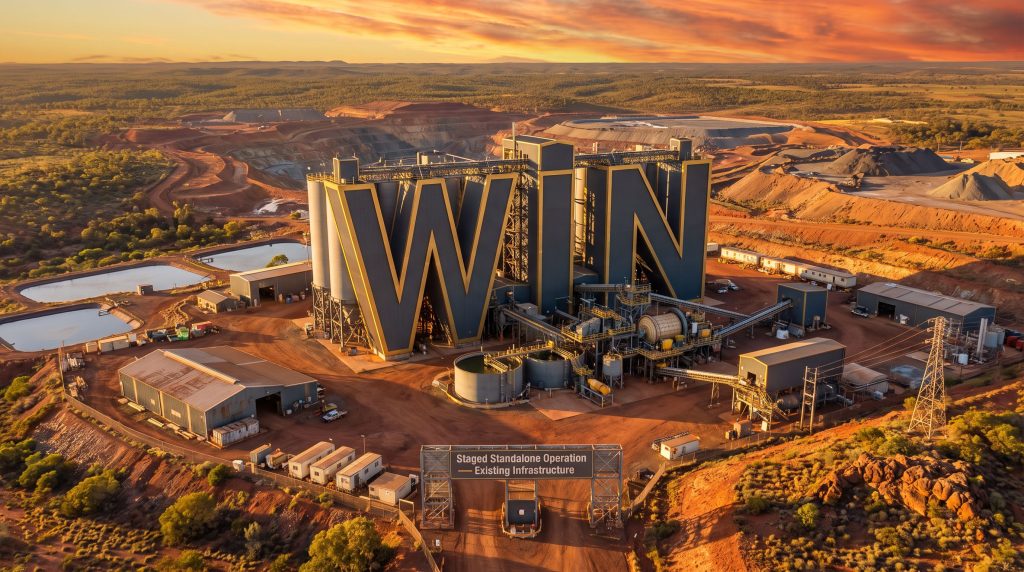
According to the announcement, Radio's economics are shaped less by raw scale and more by what is already in place on site. Many small-scale gold restart concepts struggle because processing infrastructure, mine access and site services all need to be built from scratch. At Radio, however, much of that work has already been completed, which is the central point for investors.
WIN reported that existing project infrastructure includes:
- An underground boxcut, decline and level development completed in 2021 and 2022
- Workshops and administration facilities
- Power and electrical infrastructure
- Fuel storage and communications infrastructure
- Processing plant earthworks and concrete civils
- Bore fields east and west of the mine
- An existing tailings storage facility that can be modified and expanded
- Approved explosives magazines, ROM pads and waste-rock landforms
Furthermore, the Study relies on processing equipment secured under the option arrangement previously announced on 18 June 2026. Combined with the existing civils, this appears to materially reduce the amount of new construction needed on site.
In the report, WIN stated that onsite construction is assumed to take about three months, although long-lead items such as CIL tanks, gravity concentrators and agitators would still require around 20 weeks from procurement after final investment decision.
What the Production Plan Looks Like
The Study's initial production target is 215,000 tonnes at 3.16 g/t gold for about 20,200 ounces of recovered gold over a 29-month processing schedule. This production target is based on a mix of underground ore, open-pit ore, surface stockpiles and Princess Royal tailings.
Mine Production Breakdown
| Source | Ore tonnes | Grade | Contained gold |
|---|---|---|---|
| Radio underground mine | 141,000t | 3.89 g/t Au | ~17,600 oz |
| Repeater open pit | 43,000t | 2.31 g/t Au | ~3,000 oz |
| Stockpiles and Princess Royal tailings | 30,800t | 1.06 g/t Au | ~1,000 oz |
| Total processed | 215,000t | 3.16 g/t Au | ~20,200 oz |
The underground mine is expected to provide the majority of feed and value. WIN proposed selective airleg mining accessed through the existing underground development, with a new in-lode decline extending from the 1312 level.
The Repeater open pit is designed to supply early ore and assist with processing plant ramp-up. All scheduled Repeater ore is classified as Indicated Mineral Resource, which is the higher-confidence category used in the production target. Peak annual recovered gold production is forecast at approximately 9,500 ounces in Year 2.
Understanding the Processing Route
The processing plant design in the report is based on conventional gold treatment rather than an unusual flowsheet. Ore would pass through:
- Three-stage mobile crushing
- Ball milling
- Gravity recovery
- Carbon-in-leach (CIL) treatment
Loaded carbon would then be processed offsite at a custom stripping facility in either Perth or Kalgoorlie.
What Is Carbon-in-Leach Processing?
For non-specialist readers, carbon-in-leach (CIL) is a common gold processing method where crushed ore is mixed with a cyanide solution to dissolve the gold, then activated carbon is used to capture that dissolved gold from the slurry. It is widely used because it can deliver high recoveries on suitable ore types.
The Study applies a 95.0% gold recovery to Radio material and 90.0% to Princess Royal tailings. According to the announcement, the Radio recovery assumption is supported by historical bulk treatment performance and metallurgical testwork reported on 13 August 2026.
What Do NPV, IRR and AISC Tell Investors?
Mining studies often present a list of economic figures that can seem technical at first glance. Three of the most important are NPV, IRR and AISC.
Net Present Value (NPV)
Net Present Value (NPV) is an estimate of how much value a project may generate in today's dollars after accounting for the timing of future cash flows. In this case, the Study reports NPV8, meaning future cash flows are discounted at 8% per year. A positive NPV suggests the project may create value above its estimated cost base, subject to the Study assumptions being achieved.
Internal Rate of Return (IRR)
Internal Rate of Return (IRR) is the annual return implied by the project cash flows. A higher IRR generally suggests stronger capital efficiency. Radio's reported 84% pre-tax IRR is high by junior gold project standards, though it remains a modelled outcome rather than a guaranteed result.
All-In Sustaining Cost (AISC)
All-In Sustaining Cost (AISC) is a broader cost measure that includes direct operating costs, royalties and sustaining capital. It is used in gold mining to show the approximate all-in cost to produce each ounce over time. Radio's Study AISC is $4,236/oz.
A related metric is C1 cash cost, which focuses more narrowly on direct cash operating costs. Radio's C1 cost in the Study is $3,157/oz. For investors, these metrics help answer three practical questions:
- Can the project generate value?
- How efficiently does it use capital?
- How much margin is left if gold prices move?
At the Study gold price assumption of $6,000/oz, Radio's implied AISC margin is about $1,764/oz.
Capital Costs and Funding Profile
One of the most closely watched figures in the announcement is the distinction between total life-of-mine capital and peak upfront funding.
Capital Cost Summary
| Capital item | $M |
|---|---|
| Processing facility | 8.3 |
| Tailings storage and supporting infrastructure | 2.5 |
| Camp and administration pre-production | 3.2 |
| Underground equipment and pre-production | 4.9 |
| Open-pit capital | 1.0 |
| Sustaining capital | 13.5 |
| Total life-of-mine capital | ~33.0 |
| Peak pre-finance funding requirement | ~19.0 |
The $19 million figure reflects the modelled maximum cumulative cash deficit before financing. The higher ~$33 million figure includes capital that would be spent later and funded from operating cash flow rather than all being required upfront.
That distinction is important because it goes directly to fundability. A lower upfront capital hurdle may expand the number of financing routes available to a junior company, even if total project capital over life remains materially higher.
Funding is not currently secured. In the report, WIN said it expects to consider a mix of debt, equity and alternative structures, including gold prepayment, forward sales, royalties, streaming arrangements or project-level investment.
Operating Costs and Margin Profile
Operating Cost Summary
| Cost category | $/oz |
|---|---|
| Processing and refining | 1,020 |
| General and administration | 676 |
| Underground mining | 1,167 |
| Open-pit mining | 210 |
| C1 cash cost | 3,157 |
| Royalties | 366 |
| Sustaining capital | 714 |
| Study AISC | 4,236 |
The underground mine is the largest single contributor to direct unit cost, reflecting the more selective and labour-intensive nature of narrow-vein underground mining. The report also noted that below-nameplate average plant utilisation contributes to relatively high processing and site overhead costs.
That point matters. If additional compliant feed were identified in future and processed through the plant, unit costs could improve through better utilisation. However, no such upside has been included in the current Study economics.
How Sensitive Are the Economics to the Gold Price?
WIN tested the project against a range of Australian-dollar gold prices, using $6,000/oz as the flat base-case Study assumption rather than a forecast.
| Gold price | Payback | Undiscounted pre-tax cash flow | Pre-tax NPV8 | Pre-tax IRR |
|---|---|---|---|---|
| $5,100/oz | 19 months | $6M | $3M | 21% |
| $5,550/oz | 12 months | $15M | $11M | 52% |
| $6,000/oz | 11 months | $23M | $18M | 84% |
| $6,450/oz | 10 months | $32M | $26M | 117% |
| $6,900/oz | 9 months | $42M | $33M | 151% |
The downside case is one of the more relevant aspects of the Study. At $5,100/oz, or 15% below the base-case assumption, the project is still modelled to generate positive pre-tax cash flow and a positive NPV8. For investors, that does not remove financing, execution or geological risk. It does, however, suggest the project is not viable at only a single price point in the model.
Resource Base, Confidence and What Is Excluded
The current Radio Mineral Resource cited in the report totals 366,000 tonnes at 4.2 g/t gold for 49,600 ounces. Of this, 200,000 tonnes at 4.0 g/t gold for 25,500 ounces is classified as Indicated, with the balance 166,000 tonnes at 4.5 g/t gold for 24,100 ounces classified as Inferred.
The production target is based on 86% Indicated and 14% Inferred Mineral Resources over life of mine. WIN also stated that about 91% of forecast gold production in the first two years is derived from Indicated material.
That mix is relevant because Indicated material carries a higher level of geological confidence than Inferred material. The company said it intends to complete infill drilling and underground grade control work ahead of mining, though there is no certainty that Inferred material will convert to a higher confidence category.
What the Study Currently Excludes
In addition, the Study excludes several growth options:
- Extensions to the Radio and Repeater lodes
- Princess Royal hard-rock mineralisation
- Other WIN-owned regional deposits
- Third-party feed or toll treatment
Princess Royal hard-rock remains an Exploration Target of 26,000 to 40,000 tonnes at 8 to 12 g/t gold for 7,000 to 15,000 ounces. As stated in the announcement, this is conceptual in nature and insufficient to estimate a Mineral Resource.
Development Pathway and Near-Term Milestones
According to the report, WIN is targeting lodgement of key approval applications by the end of August 2026. The indicative development schedule points to possible development activity in early 2027, subject to approvals, financing and a final investment decision.
Indicative Milestones
| Milestone | Target timing | Principal dependency |
|---|---|---|
| Works Approval and MDCP lodgement | By end August 2026 | Application completion |
| Regulatory assessment and conditions | Late 2026 / early 2027 | Regulator review |
| Financing and final investment decision | Following approvals and financing process | Acceptable terms and board approval |
| Offsite procurement and fabrication | Following FID | Long-lead orders and contractors |
| Onsite development and construction | Target early 2027 | Approvals, funding, mobilisation |
| Commissioning and first gold | To be confirmed | Construction and commissioning performance |
This schedule is indicative rather than fixed. Regulatory timing sits outside the company's control, and financing would still need to be secured on acceptable terms.
The next major ASX story will hit our subscribers first
Why Investors Are Likely to Watch the Next Phase Closely
The Radio Re-Start Study presents WIN with a relatively rare proposition in the junior gold space: a modest upfront funding requirement paired with existing mine infrastructure and a defined production target. Those features improve the clarity of the development pathway, even though the project remains at a preliminary stage.
For investors, the main points in the Study are straightforward:
- Low upfront capital relative to project scope, at about $19 million
- Fast modelled payback, at 11 months from first gold in the base case
- Positive economics at lower gold prices, based on the company's sensitivity analysis
- A high proportion of Indicated material early in the mine schedule
- A processing platform that may support future expansion if more feed is defined
Whether Radio advances from Study to construction will depend on approvals, funding and execution discipline. For now, the ASX announcement positions the project as WIN's clearest near-term path toward becoming a gold producer in Western Australia.
Want to Spot the Next Significant ASX Gold Discovery Before the Market Does?
Discovery Alert's proprietary Discovery IQ model scans ASX announcements in real time, instantly identifying significant mineral discoveries and turning complex data into actionable investment insights — just as junior gold projects like Radio demonstrate how quickly value can emerge from well-structured opportunities. Start your 14-day free trial today and see why subscribers track historic discoveries that have delivered substantial returns.