The United Kingdom's petroleum sector faces unprecedented fiscal pressures as political uncertainty transforms into policy certainty. While global energy markets grapple with geopolitical volatility and transition dynamics, Britain's approach to North Sea taxation represents a fundamental shift in how governments balance immediate revenue needs against long-term industrial sustainability. The windfall tax UK North Sea operators now confront extends beyond temporary crisis response into permanent fiscal architecture, reshaping investment flows and operational strategies across the basin.
This transformation reflects broader tensions between energy security challenges and fiscal consolidation pressures facing governments worldwide. Furthermore, Canada's energy transition challenges demonstrate similar policy tensions across mature energy jurisdictions. As mature hydrocarbon provinces globally confront similar challenges, the UK's extended Energy Profits Levy serves as a critical case study in balancing competing policy objectives during energy transition periods.
Understanding the Energy Profits Levy Framework
The Energy Profits Levy emerged during exceptional market conditions in May 2022, initially conceived as a temporary 25% supplementary charge on oil and gas profits. The Conservative government's response to Russia's invasion of Ukraine and subsequent energy price volatility established this windfall tax UK North Sea framework as crisis management policy rather than structural taxation.
However, the levy's evolution demonstrates how temporary measures become permanent fixtures. The rate increased to 35% in January 2023, then to 38% in Spring 2024, culminating in Labour's November 2024 decision to extend the framework through March 2030.
Tax Structure and Calculation Mechanics
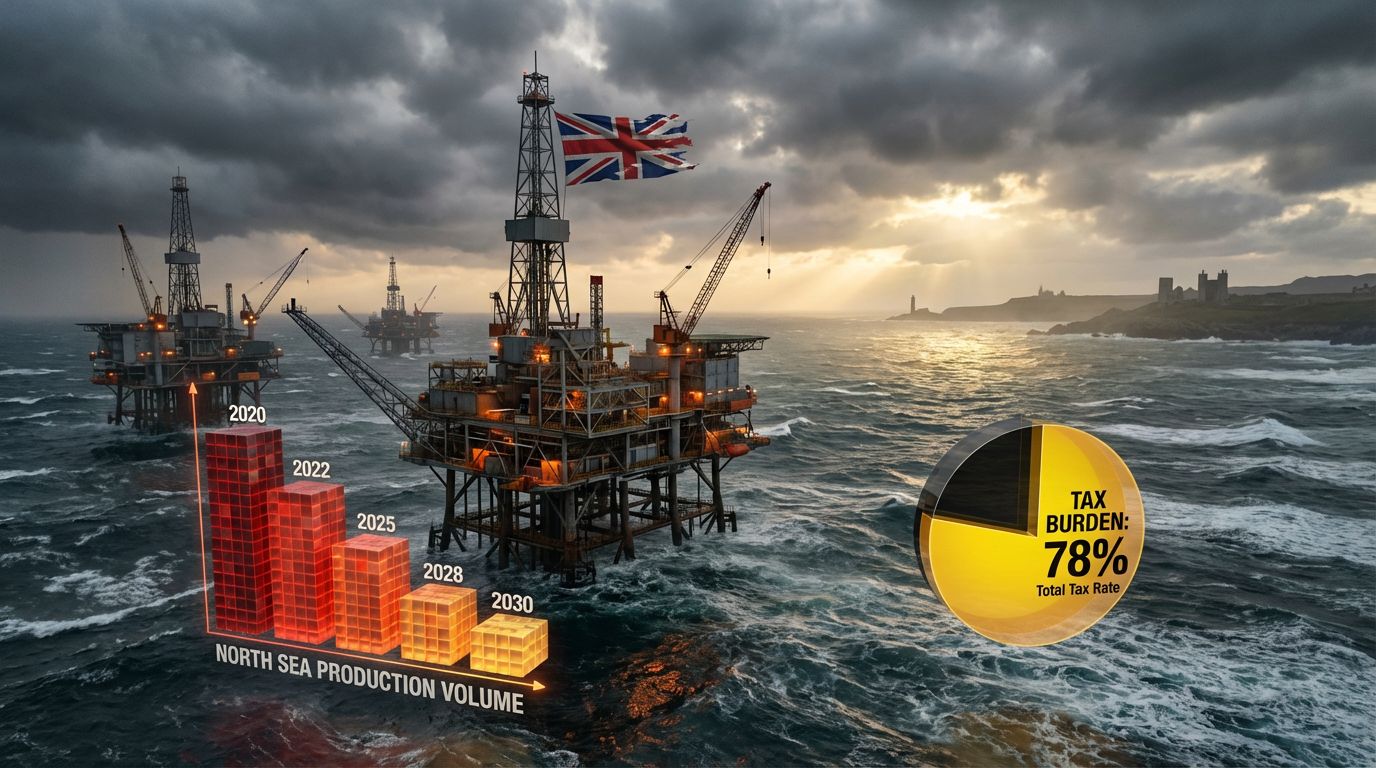
The EPL operates as a ring-fenced supplementary charge independent of standard corporation tax obligations. Combined with the 25% UK corporation tax rate, this creates a 78% headline tax burden for North Sea operations, though actual effective rates vary based on capital allowance utilisations.
Key structural elements include:
- Investment allowances: 80% of qualifying capital expenditure provides limited relief
- Ring-fenced application: EPL applies exclusively to UK oil and gas extraction profits
- Independent calculation: Operates separately from standard corporate tax frameworks
- Limited scope: Narrower than historical North Sea fiscal incentive mechanisms
The government's rationale centres on capturing exceptional profits during elevated energy price periods whilst funding energy transition initiatives and household support programmes. Officials characterise the measure as proportionate fiscal policy reflecting windfall gains during geopolitical market disruption.
Operational Responses and Workforce Restructuring
The windfall tax UK North Sea extension triggered immediate strategic adjustments across major operators, with employment reductions representing the most visible impact on regional economies. In addition, these developments have contributed to broader global market volatility affecting energy investments worldwide.
Harbour Energy's Strategic Repositioning
Harbour Energy Plc, Britain's largest independent oil and gas producer, exemplifies the sector's response to extended fiscal pressure. The company eliminated approximately 600 UK offshore positions following the EPL's 2022 introduction, with an additional 100 jobs announced for elimination after the March 2030 extension decision.
Scott Barr, managing director of Harbour Energy's UK operations, emphasised that British offshore operations will continue struggling to compete for capital within the company's global portfolio whilst the EPL remains in effect. This statement reflects a critical shift from temporary cost management to permanent structural adjustment.
Harbour Energy's broader context includes operations across nine countries, including Norway, Germany, Argentina, Mexico, and North Africa. This geographic diversification enables direct comparison of fiscal regime impacts on capital allocation decisions, with UK North Sea operations explicitly identified as lower-priority regions.
Industry-Wide Employment Impact
The geographic concentration of North Sea activities amplifies employment effects across Scotland's northeast region. Aberdeen and surrounding areas historically concentrated offshore workforce capabilities due to:
- Port infrastructure: Deep-water facilities supporting offshore vessel operations
- Supply chain clustering: Technical services, catering, and accommodation providers
- Engineering expertise: Specialised subsea and drilling technology capabilities
- Operational logistics: Helicopter transport and offshore crew management
Employment reductions create multiplier effects throughout these supporting industries, with vessel operators, catering companies, and technical service providers experiencing reduced demand for offshore support services.
Production Trajectory and Investment Implications
The windfall tax UK North Sea framework intersects with natural field decline patterns to accelerate production contraction across the basin. Mature field economics require continuous capital investment to maintain output levels, exactly the investment category constrained by EPL fiscal pressure.
Exploration Activity Cessation
The most striking indicator of policy impact appears in frontier exploration metrics. Industry sources suggest exploration drilling activity has declined dramatically in 2025, potentially representing the first complete cessation of new well exploration in North Sea history.
This development carries profound implications for long-term production sustainability. Exploration represents the primary mechanism for reserve replacement in mature hydrocarbon provinces. Without frontier activity, the basin faces accelerated decline as existing fields deplete without replacement discoveries.
Field Economics and Enhanced Recovery Challenges
North Sea production characteristics create particular vulnerability to fiscal pressure:
- Mature asset base: Most producing fields exceed 20 years operational history
- Declining reservoir pressure: Natural field decline requires ongoing intervention
- Enhanced recovery requirements: Maintaining output demands subsea tieback projects, well interventions, and processing upgrades
- Capital intensity: Optimisation projects require substantial upfront investment for incremental production gains
The EPL framework constrains precisely the capital expenditure categories essential for mature field optimisation. Enhanced recovery projects face extended payback periods under higher tax regimes, reducing project economics below investment thresholds.
Abandonment Acceleration and Asset Stranding
Marginal field economics deteriorate rapidly under elevated tax regimes. Fields with breakeven oil prices above $50-60 per barrel face threshold economics that may no longer support continued operation under 78% tax rates.
This dynamic accelerates abandonment planning across fields that might otherwise continue producing for several additional years under alternative fiscal frameworks. Early abandonment creates stranded asset risks for supporting infrastructure, including pipeline systems and processing facilities designed to handle multiple field outputs.
International Competitiveness Analysis
The windfall tax UK North Sea regime's global context reveals significant competitive disadvantages relative to alternative hydrocarbon investment destinations. Furthermore, these developments have created significant investment market impacts affecting capital allocation decisions globally.
Comparative Fiscal Framework Assessment
| Jurisdiction | Headline Tax Rate | Investment Incentives | Windfall Provisions |
|---|---|---|---|
| UK North Sea | 78% | Limited capex allowances | Permanent through 2030 |
| Norway | Variable structure | Extensive uplift mechanisms | None currently |
| Netherlands | 25.8% base rate | R&D tax credits | Temporary surcharge only |
| Denmark | Graduated structure | Depletion allowances | Limited windfall measures |
Whilst Norway maintains similarly high combined tax rates for hydrocarbon operations, its comprehensive investment incentive framework creates substantially different net economics. Norwegian operators benefit from:
- Enhanced capital allowances exceeding UK equivalents
- Exploration incentive mechanisms supporting frontier activity
- Accelerated depreciation schedules reducing effective tax rates
- State participation frameworks providing upside sharing rather than pure taxation
Capital Allocation Competitive Dynamics
International energy companies with diverse geographic portfolios face explicit capital allocation decisions between jurisdictions. The UK's 78% headline rate, combined with limited investment incentives, creates competitive disadvantages relative to:
- Middle East concessions: Lower fiscal terms with longer operational horizons
- Norwegian sector: Similar headline rates with superior investment frameworks
- North American shale: Rapid-cycle development with different risk-return profiles
- Emerging market opportunities: Higher geological risk offset by favourable fiscal terms
This competitive context explains accelerated divestment programmes among international majors and reduced acquisition interest in UK North Sea assets. For instance, Saudi Arabia exploration licenses offer more attractive fiscal terms for international energy companies.
Energy Security and Import Dependency Implications
The windfall tax UK North Sea extension creates strategic energy security implications extending beyond immediate fiscal revenue considerations. According to the BBC, industry experts warn that the tax extension could accelerate production decline.
Accelerating Import Reliance
Declining domestic production combined with reduced investment creates increasing reliance on energy imports during the critical transition period. Current import dependency levels around 35% of oil and gas consumption face acceleration toward 65% by 2030 based on production decline projections.
This trajectory creates several strategic vulnerabilities:
- Price volatility exposure: Increased sensitivity to global energy price fluctuations
- Supply chain risks: Greater dependence on international supply stability
- Geopolitical constraints: Reduced energy policy autonomy during crisis periods
- Infrastructure utilisation: Potential stranded asset risks for North Sea pipeline systems
Transition Timeline Misalignment
The rapid decline in domestic fossil fuel production may outpace renewable energy deployment capabilities, creating temporary but significant gaps in energy self-sufficiency. Whilst renewable energy capacity expands, intermittency and storage limitations require continued hydrocarbon backup capacity during transition periods.
Accelerated North Sea decline without commensurate renewable deployment creates risks of increased fossil fuel imports during precisely the period when energy security considerations argue for domestic resource utilisation during transition phases.
Regional Economic Consequences
Scotland's northeast region faces disproportionate economic impacts from windfall tax UK North Sea policy decisions, given the sector's concentration in Aberdeen and surrounding communities. Reuters reports that the government maintains its firm stance on taxation despite industry concerns.
Aberdeen Economic Ecosystem Impact
The energy sector represents approximately 30% of local economic activity in the Aberdeen region, creating significant multiplier effects from upstream industry changes:
- Property market impacts: Commercial real estate values reflecting reduced corporate presence
- Supply chain contraction: Service companies reporting 40% revenue declines across multiple sectors
- Skills migration: Engineering and technical expertise relocating to international energy hubs
- Innovation ecosystem: Reduced R&D investment in energy technologies and subsea capabilities
Labour Market Restructuring
Employment reductions extend beyond direct operator positions to encompass:
- Vessel operations: Offshore support vessel crews and shore-based logistics
- Catering and accommodation: Platform services and onshore crew facilities
- Technical services: Engineering consulting, subsea technology, and drilling support
- Aviation services: Helicopter transport and crew change operations
The specialised nature of North Sea expertise creates particular challenges for workforce transition. Unlike onshore energy sectors, offshore capabilities require specific technical training and safety certifications less transferable to alternative industries.
Investment Climate and Asset Valuation Impacts
The windfall tax UK North Sea extension provides policy certainty through 2030, enabling more accurate financial modelling whilst generally producing negative results for asset valuations.
Mergers and Acquisition Activity Decline
Transaction volumes in North Sea assets reflect deteriorating investment attractiveness:
- M&A activity reduction: 60% decline in asset transaction volumes year-over-year
- Valuation compression: Existing assets face downward revaluation under extended EPL scenarios
- Private equity withdrawal: Investment focus shifting toward renewable energy projects
- Debt financing constraints: Tightened lending criteria for upstream project financing
International Investor Sentiment
Policy certainty through 2030, whilst eliminating uncertainty, confirms investor concerns about UK North Sea competitiveness. International energy companies face explicit choices between maintaining UK exposure or reallocating capital to jurisdictions with superior fiscal terms.
The Harbour Energy case illustrates this dynamic clearly. Despite completing the acquisition of Wintershall Dea's non-Russian assets in 2024, subsequent workforce reductions and capital allocation statements indicate UK operations competing unsuccessfully for investment within the company's global portfolio.
Energy Transition Strategy and Revenue Recycling
The government's rationale for maintaining the windfall tax UK North Sea framework centres on funding renewable energy infrastructure and supporting household energy costs during transition periods.
Transition Investment Funding Mechanisms
EPL revenue allocation reportedly includes:
- Green investment programmes: 40% of proceeds directed toward renewable energy infrastructure
- Household energy support: 35% of proceeds supporting consumer energy costs
- Administrative and programme costs: 25% of proceeds covering policy implementation
This revenue recycling approach reflects policy logic that windfall tax receipts should fund transition away from fossil fuel dependence. However, the approach raises questions about optimal transition timing and import dependency risks during intermediate periods.
Transition Timing and Strategic Coordination
The challenge lies in coordinating North Sea production decline with renewable energy deployment timelines. Accelerated domestic production decline without commensurate renewable capacity addition creates temporary gaps requiring increased fossil fuel imports.
Strategic policy coordination would ideally synchronise domestic production decline with renewable deployment to minimise import dependency during transition phases. The current windfall tax framework accelerates production decline without direct mechanisms ensuring renewable capacity deployment maintains energy security during intermediate periods.
What Are the Alternative Policy Framework Options?
Before the extension announcement, industry stakeholders proposed alternative fiscal structures designed to balance revenue generation with investment sustainability and energy security objectives.
Graduated Rate Structure Proposals
Industry reform proposals included several innovative approaches:
- Price-linked tax rates: EPL rates varying with Brent crude price levels to maintain investment incentives during lower price periods
- Enhanced investment allowances: Expanded capital expenditure relief for domestic supply chain investment and energy transition projects
- Ring-fenced transition funds: Dedicated accounts for decommissioning cost sharing and renewable energy infrastructure
- Exploration incentive mechanisms: Reduced rates for frontier exploration supporting reserve replacement
These proposals aimed to generate comparable government revenue whilst maintaining exploration incentives and workforce stability. The graduated rate structure would have provided automatic adjustment mechanisms reducing fiscal pressure during lower commodity price environments.
Production-Based Alternative Frameworks
Alternative approaches might have included production-based taxation rather than profit-based levies, creating different incentive structures for operators:
- Per-barrel production taxes: Fixed rates per unit of production rather than percentage of profits
- Depletion allowances: Tax credits recognising natural resource consumption
- Infrastructure investment credits: Enhanced allowances for platform and pipeline maintenance supporting multiple fields
- Employment-linked incentives: Tax credits supporting domestic workforce retention during transition
These mechanisms would have created different economic incentives whilst potentially achieving similar revenue objectives through alternative collection methods.
How Will This Impact Future Energy Strategy?
The windfall tax UK North Sea extension through March 2030 represents a definitive policy choice prioritising immediate fiscal revenue over long-term energy sector sustainability and regional economic stability.
Investment Climate Outlook
Policy certainty through 2030 eliminates uncertainty whilst confirming challenging operating conditions for UK North Sea development. International operators now possess clear frameworks for long-term planning, though the frameworks generally discourage rather than encourage investment in UK offshore activities.
The five-year policy horizon extends beyond typical exploration and development timelines, providing operators with clear fiscal assumptions for project economics modelling. However, the fiscal terms create structural headwinds for project sanctioning and capital allocation decisions.
Transition Success Criteria
The ultimate assessment of the windfall tax UK North Sea extension depends on whether transition investments funded by EPL revenues successfully offset strategic costs including:
- Increased import dependency and associated energy security risks
- Industrial base erosion and specialised workforce migration
- Regional economic disruption in energy-dependent communities
- Infrastructure underutilisation as supporting systems lose throughput volumes
Success requires that renewable energy deployment funded by EPL revenues exceeds the energy security and economic costs of accelerated North Sea decline.
Long-Term Strategic Positioning
Britain's approach to North Sea taxation during energy transition provides a template for other mature hydrocarbon provinces facing similar policy challenges. The windfall tax UK North Sea framework represents one model for balancing immediate fiscal needs against long-term energy security and industrial sustainability.
The policy's long-term success will influence similar decisions in Norway, Netherlands, Denmark, and other mature hydrocarbon provinces considering comparable fiscal interventions during energy transition periods.
The windfall tax extension fundamentally reflects political priorities emphasising immediate revenue generation and transition funding over maintaining domestic energy production capabilities during the critical transition period. Whilst providing government revenue certainty through 2030, the decision accelerates North Sea production decline, workforce contraction, and import dependency increase.
For investors and industry participants, the policy framework provides clarity regarding operating conditions whilst signalling continued challenging investment climate for UK offshore energy development. The strategic implications extend beyond immediate fiscal impacts to encompass energy security, regional economic development, and transition strategy coordination during the critical period through 2030.
Seeking Opportunities in Global Energy Market Shifts?
Discovery Alert's proprietary Discovery IQ model delivers real-time insights on significant ASX mineral discoveries, helping investors capitalise on market-moving announcements whilst the energy sector undergoes historic transformation. Begin your 30-day free trial today to gain actionable investment intelligence that positions you ahead of traditional market analysis.