
August 5, 2026
The Structural Forces Rewriting Global Reserve Strategy
For most of financial history, gold reserve management was a passive affair. Central banks inherited large stockpiles accumulated during the Bretton Woods era, watched them sit in vaults, and occasionally sold portions when fiscal conditions demanded. That era is firmly over. The past four years have produced a fundamental reversal, with sovereign institutions accumulating gold at a pace that is double the preceding decade's average, driven by a convergence of geopolitical fragmentation, monetary system stress, and an evolving understanding of what gold can actually do inside a modern institutional portfolio.
Understanding this shift requires moving well beyond spot price analysis. The daily fluctuations in gold pricing, driven largely by short-term speculative positioning in ETFs and futures markets, obscure a far more significant structural transformation unfolding beneath the surface. World Gold Council central bank gold buying data provides the clearest window into that transformation, and the 2025 to 2026 figures are among the most compelling in the asset's modern history.
When big ASX news breaks, our subscribers know first
How Much Gold Are Central Banks Actually Buying? The 2025-2026 Data in Full
Net Purchases in Q1 2026: 244 Tonnes and What It Signals
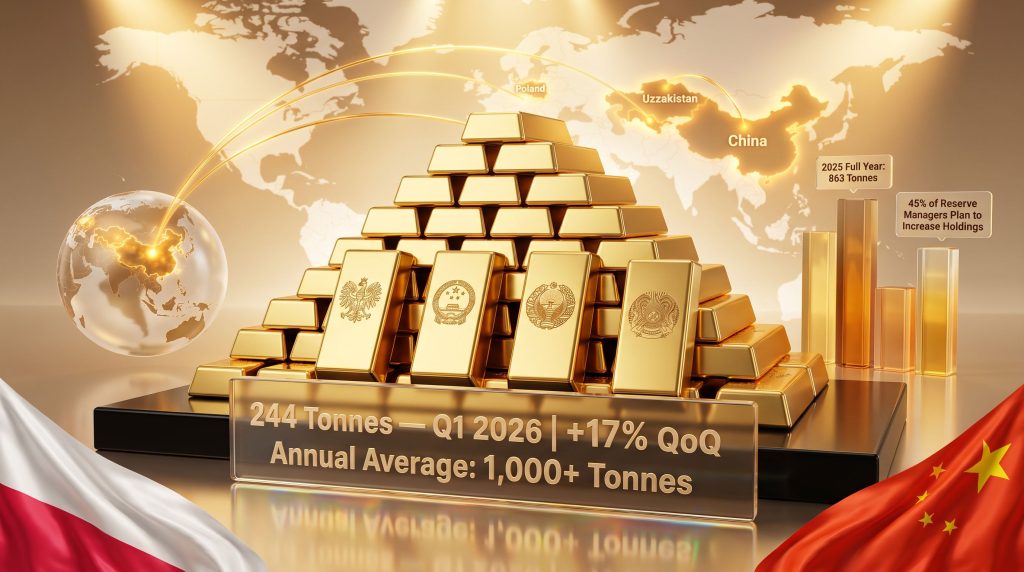
Central banks collectively added a net 244 tonnes of gold to their reserves during the first quarter of 2026, representing a 17% increase over the prior quarter. That figure is not an anomaly. It sits within a four-year structural baseline in which net annual central bank purchases have averaged approximately 1,000 tonnes, roughly double the pace maintained throughout the preceding decade.
The monthly momentum extending into May 2026 reinforces the picture. An additional 41 tonnes were added that month alone, with Poland, China, and Uzbekistan leading purchases. Furthermore, central bank gold demand across this period reflects a deliberate, policy-driven accumulation cycle rather than opportunistic positioning.
| Period | Net Purchases | Key Buyers |
|---|---|---|
| Q1 2026 | 244 tonnes (+17% QoQ) | Poland, China, Uzbekistan |
| May 2026 | 41 tonnes | Poland (18t), China (10t), Uzbekistan (9t) |
| 2025 Full Year | 863 tonnes | Broad EM and Asian bloc |
| Annual Average 2022-2024 | ~1,000 tonnes | Multi-region accumulation |
| Preceding Decade Average | ~500 tonnes/year | Baseline comparison |
Why 863 Tonnes in 2025 Remains Historically Exceptional
Some market commentary framed the 2025 full-year figure of 863 tonnes as a slight deceleration from peak years. That framing misses the context entirely. Measured against the pre-2022 ten-year average of approximately 500 tonnes per year, even a moderated 2025 represents a structural elevation that shows no sign of reverting. World Gold Council data confirms reserve managers continue to classify this as a sustained accumulation cycle rather than a temporary spike.
Who Is Leading the World Gold Council Central Bank Gold Buying Wave?
Poland's National Bank: The Standout Buyer of 2026
Poland's central bank has emerged as the single most aggressive accumulator in the current cycle. By May 2026, the National Bank of Poland had added 64 tonnes year-to-date, including 18 tonnes in May alone, marking a fourth consecutive month of double-digit purchases. The strategic rationale is explicit: reducing reserve dependency on any single foreign currency and building a non-sovereign asset buffer against geopolitical risk scenarios that are particularly salient for a NATO-border economy.
China's People's Bank: Systematic and Deliberate
China's People's Bank added 10 tonnes in May 2026, its highest single-month figure since December 2024, extending what has become a streak of more than 12 consecutive months of reported additions. What makes China's participation structurally significant extends beyond the headline numbers. A mature domestic gold ecosystem supports and reinforces this accumulation.
Key components of that ecosystem include:
- The Shanghai Gold Exchange, providing spot market infrastructure
- The Shanghai Futures Exchange, enabling derivatives-based hedging
- A large and active jewellery market providing physical demand depth
- Insurance companies now permitted to allocate to gold within their portfolios
This institutional framework means gold accumulation in China is not purely a top-down central bank decision but reflects a broad societal and financial system orientation toward the metal. In addition, examining central bank gold reserves across major economies helps contextualise the scale of China's ongoing commitment to the asset.
An Important Nuance on Chinese Reporting
A layer of complexity exists around Chinese gold data that investors should understand. China reports reserve additions through IMF-mandated disclosure channels, and those figures are considered reliable for what they cover. However, gold accumulation may also occur outside the formal central bank reserve account through other official channels.
Analysts use import destination data as a supplementary signal: gold flowing toward Beijing tends to suggest government-related acquisition, while flows directed toward Shanghai more commonly reflect investment or commercial demand.
Central Asian Sovereigns and the New Latin American Entrants
Beyond the headline buyers, a broader wave of emerging market central banks is treating gold as a core sovereign savings instrument:
- Uzbekistan added 9 tonnes in May 2026
- Kazakhstan added 7 tonnes in May 2026
Latin America has also entered the picture in a meaningful way, with several nations making their first substantive purchases in years:
| Country | 2026 Purchases to May |
|---|---|
| Chile | 8 tonnes |
| Guatemala | 2 tonnes |
| Bolivia | 1 tonne |
| Uruguay | 1 tonne |
The Turkey Case Study: Mobilisation Is Not Retreat
Turkey's gold activity is frequently misread in financial media as a bearish signal for the broader central bank demand story. The reality is considerably more nuanced.
Central banks can and do sell or swap gold to address short-term domestic liquidity requirements, including currency support operations, while maintaining full long-term reserve intent. Swap arrangements carry an embedded signal of intent to reclaim the asset once the mobilisation purpose is fulfilled. Turkey's activity is a use case for gold's practical utility, not an exit from the asset class.
Tanzania and other smaller emerging market economies have demonstrated similar behaviour, deploying gold reserves strategically when domestic conditions require while treating their overall gold position as a permanent feature of reserve architecture.
What Is Driving Central Bank Demand? A Multi-Framework Analysis
Framework 1: Reserve Diversification Under Geopolitical Stress
The seizure of Russian sovereign assets following the 2022 invasion of Ukraine fundamentally altered how reserve managers assess counterparty risk. Gold carries no credit risk, no foreign policy dependency, and cannot be frozen by a third-party government. For central banks operating in geopolitically exposed environments, these properties have moved from desirable to essential.
Geopolitical fragmentation is not a short-term condition. It is a structural force reshaping reserve allocation frameworks across the emerging market world and increasingly across developed market economies as well. Consequently, understanding how central banks influencing gold prices operate through accumulation decisions has become essential for any serious market analyst.
Framework 2: Gold as the Dollar's Only Credible Complement
A critical distinction must be maintained in any analysis of gold's rising reserve role: central banks are not abandoning the US dollar. Dollar-denominated trade remains the foundation of the global commercial system, and reserve managers have no viable wholesale alternative to dollar assets for settlement purposes.
What has changed is the composition of the non-dollar portion of reserves. The euro has not emerged as a credible diversifier at scale. Gold has filled that structural gap, functioning as the primary diversifier within dollar-heavy portfolios. World Gold Council survey data confirms this framing, with reserve managers explicitly citing gold as their preferred complement to dollar holdings rather than as a dollar replacement.
Framework 3: Dismantling the No-Yield Argument
One of the most persistent arguments against institutional gold allocation is the absence of yield. That argument is increasingly outdated and reflects an incomplete understanding of how modern gold markets function.
Central banks and institutional holders can deposit physical gold into the over-the-counter wholesale lending market, primarily through London's bullion banking infrastructure, and earn a lending fee on that position. This mechanism generates income without requiring the asset to be liquidated, effectively diffusing the cost of storage while maintaining full reserve exposure.
Additional developments reinforcing gold's yield potential include:
- Pooled gold interest structures that make the lending market more accessible to smaller institutions
- Digitisation initiatives aimed at improving the scalability of wholesale gold trading
- The Tier 1 capital classification of allocated gold, allowing it to function equivalently to cash for bank collateral purposes
- Crypto lending platforms now accepting gold as collateral, extending its utility into new financial ecosystems
Investors and institutions still relying on the traditional no-yield critique of gold are, in effect, operating with outdated information about what the asset can do inside a modern portfolio.
Framework 4: Inflation Protection as a Sovereign Imperative
Global inflation since 2021 has not been a purely Western phenomenon. Energy price volatility, supply chain disruption, conflict-driven fertiliser shortages, and food pricing pressure have created inflationary conditions that affect emerging market economies faster, deeper, and with less policy buffer than their developed market counterparts. Gold's role as a domestic purchasing power hedge is explicitly cited by reserve managers as a motivation for accumulation, particularly across commodity-importing economies in Asia, Latin America, and Africa.
What Does the World Gold Council Survey Data Reveal About Forward Demand?
Record Bullishness Among Reserve Managers
The World Gold Council's 2026 annual reserve manager survey produced the most bullish set of responses since the survey's inception in 2018. 45% of respondents indicated plans to increase their institution's gold holdings over the next 12 months, the highest proportion ever recorded. Separately, 89% of respondents expect aggregate global central bank gold holdings to rise over the same period.
These figures carry significant structural weight. Reserve management decisions operate on multi-year horizons with high implementation friction, meaning expressed intent in surveys translates reliably into actual allocation changes over time.
Additional survey findings of note:
- Declining confidence in fiat currency dependency as a standalone reserve strategy
- Expectations that reliance on fiat currencies will fall materially over the next five years
- Gold overtaking US Treasuries as the top reserve asset preference for a growing segment of reserve managers, though Treasuries remain dominant in absolute terms
The East-West Demand Divergence: Two Markets, One Price
Western Investors: Rate-Sensitive and Speculative
Western investor behaviour in gold markets over the past 18 months has been dominated by short-term rate sensitivity. As the US Federal Reserve maintained a higher-for-longer posture, North American speculators reduced gold exposure through ETF outflows and futures position liquidation. Cash deposits and short-duration bonds became temporarily more attractive alternatives.
This dynamic has been the primary driver of gold price volatility, not any change in underlying structural demand.
Eastern Physical Demand: Record-Paced and Structurally Driven
While Western paper gold was being sold, Asian physical bar and coin demand reached record levels. The divergence between these two markets produces an apparent paradox in aggregate demand data:
| Metric | Direction | Interpretation |
|---|---|---|
| Gold demand by weight | +2% | Modest volume growth |
| Gold demand by dollar value | +74% (record) | Price appreciation driving value |
| Physical bars and coins (Asia) | Record highs | Structural savings behaviour |
| Western ETF flows | Net outflows | Speculative repositioning |
| Central bank net purchases (Q1 2026) | 244 tonnes | Institutional accumulation continues |
| Jewellery recycling | Below expected | Consumers holding, not selling |
The jewellery data point deserves particular attention. At elevated gold prices, one would ordinarily expect significant recycling activity as consumers sell existing jewellery to capture gains. That this has not occurred at the expected scale signals genuine long-term conviction among physical gold holders in emerging markets, where jewellery serves as a primary savings instrument for millions of households.
The next major ASX story will hit our subscribers first
Is a New Global Gold Pricing Architecture Emerging?
The Hong Kong-Shanghai Clearing Initiative
A new gold clearing and settlement platform connecting Hong Kong and Shanghai is designed to complement the London OTC market rather than replace it. The platform is specifically structured to appeal to central bank participants, offering an Asian-region clearing infrastructure that does not require reliance on London-session price fixes.
A key ambition of the initiative is establishing an Asian regional gold price fix, providing morning-session price discovery that currently does not exist. Asian market participants currently operate without a regional benchmark, waiting for the London fix before they have a reference price for the day. Eliminating that gap would be a meaningful structural development for Asian gold market participants.
London's Strategic Response
Rather than treating Asian gold market development as competitive, London's bullion market infrastructure appears to be exploring how to extend its reach into Asia-Pacific time zones. Similar conversations are occurring in Singapore and across Middle Eastern financial centres. The trajectory points toward a multi-hub global gold market with interconnected clearing infrastructure rather than a simple London-to-Asia power transfer.
The long-term implication of a multi-hub architecture is that price discovery will increasingly reflect Eastern demand dynamics. As Asian central banks, institutional investors, and clearing systems mature, the gold price will be shaped more symmetrically by both Eastern and Western participants than at any prior point in the modern market's history.
Gold as Working Collateral: A Fundamental Reclassification
The evolution of gold's role within financial system infrastructure is one of the most consequential and least-discussed developments in commodity markets. Allocated gold now holds Tier 1 capital status, allowing banks and clearing houses to treat it equivalently to cash for collateral purposes. This regulatory reclassification has meaningfully expanded gold's utility within institutional balance sheets.
The practical effects are significant:
- Central banks can earn lending fees without selling their gold positions
- Swap arrangements allow mobilisation without permanent exit from the market
- The structural demand base becomes stickier as gold is embedded deeper into financial system plumbing
- Forced liquidation during market stress becomes less probable when gold can be borrowed against rather than sold
Turkey's swap activity provides a real-world demonstration of this dynamic. The signal embedded in swap usage is that the institution intends to reclaim the asset once the mobilisation purpose is served. This is categorically different from outright selling and should be interpreted accordingly by market analysts.
The Illicit Mining Problem: The 20% Supply Integrity Risk Nobody Is Discussing
Artisanal and Small-Scale Gold Mining at Scale
Among the most underappreciated structural risks in the gold market is the integrity of the supply chain itself. Artisanal and small-scale gold mining may account for as much as 20% of annual global gold production, with a material portion of that output potentially entering the formal supply chain through illicit channels.
Reports have emerged suggesting that gold sourced through illicit financing networks has entered the supply chains of major sovereign mints, including institutions widely regarded as paragons of provenance standards. The implications extend across multiple stakeholder categories:
- Institutional investors face ESG compliance and reputational exposure if provenance standards are not enforced upstream
- Governments and sovereign mints face legal and diplomatic risk if their certification processes are penetrated
- Industry bodies face credibility risks if voluntary standards prove insufficient at scale
Emerging Solutions and the Scale of the Challenge
Responsible gold sourcing programmes are under active development to improve traceability from mine to vault. Blockchain-based provenance tracking and independent third-party audit frameworks are among the tools being deployed. However, the scale of the problem demands systemic solutions rather than incremental improvements. If 20% of annual gold production carries uncertain provenance, the integrity of the entire market is a shared concern, not a niche ESG consideration.
Macro Forces Shaping the Gold Outlook
Fed Uncertainty and the Jackson Hole Inflection Point
The US Federal Reserve's recent split decision environment has introduced short-term volatility into gold pricing. A 9-to-8 decision outcome signals internal division and has complicated forward guidance. In this context, Federal Reserve communications from Jackson Hole take on added importance as a potential strategic inflection point, representing an opportunity for clearer longer-term signalling that could materially shift Western investor positioning.
The dot plot and forward guidance language from that gathering will be critical inputs for gold allocation models heading into the second half of the year.
The US Debt Overhang: Gold's Longest-Duration Structural Tailwind
Short-term gold price dynamics are dominated by rate expectations and speculative flows. The longer-duration structural case rests on a different set of variables entirely, chief among them the sustainability of US sovereign debt, now exceeding $40 trillion, and the credibility of fiat monetary systems more broadly. Furthermore, gold's role in the monetary system continues to deepen as reserve managers seek alternatives that carry no sovereign credit risk.
Near-term Fed decisions will continue to create price noise. The more consequential question for long-term gold allocation is whether the trajectory of US sovereign debt, the credibility of fiat monetary systems, and the pace of global reserve diversification remain intact. These are multi-year forces operating independently of any single central bank meeting outcome.
Conflict, Inflation, and the Safe Haven Paradox
Gold's behaviour during conflict events follows a pattern that is more nuanced than the simple safe haven narrative suggests. Initial conflict risk drives prices higher as risk premiums are priced in. Once the scope and likely duration of a conflict are assessed by market participants, gold can face selling pressure as it is used for liquidity, covering margin calls, generating cash flow, or taking profits on positions that have appreciated significantly.
The medium-term trajectory depends on whether inflationary consequences persist. Conflict-driven energy disruption, food pricing stress, and supply chain strain all create sustained inflationary conditions that provide durable support for gold. The Iran escalation scenario currently in view reflects precisely this dynamic, with knock-on effects on oil supply, fertiliser availability, and global food pricing extending well beyond the initial conflict event.
Frequently Asked Questions: World Gold Council Central Bank Gold Buying
How Much Gold Are Central Banks Buying in 2026?
Central banks purchased a net 244 tonnes of gold in Q1 2026, a 17% increase from the prior quarter and significantly above the five-year average. Monthly purchases reached 41 tonnes in May 2026, confirming continued accumulation momentum.
Which Central Banks Are the Most Active Buyers?
Poland's National Bank leads 2026 accumulation with 64 tonnes through May. China's People's Bank added 10 tonnes in May, its highest monthly figure since December 2024. Uzbekistan, Kazakhstan, Chile, and several other emerging market central banks are also consistent buyers. Reviewing global gold reserve rankings offers additional context on how these institutions compare in absolute reserve terms.
Why Are Reserve Managers Choosing Gold Over Other Assets?
Reserve managers cite the absence of counterparty credit risk, protection against sanctions and asset seizure, inflation hedging capability, and gold's function as the only credible diversifier within dollar-heavy reserve portfolios. Survey data indicates that fiat currency dependency is expected to decline materially over the next five years. According to Brookings Institution research, gold holdings serve a unique stabilising role that no other reserve asset fully replicates.
Can Central Banks Actually Earn Yield on Gold Holdings?
Yes. Physical gold can be deposited into the OTC wholesale lending market through London's bullion banking infrastructure to earn a lending fee. This mechanism generates income without requiring the asset to be sold and effectively eliminates the traditional opportunity cost argument against gold.
Is the 20% Illicit Mining Figure a Verified Statistic?
The 20% figure represents an estimate for the share of annual global gold production potentially attributable to artisanal and small-scale mining, a portion of which may enter formal supply chains through illicit channels. It is an estimate under active investigation by industry bodies and represents a material supply integrity risk requiring systemic solutions.
What Should Investors Watch for in the Second Half of 2026?
Key variables include Federal Reserve communications from Jackson Hole, the trajectory of the US debt sustainability debate, Q2 physical demand data from Asian markets, and the development of the Hong Kong-Shanghai clearing platform. Each of these carries potential to materially influence both gold pricing and structural allocation decisions.
Key Takeaways: What the Structural Data Is Actually Telling the Market
- Central bank gold buying has averaged approximately 1,000 tonnes annually for four consecutive years, double the prior decade's pace
- Q1 2026 net purchases of 244 tonnes confirm no structural reversal in institutional accumulation
- Western speculative selling via ETFs and futures has driven short-term price volatility without altering underlying demand trajectory
- Physical demand in bars, coins, and jewellery by dollar spend remains at record levels globally
- Gold's evolution into Tier 1 working collateral and a yield-generating instrument through lending markets is systematically dismantling traditional arguments against holding it
- A multi-hub global gold market is forming, with Asian clearing infrastructure beginning to provide price discovery independent of the London benchmark
- The 20% illicit mining supply risk represents the most material and underappreciated structural challenge currently facing the gold market
- The longest-duration tailwind for gold remains the unresolved trajectory of US sovereign debt and the credibility of fiat monetary systems broadly
This article contains forward-looking statements, survey-based projections, and market estimates. All figures are sourced from publicly available World Gold Council data and should not be construed as financial advice. Past performance and historical accumulation trends are not guarantees of future outcomes. Readers should conduct independent research before making investment decisions.
Want to Stay Ahead of the Next Major Mineral Discovery Driving These Structural Shifts?
While central banks accumulate gold at record pace, individual investors can position themselves ahead of significant ASX mineral discoveries through Discovery Alert, powered by its proprietary Discovery IQ model, which delivers real-time alerts turning complex commodity data into actionable opportunities — explore historic discovery returns to understand the potential, then begin your 14-day free trial to gain a market-leading edge.