June 4, 2026

The Processing Infrastructure Gap at the Heart of Africa's Copper Ambitions
Across the global copper supply chain, the bottleneck that most often goes unexamined is not the mine itself but the furnace. Smelting and refining capacity — the industrial infrastructure that transforms raw concentrate into tradeable refined metal — determines whether a country captures commodity value or exports it cheaply to someone else. When that infrastructure falters, even temporarily, the consequences cascade rapidly from processing yards to government revenue projections to the balance sheets of multinational mining operators. Zambia's decision to extend its Zambia copper concentrate export duty waiver through September 30, 2026 is a window into exactly this dynamic, revealing structural tensions that sit well beneath the surface of a routine policy announcement.
When big ASX news breaks, our subscribers know first
Understanding the Mechanics of Zambia's Export Duty Structure
What the 10% Concentrate Duty Is Actually Designed to Do
Zambia's standard export framework draws a deliberate line between two very different products: copper concentrate and refined copper cathode. Concentrate is the semi-processed output of crushing and flotation circuits at the mine site, typically containing between 25% and 35% copper by weight along with various impurities including sulphur, iron, and trace precious metals. Cathode, by contrast, is the finished product of smelting and electrolytic refining — a form of copper that commands a significant premium in global markets and represents considerably more domestic labour, energy, and capital input per tonne exported.
The 10% export duty on copper concentrates exists precisely to make concentrate export economically unattractive relative to domestic processing. It is an industrial policy lever, not primarily a revenue mechanism. By making it more expensive to ship semi-processed material offshore, the duty nudges mine operators toward investing in or contracting with domestic smelters. This supports Zambia's goal of developing a more sophisticated copper value chain rather than functioning purely as a supplier of raw inputs to refineries in China, India, or Europe.
Furthermore, understanding the copper price growth drivers helps contextualise why Zambia is so determined to retain as much processing value domestically as possible, given how dramatically refined copper premiums have moved in recent years.
When the Policy Logic Breaks Down
The flaw in this model emerges when domestic smelting capacity becomes unavailable. If a mine cannot process its concentrate domestically because the smelter is offline, the 10% duty stops functioning as an industrial incentive and starts functioning as a penalty on production continuity. Stockpiles accumulate. Storage facilities reach capacity. The chemical and physical properties of copper concentrate can deteriorate over extended periods in open-air storage, particularly in high-rainfall environments like Zambia's Copperbelt. Revenue that could flow to the state, to workers, and to operators simply evaporates.
In this context, the temporary suspension of the duty is not a retreat from industrial policy. It is a pragmatic recognition that the policy's underlying logic only holds when the processing infrastructure it is designed to protect is actually operational. Bowmans Law has noted that similar zero-duty instruments across the region reflect a recurring tension between value-addition ambitions and infrastructure constraints.
The 2026 Waiver: Structure, Scope, and Named Beneficiaries
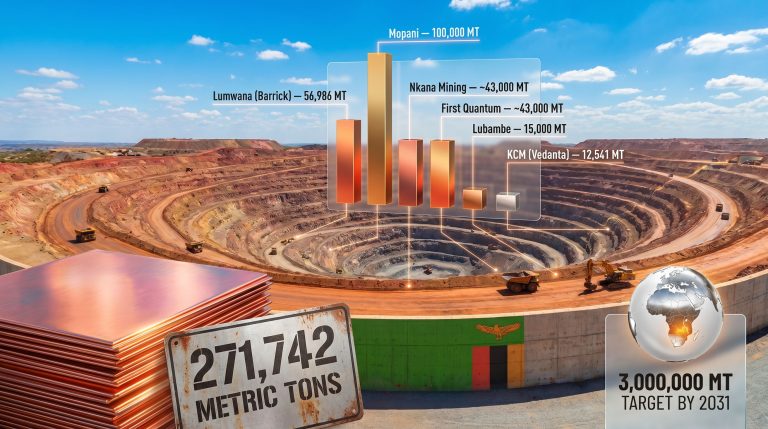
The current waiver was originally introduced in August 2025 and has now been extended to cover the period through to September 30, 2026. The total volume of copper concentrates covered under the duty suspension stands at approximately 271,742 metric tons, an increase from the earlier instrument's coverage of around 255,357 metric tons. The waiver was formalised via a government notice, with the official document circulated one day prior to the effective grant date in late June 2026.
What makes this iteration of the waiver particularly notable is the granularity of its quota allocations. Rather than issuing a blanket suspension, Zambia's government has assigned named volume limits to six specific mining operations:
| Mining Operation | Duty-Free Quota (mt) | Ownership |
|---|---|---|
| Mopani Copper Mines | 100,000 | IRH (Abu Dhabi) + ZCCM-IH (Zambia state) |
| Lumwana Mining Company | 56,986 | Barrick Mining Corp |
| First Quantum Minerals | ~43,000 | Canadian-listed major |
| Nkana Mining and Minerals Processing | ~43,000 | Chinese state-linked |
| Lubambe Copper Mine | 15,000 | JCHX Mining (70% Chinese) |
| Konkola Copper Mines | 12,541 | Vedanta Resources |
The quota-based architecture matters because it limits fiscal exposure while providing operational clarity. Any volumes exported above these thresholds remain subject to the full 10% duty, which creates a hard commercial ceiling on the concession and preserves some of the duty's original incentive function.
Mopani's Dominant Position in the Waiver
Mopani Copper Mines holds the single largest quota at 100,000 metric tons, nearly double that of the next largest beneficiary. This reflects both the scale of Mopani's operations and the extent of its smelter challenges. Mopani's Mufulira smelter is one of Zambia's most significant processing facilities, and extended maintenance at that site has a disproportionate impact on the country's aggregate concentrate processing capacity.
The joint ownership structure — with Abu Dhabi's International Resources Holding and Zambia's state mining vehicle ZCCM-IH as co-owners — adds a layer of political complexity to every operational decision made at the facility. Notably, as reported by Bloomberg Law, IRH's Zambia copper unit had initially indicated it would not take up the concentrate export waiver, adding further complexity to the policy's operational uptake.
Zambia's 3 Million Ton Target and the Processing Capacity Paradox
The Numbers Behind the Ambition
Zambia exported 890,346 metric tons of copper in 2025. Its stated national production target is 3 million metric tons by 2031. Closing that gap requires adding approximately 2.1 million metric tons of annual output within six years. At a purely geological level, Zambia's Copperbelt has the resource base to support this ambition. The region hosts some of the world's highest-grade sediment-hosted copper deposits, with ore grades in certain zones ranging from 2% to over 4% copper — significantly above the global average for open-pit operations.
However, a production volume of 3 million tons demands not just more mining but exponentially more smelting capacity. The smelter outages currently driving the need for the Zambia copper concentrate export duty waiver are a preview of the infrastructure challenges that will intensify as output scales. Consequently, smelter throughput limitations — not ore availability — may prove to be the binding constraint on Zambia's copper ambitions. These challenges also intersect directly with the global copper supply forecast, where Zambia is expected to play an increasingly important role through the late 2020s.
Why Smelter Reliability Is a Sovereign Economic Risk
The processing infrastructure dependency creates a concentration risk that deserves more analytical attention than it typically receives. When a single large smelter undergoes an extended outage, the downstream effects include:
- Reduced national copper export volumes, directly affecting foreign exchange earnings
- Accumulation of concentrate stockpiles with associated storage costs and degradation risk
- Pressure on mine operators to either curtail production or seek export duty relief
- Reduced fiscal revenue from export levies and royalties tied to refined output values
- Potential covenant pressure for mining companies with project finance debt structures
For a country where copper accounts for the substantial majority of export earnings, the reliability of processing infrastructure is not an operational detail. It is a macroeconomic variable.
Historical Context: This Is Not the First Time
The 2020 Precedent and What It Tells Us
Zambia introduced a comparable statutory instrument suspending export duties on copper ores and concentrates in 2020, referencing products under the HS heading 26.03. That earlier instrument was subsequently repealed rather than made permanent, establishing the precedent that these suspensions are intended as temporary, operationally-triggered measures rather than structural reforms. The 2026 extension operates under a distinct legal basis but shares the same fundamental logic.
| Dimension | 2020 Instrument | 2026 Extension |
|---|---|---|
| Legal basis | Statutory instrument (repealed) | Government notice/regulation |
| Primary trigger | Broader economic conditions | Smelter maintenance and outages |
| Total volume covered | Not individually quota-allocated | ~271,742 metric tons |
| Named beneficiaries | No | Yes, six operations |
| Duration | Temporary (later repealed) | Through September 30, 2026 |
The evolution from a broad, unnamed suspension in 2020 to a named, quota-allocated mechanism in 2026 suggests that Zambia's government has developed more sophisticated administrative tools for managing these trade-offs. The quota system limits the concession's fiscal cost while ensuring the relief reaches operations that genuinely need it.
Regional and Competitive Context
How Zambia's Approach Compares Across the Copper Belt
The Democratic Republic of Congo, which now surpasses Zambia in copper output and is home to a significant share of global cobalt production, takes a structurally different approach to concentrate export controls. The DRC has periodically imposed outright export bans on unprocessed mineral concentrates rather than duty-based deterrents, reflecting a more interventionist posture toward resource nationalism.
Zambia's quota-based, time-limited waiver model is considerably more administratively nuanced, though it is also more dependent on consistent government capacity to monitor and enforce quota compliance. The broader global copper supply crunch adds urgency to these comparisons, as both nations are under increasing scrutiny from buyers and investors seeking reliable long-term supply.
In addition, as AfCFTA frameworks continue to develop rules around mineral processing and value addition, individual country export duty structures will increasingly need to demonstrate coherence with regional trade commitments. Countries that rely heavily on temporary waivers may face questions about the consistency of their stated value-addition policies with their actual trade behaviour.
The next major ASX story will hit our subscribers first
Investor Implications: Short-Term Relief, Long-Term Signals
What Mining Operators Gain From the Waiver
For the six named operations, the waiver provides several near-term operational benefits:
- Working capital pressure is reduced by enabling revenue realisation from stockpiled material
- Concentrate that would otherwise sit idle can be shipped to offshore smelters and generate cash flow
- The defined quota and deadline creates a commercial planning window for mine management teams
- Relationships with international trading houses and offtake partners can be maintained through continuous material supply
Medium-Term Strategic Considerations
The repeated use of concentrate export duty waivers is a diagnostic signal for investors. Each extension of this policy tool reveals that Zambia's smelting infrastructure has not yet reached the reliability and scale required to process domestic concentrate output at all production levels. For capital allocators assessing long-term Zambia exposure, the critical question is not whether the waiver is granted but whether smelter rehabilitation and capacity expansion is progressing on a timeline that reduces the need for future waivers.
The diversity of ownership structures among the six beneficiaries — including Gulf sovereign capital, Canadian resource majors, Chinese state-linked entities, and Indian conglomerates — also reflects the geopolitically complex ownership landscape of Zambia's copper sector. Each of these investor categories brings different risk tolerances, capital allocation frameworks, and political relationships to their Zambian operations, all of which influence how they respond to policy instruments like the export duty waiver.
Furthermore, the copper production decline observed among major global producers only amplifies the strategic importance of Zambia resolving its processing constraints in a timely manner. Similarly, the rising critical minerals demand driven by the global energy transition means the stakes for getting Zambian copper supply chains right have never been higher.
Frequently Asked Questions: Zambia Copper Concentrate Export Duty Waiver
What Is a Copper Concentrate Export Duty Waiver?
It is a temporary government suspension of the tariff normally applied to exports of semi-processed copper material. The suspension is time-limited and, in Zambia's current framework, volume-limited through individually assigned quotas for named mine operators.
Why Does Zambia Apply a Duty to Copper Concentrate Exports at All?
The duty is an industrial policy instrument designed to incentivise domestic processing. By making concentrate exports more expensive, the government encourages miners to route their output through Zambian smelters rather than shipping semi-processed material abroad, thereby capturing more economic value within the country.
How Much Copper Concentrate Is Covered by the 2026 Waiver?
The total duty-free volume across all six named operations is approximately 271,742 metric tons, running through September 30, 2026.
Which Operation Holds the Largest Quota?
Mopani Copper Mines holds the largest individual quota at 100,000 metric tons, followed by Barrick Mining's Lumwana operation at 56,986 metric tons.
Could the Waiver Be Extended Further?
If smelter rehabilitation programmes are not completed by the September 30 deadline, a further extension is operationally plausible. However, each extension carries a fiscal cost and risks creating a perception that concentrate exports are becoming normalised rather than exceptional, which would undermine the long-term credibility of Zambia's value-addition policy framework.
What Happens When a Company Exceeds Its Allocated Quota?
Volumes exported above individually assigned duty-free thresholds remain subject to the standard 10% export duty, making excess exports materially less commercially attractive. This creates a hard volume ceiling on the policy concession.
What the Waiver Reveals About the Road to 3 Million Tons
The immediate story here is operational relief for miners managing smelter downtime. The more important story, however, is structural. Zambia's path from 890,346 metric tons of annual copper exports to the 3 million ton target by 2031 runs directly through processing infrastructure that has demonstrably struggled to maintain continuous throughput.
The Zambia copper concentrate export duty waiver, deployed twice now within six years and expanded in scope with each iteration, functions as both a symptom and a diagnostic tool. For policymakers, the implication is that the 3 million ton ambition requires a parallel infrastructure investment programme in smelting and refining capacity that matches the scale of planned upstream mining expansion.
For investors, it signals that Zambian copper exposure carries processing risk that is separate from and in addition to the geological, geopolitical, and commodity price risks already embedded in their models. And for the global copper market — which will need every available tonne of new supply to meet electrification demand through the 2030s — Zambia's ability to resolve these processing bottlenecks is not a local policy matter but a question with genuine relevance to global supply adequacy.
This article is intended for informational purposes only and does not constitute financial or investment advice. Readers should conduct their own due diligence before making investment decisions based on any information contained herein.
Want to Catch the Next Major Copper Discovery Before the Market Does?
Discovery Alert's proprietary Discovery IQ model instantly identifies significant ASX mineral discoveries across 30+ commodities — including copper — delivering real-time alerts that translate complex exploration data into actionable investment insights for both traders and long-term investors. Explore historic discovery returns on Discovery Alert's dedicated discoveries page and begin your 14-day free trial today to position yourself ahead of the market.