
July 27, 2026
When Smelters Stall, Policy Moves: Understanding Zambia's Copper Concentrate Export Relief Framework
Processing infrastructure has always been the quiet bottleneck in mining-driven economies. A country can extract record volumes of ore, build world-class open-pit operations, and attract billions in foreign capital, yet remain structurally vulnerable to a single point of failure: the smelter. When furnaces go offline, the entire value chain backs up, concentrate stockpiles accumulate, and governments face an uncomfortable choice between fiscal principle and operational pragmatism. Zambia is navigating exactly this tension right now, and the mechanism it has deployed — a Zambia duty-free copper concentrate export waiver amid smelter outages — offers a revealing window into how resource-dependent nations manage the gap between extraction ambition and processing reality.
When big ASX news breaks, our subscribers know first
The Value-Addition Imperative and Why Concentrate Exports Complicate It
Copper is not a monolithic commodity. The market distinguishes sharply between copper concentrate, which is a partially processed ore slurry typically containing between 25% and 35% copper content alongside iron sulphides, silica, and trace elements, and refined copper cathode, which is electrolytically purified metal carrying purity levels of 99.99%. The price differential between these two forms is substantial, and the processing margin captured between them represents genuine economic value that resource-owning nations have every incentive to retain domestically.
Zambia has built its copper export identity around cathode. The country's smelters convert sulphide concentrates into blister copper through pyrometallurgical flash smelting or conventional reverberatory furnace processes. Electrolytic refineries then strip out remaining impurities to produce London Metal Exchange-deliverable cathode, adding meaningful revenue per tonne compared to selling raw concentrate into the global smelting market, where buyers apply treatment and refining charges, known as TC/RC terms, that effectively discount the seller's return.
When domestic smelting capacity disappears, even temporarily, this entire value-addition pipeline collapses. Miners are left holding inventory that cannot be processed, refined, or exported in its highest-value form. The Zambia duty-free copper concentrate export waiver functions as a fiscal release valve, removing the 10% export duty that would otherwise make concentrate exports economically punishing on top of the TC/RC discount already embedded in international offtake terms. Furthermore, understanding the broader copper supply crunch helps contextualise why these policy decisions carry such global weight.
The Mechanics of the Waiver and Its Current Scope
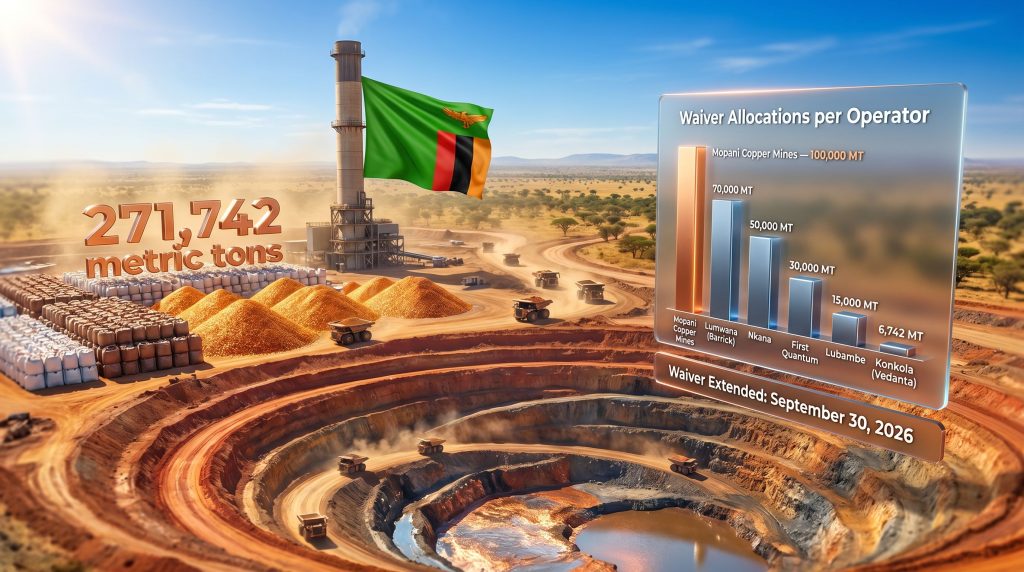
The duty suspension mechanism was first activated in August 2025, establishing both a legal precedent and an administrative template. The June 2026 extension stretches this relief through September 30, 2026, covering a total of 271,742 metric tons of copper concentrates distributed across six major operators under a quota-based allocation framework. According to CNBC Africa, the extension reflects the ongoing severity of smelter disruptions across the Copperbelt.
The quota structure is significant because it reflects both operational scale and the relative severity of processing disruptions at each site:
| Mining Operator | Ownership Structure | Duty-Free Export Quota (Metric Tons) |
|---|---|---|
| Mopani Copper Mines | International Resources Holding (Abu Dhabi) + ZCCM-IH | 100,000 |
| Lumwana Mining Company | Barrick Mining Corp | 56,986 |
| Nkana Mining and Minerals Processing | Chinese-owned | ~43,000 |
| First Quantum Minerals | Canadian-listed | ~43,000 |
| Lubambe Copper Mine | JCHX Mining (China, 70% stake) | 15,000 |
| Konkola Copper Mines | Vedanta | 12,541 |
| Total Allocated | 271,742 |
Mopani's allocation of 100,000 metric tons, representing nearly 37% of the entire waiver package, reflects both the scale of its operations and the depth of its smelter challenges. Vedanta's Konkola Copper Mines received the smallest allocation at 12,541 tons. Notably, Vedanta separately announced a shutdown of its Nchanga copper smelter for maintenance in early June 2026, confirming that smelter disruptions are not isolated to a single operation but are a sector-wide phenomenon across Zambia's Copperbelt.
What Is Actually Happening Inside Zambia's Smelters
Why Do Smelter Outages Occur So Frequently?
Understanding why these waivers are necessary requires some technical grounding in copper smelting operations. Modern copper smelters are complex pyrometallurgical systems operating at temperatures exceeding 1,200 degrees Celsius. The primary vessels — whether flash smelting furnaces of the Outotec type or the older reverberatory designs — require periodic relining with refractory brickwork, a process that can take weeks to months depending on the extent of brick degradation.
Several factors compound the maintenance challenge in Zambia specifically:
- Refractory lining wear accelerates under high-sulphur feed conditions, and Zambian sulphide ores can carry sulphur grades that stress furnace linings more aggressively than lower-sulphur oxide ore feeds
- Converting furnaces that process blister copper from matte are equally vulnerable to thermal cycling damage, particularly when operations fluctuate due to power supply interruptions
- Waste heat boilers and gas cleaning systems attached to smelters require their own maintenance cycles, and failures in these ancillary systems can force full furnace shutdowns even when the primary smelting vessel remains functional
- Zambia's hydropower-dependent electricity grid introduces a structural vulnerability: drought-driven generation shortfalls, a recurring feature of the country's power landscape, force smelters into unplanned load-shedding cycles that accelerate thermal stress on refractory materials
The compounding effect is critical. Deferred maintenance during periods of high copper prices, when operators are reluctant to take smelters offline, creates accumulated wear that eventually manifests as extended unplanned shutdowns. The current round of smelter maintenance programmes appears to reflect exactly this pattern across multiple Zambian operations simultaneously.
Technical Note: In copper smelting, TC/RC terms negotiated between miners and smelters globally serve as a barometer of concentrate market tightness. When TC/RC charges fall, it signals that smelters are competing for scarce concentrate feed. Zambian concentrate volumes entering the spot market through duty-free exports could modestly influence these benchmark negotiations, particularly for Asian smelting hubs in China and India that are positioned to absorb additional African feed material.
The Fiscal Cost of Relief and the Revenue Trade-Off
The duty waiver is not costless to Zambia's treasury. A 10% export duty foregone across 271,742 metric tons of concentrate represents a material budget consideration, though the precise fiscal impact depends on the copper price embedded in the concentrate valuation at the time of export. The Zambian Business Times estimates the 10% copper concentrate export tax holiday could cost Zambia approximately $100 million, underscoring the significance of this fiscal concession.
Policymakers appear to have concluded that this foregone revenue is preferable to the alternative: allowing concentrate stockpiles to force production curtailments, which would reduce royalty revenues, corporate tax collections, employment-linked payroll taxes, and the broader multiplier effects of active mining operations. The calculus is essentially one of short-term fiscal sacrifice to protect long-term revenue streams.
This logic is not unique to Zambia. Indonesia has used analogous export restriction and relaxation mechanisms in its nickel and bauxite sectors to manage the tension between value-addition policy goals and immediate operator viability. What distinguishes Zambia's approach is the quota-based allocation structure, which maintains administrative oversight over who benefits from the waiver rather than extending a blanket suspension to all operators regardless of demonstrated need. In addition, the Zambia copper production forecast for 2025 and beyond suggests that sustained fiscal discipline will be critical to realising long-term ambitions.
Ownership Geography and What the Waiver Reveals About Capital Flows
The distribution of waiver quotas across Zambia's mining operators tells a broader story about the internationalisation of African copper capital. The beneficiary roster spans Abu Dhabi sovereign-linked capital through International Resources Holding at Mopani, Canadian mining majors through Barrick at Lumwana, Chinese state-affiliated operators through JCHX at Lubambe and through the Nkana ownership structure, British-Indian capital through Vedanta at Konkola, and Canadian-listed First Quantum Minerals.
This multi-polar ownership structure creates genuine complexity for national industrial policy. Each ownership group brings different strategic priorities, different home-country financing conditions, and different approaches to capital allocation for smelter rehabilitation. Coordinating a coherent domestic beneficiation strategy across such a diverse ownership landscape requires sustained regulatory capacity and consistent policy signalling from Lusaka. Furthermore, tracking the global copper supply gap helps investors understand how Zambia's domestic challenges feed into worldwide supply dynamics.
The deepening presence of Chinese capital in particular is analytically significant. Chinese-affiliated operators collectively hold waiver allocations of approximately 58,000 metric tons across Nkana and Lubambe combined, reflecting the substantial footprint that Chinese mining investment has built in the Zambian Copperbelt over the past decade and a half.
The next major ASX story will hit our subscribers first
The 3-Million-Ton Ambition Versus Processing Infrastructure Reality
Zambia exported 890,346 metric tons of copper in 2025, establishing the production baseline against which its declared target of 3 million tons by 2031 must be assessed. Achieving that target within six years would require roughly a tripling of current output, an extraordinary expansion trajectory that depends not only on new mine development and existing mine deepening but on a proportional expansion of smelting and refining capacity.
The current smelter crisis illuminates a structural gap: processing infrastructure is already under stress at roughly 890,000 tonnes per year of production. Reaching 3 million tonnes annually would require approximately 3.4 times the current smelting throughput capacity operating reliably and continuously. This is not merely an investment challenge but a technical, logistical, and governance challenge of considerable complexity.
Key infrastructure requirements for the 2031 target include:
- Rehabilitation of existing smelter assets at Mopani, Konkola, and Nkana to full design capacity
- New greenfield or brownfield smelter developments capable of handling incremental concentrate volumes from new mine production
- Expansion of Zambia's electricity generation capacity, likely including new hydropower assets and potentially solar hybrid systems to reduce grid vulnerability
- Skilled labour development pipelines for smelter operations, a constraint that is frequently underestimated in production expansion plans
Analytical Perspective: Repeated duty waivers on copper concentrate exports, while operationally pragmatic in the short term, create a subtle signalling risk for the 2031 target. If international investors and offtake partners begin pricing in chronic smelter unreliability as a structural feature of Zambia's copper sector rather than a temporary disruption, the cost of capital for new processing infrastructure investment could rise, paradoxically making the target harder to achieve.
Frequently Asked Questions: Zambia's Copper Concentrate Export Waiver
What is the Zambia copper concentrate export duty waiver?
The waiver is a temporary government suspension of the standard 10% export duty applied to copper concentrate, activated when domestic smelting capacity is insufficient to process available mine output. The current extension runs through September 30, 2026, covering 271,742 metric tons across six operators. The Zambia duty-free copper concentrate export waiver amid smelter outages has consequently become an established policy instrument rather than a one-off emergency measure.
Why does Zambia normally export copper as cathode rather than concentrate?
Refined copper cathode commands a significantly higher price per tonne than raw concentrate, maximising Zambia's foreign exchange earnings per unit of copper extracted. The concentrate export waiver represents a deliberate and temporary departure from this value-addition principle, driven by processing infrastructure constraints rather than any change in long-term trade policy preference. For context, reviewing copper investment strategies reveals how value-addition policy shapes investor decision-making across the sector.
When was the duty suspension first introduced?
The initial duty suspension was implemented in August 2025, making the June 2026 extension a continuation of an established policy instrument rather than a novel emergency measure. The pattern of repeated activations suggests this mechanism has become embedded in Zambia's copper sector management toolkit.
Which operator holds the largest individual quota?
Mopani Copper Mines holds the largest allocation at 100,000 metric tons, representing approximately 37% of the total waiver package. Mopani is jointly owned by Abu Dhabi-based International Resources Holding and Zambia's state mining company ZCCM-IH.
What are the global market implications?
Zambian concentrate volumes redirected to international smelters — likely in China, India, and potentially the Middle East — will influence spot TC/RC dynamics and contribute to global copper supply variability. Given copper's critical role in electrical infrastructure, EV manufacturing, and grid expansion, processing disruptions in Africa's second-largest copper producer carry strategic weight beyond their immediate volume impact. Understanding the global copper trade strategy helps frame how these African supply shifts ripple through international markets.
What Investors and Industry Observers Should Monitor
Several metrics will determine whether the current waiver represents a contained operational episode or signals deeper structural challenges in Zambia's copper sector:
- Whether the September 30, 2026 deadline is observed or triggers another extension, which would indicate that smelter rehabilitation timelines are more protracted than officially acknowledged
- Progress updates on specific smelter maintenance programmes at Mopani and Konkola, the two operations with the most visible disruption profiles
- Zambia's total copper export volumes in the second half of 2026 compared against the 890,346-tonne 2025 baseline
- Movement in copper concentrate TC/RC benchmark negotiations as Zambian spot volumes enter Asian smelting markets
- Any formal revision to the 3-million-tonne 2031 production target, which would represent a significant policy signal regarding the viability of the current expansion roadmap
- Capital commitment announcements from major operators regarding smelter rehabilitation or new processing facility development, which would provide tangible evidence of infrastructure investment momentum
The broader lesson embedded in Zambia's concentrate export waiver cycle is one that applies across Africa's mining corridors: extraction capacity and processing capacity must expand in tandem for resource nationalism and value-addition policies to be operationally credible rather than aspirational. The gap between these two capacities, measured in tonnes of concentrate accumulating at mine sites, is ultimately a gap in investment, planning, and infrastructure resilience that no export duty waiver can permanently resolve.
For ongoing coverage of African copper sector developments and mining policy analysis, Mining Weekly provides regular reporting on Zambian and broader African base metals at miningweekly.com.
Want to Stay Ahead of the Next Major Copper Discovery on the ASX?
Discovery Alert's proprietary Discovery IQ model delivers real-time alerts on significant ASX mineral discoveries — instantly cutting through complex data to surface actionable opportunities in copper and beyond, ideal for investors tracking the global supply shifts explored above. Explore historic discoveries and their exceptional market returns on Discovery Alert's dedicated discoveries page, and begin your 14-day free trial today to position yourself ahead of the market.