
August 8, 2026
Scenario Planning for a Copper Superpower: How Zambia's Election Could Reshape Global Supply
The global mining investment community has a well-documented tendency to underestimate the compounding effect of policy risk on long-duration capital decisions. A fiscally attractive mining jurisdiction that cannot guarantee regulatory continuity over a ten-year mine development cycle is, in practical terms, less attractive than a jurisdiction with marginally higher tax rates and strong institutional predictability. This calculus sits at the centre of every capital allocation conversation happening around Zambia's copper sector right now, as the country heads toward its 13 August 2026 general election with a production ambition that is simultaneously compelling and structurally demanding — making Zambia election copper mining incentives a defining issue for global supply chains.
Understanding what is actually at stake requires moving beyond the headline copper price and examining the interlocking policy levers, infrastructure constraints, and fiscal architecture that will determine whether Zambia converts a world-class resource endowment into a world-class production profile, or whether it defers that outcome to another commodity cycle.
When big ASX news breaks, our subscribers know first
Africa's Second-Largest Copper Producer and the Scale of Its Growth Mandate
Zambia currently ranks as Africa's second-largest copper producer, sitting behind the Democratic Republic of Congo in the continent's output hierarchy. While the DRC dominates in volume, Zambia has historically distinguished itself through relative institutional stability and a more predictable regulatory environment — qualities that attract a different category of long-horizon capital. The Zambia copper growth forecast reflects just how significant this momentum has become.
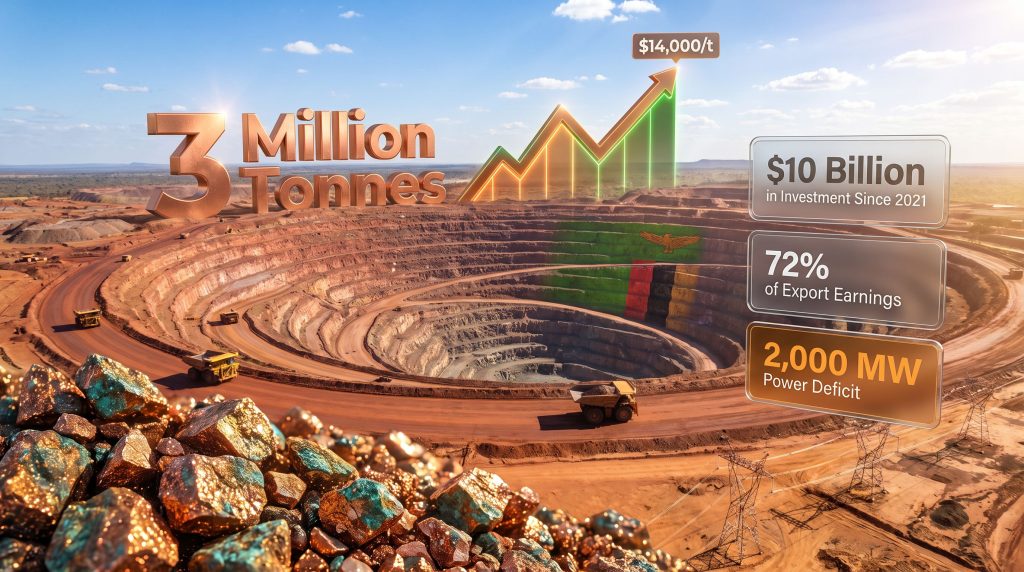
The Zambian government has formally declared a target of 3 million tonnes of copper per annum, a figure that represents nearly three times current production levels. This is not an incremental growth objective. It is a structural transformation of the country's productive capacity, requiring the simultaneous resolution of exploration pipeline gaps, energy deficits, workforce shortfalls, and processing infrastructure limitations.
The macroeconomic backdrop is genuinely supportive. Benchmark copper futures have risen more than 40% over the past 12 months, reaching approximately $14,000 per tonne, driven by structural demand from electric vehicle manufacturing, utility-scale power grid expansion, and construction activity across emerging markets. Understanding the broader copper price growth drivers helps explain why this price environment materially improves the economics of greenfield exploration and new processing capacity — but only where the regulatory and fiscal framework provides sufficient certainty to unlock long-duration capital commitments.
The copper price environment is providing a rare policy window, but commodity cycles are not permanent. The decisions Zambia makes in the 12 to 24 months following the August election will determine whether this window is captured or deferred.
What the Mining Sector Is Demanding Before and After Polling Day
Exploration Incentives and the Greenfield Pipeline Problem
The most structurally significant challenge facing Zambia's production ambition is not the copper price or even the tax regime. It is the exploration pipeline. Without a robust inventory of new discoveries advancing toward development-ready status, the 3-million-tonne target becomes arithmetically unachievable regardless of downstream conditions.
Anthony Malenga, president of the Zambia Chamber of Mines, has noted that the tax reforms and improved government engagement since 2021 attracted more than $10 billion in investment into the sector, but has cautioned that sustaining that growth trajectory now requires substantially greater spending on greenfield exploration and meaningful licensing reform. Mining firms in Zambia have, furthermore, made clear that their election priorities centre on stronger policy commitments to support this expansion.
The distinction between brownfield and greenfield exploration is critical to understanding this challenge:
| Exploration Type | Risk Profile | Capital Intensity | Lead Time to Production | Policy Levers |
|---|---|---|---|---|
| Brownfield expansion | Lower | Moderate | 3 to 7 years | Processing incentives, royalty terms |
| Greenfield discovery | Higher | High | 8 to 15 years | Licensing reform, exploration incentives |
Brownfield projects on existing mineralised systems can reach production more rapidly, but they cannot replicate the volume growth that only greenfield discovery can provide at scale. A production tripling scenario is structurally dependent on the greenfield pipeline being seeded today, which means licensing reforms and exploration incentives announced in 2026 will not show up in production figures until well into the 2030s.
Export Duties, Processing Incentives, and the Value Addition Dilemma
Ayo Sopitan, chief executive of Metalex Commodities, has articulated the industry's core concern around export duties with precision: producers who lack domestic refining capacity face a structural cost disadvantage through duties imposed on copper concentrate exports — a burden that simultaneously depresses operating margins and disincentivises investment in downstream processing infrastructure.
This creates a dual-objective policy tension that is genuinely difficult to resolve. The government's preference for value addition within Zambia's borders is economically rational at the national level. However, the incentive architecture must make domestic refining economically competitive with the alternative of concentrate export for it to actually redirect private capital into smelting and refining infrastructure.
Sopitan has also emphasised the importance of stronger rule-of-law frameworks and accessible dispute-resolution mechanisms as foundational requirements for the kind of long-duration investment that processing infrastructure demands. These are not peripheral considerations — they are primary determinants of whether a mining company commits to a smelter.
Local Content Obligations: Ambition Versus Execution Capacity
Zambia's evolving local-content regime is among the more consequential regulatory developments for operating producers. Current regulations require domestic procurement to increase from approximately 20% toward 40% over a three-to-five-year horizon. Specifically, the 2026 mining regulations stipulate:
- A minimum 25% of annual procurement allocated to local suppliers within six months of the rules taking effect
- Escalation to 40% local procurement within five years
- A 15% local preference margin applied during bid evaluation processes
The analytical question is not whether these objectives are desirable — they broadly are — but whether the timeline is calibrated to the actual development pace of Zambia's domestic supply chain. Local content requirements that escalate faster than the domestic supplier base can absorb them tend to produce one of two outcomes: either producers pay a cost premium to meet the thresholds, compressing returns and slowing expansion, or they comply technically while undermining the spirit of the policy through thin local participation structures.
Policy Risk Callout: Aggressive escalation timelines for local-content obligations that outpace the genuine development of domestic supplier capacity can inadvertently raise project costs, compress investor returns, and slow the very production expansion they are designed to support.
How the Fiscal Architecture Has Already Shifted Since 2021
The Hichilema government's first term has delivered a measurably improved fiscal framework for the mining sector. Two reforms stand out for their structural significance:
- The property transfer tax on exploration mineral-rights transfers was reduced from 10% to 7.5%
- Mineral royalty tax was made deductible against taxable income, a change that reduces the effective tax burden on producing operations and improves after-tax cash flow comparisons with peer jurisdictions
The combined effect of these changes, alongside improved regulatory engagement, is credited with attracting the $10 billion in investment referenced by the Zambia Chamber of Mines since 2021. The government has also signalled that it does not intend to alter mining tax rates in the near term — a positive signal for capital allocation decisions where tax stability is a primary investment screen.
| Policy Dimension | Current Status | Investor Concern Level |
|---|---|---|
| Mining tax rates | Stable, no changes flagged | Low |
| Mineral royalty deductibility | Implemented post-2021 | Low |
| Exploration licensing reform | Ongoing, industry seeking acceleration | Moderate |
| Local-content procurement thresholds | Escalating to 40% over 5 years | Moderate to High |
| Export duties on concentrates | Remain in place | High for non-integrated producers |
| Power supply adequacy | Deficit of at least 2,000 MW estimated | High |
The Power Supply Deficit: A Hard Ceiling on Production Growth
If the fiscal and regulatory landscape represents a moderate-risk environment, the energy infrastructure deficit represents a genuine near-term constraint with the potential to function as a hard ceiling on production growth. Industry estimates place the additional generating capacity required to support the 3-million-tonne target at a minimum of 2,000 megawatts — a figure that substantially exceeds what incremental grid improvements can deliver.
Copper mining at scale is an energy-intensive industrial process. Smelting and refining operations are especially power-hungry, which means that the export-duty problem and the energy problem are structurally linked. Encouraging producers to invest in domestic refining capacity simultaneously requires guaranteeing them access to reliable, cost-competitive power at industrial scale. The broader energy transition demand is, furthermore, amplifying the urgency of resolving these structural bottlenecks.
Available policy levers for addressing the deficit include:
- Independent power producer frameworks that attract private capital into generation
- Regional grid interconnection to access Southern African Power Pool capacity
- Rehabilitation and expansion of existing hydropower infrastructure
- Renewable energy co-investment models, particularly solar, given Zambia's irradiation profile
The labour market dimension adds a further layer of complexity. Scaling copper output to three million tonnes requires not only capital and energy but a proportional expansion of a skilled industrial workforce — from geologists and mining engineers to metallurgists and process technicians. Local-content workforce requirements intersect with this skills constraint in ways that can create bottlenecks if not planned for explicitly.
Three Scenarios for Zambia's Copper Output Trajectory
Scenario A: Policy Continuity with Infrastructure Resolution
Fiscal stability is maintained through and beyond the election. The power deficit is addressed through accelerated independent power producer investment. Exploration licensing reform deepens the greenfield pipeline. Processing incentives redirect capital into domestic refining. Under this scenario, Zambia plausibly achieves 2 to 2.5 million tonnes within a decade and positions itself as a tier-one global copper jurisdiction.
Scenario B: Policy Continuity Without Infrastructure Resolution
The fiscal environment remains broadly supportive, but power shortages persist and exploration activity remains constrained by licensing inefficiencies. Brownfield expansions proceed where power is available, but the greenfield pipeline does not develop at the required pace. Production grows incrementally to 1.5 to 2 million tonnes, and the 3-million-tonne target remains aspirational rather than achievable within a defined timeframe.
Scenario C: Policy Disruption
Post-election regulatory uncertainty, accelerated local-content obligations that outpace supplier development, or export duty escalation erodes investor confidence. The investment pipeline stalls, brownfield expansions are delayed, and Zambia loses competitive positioning to peer jurisdictions competing for the same pool of global mining capital. Under this scenario, output growth is marginal and the window provided by the current copper price cycle is largely lost.
The next major ASX story will hit our subscribers first
Zambia Versus Its African Peers: Competing for the Same Capital
Zambia does not compete for mining investment in isolation. Every dollar committed to a Zambian copper project is a dollar not allocated to the DRC, Tanzania, Namibia, or Botswana. Understanding the competitive landscape is essential to evaluating the stakes of the post-election policy environment and the role of Zambia election copper mining incentives in attracting long-horizon capital.
The DRC produces significantly more copper than Zambia but carries materially higher political risk, more severe infrastructure deficits, and a regulatory environment that has recently attracted criticism from mining industry bodies concerned about investor confidence. A sustained period of DRC regulatory uncertainty could redirect capital toward Zambia — but only if Zambia's own policy environment remains competitive. Indeed, the ongoing copper supply crunch is intensifying competition among African producers for the same finite pool of global mining capital.
A comparative view of the broader African critical minerals landscape:
| Jurisdiction | Primary Resource | Comparative Advantage | Key Risk |
|---|---|---|---|
| Zambia | Copper | Institutional stability, improving fiscal framework | Power deficit, local-content pace |
| DRC | Copper, cobalt | Enormous resource scale | Political risk, regulatory unpredictability |
| Tanzania | Nickel, gold | Emerging critical minerals profile | Regulatory evolution |
| Namibia | Uranium, copper, green hydrogen | Diversified critical minerals base | Infrastructure scale |
| Botswana | Diamonds, critical minerals | Strong institutions | Resource transition complexity |
Competitive Positioning Note: Zambia's copper endowment is world-class by any measure, but the country competes for a finite pool of global mining capital. Policy clarity, infrastructure investment, and processing incentives are the variables that determine whether that capital flows toward Lusaka or toward peer jurisdictions.
What a Second Hichilema Term Means for the Investment Case
With more than 8 million Zambians participating in the 13 August vote, President Hakainde Hichilema is broadly expected to secure re-election. A second term is widely interpreted by analysts as a signal of continued pro-investment policy orientation, building on the reforms implemented since 2021. Zambia's $10 billion copper ambition has, consequently, become a focal point for investors monitoring the election outcome.
In practical terms, policy continuity under a second Hichilema administration would likely mean:
- Sustained and structured engagement between government and the mining sector on fiscal and licensing issues
- Incremental progress on exploration licensing reform
- Continued signalling against near-term tax rate changes
- Ongoing negotiation around the implementation trajectory of local-content obligations
The industry's specific post-election asks are well-defined. Producers and explorers are seeking:
- Stronger rule-of-law frameworks and accessible dispute-resolution mechanisms for mining sector disagreements
- Accelerated licensing reform to ensure exploration permits are allocated efficiently to development-capable operators
- Expanded power generation investment, potentially through co-investment structures between the government and private sector
- Clearer and more gradual implementation timelines for local-content obligations to allow producers to plan procurement strategies with confidence
- Processing incentives that make domestic refining economically rational rather than an obligation attached to punitive export duties
Encouraging copper project partnerships between major producers and junior explorers has, furthermore, emerged as a key mechanism for accelerating exploration activity within the country.
Frequently Asked Questions: Zambia Election Copper Mining Incentives
What is Zambia's copper production target and why does it matter globally?
Zambia aims to produce 3 million tonnes of copper per year, nearly three times current output, to capitalise on surging demand from energy transition industries. At that scale, Zambia would represent a meaningful share of global supply, with significant implications for copper pricing and supply security.
What tax reforms has Zambia implemented for the mining sector since 2021?
Since 2021, Zambia reduced the property transfer tax on exploration mineral-rights transfers from 10% to 7.5% and made mineral royalty tax deductible against taxable income, reducing the effective burden on producing operations.
What are Zambia's local-content requirements for mining companies?
Current regulations require mining firms to allocate at least 25% of annual procurement to local suppliers within six months of the rules taking effect, rising to 40% within five years, with a 15% local preference margin applied in competitive bid evaluation.
Why is power supply a critical issue for Zambia's copper production target?
The industry estimates a shortfall of at least 2,000 megawatts of generating capacity relative to what would be required to support a tripling of copper output. Copper mining and processing — particularly smelting and refining — is extraordinarily energy-intensive.
How significant is mining to Zambia's broader economy?
Mining contributes approximately 9% of GDP, generates around 72% of export earnings, and accounts for close to half of total government revenue. It is, by any measure, the structural backbone of the Zambian economy.
How much investment has entered Zambia's mining sector since 2021?
The Zambia Chamber of Mines attributes more than $10 billion in investment to the post-2021 policy reforms and the improved engagement between the government and the mining sector during President Hichilema's first term.
The Strategic Outlook: Converting a Policy Window Into a Production Reality
Zambia sits at a genuinely rare intersection of resource endowment quality, commodity price cycle, and relative political stability. These three conditions converging simultaneously is not a permanent state. Commodity cycles turn, political environments shift, and competing jurisdictions do not stand still.
The binding constraints are clear: energy infrastructure and regulatory implementation. The resource is proven. The price is supportive. The fiscal direction, while imperfect, is broadly positive. What converts aspiration into output is the resolution of the 2,000 MW power deficit and the calibration of local-content obligations to a pace that domestic supplier development can actually sustain.
The post-election policy agenda, in order of structural urgency, should address Zambia election copper mining incentives through the following priorities:
- Accelerating independent power producer licensing to begin closing the generation deficit
- Publishing clear and predictable implementation timelines for local-content escalation
- Reforming exploration licensing to reduce permitting timelines and direct permits to development-capable operators
- Establishing accessible and credible dispute-resolution mechanisms to reinforce rule-of-law confidence among long-horizon investors
- Designing processing incentives that make domestic refining genuinely competitive with concentrate export economics
The country's copper story is compelling. The question that the 13 August election and its aftermath must answer is whether the policy architecture can be built quickly enough to match the ambition. Global copper markets are watching Lusaka closely. The window is open, but it will not remain so indefinitely.
This article contains forward-looking scenario analysis and should not be construed as financial or investment advice. Commodity price projections and production scenarios involve inherent uncertainty and are subject to change based on market conditions, regulatory developments, and geopolitical factors.
Want to Capitalise on the Next Major Copper Discovery Before the Broader Market Reacts?
As Zambia's copper sector heads toward a defining policy moment, Discovery Alert's proprietary Discovery IQ model scans ASX announcements in real time, instantly identifying significant mineral discoveries across copper and 30+ other commodities — translating complex data into clear, actionable opportunities for both short-term traders and long-horizon investors. Explore how major mineral discoveries have historically generated exceptional returns on Discovery Alert's dedicated discoveries page, and begin your 14-day free trial today to position yourself ahead of the market.