July 21, 2026
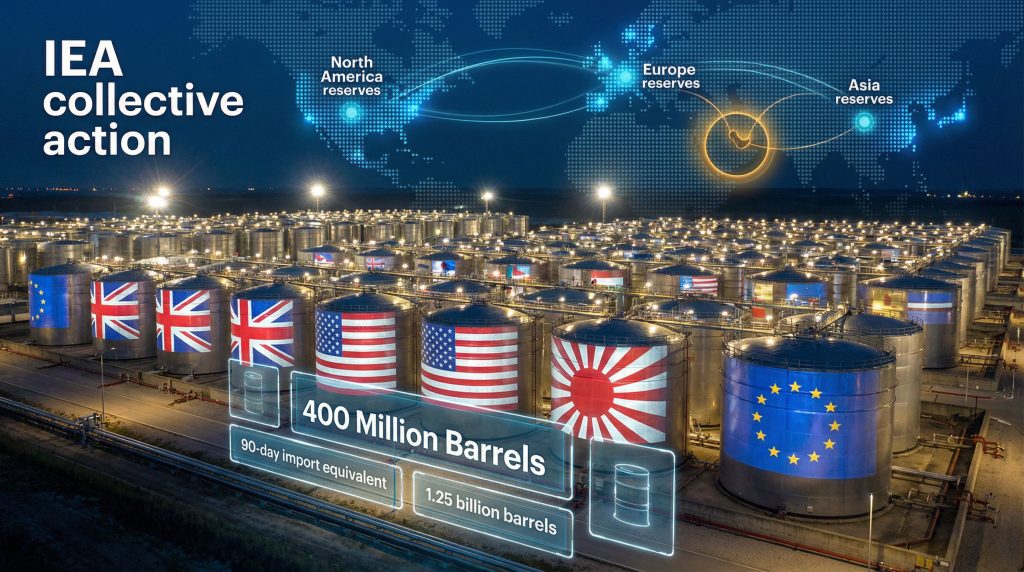
The International Energy Agency has announced a historic decision to coordinate the release of 400 million barrels from member countries' strategic petroleum reserves, marking the largest emergency oil intervention since the agency's establishment in 1974. This unprecedented action comes in response to severe supply disruptions affecting global energy security, with oil price movements experiencing dramatic volatility as markets grapple with the crisis.
What Are Strategic Petroleum Reserves and Why Do They Matter for Energy Policy?
The Architecture of Emergency Oil Stock Systems
Strategic petroleum reserves (SPR) are vital stockpiles held by countries to safeguard against major supply disruptions. For International Energy Agency (IEA) member nations, maintaining such reserves is not only an economic precaution but also a regulatory requirement. Each member country is obligated to retain oil stocks equal to at least 90 days of the previous year's net imports.
This system acts as a buffer, deploying oil rapidly to global markets if regular supply lines are interrupted. Furthermore, SPR holdings are split into crude oil and refined product reserves. Notably, North America's inventory is dominated by crude, whilst Europe and Asia tend toward a more balanced mix.
As of the end of 2025, IEA members collectively managed approximately 1.25 billion barrels in public reserves—about 30% of total OECD oil inventories. This trans-regional approach underscores the need for diversified reserves, tailored to consumption and refining capabilities within each economy.
Legal Framework Governing Emergency Stock Releases
IEA emergency stock releases must be authorised via unanimous agreement among all 32 member states. While the agency sets collective action guidelines, each nation maintains flexibility regarding product mix, timing, and logistical distribution. This allows countries to factor in domestic circumstances, ensuring rapid and effective implementation.
Importantly, participation in each release by commercial entities remains voluntary—traders and end users are not compelled to purchase released stocks. The amount of oil actually absorbed by the market varies, with some past releases notably undersubscribed. Operational details, including blend of crude versus product offered and allocation across countries, are determined jointly and announced as each crisis unfolds.
When big ASX news breaks, our subscribers know first
How Do Geopolitical Crises Trigger Coordinated Energy Responses?
Crisis Classification and Response Thresholds
An IEA-coordinated release is only triggered by severe disruptions, assessed according to quantitative and qualitative benchmarks. The 2026 US-Israel conflict with Iran, which shut the Strait of Hormuz and halted roughly 25% of global seaborne oil trade, surpassed all historical supply shock thresholds and prompted urgent agency action.
To place this in context, the IEA to release 400mn barrels of oil from stocks represents only the sixth collective release since the IEA's establishment in 1974. Previous releases were far smaller, illustrating the exceptional gravity of the current crisis. Recent military attacks targeted energy-producing, storage, and refining infrastructure, creating cross-border risks that forced policy escalation beyond regional containment.
Multi-National Coordination Mechanisms
Managing such crises requires calibrated multinational cooperation. G7 leaders typically convene first, assessing collective vulnerability and national contribution capacities. Each member country's release volume is determined using formulas that weigh stock levels and import dependency.
Coordination demands detailed communications protocols, with central agencies and national governments aligning timelines and operational schedules. Post-approval, countries deploy stocks on timeframes optimised for domestic logistics but harmonised for global impact. Updates and refinements are released as events progress to maintain transparency and market confidence.
What Makes the 400 Million Barrel Release Historically Significant?
Scale Comparison with Previous Emergency Actions
The 2026 intervention dwarfs every past IEA collective action. Consider the following comparative table:
| Release Year | Volume (Million Barrels) | Triggering Event | Market Impact |
|---|---|---|---|
| 2022 | 182 | Russia-Ukraine conflict | Price stabilisation |
| 2011 | 60 | Libya civil war | Regional supply offset |
| 2005 | 60 | Hurricane Katrina | US refinery disruption |
| 2026 | 400 | Iran-US conflict | Unprecedented scale |
The magnitude of the 2026 event represents a nearly three-fold jump over the largest prior release. This reflects both increased risk and the modern oil market's complexity, particularly evident in WTI/Brent futures trading patterns.
Regional Distribution Patterns
- North America: Primarily crude oil, maximising flexibility for refineries when supply chains are stressed
- Europe: Varied mix of crude and refined products, offering regional adaptability and faster supply to consumer markets
- Asia: Balanced approach, enabling both immediate and intermediary supply support
- UK: Contributed 13.5 million barrels, details of product mix and timeframes remain under national discretion
This diverse structure enhances resilience, tackling both upstream (production) and downstream (consumer) interruptions in different parts of the globe.
How Do Emergency Stock Releases Actually Function in Practice?
Release Mechanism Implementation
Countries extract inventory from their SPRs, dipping below the 90-day minimum if necessary. The release may include various blends of crude oil and refined products, depending on regional needs and refinery compatibility. While the IEA facilitates the framework, the operational logistics are left largely to member governments.
Key operational realities include:
- Markets are not required to absorb the offered volumes
- Past releases (such as the 2022 event) saw less uptake than volume made available, depending on price dynamics and commercial demand
- Release timelines and modalities are tailored to both the crisis scale and the infrastructure readiness of each country
Supply Chain Integration Challenges
Delivering released oil to where it's needed faces obstacles. Moving product from safeguarded storage sites to consuming regions involves activating complex transportation logistics. Additionally, refineries may already be operating at or near capacity, creating bottlenecks.
Compatibility between crude types and regional refinery setups sometimes limits immediate substitutability. Furthermore, distribution networks must flexibly adapt to absorb emergency volumes, whilst managing existing commercial flows.
What Are the Market Dynamics Behind Strategic Reserve Interventions?
Price Volatility Management Objectives
The IEA's strategic goal is to cap erratic market swings—recent price activity saw Brent crude surge toward $120 per barrel before retreating to around $90 following the release announcement and partial restoration of confidence. This dramatic price correction demonstrates how the IEA to release 400mn barrels of oil from stocks can effectively stabilise markets.
Key aims include:
- Reducing panic-induced supply premiums and restoring order to futures curves
- Offsetting the loss of roughly 14 million barrels per day of crude previously shipped through Hormuz
- Assessing whether reserve oil acts as a bridge until production and logistics return to normal
The recent oil price rally preceding the announcement highlighted the market's vulnerability to supply disruptions.
Commercial Market Response Patterns
Commercial uptake is influenced by spot prices, storage capacity, and local product demand. During crises, storage tanks may be unavailable or limited, dampening incentive for rapid absorption. Alternative supply development, particularly through pipelines in regions like Saudi Arabia, becomes critical to bypass risky sea routes.
Moreover, sanctions waivers for certain crude sources (notably Russian supplies in previous crises) can alter demand for released SPR barrels. These factors contribute to comprehensive oil price crash analysis frameworks that market participants rely upon.
How Do Regional Energy Security Policies Differ Across IEA Members?
National Implementation Variations
Japan demonstrated rapid mobilisation with an 80 million barrel release, commencing just days after the IEA decision. European Union members face harmonisation hurdles, each balancing collective obligations with unique refinery setups and consumption patterns.
The United States primarily relies on its vast crude SPR and extensive transport network for quick deployment. However, some newer or smaller IEA members, particularly in emerging markets, may face constraints due to capacity, resource, or regulatory limitations.
Storage Infrastructure and Capacity Analysis
Regions differ in their use of government-owned or privately-held reserve structures. Strategic storage is usually located near major ports, industrial zones, or refinery clusters to maximise delivery speed and minimise security risks. Maintenance protocols require regular turnover of stocks to preserve product quality—ROTO (rotation) policies are enforced to prevent degradation.
Consequently, scaling up reserve infrastructure is capital-intensive, requiring long-term investment for tanks, pipelines, and security enhancements. These considerations often influence decisions revealed in OPEC meeting insights regarding global production capacity.
The next major ASX story will hit our subscribers first
What Long-Term Policy Implications Emerge from This Coordinated Response?
Energy Security Governance Evolution
The magnitude of the 2026 release signals an evolution in energy security thinking. The IEA is adapting its core mandate, moving from oil-only strategies toward broader crisis management, including renewables, critical minerals, and hybrid threats.
Overlapping with climate and transition planning, reserve policies are now being cross-referenced with decarbonisation targets and renewable integration. There is a growing recognition that analogous frameworks may be needed for minerals essential for clean energy (like lithium or cobalt), given similar risks of supply shock.
Future Crisis Preparedness Enhancements
Stockpile adequacy reviews will consider cyber, hybrid, and civilian threat vectors, not just traditional warfare or embargoes. Emergency planning increasingly involves renewable sources—such as biofuel and hydrogen—ensuring diversified crisis response options.
Collaborative agreements with non-IEA partners will become more prominent, expanding the perimeter of shared energy security. Furthermore, technological solutions like digital stock management platforms and AI-powered crisis simulations will underpin future rapid response capability.
How Does This Release Compare to Other Global Energy Crisis Responses?
Historical Context and Precedent Setting
The IEA was born of the 1973-74 oil embargo, which set the foundational logic for collective stockholding and response protocols. Actions during the Gulf War and post-Katrina periods were significant but modest compared to today's crisis in both volume and complexity.
Previous global emergencies (like the Covid-19 pandemic) were marked by demand shocks rather than abrupt supply losses, requiring different response levers and market interventions. There has been a progressive increase in release scale, climaxing in the 400 million barrel action—a pivotal point likely referenced in future multilateral strategies.
Effectiveness Measurement Frameworks
Success is assessed by observing stabilisation in futures prices, narrowing of regional price differentials, and restored trade flows through critical chokepoints. Enhanced cooperation and resilience testing often leave member states better prepared for subsequent shocks, strengthening institutional memory and operational playbooks.
Evaluations also consider whether bottlenecks in logistics or refining capability limited the utility of the release. These assessments feed into future infrastructure planning, as highlighted in recent IEA strategic reserve analysis reports.
What Are the Economic and Strategic Implications for Global Energy Markets?
Short-Term Market Stabilisation Effects
Significant reductions in price volatility are expected immediately post-release, as seen with the sharp correction from $120 to $90 per barrel. Emergency logistics networks are activated, refining capacity is maximised, and supply chain bottlenecks are methodically addressed to enhance market flow.
Releases encourage risk mitigation behaviour among traders and end users, restoring orderly price discovery and risk premium management. The decision for the IEA to release 400mn barrels of oil from stocks demonstrates unprecedented commitment to market stability.
Long-Term Strategic Reserve Policy Evolution
Subsequent reviews will evaluate if reserve sizes remain adequate under new geopolitical risk scenarios, prompting possible recalibration or expansion. Diversification away from pure petroleum stockpiles is being explored, including renewables and advanced biofuels.
Regional cooperation, both within and beyond the IEA, will likely be deepened to create new frameworks for joint crisis preparedness. Integration of strategic reserve planning into broader energy transition roadmaps will facilitate more robust crisis management for the evolved global energy system.
The latest oil market developments suggest that coordinated interventions like this will become increasingly important as geopolitical tensions continue to affect global energy security.
Disclaimer:
This analysis is intended for informational and educational purposes only. The underlying crisis remains highly dynamic; investment decisions should be based on ongoing developments, verified data, and consultation with qualified energy and financial professionals.
Further Exploration:
Readers interested in the intersection of international energy security, coordinated emergency response, and strategic reserve policy can access educational materials from governmental agencies, the IEA, and independent energy policy institutes for deeper understanding.
Ready to Navigate Energy Market Volatility?
As geopolitical events continue to drive dramatic oil price swings and strategic reserve interventions, Discovery Alert's proprietary Discovery IQ model provides real-time insights into energy and commodity discoveries that can capitalise on market opportunities. Explore how historic mineral discoveries have delivered substantial returns during periods of market uncertainty, and begin your 14-day free trial today to secure your competitive advantage.