July 21, 2026
The Hidden Mechanics Behind a Shrinking Global Aluminum Market
When geopolitical conflict intersects with industrial supply chains, the damage rarely stays contained within borders. Aluminum, one of the most widely consumed industrial metals on earth, is experiencing precisely this kind of cascading disruption in 2026. The metal's production economics are deeply tied to energy availability, upstream raw material logistics, and the stability of maritime trade corridors. When any of those inputs is compromised, the consequences travel fast and far, reaching manufacturers, automotive assemblers, and trade negotiators thousands of kilometres from the original point of impact.
Understanding why global aluminum output slips as war tightens supply requires more than a headline reading of monthly production data. It demands a close look at how smelting infrastructure works, why certain facilities are irreplaceable in the short term, and how tariff architecture amplifies commodity stress for import-dependent economies.
When big ASX news breaks, our subscribers know first
Why Primary Aluminum Production Is Uniquely Vulnerable to Conflict
Primary aluminum is produced through an energy-intensive electrolytic process called the Hall-Heroult method, in which alumina (refined from bauxite ore) is dissolved in molten cryolite and subjected to a powerful electrical current. The result is liquid aluminum, which is then cast into ingots or slabs for downstream use.
What makes this process particularly fragile during conflict is its continuous nature. Unlike many industrial operations that can be paused and restarted with relative ease, electrolytic smelting requires uninterrupted power. A forced shutdown causes the molten bath to solidify, potentially destroying the carbon lining of the reduction cell, known as the pot.
Rebuilding a damaged pot takes weeks. Rebuilding dozens of damaged pots across a large facility can take many months, even without any associated infrastructure damage from military strikes. This technical reality explains why force majeure declarations from Gulf smelters carry such weight. They are not simply contractual formalities. They are signals that the physical restoration timeline is measured in quarters, not weeks.
The Scale of the Gulf Production Collapse
International Aluminium Institute data for June 2026 confirmed that global primary aluminum output fell 1.5% year-on-year, settling at approximately 5.98 million tonnes. Daily global production averaged 199,300 tonnes, a marginal 0.3% improvement over May, though that comparison is distorted by May carrying one additional calendar day.
The headline number understates the regional severity. According to recent IAI reporting, Persian Gulf production, which had been running at roughly 17,800 tonnes per day prior to the conflict, collapsed to approximately 11,000 tonnes per day in June, representing a 38% reduction from pre-conflict baselines.
| Metric | Pre-Conflict Baseline | June 2026 Actual | Change |
|---|---|---|---|
| Gulf daily output | ~17,800 mt/day | ~11,000 mt/day | -38% |
| Gulf monthly output | ~507,000 tonnes | ~332,000 tonnes | -34.5% |
| Gulf share of global capacity | ~9% | Partially offline | Ongoing |
| LME aluminum price range | Below $3,400/mt | $3,640-$3,760/mt | ~+10% |
The three facilities at the centre of this contraction represent a combined annual production capacity of approximately 3.2 million tonnes:
- Al Taweelah (UAE): Producing 1.6 million tonnes annually, this Emirates Global Aluminium facility was completely shut down following drone and missile strikes on March 28, 2026. A partial restart has been achieved ahead of initial estimates, though full capacity restoration is expected to take up to 12 months.
- Aluminium Bahrain (Alba): Approximately 19% of production capacity, equivalent to three full production lines, was suspended, with outbound shipments halted due to disruptions to gas supply and maritime access.
- Qatalum (Qatar): Output reduced by roughly 40% as upstream natural gas supply constraints cascaded directly into smelting operations, illustrating how Gulf smelters are exposed to feedstock disruption as much as physical infrastructure damage.
How the Strait of Hormuz Turned a Local Strike Into a Global Problem
The Upstream Supply Chain Dimension
A detail that receives insufficient attention in most commodity analyses is the upstream supply chain dimension of Gulf smelter disruptions. The bauxite supply chain underpinning Gulf smelters is heavily import-dependent, drawing from producers in Australia, Guinea, Brazil, and Indonesia, with shipping routes that transit or rely on Hormuz-adjacent maritime corridors.
When those corridors were disrupted, smelters that survived initial strikes were cut off from raw material replenishment. This created a secondary constraint layer on top of the direct physical damage, extending the effective duration of the supply shock well beyond the initial attack timeline. It is a dynamic that commodity markets frequently underprice in the early stages of a conflict, focusing on facility damage while overlooking feedstock logistics.
The alumina-to-aluminum conversion ratio sits at approximately 2:1, meaning that a facility producing 1.6 million tonnes of primary aluminum annually requires roughly 3.2 million tonnes of alumina input per year. Any interruption to that feedstock flow compounds smelter damage significantly.
From a 0.4% Decline to a 3 Million Tonne Deficit
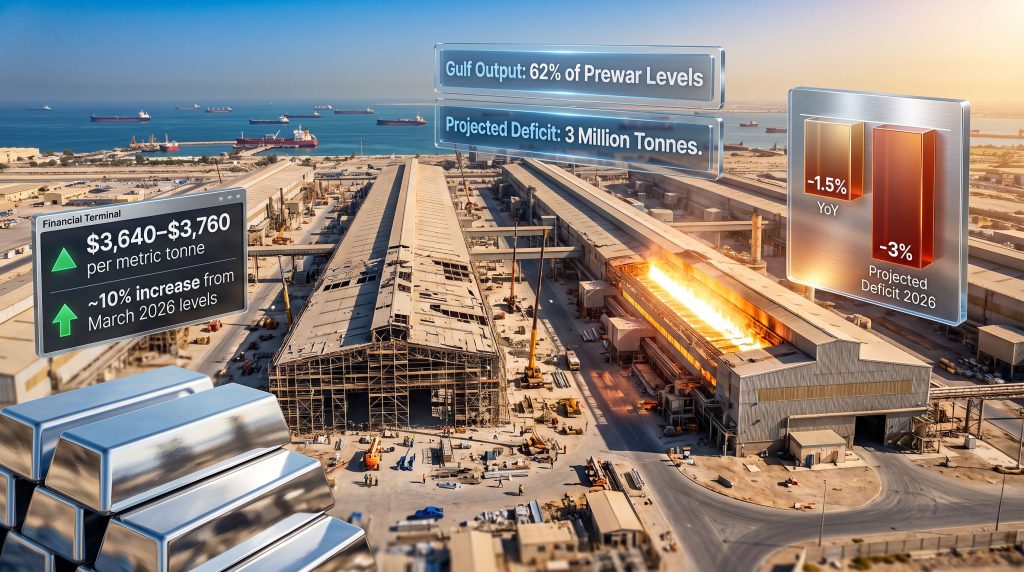
Before the March 2026 conflict escalation, the global aluminum market was tracking toward a modest 0.4% output decline for the full year. Wood Mackenzie's revised projections now point to a potential market deficit of up to 3 million tonnes, representing approximately a 3% contraction in global supply. That is one of the sharpest single-year demand-supply revisions the aluminum market has seen in decades.
Adding urgency to this picture, LME aluminum stocks including off-warrant metal have fallen below 400,000 tonnes, a level that reflects active inventory drawdowns being deployed to bridge near-term supply gaps. The inventory buffer that would normally absorb a temporary regional shock is being consumed, reducing the market's capacity to tolerate further disruption without sharper price responses.
LME aluminum cash prices have traded within a $3,640 to $3,760 per metric tonne range since mid-May 2026, representing roughly a 10% premium over March 2026 levels. Whether prices break above $4,000 per tonne depends heavily on how quickly Al Taweelah's phased restart progresses and whether Hormuz shipping normalises. Furthermore, tariff-driven supply chain disruption is amplifying already strained procurement conditions across aluminium-consuming industries.
China's Role as the Market's Swing Supplier
Chinese Exports and Western Dependency Concerns
One of the least-discussed structural features of the global aluminum market is China's function as a swing exporter. Chinese primary aluminum production has expanded significantly over the past two decades, and domestic consumption, while enormous, does not always absorb full capacity. When external markets tighten, Chinese producers have demonstrated a consistent ability to redirect surplus output toward export channels rapidly.
Chinese aluminum exports surged approximately 16% in May 2026, as producers moved to serve markets previously supplied by Gulf smelters. This is not a new dynamic, but its scale in 2026 is accelerating a longer-term concern among Western supply chain strategists: that dependence on Chinese export availability creates a structural vulnerability for industries that need supply chain predictability across multi-year production cycles.
For automotive and aerospace manufacturers specifically, where aluminum specifications and alloy grades must meet tight tolerances, switching suppliers is not simply a logistics exercise. It involves qualification processes, testing protocols, and in some cases, redesign of components to accommodate different alloy profiles.
The next major ASX story will hit our subscribers first
Mexico's Double Compression: Constrained Supply and Maximum Tariff Exposure
For Mexico, the global aluminum supply tightening arrives at the worst possible moment. The country lacks significant primary smelting capacity, making it structurally dependent on imported aluminum to supply its automotive, aerospace, packaging, and construction industries.
That dependency is now intersecting with one of the steepest metals duty regimes in the world. US aluminium tariffs under Washington's Section 232 programme impose a 50% duty on aluminum and steel imports, applied to Mexican exports to the US market. The combined effect over the twelve months through April 2026 was cumulative tariff payments of approximately US$23 billion at US customs.
| Trade Measure | Rate | Impact on Mexico |
|---|---|---|
| Section 232 aluminum tariff | 50% | Applied to Mexican aluminum exports to the US |
| Section 232 steel tariff | 50% | Applied to Mexican steel exports to the US |
| Mexico's US tariff payments (12 months to April 2026) | ~US$23 billion | Cumulative customs cost |
| Mexican steel export decline to US (2025) | -36.6% | Volume impact of tariff regime |
Mexico's Economy Minister Marcelo Ebrard has characterised the 50% duty rates as unsustainable, warning that as many as 350,000 manufacturing jobs concentrated in the automotive sector could be at risk by the end of 2026 if meaningful tariff relief is not secured.
The USMCA Review and the Limits of Diplomatic Relief
Mexico has formally requested removal of Section 232 duties on steel, aluminum, and automotive products through the USMCA Joint Review process. Economy Minister Ebrard has positioned Mexico's fallback objective as securing a 10-year review cycle, offering both parties annual flexibility rather than locking in a longer-term extension that may prove politically difficult in Washington.
Approximately 85% of Mexican goods currently enter the US duty-free, which means the outstanding aluminum and steel dispute, while concentrated, represents a strategically significant unresolved pressure point in an otherwise functional trade relationship.
On June 1, 2026, the US restructured its Section 232 tariffs into a tiered system running through 2027. Key features of that restructuring include:
- Retention of the 50% rate on aluminum, steel, and copper
- Extension of coverage to derivative products, broadening the tariff footprint
- Elimination of product exclusions, closing pathways that some manufacturers had previously used to reduce their duty burden
- A prohibition on tariff stacking, which sharpens the incentive for firms to localise production inside the US or its preferential trade partners
One conditional relief mechanism does exist. In April 2026, the US Department of Commerce opened a process through which Section 232 duties on steel and aluminum could be reduced by up to 50% for producers operating in Mexico or Canada, provided they commit to expanding primary capacity tied to US automotive supply chains. This is a narrow pathway, but it is actionable for well-capitalised producers with the appetite to make long-term capacity commitments.
Investment Realignment and the Case for Regional Aluminum Capacity
Secondary Aluminum as a Strategic Alternative
The convergence of global supply tightening and tariff-driven cost pressure is beginning to shift investment patterns in North American aluminum. Producers are commissioning recycled aluminum and finishing operations inside Mexico to serve regional automakers, a capital-efficient approach that sidesteps primary smelting investment while still closing documented gaps in high-pressure aluminum casting capacity for the auto sector.
Secondary aluminum, produced by melting and refining scrap, requires only about 5% of the energy needed to produce primary aluminum from bauxite. In an environment where energy costs are a primary driver of smelting economics, secondary production offers a compelling cost profile. It also carries a much shorter ramp-up timeline than building greenfield primary smelting capacity.
Notably, aluminium industry leaders are increasingly positioning secondary processing facilities as a near-term bridging strategy while primary capacity restoration timelines remain uncertain. In addition, developments such as the alumina refining partnership model are drawing attention as a template for how joint ventures can accelerate capacity deployment under constrained conditions.
The economic logic of building aluminum supply closer to end consumers strengthens materially as global market tightness persists and the cost of imported primary metal increases through both commodity pricing and tariff burden.
Scenario Pathways for the Next 12 to 18 Months
Three distinct trajectories are plausible from the current market position, each with materially different implications for aluminum prices, Mexican manufacturing competitiveness, and Western supply chain strategy.
Scenario A: Gradual Gulf Recovery
Al Taweelah completes its phased restart within 12 months. Gulf output returns to 80 to 85% of pre-conflict levels by mid-2027. The global deficit narrows but does not fully close. LME prices stabilise in the $3,400 to $3,600 per tonne range.
Scenario B: Prolonged Disruption
Infrastructure restoration stalls. Hormuz shipping constraints persist beyond 2026. The 3-million-tonne deficit deepens into 2027. LME prices breach $4,000 per tonne. Chinese export volumes increase further, accelerating Western dependency concerns and prompting political responses. As analysts have noted, the Iran conflict's long-term threat to aluminium supply could prove more structurally significant than initial market estimates suggested.
Scenario C: Accelerated North American Localisation
The US conditional relief mechanism drives meaningful investment in North American primary and secondary capacity. Mexico emerges as a net beneficiary of supply chain restructuring, partially offsetting tariff-related losses through increased domestic processing value and positioning itself as a preferred sourcing location for US automotive OEMs under USMCA rules of origin.
Disclaimer: The scenario projections above are analytical frameworks based on current market data and publicly available forecasts. They do not constitute financial advice. Aluminum markets are subject to geopolitical, macroeconomic, and policy variables that can alter outcomes materially from any projected trajectory.
Key Market Signals to Track
For analysts and industrial buyers monitoring global aluminum output as war continues to tighten supply, the following indicators carry the most forward-looking significance:
- Al Taweelah restart progress: Emirates Global Aluminium's monthly production updates will serve as the clearest indicator of Gulf supply recovery tempo
- LME on-warrant inventory levels: Sustained drawdowns below 400,000 tonnes would signal that the inventory buffer is insufficient to absorb further disruption
- Chinese export volumes: Monthly customs data from China's General Administration of Customs will reveal whether Chinese producers are accelerating export redirection or moderating volumes in response to domestic demand signals
- USMCA negotiation outcomes: Any agreed framework for Section 232 relief, even partial, would materially alter the cost calculus for Mexican aluminum-consuming manufacturers
- Hormuz shipping insurance premiums: War risk insurance rates on Hormuz-transiting cargo serve as a real-time market signal of perceived conflict duration and intensity, and directly influence alumina logistics costs for surviving Gulf smelters
The June 2026 IAI data confirms that the Gulf supply shock is easing in pace but far from resolved in scale. With daily output still running 38% below pre-conflict norms and a year-long restoration horizon at the region's largest facility, the structural supply deficit is not a transient pricing anomaly. It is a market condition with a multi-year tail, and the industrial economies most exposed to that tail are now urgently reassessing where and how they source one of manufacturing's most essential metals.
Want To Stay Ahead of the Next Major Mineral Discovery on the ASX?
Discovery Alert's proprietary Discovery IQ model scans ASX announcements in real time, delivering actionable alerts on significant mineral discoveries — including commodities like bauxite and alumina that sit at the heart of global supply chains — so subscribers can act before the broader market catches on. Explore historic discoveries and their returns or start your 14-day free trial today to gain an immediate market-leading edge.