July 21, 2026
The Commodity Supercycle Has a New Architect: Understanding BHP's Multi-Decade Repositioning
Most discussions about mining giants focus on quarterly output numbers and spot prices. However, beneath the headline figures, something more consequential is unfolding. The global materials economy is undergoing a structural reorientation, and the companies best positioned to capture it are those that recognised the shift early and restructured their portfolios accordingly. BHP's FY2025 and FY2026 production cycles, viewed through this lens, reveal far more than operational competence.
Understanding what BHP's record iron ore output and copper production truly signal requires stepping back from the production reports and examining the forces that made these results both achievable and strategically meaningful. Furthermore, the BHP strategic pivot underway reveals a deliberate architecture being assembled commodity by commodity, jurisdiction by jurisdiction.
When big ASX news breaks, our subscribers know first
Two Fiscal Years, Two Records, One Strategic Vision
It is worth clarifying the production timeline before diving into analysis, because the two consecutive record-setting years represent distinct operational achievements.
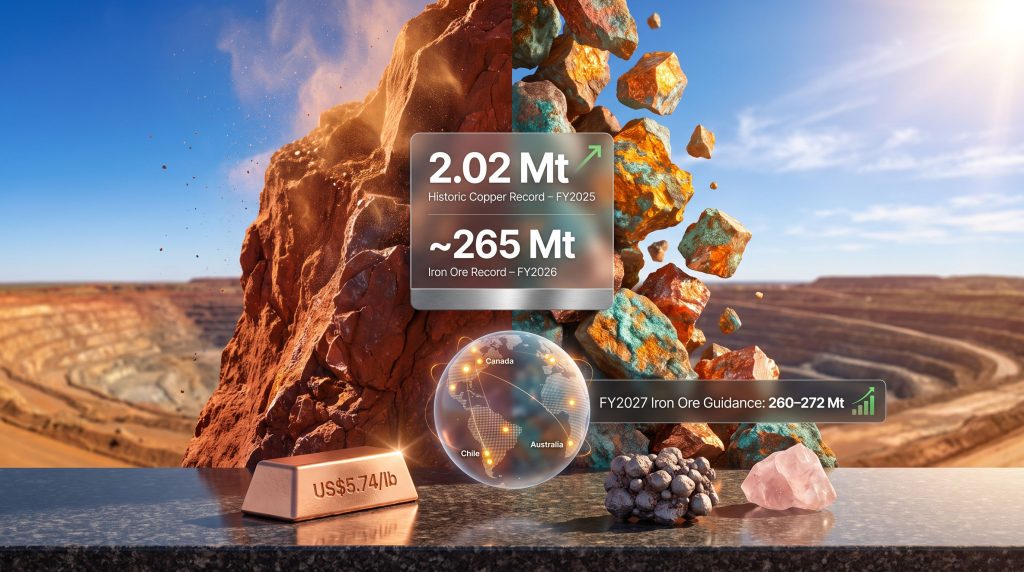
Key Clarification: In FY2025 (ended June 2025), BHP surpassed the 2-million-tonne copper threshold for the first time in its history, producing approximately 2.02 million tonnes. In FY2026 (ended June 2026), the company set a new iron ore production record of approximately 265 million tonnes, while copper output moderated to 1.953 million tonnes due to planned grade transitions at Escondida. These are operationally distinct achievements occurring across a two-year arc of consolidation and capital deployment.
| Metric | FY2024 | FY2025 | FY2026 | Change (FY24-FY26) |
|---|---|---|---|---|
| Iron Ore Output (Mt) | 260 Mt | 263 Mt | ~265 Mt | +1.9% |
| Copper Output (Mt) | 1.865 Mt | 2.02 Mt | 1.953 Mt | +4.7% |
| Avg. Iron Ore Price (USD/wmt) | – | – | US$84.56 | – |
| Avg. Realized Copper Price (USD/lb) | – | – | US$5.74 | ~+35% YoY |
The numbers alone are significant, but their strategic context is what separates this from routine operational reporting. BHP is not simply producing more of the same things. It is producing more of the right things at the right moment in global commodity history.
Western Australia Iron Ore: Engineering a Production Record
The WAIO Competitive Moat
BHP's Western Australia Iron Ore division is one of the most consequential mining operations on earth. Its position on the global iron ore cost curve, consistently among the lowest-cost major producers, provides a structural buffer that higher-cost competitors simply cannot replicate. When iron ore prices fall, WAIO remains profitable while marginal producers curtail output. When prices recover, WAIO captures outsized margin expansion.
The FY2026 record of approximately 265 million tonnes was underpinned by several compounding operational improvements:
- The South Flank hub exceeding its nameplate production capacity during FY2025, establishing a new performance baseline
- Record Central Pilbara production volumes contributing to both the FY2025 and FY2026 milestones
- Rail network optimisation across the Pilbara corridor, enabling record shipment volumes that matched and supported elevated mining rates
- Continued productivity gains across the haulage and processing chain
The average realised iron ore price of US$84.56 per wet metric tonne in FY2026 helped offset inflationary cost pressures across labour, diesel, and equipment categories. In addition, the China steel and iron ore market continues to support long-term consumption volumes at levels sufficient to justify BHP's capital deployment, despite softened property sector demand.
The Ministers North Expansion: Reading the Forward Signal
BHP's approval of the US$900 million Ministers North project in Western Australia carries forward-looking implications that extend well beyond the project itself. The investment, targeting approximately 20 million tonnes per year of additional capacity at full ramp with first ore expected in FY2029, signals management's conviction that iron ore demand will remain structurally robust through the next decade.
FY2027 guidance of 260 to 272 million tonnes spans a meaningful range. At the guidance midpoint and current pricing of US$84.56 per wet metric tonne, even a 10-million-tonne swing in output represents hundreds of millions of dollars in revenue sensitivity. This makes weather patterns in the Pilbara, rail system reliability, and port throughput efficiency among the most financially significant operational variables in global mining.
Copper's Historic Threshold: What the 2-Million-Tonne Milestone Actually Means
Porphyry Grade Cycles and Why They Matter to Investors
One of the least understood aspects of large copper mine operations among non-specialist investors is the concept of grade cycling. Porphyry copper deposits, which include world-class assets like Escondida, are enormous low-grade ore bodies where metal concentration varies considerably across different mining zones. As mining advances through higher-grade zones, output surges. As it transitions into lower-grade sections, output moderates even when operational efficiency improves.
This is precisely what occurred at Escondida across FY2025 and FY2026:
- FY2025: Escondida delivered a 16-17% production surge to a 17-year output high, driven by concentrator throughput improvements, recovery rate optimisation, and record material movement. This pushed BHP's total copper above 2.02 million tonnes for the first time.
- FY2026: Escondida produced 1.261 million tonnes while processing lower-grade ore. Operational discipline offset grade headwinds, but the grade transition was unavoidable given the mine's geological sequencing.
Grade decline at porphyry copper mines is not an operational failure. It is a structural feature of mature deposits that experienced investors recognise as cyclical rather than permanent. The critical distinction is whether the mining operation maintains throughput efficiency and recovery rates during the transition period. Escondida's FY2026 performance suggests it did exactly that.
Copper South Australia: Olympic Dam's Quiet 20-Year High
While Escondida commands most of the attention in copper discussions, BHP's Copper South Australia division delivered a significant milestone of its own. Olympic Dam, one of the world's most complex polymetallic deposits containing copper, uranium, gold, and silver, achieved its highest copper production in two decades during FY2026.
The broader Copper South Australia division, which includes Carrapateena and Prominent Hill, produced 321,000 tonnes, up approximately 2% year-over-year. This achievement is notable because Olympic Dam's geological complexity makes sustained throughput improvements technically demanding. A 20-year production high at this asset reflects genuine operational advancement, not simply favourable grade exposure.
Spence, by contrast, underperformed relative to other BHP copper assets due to ore complexity and declining feed grades. BHP has approved two capital projects specifically targeting recovery improvements and complex ore handling at Spence, both expected to deliver production improvements from 2028 onward.
The Structural Copper Demand Case: Four Converging Forces
The reason BHP's copper positioning attracts such intense investor attention is the intersection of four simultaneous demand growth vectors, each operating on multi-decade timelines. The broader copper supply crunch further underscores why BHP's positioning is so strategically significant:
- Electric vehicles require significantly more copper per unit than internal combustion engine vehicles, with EV copper intensity continuing to rise as battery capacities increase
- Renewable energy infrastructure, including wind turbines, utility-scale solar, and grid-scale storage systems, demands copper-intensive wiring and connection hardware at scale
- Power grid modernisation across developed economies requires large-volume copper investment in transmission and distribution infrastructure that has been underinvested for decades
- AI data centre expansion creates dense copper interconnect and power distribution requirements that are scaling rapidly with compute demand
The supply-side response, however, faces structural constraints that cannot be quickly overcome:
- New copper mine development typically spans 15 to 20 years from discovery to first production
- Average global copper ore grades have declined significantly over the past several decades, meaning more rock must be processed to yield the same metal output
- Greenfield copper project construction costs have escalated substantially, raising the capital intensity threshold for new entrants
BHP's average realised copper price of US$5.74 per pound in FY2026, approximately 35% higher year-over-year, reflects market recognition of this supply-demand imbalance. According to BHP's copper growth strategy, the company is specifically targeting this structural tightness through its multi-continent expansion pipeline.
Disclaimer: Forward-looking statements regarding copper prices and demand projections involve significant uncertainty. Past pricing performance does not guarantee future results.
BHP's Global Copper Growth Map: Six Projects Across Four Countries
| Project | Country | Stage | Key Milestone | Strategic Rationale |
|---|---|---|---|---|
| Cerro Colorado | Chile | EIA Submitted | Potential 20-year life extension | Diversifies Chilean copper base beyond Escondida and Spence |
| Vicuña | Argentina | RIGI Approved | FID targeted 2026 | Four decades of fiscal stability secured |
| Faraday / Copper Creek | USA | Development | Arizona copper hub formation | North American critical mineral supply positioning |
| Resolution | USA | Advanced Exploration | Long-term pipeline | Domestic supply security |
| Globe-Miami | USA | Development | Long-term pipeline | Complements Arizona copper hub |
| Spence Improvement Projects | Chile | Approved | Production from 2028 | Grade complexity and recovery mitigation |
The Vicuña project in Argentina deserves particular attention. Securing approval under Argentina's Large Investment Incentive Regime (RIGI), which provides fiscal stability guarantees extending approximately four decades, is a significant de-risking achievement for a long-duration mining investment in an emerging market jurisdiction. Fiscal stability frameworks of this duration are rare, and they represent a material reduction in sovereign risk for capital committed over multi-decade project lifespans.
The next major ASX story will hit our subscribers first
Potash: The Third Pillar of BHP's Commodity Architecture
BHP's Jansen potash project in Saskatchewan, Canada, remains on schedule to begin production in 2027. The strategic logic of this investment is often underappreciated relative to the copper narrative, but it is equally deliberate.
Potash functions as a critical agricultural input, improving crop yields across major food-producing regions globally. The structural demand drivers are distinct from those supporting copper and iron ore:
- Global population growth increasing absolute food production requirements
- Arable land constraints creating a productivity imperative for yield-enhancing fertilisers
- Food security policy prioritisation among major importing nations, particularly those with significant import exposure to concentrated potash-producing geographies
By entering potash at scale, BHP reduces its revenue concentration in iron ore and copper price cycles while aligning its portfolio with a third category of long-duration structural demand. This is portfolio construction with a 20-year time horizon, not a response to near-term pricing signals.
Emissions Progress Without Carbon Credit Dependency
BHP's climate trajectory carries a detail that institutional ESG investors are increasingly prioritising: its operational emissions reductions are being achieved without reliance on carbon credit purchases or offset mechanisms.
This distinction matters significantly in institutional investment circles. Carbon credit-dependent emissions reductions represent an accounting adjustment rather than an operational one. Reductions achieved through renewable energy procurement, operational efficiency, and technology deployment represent genuine decarbonisation that holds up under scrutiny from institutional investors applying rigorous ESG screening criteria.
Operational emissions fell to 8.7 million tonnes of CO₂ equivalent in FY2025, approximately 5% below the prior year. BHP has stated it remains on track to achieve at least a 30% reduction in operational greenhouse gas emissions by FY2030 relative to its FY2020 baseline. Consequently, mining electrification and decarbonisation efforts are gaining broader industry traction, with BHP's trial of Caterpillar 793 XE battery-electric haul trucks at WAIO representing a notable industry-first initiative.
Scope 3 emissions, covering downstream customer use of BHP's products, increased marginally by 0.1%, reflecting the fundamental tension between growing commodity production volumes and decarbonisation of end-use industries. This is a sector-wide challenge, not a BHP-specific one.
FY2027 Scenario Analysis: Three Pathways
| Scenario | Iron Ore Output | Copper Output | Key Variable |
|---|---|---|---|
| Bull Case | ~272 Mt (top of guidance) | ~1.80 Mt | Strong WAIO performance; Escondida grade stabilisation |
| Base Case | ~265 Mt | ~1.73 Mt | In-line with guidance midpoints |
| Bear Case | ~260 Mt (low end of guidance) | ~1.65 Mt | Weather disruptions; extended grade headwinds at Escondida |
The anticipated decline in copper output to a guidance range of 1.65 to 1.80 million tonnes in FY2027 should be understood in the context of Escondida's grade cycle. This is not a signal of diminished productive capacity. It is a predictable consequence of mining sequencing at the world's largest copper mine. The capital projects targeting Spence and the broader expansion pipeline across Chile, Argentina, and the United States are specifically designed to offset grade-related moderation at Escondida over the medium term.
Furthermore, the critical minerals demand trajectory underpinning BHP's investment thesis remains intact, regardless of near-term grade cycling at individual assets. As reported by Mining Magazine, BHP's consecutive record-setting performance underscores its dominant position across two of the world's most strategically important commodity categories.
This scenario analysis is forward-looking and speculative in nature. Actual outcomes will depend on commodity prices, operational variables, weather events, and regulatory conditions that cannot be predicted with certainty.
Key Takeaways for Investors and Industry Observers
- BHP's FY2025 copper record of 2.02 Mt and FY2026 iron ore record of ~265 Mt represent operationally distinct achievements across a deliberate two-year strategic arc
- The US$900 million Ministers North approval signals management conviction in sustained iron ore demand through the next decade
- Escondida's grade cycling is a structural geological feature, not an operational failure, and is expected to constrain copper output through FY2027 before the broader project pipeline delivers incremental capacity
- Olympic Dam's 20-year copper production high in FY2026 is a technically significant milestone given the deposit's complexity
- The Vicuña project's RIGI approval represents a rare and material de-risking event for long-duration capital in an emerging market jurisdiction
- BHP's average realised copper price of US$5.74 per pound, approximately 35% higher year-over-year, validates the structural supply-demand imbalance thesis
- Jansen potash production beginning in 2027 adds a third structurally supported commodity to BHP's portfolio, reducing earnings concentration risk
- Operational emissions reductions to 8.7 Mt CO₂-equivalent achieved without carbon credits carries increasing weight with institutional ESG capital allocators
The convergence of BHP record iron ore output and copper production, disciplined cost management, and a multi-continent growth pipeline positions BHP not merely as a volume producer, but as a strategically constructed participant in the global critical minerals transition. Whether iron ore prices hold, copper demand accelerates as forecast, or potash demand grows in line with food security imperatives, BHP's portfolio architecture is designed to benefit from more than one of these pathways simultaneously. That multi-commodity optionality, rarely built at this scale, may prove to be its most durable competitive advantage.
Want to Catch the Next Major Mineral Discovery Before the Market Does?
While BHP's multi-decade repositioning across copper, iron ore, and potash illustrates the transformative value of identifying structural commodity shifts early, Discovery Alert's proprietary Discovery IQ model delivers real-time alerts on significant ASX mineral discoveries the moment they are announced — visit the Discovery Alert discoveries page to explore historic examples of exceptional returns, and begin your 14-day free trial to position yourself ahead of the broader market.