
July 20, 2026
The Governance Crisis Quietly Undermining Europe's Critical Minerals Ambition
Across the global mining sector, there is a well-established tension between the urgency of resource development and the procedural rigour that gives large-scale extraction its social legitimacy. Historically, when governments accelerate industrial programmes under strategic necessity, accountability frameworks tend to lag behind policy ambition. CRMA strategic mining projects transparency is experiencing precisely this dynamic in real time, and the consequences for Europe's green transition are more serious than most policy commentary acknowledges.
The Critical Raw Materials Act was conceived as the EU's definitive answer to dependence on foreign mineral supply chains. Its architects understood that lithium, cobalt, nickel, rare earth elements, and a range of other critical inputs were not simply commodities but foundational to every major decarbonisation technology the continent plans to deploy at scale. What the legislation did not adequately anticipate was how quickly the gap between its transparency requirements and actual institutional behaviour would become a structural liability.
When big ASX news breaks, our subscribers know first
How the CRMA Defines Transparency and Where the Framework Is Breaking Down
The Critical Raw Materials Act does not treat transparency as an afterthought. Its statutory text places explicit, legally binding obligations on project promoters awarded strategic status. These obligations include:
- Maintaining a publicly accessible project website containing environmental and social sustainability disclosures
- Submitting biennial progress reports covering project milestones and community engagement activities
- Demonstrating transparent business practices as a condition of retaining strategic designation
- Conducting meaningful stakeholder engagement throughout the project lifecycle
The legal architecture appears comprehensive. The operational reality, however, tells a fundamentally different story. A review of 22 strategic extraction projects reveals compliance rates that would be difficult to defend in any serious governance context:
| Transparency Obligation | Compliance Rate |
|---|---|
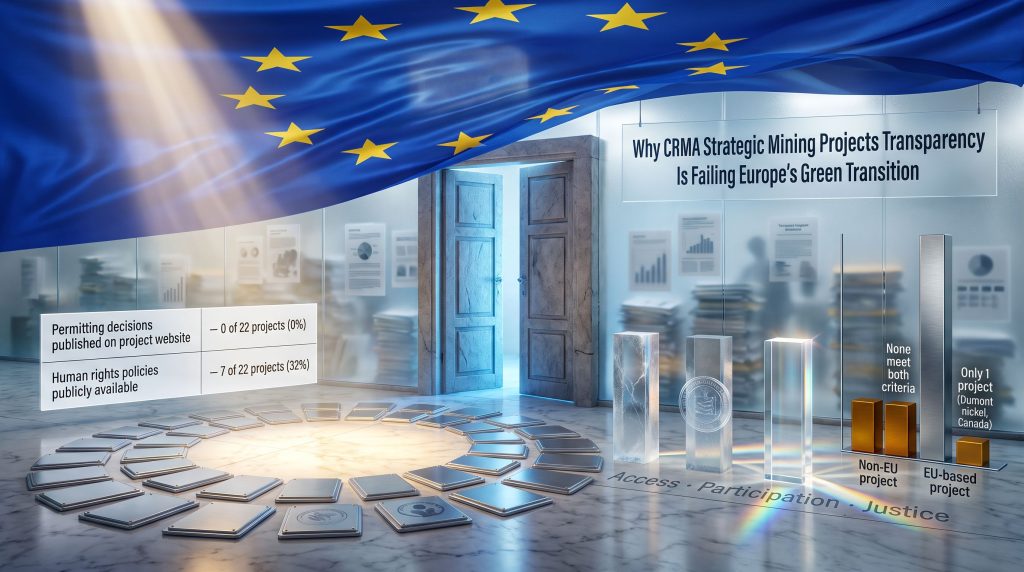
| Permitting decisions published on project website | 0 of 22 projects (0%) |
| Human rights policies publicly available | 7 of 22 projects (32%) |
| Environmental impact assessments published | Majority absent |
| Social impact assessments published | Majority absent |
Not a single one of the examined projects had published permitting decisions on its website. Fewer than one-third had made human rights policies available. Environmental and social impact assessments, which are foundational to any credible sustainability claim, were absent from the majority of project disclosures.
Furthermore, this critical raw materials facility framework was designed to set a high bar for accountability. These figures, however, do not describe isolated compliance failures. They describe a systemic pattern in which legally mandated transparency obligations are functioning as aspirational benchmarks rather than enforceable standards.
This distinction matters enormously. When non-compliance is systemic and goes largely unchallenged by the European Commission, the statutory requirements lose their coercive force entirely. What remains is a framework that creates the appearance of accountability without its substance.
The Three Layers of Information Blackout in Strategic Project Selection
The transparency deficit extends well beyond individual project websites. The process by which the European Commission selects and designates strategic projects under the CRMA is itself opaque across multiple dimensions.
Layer 1: Application substance withheld. Neither the content of individual project applications nor the technical evaluation criteria applied during the assessment process have been made available to the public, affected communities, or civil society organisations. Stakeholders have no basis on which to assess whether projects genuinely meet the Act's strategic criteria.
Layer 2: Expert identities concealed. The independent technical experts engaged to evaluate project applications have not been identified publicly. This creates an irreducible conflict-of-interest risk. Without knowing who conducted assessments, it is structurally impossible to determine whether evaluators hold financial or professional relationships with applicant companies.
Layer 3: Reasoned decisions unpublished. The full reasoned decisions on individual project outcomes remain unavailable. Communities in regions where strategic projects are proposed cannot access the procedural basis for decisions that may materially affect their environment, land use, and quality of life.
When all three informational layers are simultaneously closed to public scrutiny, the conditions for regulatory capture and political interference become materially elevated. This is not a theoretical governance risk; it is the operational reality of CRMA implementation as it currently stands.
Did Political Pressure Distort the March 2025 Strategic Project List?
Perhaps the most serious governance concern to emerge from CRMA implementation involves the composition of the strategic project list published in March 2025. Internal documentation indicates that 11 projects were added to the final list following direct interventions by EU Member States, despite having received unfavourable assessments from external technical reviewers during the evaluation process.
This raises questions that the Commission has not publicly addressed:
- Were the technical merit criteria that the CRMA establishes systematically overridden by geopolitical or economic lobbying from national governments?
- What accountability mechanism exists when Member State pressure produces outcomes that contradict independent expert findings?
- Does the absence of published assessment criteria make it structurally impossible to determine whether final decisions were defensible on technical grounds?
Strategic project designation is not a ceremonial honour. It confers tangible, material benefits including accelerated permitting timelines, priority access to EU financing instruments, and elevated political support at both national and supranational levels. Consequently, if projects receiving these benefits were selected on the basis of political pressure rather than technical merit, the EU faces a direct risk of misallocating strategic resources toward operations that may underperform on environmental, operational, or supply security grounds.
The integrity of Europe's critical minerals supply chain strategy depends on the quality of the projects at its foundation. A selection process compromised by political lobbying produces a strategically compromised list.
The Ombudsman Finding and What Maladministration Actually Means
The European Ombudsman holds authority to investigate complaints of maladministration by EU institutions, bodies, and agencies. Maladministration findings carry significant institutional weight, even where they do not carry direct enforcement power. The Ombudsman's determination that the European Commission's refusal to release strategic project documentation constitutes maladministration is a formal rebuke of institutional conduct.
Specifically, this finding:
- Signals that the Commission's document-withholding practices fall below the standards expected of well-governed public institutions
- Creates meaningful political pressure on the Commission to revisit its access-to-documents practices under Regulation 1049/2001
- Strengthens the legal and procedural standing of civil society organisations pursuing further transparency challenges through formal mechanisms
The Commission has cited several exemptions under Regulation 1049/2001 to justify non-disclosure:
| Exemption Claimed | Legal Basis Cited |
|---|---|
| Commercial confidentiality | Regulation 1049/2001, Article 4(2) |
| Public security considerations | Regulation 1049/2001, Article 4(1)(a) |
| Protection of economic interests | Regulation 1049/2001, Article 4(1)(b) |
Critics, including Members of the European Parliament and civil society legal organisations, argue that these exemptions are being applied as broad, reflexive shields rather than the narrow, case-by-case exceptions the regulation was designed to create. The legal distinction is important: Regulation 1049/2001 contemplates that exemptions will be applied proportionately and with specific justification, not deployed categorically to protect an entire class of documents from public access.
The Aarhus Convention Dimension: Legally Binding Rights Being Quietly Circumvented
The governance failure at the heart of CRMA implementation carries implications that extend beyond institutional policy into binding international law. The Aarhus Convention, ratified by the EU, establishes enforceable public rights across three interconnected pillars:
- Access to environmental information, both on request and proactively
- Public participation in environmental decision-making processes
- Access to justice in environmental matters, including the right to challenge decisions
Civil society organisations have formally argued that the Commission's systematic refusal to release environmental assessments, impact studies, and project evaluation documents constitutes a breach of these Aarhus obligations. The argument is structurally strong. The Convention does not permit signatory bodies to categorically withhold environmental information on the grounds of commercial sensitivity when public health, ecosystem integrity, or community welfare are potentially affected.
What makes this dimension particularly significant is that the Aarhus Convention was designed precisely for situations like this: large-scale infrastructure decisions with environmental implications being made by public authorities without adequate transparency or meaningful public participation. The CRMA's implementation appears to conflict with the Convention's intent at a fundamental level. For a deeper understanding of mining regulations insights, the broader pattern of regulatory gaps across the extractive sector is worth examining in this context.
The next major ASX story will hit our subscribers first
A Two-Tier Accountability Problem: EU Projects Versus Third-Country Operations
The transparency shortfall is measurably more severe for strategic projects located outside EU borders, where the Commission's regulatory reach is structurally limited and civil society oversight mechanisms are weaker.
| Project Category | Human Rights Policy Published | Environmental Assessment Published |
|---|---|---|
| EU-based strategic projects | 7 of 22 promoters (32%) | Majority absent |
| Non-EU strategic projects | None meet both criteria | Only 1 project (Dumont nickel, Canada) |
This data reveals a two-tier accountability structure in which the weakest governance outcomes are concentrated precisely where geopolitical mining risks are highest. Projects operating in third-country jurisdictions may be subject to weaker national environmental and social frameworks. Without EU-mandated disclosure requirements being actively enforced, strategic designation effectively extends EU reputational endorsement to projects that may not meet the standards the Act claims to require.
The Dumont nickel project in Canada represents a solitary exception in an otherwise comprehensive disclosure failure among non-EU projects. That a Canadian operation provides the benchmark for environmental transparency among CRMA-designated projects located outside Europe illustrates how far the system falls short of its stated ambitions. According to the European Environmental Bureau, communities and environmental concerns are routinely sidelined in strategic project decisions abroad, further compounding this accountability gap.
ClientEarth and the Role of Legal Strategy in Filling the Governance Void
When institutional self-governance fails, litigation and formal complaint mechanisms increasingly serve as surrogate accountability tools. The successful challenge brought by environmental legal organisation ClientEarth against the European Commission's document-withholding practices demonstrates that this strategic approach can yield concrete results.
The methodology employed reflects a pattern emerging in EU environmental law enforcement:
- Filing formal access-to-documents requests under Regulation 1049/2001
- Escalating refusals to the European Ombudsman through structured complaint processes
- Building parliamentary and public pressure through documented maladministration findings
- Creating legal precedents that constrain future Commission discretion in applying document exemptions
This approach is significant not only for the immediate outcome it produced but for the precedent it sets. Each successful challenge narrows the space within which the Commission can reflexively invoke commercial or security exemptions without specific justification. Over time, a body of precedent developed through these mechanisms can effectively rewrite the operational norms of institutional transparency, even in the absence of statutory reform.
What Genuine Reform Would Require: A Staged Policy Framework
Restoring credibility to CRMA strategic mining projects transparency requires intervention across multiple timeframes. Incremental adjustments to existing practice will not be sufficient given the depth of the compliance failures documented to date.
Short-term corrective measures (0 to 12 months):
- Mandatory publication of all strategic project applications and technical assessments, subject only to narrowly scoped commercial exemptions with specific written justification
- Public disclosure of independent expert identities and signed conflict-of-interest declarations
- Publication of full reasoned decisions for all strategic project determinations, including projects that did not receive designation
Medium-term institutional reforms (1 to 3 years):
- Establishment of an independent CRMA oversight body with formal audit authority over the selection process and compliance monitoring
- Mandatory biennial transparency audits with published compliance scorecards for all strategic project promoters
- Creation of a centralised, publicly searchable project information portal integrating all required disclosures in a standardised format
Long-term governance architecture (3 or more years):
- Explicit statutory alignment of CRMA transparency obligations with Aarhus Convention requirements through legislative amendment
- Integration of community consent mechanisms into the strategic project designation process, particularly for projects in ecologically sensitive or densely populated areas
- Development of enforceable sanctions for promoters failing to meet disclosure obligations, including suspension or revocation of strategic status
The Social Licence Problem That No Designation Can Solve
There is a dimension of CRMA governance failure that carries consequences more immediate than legal exposure or reputational damage to EU institutions. Mining operations in European regions and in third-country communities require robust social licence to operate without prolonged legal opposition, community-led injunctions, or project delays that can run into years and billions of euros.
Social licence is not granted through legislation. It is earned through demonstrated transparency, genuine engagement, and the verifiable alignment of project activities with community and environmental interests. The opacity that currently characterises CRMA strategic mining projects transparency processes does not protect projects from scrutiny; it defers scrutiny to a later stage when opposition is more organised, legal challenges are more advanced, and delays are more costly.
In addition, the broader question of critical minerals demand across the energy transition adds urgency to resolving these governance failings before they compound into supply security crises. Europe's critical minerals strategy is premised on the assumption that strategically designated projects will deliver reliable, ethically produced supply chains. That premise cannot hold when selection processes are politically manipulated, environmental risks remain undisclosed, and affected communities lack access to basic procedural information.
The stakes here extend beyond administrative tidiness. If the projects that form the backbone of Europe's green industrial transition lack genuine community consent and transparent governance foundations, the entire supply security strategy rests on an unstable base. Legal challenges, permit revocations, and sustained civil society opposition have derailed strategically significant mining projects before, and they will do so again where transparency deficits create the conditions for mobilisation. A Business and Human Rights Resource Centre analysis of local realities surrounding CRMA-designated operations further underscores how CRMA strategic mining projects transparency failures translate directly into on-the-ground harm for affected communities.
Frequently Asked Questions: CRMA Strategic Mining Projects Transparency
What is the Critical Raw Materials Act?
The CRMA is EU legislation designed to secure Europe's access to minerals essential for clean energy technologies, digital infrastructure, and defence manufacturing. It creates a framework for designating strategic projects that receive priority treatment under EU law, including faster regulatory approvals and access to EU financing mechanisms.
What does strategic project status actually confer?
Beyond symbolic recognition, strategic designation grants operations accelerated permitting timelines, priority access to EU funding instruments, and elevated political support. In exchange, promoters must meet statutory transparency and stakeholder engagement standards as ongoing conditions of their designation.
Why did the European Ombudsman criticise the Commission?
The Ombudsman found that the Commission's refusal to release documents about strategic project assessments and selection decisions constitutes maladministration, meaning the institution acted contrary to good governance principles. The finding followed a formal complaint process and represents a significant institutional rebuke.
How does the Aarhus Convention apply here?
The Aarhus Convention is a binding international agreement ratified by the EU that guarantees public rights to environmental information and meaningful participation in environmental decision-making. Civil society organisations argue that the Commission's systematic document-withholding practices breach these obligations, a claim that the Commission's stated exemption justifications have not convincingly addressed.
What is the actual compliance rate among strategic projects?
Based on reviewed data, zero of 22 examined strategic extraction projects published permitting decisions on their websites. Fewer than one-third published human rights policies. Environmental and social impact assessments were absent from the majority of project disclosures, indicating failures that are systemic rather than exceptional.
Want to Stay Ahead of the Next Major Mineral Discovery on the ASX?
While Europe navigates the governance complexities of its critical minerals strategy, Discovery Alert's proprietary Discovery IQ model is scanning ASX announcements in real time — delivering instant alerts on significant mineral discoveries across lithium, nickel, cobalt, rare earths, and more than 30 other commodities. Explore Discovery Alert's dedicated discoveries page to see the historic returns that major mineral discoveries have generated, and begin your 14-day free trial today to position yourself ahead of the broader market.