July 20, 2026
The Hidden Backbone of Battery Metals: Why Sulphuric Acid Supply Chains Matter More Than Most Investors Realise
Most discussions about critical minerals demand focus on the metals themselves: lithium, nickel, cobalt, copper. Far less attention is paid to the industrial chemicals that make extraction possible in the first place. Sulphuric acid sits at the centre of this overlooked infrastructure, quietly enabling a significant share of global copper and nickel production. When its availability is disrupted at scale, the consequences ripple across mining operations, battery supply chains, and agricultural systems simultaneously.
The near-total collapse of China's sulphuric acid exports in June 2026 is precisely that kind of disruption. China sulphuric acid exports plunge 99% in a single month is not merely a trade statistic. It represents a structural shock to seaborne acid availability that leaves some of the world's most strategically important mining operations scrambling for alternative supply.
When big ASX news breaks, our subscribers know first
Understanding the Architecture of China's Sulphuric Acid Export Dominance
To appreciate the scale of what has changed, it helps to understand how China became the world's dominant seaborne sulphuric acid supplier in the first place. The answer lies not in deliberate strategy, but in industrial arithmetic.
Sulphuric acid is an unavoidable byproduct of pyrometallurgical copper smelting. For every tonne of copper produced through smelting, approximately one tonne of sulphuric acid is generated as a co-product. China's copper smelting industry expanded aggressively over the past two decades, and with it came enormous volumes of acid that needed a commercial outlet.
Domestic demand for sulphuric acid in China is substantial, driven primarily by phosphate fertiliser manufacturing. However, domestic consumption alone could not absorb the full output of an ever-growing smelting sector. The excess found its natural market in export, particularly in Asia-Pacific and Latin America, where hydrometallurgical mining operations required large and consistent acid volumes.
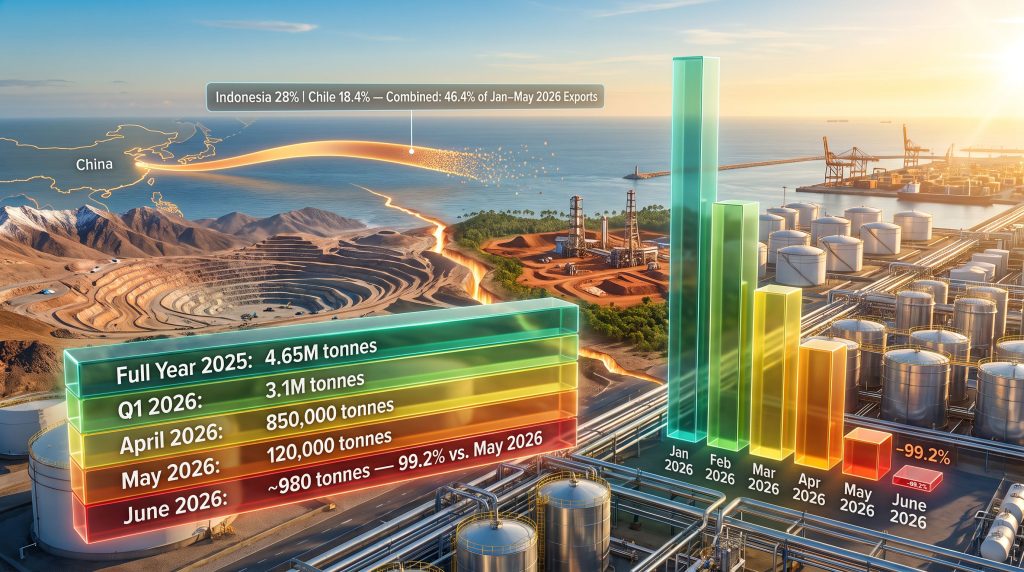
By 2025, China was exporting 4.65 million tonnes of sulphuric acid annually, making it the single largest seaborne supplier globally. This export position had an additional function for Chinese smelters: it served as a financial buffer. As treatment and refining charges (TC/RCs) for copper concentrate fell sharply, and in some periods turned negative, acid revenue became an increasingly important component of smelter margin management.
The TC/RC Collapse and the Acid Revenue Dependency
TC/RCs represent the fees that copper smelters charge miners to process copper concentrate into refined metal. When concentrate supply is abundant relative to smelting capacity, TC/RCs rise and smelters profit. When smelting capacity outpaces concentrate supply, as has occurred in recent years with China's aggressive smelter expansion, TC/RCs compress.
In the current cycle, some Chinese smelters have operated at negative TC/RCs, meaning they have effectively paid to access copper concentrate rather than being paid to process it. In this financial context, sulphuric acid export revenue was not a peripheral income stream. It had become structurally embedded in the commercial viability of Chinese copper smelting operations. The export ban therefore creates a paradox: a policy designed to protect domestic fertiliser supply simultaneously undermines the financial model of the industry generating that acid.
What the Customs Data Actually Reveals: Deconstructing the 99% Decline
The headline figure demands careful interpretation. The widely cited 99% collapse refers specifically to the sequential month-on-month change in June 2026, when China sulphuric acid exports plunge 99% from approximately 116,700 tonnes in May to just 980 tonnes. It is a dramatic figure, but it requires context to fully assess.
Key Analytical Note: The 99.2% figure measures sequential volume change between May and June 2026. The year-on-year picture across the first half of 2026 shows a decline of between 49% and 75%, depending on the reference month. Both measures confirm a severe contraction, but they are measuring different things.
The full data picture across 2026 looks as follows:
| Reporting Period | Export Volume | Change vs. Prior Period |
|---|---|---|
| Full Year 2025 | 4.65 million tonnes | Baseline |
| January–February 2026 | 385,000 tonnes | -47.14% YoY |
| Q1 2026 | 528,400 tonnes | -50% YoY |
| January–April 2026 | 666,808 tonnes | -49% YoY |
| May 2026 | 116,700 tonnes | -75.87% YoY |
| June 2026 | ~980 tonnes | -99.2% vs. May 2026 |
| H1 2026 Total | ~784,362 tonnes | Significant YoY reduction |
What this table reveals is that the export restriction did not arrive without warning. Volumes were already declining sharply from January onwards, suggesting early implementation measures were already tightening supply before the formal ban took full effect. The June figure represents the near-complete enforcement of those restrictions rather than a sudden policy surprise.
Exemptions, Residual Flows, and What the 980 Tonnes Represents
Not all sulphuric acid was subject to the export ban. Chinese authorities explicitly exempted electronic-grade sulphuric acid, which is used in semiconductor and solar panel manufacturing and sits at the high-value end of the acid quality spectrum. The approximately 980 tonnes that cleared customs in June almost certainly represents residual electronic-grade shipments or pre-approved legacy contracts working through the clearance system.
The destination data reinforces this interpretation. Thailand received just 264 tonnes and Vietnam 223 tonnes in June, volumes consistent with speciality chemical supply rather than industrial mining acid. Both countries are significant electronics manufacturing hubs, which aligns with the electronic-grade exemption.
Projecting the Full-Year Damage
With the restriction in force through December 2026, the seaborne acid market faces the removal of an estimated 3 million tonnes of Chinese supply relative to the 2025 baseline. Full-year 2026 exports are now projected to represent a 60 to 70 percent decline from 2025 volumes, with the actual outcome depending on whether any partial resumption occurs in the second half of the year.
The Countries Most Exposed: Chile and Indonesia Carry Disproportionate Risk
The geographic concentration of China's export customer base amplifies the supply shock significantly. Two countries, Chile and Indonesia, absorbed 46.4% of all Chinese sulphuric acid exports between January and May 2026. In June, they received effectively nothing.
| Country | Share of China's Jan-May 2026 Exports | Primary Industrial Use |
|---|---|---|
| Indonesia | 28% | High-Pressure Acid Leach (HPAL) nickel processing |
| Chile | 18.4% | Heap leach copper extraction |
| Combined (Top 2) | 46.4% | Multiple base metal operations |
| Thailand | Largest June recipient (264 t) | Industrial and electronics chemicals |
| Vietnam | Second June recipient (223 t) | Industrial and electronics chemicals |
Chile: Acid Dependency in the World's Largest Copper Producer
Chile's copper industry is the world's largest, accounting for roughly 27% of global mine production. A significant portion of that output comes from oxide copper deposits processed through heap leaching and solvent extraction-electrowinning (SX-EW), both of which require continuous sulphuric acid supply to function. Furthermore, the copper supply crunch already emerging from structural deficits makes any additional output constraint particularly consequential for global markets.
In heap leaching, sulphuric acid is applied to crushed ore stacked on lined pads. The acid dissolves copper minerals, creating a copper-rich solution that is then processed through SX-EW circuits to produce refined copper cathode. The process is inherently acid-intensive and cannot be substituted with alternative reagents without fundamentally redesigning the metallurgical flowsheet.
Chile accounted for approximately 32% of China's total 4.65 million tonne exports in 2025, making it the largest single-country customer by volume. The abrupt removal of that supply creates immediate pressure on:
- Securing replacement acid from alternative seaborne sources, including Japanese and South Korean copper smelter byproduct
- Accelerating domestic sulphur-burning acid plant capacity, which requires multi-year capital commitment
- Managing spot acid price escalation as competing buyers chase limited alternative supply
- Potential output constraints at SX-EW operations if acid inventory buffers are depleted before alternative supply is secured
Indonesia: HPAL Operations and Battery Metal Supply at Risk
Indonesia's exposure carries additional strategic weight because it sits upstream of global EV battery supply chains. The country's laterite nickel deposits are processed almost exclusively through High-Pressure Acid Leaching (HPAL), a hydrometallurgical technique that produces battery-grade nickel sulphate suitable for use in lithium-ion cathode materials. Consequently, Indonesian nickel supply faces mounting pressure precisely at a moment when global demand is accelerating.
HPAL is among the most acid-intensive industrial processes in the mining sector. Consumption figures typically range between 300 and 400 kilograms of sulphuric acid per tonne of ore processed, depending on ore grade and mineralogy. For large-scale HPAL plants processing tens of millions of tonnes of ore annually, this translates into acid requirements measured in hundreds of thousands of tonnes per year per facility.
Indonesia's dependency on Chinese acid was already growing rapidly. Its share of China's exports rose from 15% in 2025 to 28% in the January to May 2026 period, suggesting that Indonesian HPAL capacity was expanding faster than its ability to source acid from alternative origins. The timing of the export ban therefore catches Indonesian operations at a point of maximum exposure.
Downstream Risk: If Indonesian HPAL output is constrained by acid scarcity, the resulting nickel sulphate shortfall transmits upstream pressure into battery cathode manufacturing, ultimately affecting the cost and availability of EV battery cells globally.
The Byproduct Paradox: How the Export Ban Hurts Chinese Smelters
One of the less-discussed dimensions of this situation is the self-inflicted commercial damage to China's own copper smelting industry. Because sulphuric acid is a compulsory byproduct of smelting, Chinese producers cannot simply stop making it. Every tonne of copper they produce generates approximately one tonne of acid that must go somewhere.
With export channels effectively closed, that acid must be absorbed by the domestic market or result in production curtailments. China's domestic acid market, dominated by phosphate fertiliser manufacturing, has finite absorption capacity. If acid volumes exceed what domestic buyers can consume at commercially viable prices, the following consequences become likely:
- Domestic sulphuric acid prices fall as oversupply builds
- Acid revenue contributions to smelter margins compress or disappear
- Some smelters face simultaneous pressure from negative TC/RCs and collapsing acid revenue
- Production curtailments at marginal smelting operations become economically rational
- Reduced copper concentrate processing in China could tighten refined copper supply domestically
This creates a policy feedback loop that Chinese authorities will need to monitor carefully. The fertiliser security rationale for the export ban is internally coherent, but its second-order effects on copper production economics represent a meaningful industrial cost. Indeed, understanding the broader copper price growth drivers helps illustrate why these feedback loops carry such significant market weight.
Alternative Supply Sources: An Honest Assessment of Gap-Filling Capacity
The obvious question for acid-importing nations is where replacement supply can be sourced. The honest answer is that no single alternative origin can fill a gap of 3 million tonnes within a short timeframe.
| Alternative Source | Current Capacity | Ability to Fill China Gap |
|---|---|---|
| Japan (copper smelter byproduct) | Moderate | Partial, limited surplus export volumes |
| South Korea | Moderate | Partial, domestic demand competition |
| Middle East (sulphur burning) | Growing | Constrained by same conflict dynamics |
| Domestic production in Chile/Indonesia | Limited | Requires multi-year capital investment |
Japan and South Korea both operate significant copper smelting industries and export acid from their own byproduct streams. However, their combined surplus export capacity represents a fraction of the volume China previously supplied. Middle Eastern sulphur-burning acid plants represent a theoretically scalable alternative, but they face the same upstream sulphur supply disruptions that contributed to China's export restriction in the first place. For further context, China's use of sulphuric acid as a geopolitical lever has been documented as a broader pattern of industrial resource statecraft.
The next major ASX story will hit our subscribers first
Three Scenarios for the Seaborne Market Through 2027
Scenario 1: Restriction Extended Beyond December 2026
If Middle East sulphur supply chains remain disrupted or domestic Chinese fertiliser security concerns persist, export controls could extend into 2027. This scenario deepens the seaborne acid deficit and sustains elevated spot prices for an extended period, applying maximum pressure on Chilean SX-EW operations and Indonesian HPAL plants.
Scenario 2: Partial Resumption in Late 2026 or Early 2027
China selectively reopens export quotas once domestic supply stabilises. Spot prices in Asia-Pacific and Latin America remain elevated relative to historical norms but begin normalising. Indonesian HPAL projects with long-term acid supply agreements secured before the ban gain significant competitive advantage over spot-market-dependent operations.
Scenario 3: Structural Realignment of Global Acid Supply
Importing nations respond to the supply shock by investing in domestic sulphur-burning acid production capacity and diversifying supply agreements toward Japan, South Korea, and Middle Eastern producers. This scenario plays out over three to five years and results in a less concentrated seaborne acid market, reducing systemic vulnerability to future Chinese export policy decisions.
Investor and Market Implications: Who Wins, Who Loses
For investors monitoring base metals and battery materials, the sulphuric acid supply shock has several practical implications worth tracking. In addition, these dynamics intersect directly with the ongoing battery storage expansion reshaping global energy infrastructure and mineral demand patterns.
- Integrated operators with captive acid generation (smelter-leach combinations) hold a structural cost advantage over operations dependent on purchased acid
- Indonesian HPAL projects with pre-secured long-term acid supply contracts are better positioned than those relying on spot procurement
- Chilean copper producers at SX-EW operations face near-term production cost escalation; operations with higher ore grades may absorb this more comfortably than those at the margin
- Sulphur producers and traders may benefit from sustained pricing pressure if Middle East disruptions prolong tight sulphur markets globally
- Nickel sulphate supply faces upstream constraint risk, with downstream implications for battery cathode manufacturers managing inventory
Disclaimer: The above observations represent analytical perspectives based on publicly available trade data and market dynamics. They do not constitute financial advice. Investors should conduct independent due diligence before making investment decisions.
Frequently Asked Questions: China Sulphuric Acid Export Collapse
What caused China to halt sulphuric acid exports in 2026?
China suspended most sulphuric acid exports beginning in May 2026 to protect domestic fertiliser production capacity. The policy decision followed disruptions to sulphur import supply chains arising from Middle East conflict, which tightened the upstream feedstock available for domestic acid production and prompted authorities to prioritise national food security infrastructure.
Which countries are most affected by China's sulphuric acid export ban?
Chile and Indonesia face the greatest disruption, having collectively absorbed approximately 46.4% of Chinese exports in the January to May 2026 period. Chile depends on sulphuric acid for heap leach copper recovery, while Indonesia relies on it for HPAL-based nickel processing feeding battery supply chains.
Is the 99% export plunge permanent or temporary?
The 99.2% month-on-month decline in June 2026 reflects the immediate enforcement of export restrictions currently scheduled through December 2026. Full-year volumes are estimated to be 60 to 70 percent below 2025 levels. Whether restrictions extend beyond 2026 depends on the evolution of domestic sulphur supply and fertiliser production conditions.
How does the acid export ban affect Chinese copper smelters?
Chinese copper smelters generate sulphuric acid as an inescapable byproduct of production. With export channels closed, domestic acid markets face oversupply pressure, compressing acid prices and reducing the revenue contribution that had been partially compensating for deeply negative copper processing fees. This adds further complexity to an industry already navigating a significant copper supply crunch in global concentrate markets.
Could this export restriction affect EV battery supply chains?
Yes. Indonesian HPAL operations are a primary source of battery-grade nickel sulphate. Sustained acid scarcity constrains HPAL throughput, reducing nickel sulphate output and adding upstream cost pressure to EV battery manufacturing globally. The transmission mechanism from acid supply to battery cell cost is real, if not always immediately visible in headline commodity prices.
For ongoing coverage of base metals, hydrometallurgy, and critical mineral supply chain developments, Mining Weekly provides reporting across international markets at miningweekly.com.
Want to Know Which ASX Mineral Discoveries Could Benefit From Critical Mineral Supply Chain Disruptions?
Discovery Alert's proprietary Discovery IQ model scans ASX announcements in real time, instantly identifying significant mineral discoveries across copper, nickel, and other battery metals before the broader market reacts — explore historic examples of major discovery returns to understand the opportunity, and begin your 14-day free trial at Discovery Alert to position yourself ahead of the next major find.