July 20, 2026
When Energy Infrastructure Becomes a Strategic Target: Understanding Iran's Gas Crisis
The global energy system has always carried an embedded vulnerability that policymakers prefer not to discuss openly: the physical concentration of production capacity into a small number of critical nodes. When those nodes are disrupted, the downstream consequences ripple across entire economies. Iran's effort to restore lost gas output illustrates this dynamic with uncomfortable clarity, exposing how fragile even large-scale energy systems can be when strategic infrastructure becomes a target.
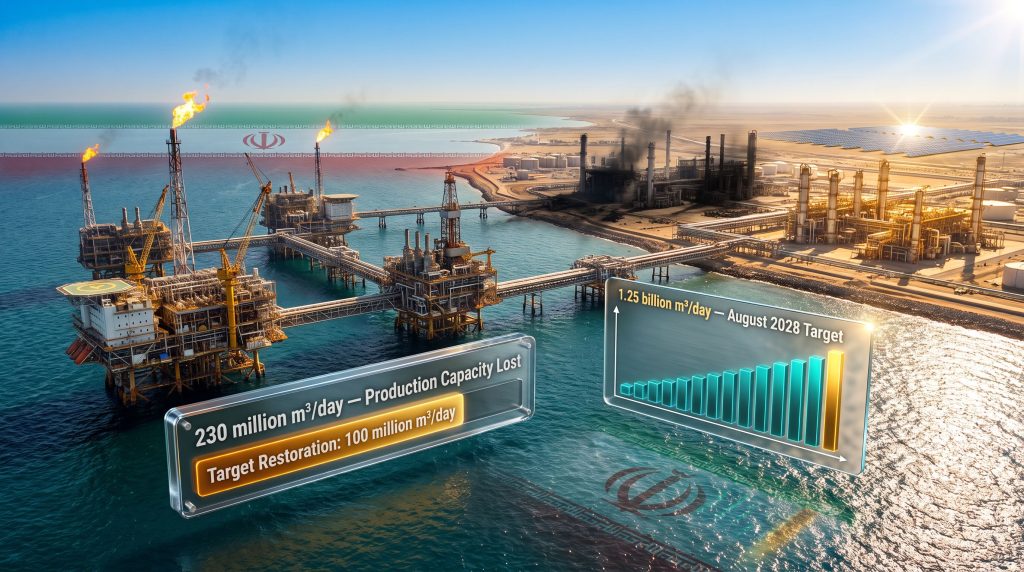
Since strikes on Iranian energy infrastructure began in late February 2026, the country has lost approximately 230 million cubic metres per day (m³/day) of natural gas production capacity. Against a pre-conflict national output baseline of roughly 650 million m³/day, this represents a production loss of more than 35% in a matter of months. Senior Iranian government officials have indicated that efforts are underway to restore around 100 million m³/day of that lost capacity within the coming months — a target that, if achieved, would still leave a structural shortfall of approximately 130 million m³/day relative to pre-conflict output levels.
The effort to restore lost gas output in Iran is not simply a technical repair exercise. It is, furthermore, a window into how energy infrastructure functions, fails, and recovers under pressure — with consequences that extend well beyond Iranian borders.
When big ASX news breaks, our subscribers know first
The Production Baseline and What Was Lost
Before the current conflict-related disruptions, Iran held a position among the world's top natural gas producers. South Pars, the vast offshore field in the Persian Gulf shared geologically with Qatar's North Dome, formed the backbone of this output, accounting for more than 70% of Iran's total national gas supply.
This geographic and operational concentration created an inherent systemic risk. When strikes targeted energy infrastructure beginning in late February 2026, South Pars-linked processing facilities absorbed a significant share of the damage, with the broader consequences rippling into LNG supply implications for global markets.
The scale of disruption can be understood through a structured breakdown:
| Metric | Volume |
|---|---|
| Pre-conflict national gas output | ~650 million m³/day |
| Total production capacity lost since late February 2026 | ~230 million m³/day |
| Planned near-term restoration target | ~100 million m³/day |
| Remaining capacity gap after restoration | ~130 million m³/day |
| Long-term production target (by August 2028) | 1.25 billion m³/day |
Even after achieving the planned restoration of 100 million m³/day, Iran's gas system will still be operating at roughly 80% of its pre-conflict capacity. The remaining 130 million m³/day gap carries substantial implications for domestic energy stability and industrial output.
Why Onshore Processing Is the Real Constraint
A critical but frequently misunderstood aspect of natural gas production is that raw extraction and usable supply are not the same thing. Gas extracted from offshore platforms must pass through an extensive chain of onshore infrastructure — including separation units, compression systems, and refinery processing facilities — before it can enter domestic distribution networks or be directed toward export.
Strikes in March 2026 are reported to have targeted onshore processing and refinery facilities rather than the offshore extraction platforms themselves. This distinction matters enormously for recovery timelines.
Three offshore South Pars production platforms resumed operations in May 2026, demonstrating that upstream extraction capacity retained meaningful resilience. However, the Phase 14 refinery — one of the onshore processing sites understood to have sustained significant damage — represents the kind of bottleneck that can render otherwise functional extraction capacity commercially unusable.
This creates what energy infrastructure analysts describe as a two-tier damage model:
- Upstream capacity (offshore platforms): Partially restored, demonstrating physical resilience to the strikes
- Downstream capacity (onshore processing): More severely degraded, forming the primary constraint on converting extracted gas into usable supply
- Processing rerouting: Iranian operators have moved to redirect raw gas volumes through undamaged or partially functional onshore facilities as a bridging measure
- Permanent repairs: Structural restoration work at damaged refinery sites is expected to extend across a longer timeline than platform reactivation
For context, industrial-scale gas processing infrastructure typically requires repair timelines measured in months to years depending on the nature of structural damage, the availability of specialised components, and the operating conditions during the repair period.
Iran's Three-Phase Restoration Strategy
How Is Iran Approaching the Recovery?
The Iranian government's approach to restoring lost gas output can be understood as a phased operational strategy, each stage addressing a distinct layer of the production chain:
- Platform reactivation: Restoring output at South Pars offshore platforms where infrastructure remained sufficiently intact — a process that reached partial completion by May 2026
- Processing rerouting: Redirecting gas volumes through alternative onshore facilities to bypass damaged refinery capacity and restore usable supply volumes more rapidly than permanent repairs would allow
- Refinery restoration: Conducting full structural repairs at damaged onshore processing facilities, including the Phase 14 refinery, to restore complete processing throughput over a longer horizon
Beyond near-term restoration, Iran's oil ministry has outlined an ambition to expand gas output by an additional 60 million m³/day within 12 months through contributions from South Pars and supplementary producing fields. The longer-term target of 1.25 billion m³/day by August 2028 would represent a near-doubling of pre-conflict production levels, contingent on both full infrastructure restoration and substantial new investment.
A critical operational factor has been workforce continuity. Oil and gas sector workers maintained operations at energy facilities throughout the period of active strikes, with Iranian government officials attributing the prevention of total production shutdowns in part to the efforts of the sector's workforce. This human dimension of infrastructure resilience is often overlooked in technical analyses of production recovery.
Domestic Energy Consequences: The Summer Demand Amplifier
What Does Reduced Gas Supply Mean for Ordinary Iranians?
The timing of Iran's production disruptions has compounded their impact. Iran's energy system faces its most acute seasonal stress during summer months, when electricity demand for cooling rises sharply across residential, commercial, and industrial sectors.
The interaction between reduced gas supply for thermal power generation and peak summer electricity consumption has contributed to rolling power outages affecting households and businesses across the country. This dynamic operates as a feedback loop: gas shortfalls reduce generation capacity precisely when demand pressure is highest, eliminating the margin that would otherwise allow the grid to absorb supply variability.
Iran's government has confirmed it is implementing consumption management measures and pursuing a parallel expansion of electricity generation capacity. A notable element of this response is the accelerated deployment of solar power capacity. Furthermore, renewable energy solutions of this kind serve dual purposes: providing near-term grid relief during peak demand periods and establishing longer-term structural diversification away from gas-dependent generation, reflecting broader energy transition pressures reshaping national energy strategies globally.
The petrochemical sector faces particular exposure to sustained gas supply disruptions. Natural gas functions as both a primary feedstock and an energy input for petrochemical manufacturing, meaning that production shortfalls affect output volumes directly rather than simply raising operating costs. Iranian petrochemical production is a significant contributor to the country's non-oil export revenues, creating a direct economic transmission mechanism from gas supply disruption to foreign exchange earnings.
South Pars, North Dome, and the Structural Disparity
The South Pars/North Dome reservoir is the largest natural gas accumulation in the world. The Iranian side of the field contains approximately the same volume of recoverable reserves as the Qatari North Dome side, yet the two countries' ability to monetise those reserves has diverged dramatically over recent decades.
Qatar has built one of the world's most sophisticated LNG export infrastructures above its share of the reservoir, becoming a dominant supplier to global gas markets. Iran, constrained by decades of sanctions that have limited access to foreign capital, technology, and offtake agreements, has been unable to develop comparable LNG export capacity. The IEA has noted that oil and gas recovery in affected regions may take up to two years, widening this structural disparity further, with Iran's production contracting at precisely the moment Qatar is pursuing additional expansion.
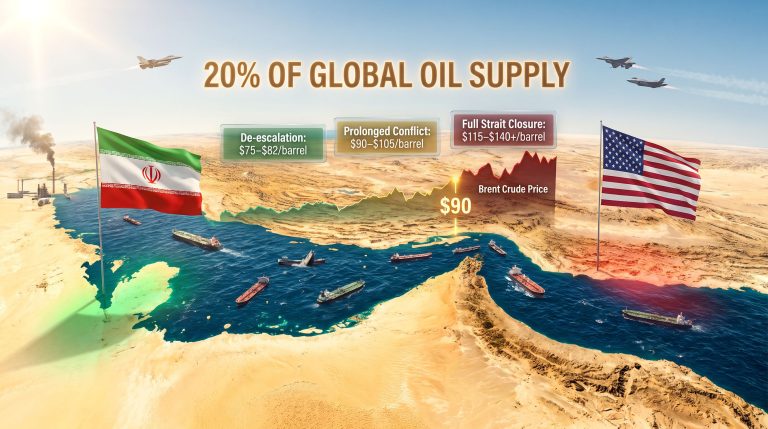
This asymmetry carries broader implications for regional energy dynamics. In addition, the ongoing global market instability driven by geopolitical conflict is influencing oil price movements and compounding uncertainty across energy-dependent industries worldwide.
The next major ASX story will hit our subscribers first
Scenario Analysis: Three Pathways for Recovery
The trajectory of Iran's effort to restore lost gas output is subject to meaningful uncertainty. Three broad scenarios frame the range of plausible outcomes:
Optimistic Scenario
Onshore refinery repairs progress faster than baseline expectations, and processing rerouting strategies prove sufficient to bridge supply gaps during the repair period. The 100 million m³/day restoration target is achieved within the stated timeframe, and combined with the ministry's 12-month expansion plan, Iran approaches functional output above 700 million m³/day by mid-2027.
Base Case Scenario
Restoration proceeds in phases over 6 to 12 months, with full refinery repair extending across a considerably longer horizon. Iran stabilises at a reduced but gradually improving output level, with domestic supply imbalances persisting through 2026 and into 2027. Industrial sectors face continued rationing, and solar capacity additions provide meaningful but limited near-term grid relief.
Pessimistic Scenario
Continued geopolitical tensions result in further infrastructure strikes, or damage assessments at key facilities prove more extensive than currently understood. Restoration timelines extend to years rather than months, Iran's domestic energy deficit deepens materially, petrochemical output contracts significantly, and the 2028 production target becomes structurally unachievable without a fundamental change in the operating environment.
Industry specialists broadly agree that while partial restoration of Iran's gas output is achievable in the near term, complete recovery to pre-conflict production levels is unlikely to follow a linear path. The complexity of onshore processing infrastructure repair, combined with the potential for continued external disruption, introduces persistent uncertainty into any recovery timeline.
Key Takeaways: Iran's Gas Restoration in Context
For readers tracking Iran's energy situation and the broader regional implications, the following structural points provide the essential framework:
- Iran's near-term target is to restore 100 million m³/day, representing less than half of the 230 million m³/day lost since late February 2026
- The primary technical constraint on recovery is onshore processing capacity, not offshore extraction capability
- Three South Pars offshore platforms resumed production in May 2026, demonstrating upstream resilience, while onshore refinery damage remains the binding limitation
- Seasonal summer electricity demand amplifies the domestic consequences of reduced gas supply, contributing to rolling power outages
- The petrochemical sector faces direct exposure through both feedstock and energy input shortfalls, with downstream effects on export revenues
- Government responses span demand management, processing rerouting, and accelerated solar energy deployment, reflecting a multi-layered stabilisation strategy
- The long-term target of 1.25 billion m³/day by August 2028 is contingent on geopolitical stability, infrastructure investment, and sustained operational continuity
- The structural contrast between Iran's constrained South Pars development and Qatar's expanding North Dome LNG supply implications illustrates the long-term cost of sustained underinvestment in production infrastructure
This article contains forward-looking statements and scenario projections based on publicly available information as of the date of publication. Actual outcomes may differ materially from those projected depending on geopolitical developments, technical factors, and conditions not anticipated at the time of writing. This content does not constitute investment advice.
Want to Position Yourself Ahead of the Next Major Energy or Mineral Discovery?
Discovery Alert's proprietary Discovery IQ model scans ASX announcements in real time, instantly identifying high-potential mineral discoveries across more than 30 commodities — translating complex data into clear, actionable opportunities for both short-term traders and long-term investors. Explore how historic discoveries have generated significant market returns and begin your 14-day free trial today to secure a market-leading edge.