
July 20, 2026
The Escalatory Spiral: How the US-Iran Conflict Is Reshaping Global Energy Security
When military conflicts begin absorbing civilian infrastructure into their target sets, the strategic calculus changes fundamentally. US strikes on Iran after troops killed have now entered their ninth consecutive night, and power grids, desalination plants, port facilities, and transportation networks are no longer off-limits. They are pressure instruments, deployed when one or both parties concludes that purely military attrition is insufficient to force a change in behaviour. That shift has visibly occurred, and its consequences extend well beyond the battlefield.
As of July 20, 2026, the United States has completed nine consecutive nights of strikes against Iranian military assets, a sustained operational tempo that has no modern parallel in Middle Eastern conflict history. The collapse of the June ceasefire, Iran's formal abandonment of the interim deal, and the deaths of US service personnel have combined to eliminate the most accessible off-ramp available to both sides. What remains is an escalatory spiral with fewer and fewer mechanisms for reversal.
When big ASX news breaks, our subscribers know first
How the Ceasefire Collapsed and Why It Matters
The interim memorandum signed in mid-June 2026 was never a durable peace agreement. It was a structured pause, a 60-day window designed to give US and Iranian negotiators space to work through two foundational issues: the terms under which the Strait of Hormuz would be reopened to international shipping, and parameters around curtailing Iran's nuclear programme. Both sides entered the arrangement with deep mutual suspicion, and both ultimately accused the other of violating its terms before the window had meaningfully progressed.
Iran's formal announcement on Saturday, July 19, 2026, that it would no longer adhere to the memorandum's terms marks more than the failure of one agreement. It represents a structural deterioration in negotiating conditions. Every abandoned ceasefire raises the baseline of mutual distrust, making the next framework harder to construct, harder to monitor, and harder to sustain even if reached.
The Iranian Supreme Leader's characterisation of the US president's signature as worthless signals not merely rhetorical frustration but a deliberate attempt to delegitimise any future agreement before it can be formed. For diplomatic analysts, this dynamic is recognisable. Conflict resolution research consistently identifies three prerequisites for ceasefire durability: mutual exhaustion, face-saving exit options, and credible third-party guarantors. As of late July 2026, none of these conditions are clearly present.
Nine Nights of Strikes: What the US Is Targeting and Why
US Central Command has articulated a focused operational objective: degrading Iran's capacity to threaten commercial vessels and civilian mariners transiting the Strait of Hormuz. Confirmed strike locations include Qeshm Island and southern Iranian cities including Shadegan, Sirik, and Hajiabad. Target categories have included command-and-control networks, maritime strike capabilities, missile and drone launch infrastructure, and communications systems.
The logic of targeting these specific assets reflects a doctrine of maritime denial degradation. By systematically dismantling the IRGC Navy's ability to surveil, intercept, and engage vessels in the Strait, the US aims to reestablish freedom of navigation through what it and most of the international community regard as an international waterway. However, the evolution of the strike campaign beyond purely military targets signals something more consequential, with analysts describing a shift from tactical military objectives toward strategic pressure.
US and Iranian Casualties: The Human Toll
The human cost of this conflict has accumulated rapidly across both sides.
| Category | Figures |
|---|---|
| Total US military deaths (since Feb. 28, 2026) | 17 service members |
| US troops killed in Jordan (Friday, July 18) | 2 killed, 4 wounded, 1 initially missing |
| US service member killed in Iraq (Saturday, July 19) | 1 killed during controlled drone detonation; 1 wounded |
| Total US wounded across the conflict | More than 420 |
| Iranian casualties (since June 27) | 50 killed, 500+ injured (per Iranian officials) |
The Iraq incident is particularly notable from a military risk perspective. The death occurred not during a direct exchange of fire but during a controlled detonation of an unexploded Iranian one-way attack drone, a category of casualty that highlights how even ordnance disposal operations carry lethal risk in high-tempo conflict environments. One-way attack drones are designed to be inexpensive, difficult to intercept in volume, and capable of inflicting damage on hardened targets, reflecting a broader shift in asymmetric warfare that disadvantages conventional air defence systems.
The Strait of Hormuz: Why This Waterway Is the Conflict's Defining Flashpoint
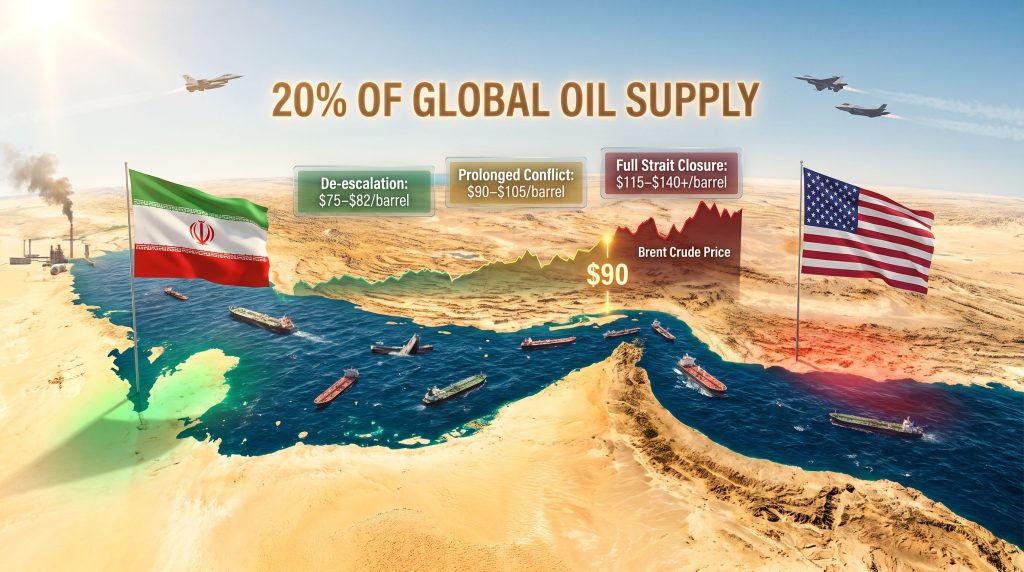
No geographic feature carries more weight in this conflict than the Strait of Hormuz. Roughly 20% of the world's daily oil supply transits through this narrow waterway, making it the single most important maritime chokepoint in the global energy system. Qatar's liquefied natural gas exports also pass through the Strait, meaning any disruption affects not just crude oil but the natural gas markets that post-Russian-invasion Europe has worked extensively to diversify into. For broader context on the LNG supply outlook, the stakes for European buyers are particularly significant.
The IRGC Navy's assertion that it will not permit oil, gas, or chemical fertiliser to pass through the Strait without Iranian coordination is a direct challenge to the foundational principle of freedom of navigation under international maritime law.
Recent incidents underscore the deteriorating maritime security environment:
- The IRGC Navy reported intercepting four unidentified vessels attempting to transit the Strait via what it described as an unsafe route, with two reportedly disabled.
- UK Maritime Trade Operations confirmed receiving military intelligence reports of a vessel fire northwest of Kumzar, Oman, with the cause unverified.
- Tanker traffic exiting the Persian Gulf has measurably declined as operators reassess route risk, according to UBS commodity analyst Giovanni Staunovo, who noted that repeated vessel strikes have produced a tangible tightening in the oil market.
Strategic Warning: A prolonged Strait of Hormuz disruption would affect not just Persian Gulf crude flows but also Qatar's LNG export capacity, with direct downstream consequences for European energy security at a time when the continent remains structurally vulnerable following the loss of Russian pipeline gas.
Oil Prices, Market Dynamics, and the Risk Premium
Brent crude surged above $90 per barrel following the latest escalation, representing a near 4% intraday move before partially retracing. Furthermore, energy markets are pricing in two separate risk vectors simultaneously. The first is operational disruption, specifically the near-term probability that tanker traffic through the Strait is physically impeded. The second is infrastructure destruction risk, the possibility that attacks on Gulf energy facilities produce structural supply reductions rather than temporary logistical delays.
These two risks are not equivalent in their market impact. The 2019 Abqaiq-Khurais attacks in Saudi Arabia demonstrated how sudden infrastructure strikes produce immediate and severe price spikes, with Brent jumping roughly 15% in a single session. A sustained campaign targeting multiple Gulf energy facilities simultaneously would carry significantly less recoverable upside. In addition, crude oil price trends have become increasingly sensitive to geopolitical flashpoints, as seen in crude oil price trends analysis throughout 2025.
Kuwait Petroleum Corporation's disclosure that an unspecified oil facility sustained significant material losses, prompting evacuation, alongside strikes on two power and desalination plants, provides a concrete early data point for infrastructure vulnerability in this conflict cycle.
Oil Market Scenario Analysis
| Scenario | Trigger Conditions | Estimated Brent Range |
|---|---|---|
| De-escalation and Negotiation | Both parties return to ceasefire framework; Strait reopens | $75–$82/barrel |
| Prolonged Conflict, Partial Disruption | Strikes continue but Strait remains partially operational | $90–$105/barrel |
| Full Strait Closure or Major Infrastructure Strike | Iran executes complete blockade or major Gulf energy facility destroyed | $115–$140+/barrel |
Disclaimer: The price scenarios above represent analytical projections based on historical conflict-driven energy market dynamics and current reporting. They do not constitute financial advice. Commodity prices are subject to rapid and unpredictable change.
Regional Players: Who Bears the Greatest Risk
Kuwait's Disproportionate Exposure
Of all the regional actors outside Iran and the United States, Kuwait has absorbed the most significant collateral damage. This weekend alone, the country sustained strikes on two power and desalination plants, causing fires and severe structural damage to what Kuwaiti military authorities described as vital institutions. The simultaneous evacuation of an oil facility following major material losses compounds the energy and humanitarian exposure facing a state that lacks the geographic depth to absorb sustained infrastructure targeting.
Saudi Arabia, the UAE, and Qatar: Balancing Alliances Against Vulnerability
Saudi Arabia, the UAE, and Qatar have collectively expressed concern over the escalating targeting of civilian infrastructure. The UAE specifically condemned strikes on schools, hospitals, desalination plants, energy facilities, and transportation hubs, a signal that Gulf Cooperation Council members are growing uncomfortable with the conflict's expanding scope.
Qatar's exposure deserves particular attention. As one of the world's largest LNG producers, Qatar's entire export capacity transits the Strait of Hormuz. Any sustained blockade would effectively freeze Qatar's ability to deliver contracted volumes to European and Asian buyers, triggering force majeure clauses and adding another dimension to what is already a complex global energy security crisis. Consequently, commodity market volatility of this nature presents acute hedging challenges for energy importers worldwide.
The Fracture Within Tehran's Leadership
One of the least discussed but potentially most consequential dynamics in this conflict is the visible split within Iran's own leadership. Secretary of State Marco Rubio publicly identified divergent factions within the Tehran regime, one oriented toward pragmatic negotiation and another committed to continued military confrontation.
This internal division is analytically significant for two reasons. First, even if a negotiating pathway exists, Iran's capacity to deliver a durable agreement is constrained by the absence of unified internal authority. Second, hardline factions may deliberately pursue actions designed to preclude negotiated outcomes. The absence from public view of Iran's Supreme Leader Mojtaba Khamenei since sustaining injuries in the early days of the conflict adds a further layer of uncertainty to Tehran's decision-making coherence.
The next major ASX story will hit our subscribers first
Could Diplomacy Still Reverse the Trajectory?
The conditions for a negotiated exit remain theoretically available but practically distant. Any renewed framework would need to address the same core issues that the June memorandum attempted to bridge: Strait of Hormuz access terms and parameters around Iran's nuclear programme. However, the geopolitical mining landscape analysis highlights how regional instability ripples well beyond energy markets into broader resource supply chains.
Iranian Foreign Minister Abbas Araghchi's statement that certain nuclear-related demands may remain unresolvable is a deliberate diplomatic signal. It narrows the space for negotiation before talks resume, pre-positioning Iran's public posture for an agreement failure that hardliners within the regime may actively prefer.
The US, meanwhile, is reinforcing its regional air power with additional F-16 and F-35 fighter jets and aerial refuelling aircraft, movements that expand potential strike capacity and signal readiness for a sustained or intensified campaign. Furthermore, gold safe-haven demand has surged in parallel with this escalation, as investors seek protection against the market uncertainty generated by this conflict. In high-tempo conflict environments, the probability of miscalculation events increases substantially as operational tempo rises.
Analytical Note: The convergence of broken diplomatic frameworks, internal regime fractures in Tehran, expanding US strike capacity, and deteriorating Strait of Hormuz security creates a scenario environment where the risk of unintended escalation is at least as significant as the risk of deliberate escalation. Markets and policymakers should price both dimensions accordingly.
Frequently Asked Questions: US Strikes on Iran Explained
What triggered the latest wave of US strikes on Iran after troops were killed?
The deaths of three US service members over a 48-hour period triggered the ninth consecutive night of US military operations against Iranian military infrastructure. President Trump publicly framed the strikes as a direct response to those casualties and as part of the broader objective of preventing Iran from acquiring a nuclear weapon. Al Jazeera's coverage of Trump's public statements provides additional context on the political framing of these operations.
How many US troops have been killed since the conflict began?
As of July 20, 2026, 17 US service members have been killed since the conflict commenced on February 28, 2026, with more than 420 wounded across the duration of operations.
Why is the Strait of Hormuz central to this conflict?
Approximately 20% of the world's daily oil supply transits through the Strait of Hormuz, alongside significant volumes of Qatar's LNG exports. Iranian control or disruption of this waterway would simultaneously affect crude oil flows from Saudi Arabia, the UAE, Kuwait, and Iraq, creating a systemic shock to global energy supply chains with no short-term substitute routing available at scale.
Has Iran formally abandoned the ceasefire?
Yes. Iran announced on Saturday, July 19, 2026, that it would no longer adhere to the interim memorandum signed in mid-June, citing what it characterised as US violations of the agreement's terms.
Which countries beyond Iran and the US have been most affected?
Kuwait has experienced the most direct collateral damage, with an oil facility evacuated after sustaining major material losses and two power and desalination plants struck. Jordan summoned an Iranian diplomat following the IRGC-attributed attack that killed US troops stationed on Jordanian soil.
What is the current Brent crude price environment?
Brent crude surged above $90 per barrel following the latest escalation round, with analysts warning that a full Strait of Hormuz closure or sustained infrastructure destruction campaign could push prices into the $115 to $140+ range based on historical conflict-period supply disruption modelling.
Want to Stay Ahead of the Resource Opportunities Emerging From Global Energy Disruption?
When geopolitical shocks like the US-Iran conflict rattle energy markets and redirect capital toward hard commodities, significant mineral discoveries on the ASX can represent compelling opportunities — and Discovery Alert's proprietary Discovery IQ model delivers real-time alerts the moment those discoveries are announced, turning complex data across 30+ commodities into clear, actionable insights. Explore historic discovery returns on Discovery Alert's discoveries page and begin your 14-day free trial to ensure you're positioned before the broader market reacts.