July 20, 2026
The Hidden Liability Sitting Behind Every Tailings Dam
For more than a century, the economics of iron ore mining were shaped by a single, largely unquestioned assumption: that water was not just available, but expendable. Vast volumes were consumed across beneficiation circuits, used to transport crushed ore through processing plants, separate mineral fractions, and ultimately carry waste material into storage impoundments. That waste, suspended in water as fine-grained slurry, accumulated behind engineered earthworks that grew taller with every tonne of ore processed.
The consequences of that assumption are now impossible to ignore. The 2019 collapse of the Brumadinho tailings dam in Brazil killed 270 people and released approximately 12 million cubic metres of iron ore waste into the surrounding landscape, contaminating waterways and destroying ecosystems across a vast area. It was not an isolated incident. Brumadinho followed the 2015 Mariana disaster, also in Brazil, where a tailings dam failure released around 60 million cubic metres of mining waste into the Rio Doce river system.
Together, these events fundamentally altered how regulators, investors, and mining operators assess the risk embedded in conventional wet iron ore processing.
The industry's response has been accelerating ever since. Iron ore production without water is no longer a theoretical ambition or a niche technical pursuit. It is becoming a strategic imperative, driven by converging pressures from environmental regulation, water scarcity, ESG capital allocation, and the growing demand for high-grade iron ore concentrates suited to green steelmaking.
When big ASX news breaks, our subscribers know first
Why Water-Intensive Processing Is Becoming Operationally Untenable
The Scale of Water Dependency in Conventional Beneficiation
Conventional wet beneficiation of iron ore can consume hundreds of litres of water per tonne of ore processed, depending on ore grade, particle size distribution, and circuit configuration. In high-throughput operations producing tens of millions of tonnes annually, this translates to water demands that rival those of entire regional agricultural sectors.
This dependency creates compounding operational risk across several dimensions:
-
Water scarcity exposure: Many of the world's most significant iron ore deposits are located in regions experiencing increasing hydrological stress, including parts of Western Australia, Brazil's interior, and West Africa. As aquifer depletion and changing precipitation patterns reduce available freshwater, water procurement costs rise and social licence to operate narrows.
-
Tailings dam liability: Every litre of water used in wet beneficiation eventually ends up in a tailings storage facility, carrying fine ore particles with it. These facilities require continuous engineering management, monitoring, and regulatory compliance. Post-Brumadinho, many jurisdictions have introduced mandatory upstream dam decommissioning requirements, creating stranded capital liabilities for operators.
-
Insurance and financing constraints: Major institutional lenders and insurers have begun applying risk surcharges to mining operations with significant tailings dam portfolios. The Global Industry Standard on Tailings Management, developed in the aftermath of Brumadinho, has introduced new obligations that materially increase the cost of maintaining conventional wet processing operations.
-
Regulatory trajectory: Brazil introduced legislation following Brumadinho mandating the decommissioning of upstream-method tailings dams by 2025. Australia has tightened its tailings regulatory framework across multiple states. The direction of travel globally is unambiguous. Furthermore, mining sustainability transformation is increasingly shaping how operators plan capital expenditure.
Conventional wet beneficiation can require hundreds of litres of water per tonne of ore processed. In water-stressed regions, this operational dependency is no longer economically or environmentally viable.
What Iron Ore Production Without Water Actually Involves
Distinguishing Between Dry, Natural Moisture, and Semi-Dry Processing
The terminology around waterless iron ore processing requires precision, because the technical approaches differ significantly in their equipment requirements, applicable ore types, and achievable outcomes.
Natural moisture processing relies on the inherent moisture content already present within the ore body, without adding any process water. Crushed ore is screened and classified using the small amount of moisture naturally occurring in the rock to assist particle adhesion and separation at screen surfaces. This approach works effectively for high-grade ores with relatively coarse liberation characteristics, where the target iron mineral is already well liberated at manageable crush sizes.
Fully dry processing uses no moisture of any kind, instead employing air classification, high-intensity magnetic separation, or electrostatic methods to separate iron-bearing minerals from gangue. This is mechanistically distinct from wet processing, not merely a modified version of it. The physics of particle separation in an air medium differ fundamentally from separation in a water medium, and equipment must be specifically engineered for these conditions.
Semi-dry or filtered tailings methods represent a hybrid approach, where water used in beneficiation is largely recovered through pressure filtration before tailings are deposited as stackable solids rather than slurry. This does not eliminate water from the processing circuit but dramatically reduces net consumption and eliminates the need for a conventional tailings impoundment.
How the Methods Compare
| Processing Method | Water Input | Tailings Output | Grade Achievable | Best Suited For |
|---|---|---|---|---|
| Conventional Wet Beneficiation | High (hundreds of L/tonne) | Wet slurry tailings dam | 60-65% Fe | Low-to-medium grade ores |
| Natural Moisture Screening | None added | Dry coarse reject | 60-63% Fe | High-grade, low-moisture ores |
| Dry Magnetic Separation (FDMS) | Zero | Dry fine tailings | 66-69% Fe | Ultrafine particles below 100 microns |
| Dry Stacking and Filtering | Minimal | Compacted dry stack | Variable | Post-concentration tailings management |
The Core Technologies Making Waterless Processing Possible
Fines Dry Magnetic Separation: Processing at the Ultrafine Scale
Fines Dry Magnetic Separation, or FDMS, represents the most technically sophisticated of the emerging dry processing methods, and arguably the one with the greatest long-term impact on iron ore industry structure.
FDMS combines high-intensity magnetic separation with pneumatic air classification to process iron ore particles smaller than 100 micrometres without any water medium. In conventional wet processing, water provides the transport and dispersion medium that keeps fine particles separated and mobile through the circuit. FDMS replaces this function with carefully controlled air streams that suspend fine ore particles, allowing magnetic rollers to extract iron-rich fractions with precision that can match or exceed wet magnetic separation in specific ore types.
The technology's performance specifications at current development stages are notable:
- Pilot-scale processing rate of approximately 30 tonnes per hour
- Industrial-scale target capacity of 1.5 million metric tonnes per year per facility
- Iron concentrate grades in the range of 66-69% Fe, comfortably meeting the specifications required by Direct Reduction Ironmaking (DRI) processes
- Patent recognition across 59 countries, providing intellectual property protection for technology developers
FDMS operates by suspending fine ore particles in an air stream, allowing magnetic rollers to extract iron-rich fractions with precision comparable to, and in some cases exceeding, wet magnetic separation methods.
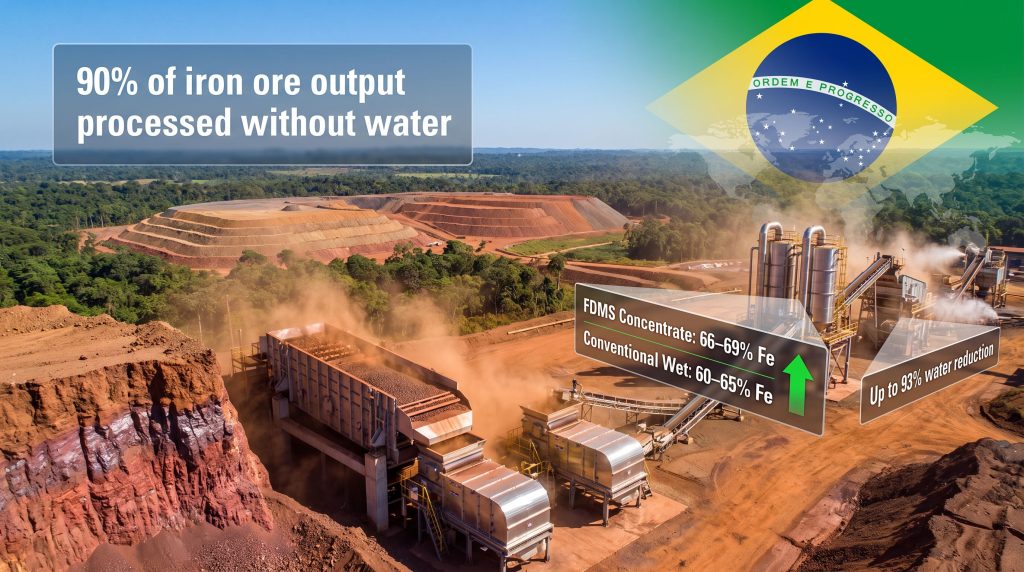
A critical but underappreciated aspect of FDMS is its grade selectivity. Because iron minerals in many ore types carry different magnetic susceptibilities than silica, alumina, and phosphorus-bearing gangue minerals, air-based magnetic separation can achieve rejection of these deleterious elements without the dilution effects that sometimes occur in water-based circuits. The result is concentrates that consistently grade above 66% Fe, compared to the 60-65% Fe typical of conventional wet beneficiation outputs.
This grade advantage is commercially significant. DRI-grade concentrates — those above 67% Fe with low impurity levels — command meaningful price premiums over standard blast furnace pellet feed. As green iron production capacity based on hydrogen-fed DRI expands globally, demand for this higher-grade material is expected to grow substantially through the late 2020s.
Dry Vibrating Screen Technology: Engineering Without Process Water
For coarser ore fractions, dry vibrating screen technology offers a more immediately deployable pathway to waterless processing. The engineering challenge in dry screening is the absence of water as a transport medium. In conventional wet screening, water fluidises the ore bed on the screen surface, helping particles find their way through apertures and preventing blinding of screen panels.
Dry screening compensates through screen design optimisation: increased vibration frequency, steeper deck inclination, and careful aperture engineering that accounts for the different flow behaviour of dry particles. The ore's natural moisture, even at low levels, assists particle separation at the screen surface and prevents excessive dust generation.
Quantified operational gains from advanced dry vibrating screen installations include:
- Up to 1,000 additional tonnes processed per day per production line compared to equivalent wet configurations
- Approximately 4.8% higher throughput efficiency versus water-based screening lines in suitable ore types
The Haver and Boecker N-Class vibrating screen is a representative example of purpose-built dry screening equipment, specifically engineered for the mechanical demands of iron ore processing without process water. Screen aperture sizing, vibration frequency selection, and deck inclination must all be reconfigured relative to wet screening installations, reflecting the genuinely different physics involved.
Dry Stacking and Filtered Tailings: Eliminating the Dam Entirely
Where some process water remains in the beneficiation circuit, pressure filtration of tailings offers a pathway to eliminating conventional tailings storage entirely. Filter presses or vacuum disc filters remove residual moisture from tailings slurry, producing a filter cake with sufficient structural strength to be deposited as a dry stack without the need for a containing embankment.
The water recovery benefits are substantial. Dry stacking systems can reduce total process water consumption by up to 93% compared to conventional wet beneficiation circuits. From an ESG and regulatory perspective, the elimination of a tailings dam severs the operational link between iron ore production and one of the mining industry's most significant liability categories.
The geotechnical principles behind dry stack stability differ meaningfully from conventional tailings impoundment engineering. Dry stacked tailings behave more like a compacted earthfill embankment than a fluid-saturated impoundment, offering greater intrinsic stability and significantly reduced risk of catastrophic liquefaction failure.
Where Waterless Processing Is Already Operating at Scale
Brazil's Carajás Complex: The Global Benchmark
The most advanced large-scale example of iron ore production without water is operating not as a pilot project or demonstration facility, but as the world's highest-volume iron ore production complex. Brazil's Carajás system, operated in Pará state, currently processes approximately 90% of its iron ore output without added process water, with a stated target of achieving 100% water elimination across the complex by 2027.
Several characteristics of Carajás ore make it uniquely compatible with dry processing methods:
- The deposit contains some of the highest-grade iron ore in the world, with in-situ grades that reduce the beneficiation intensity required to reach product specifications
- The ore is relatively low in clay minerals, which are the primary source of screen blinding and particle agglomeration problems in dry processing
- Liberation of iron minerals from gangue occurs at relatively coarse particle sizes, reducing the need for ultrafine grinding that would complicate dry separation
Key facilities already producing iron ore on a waterless basis include the S11D complex at Canaã dos Carajás and Serra Leste at Curionópolis, both operating within the Northern System.
The Capanema Project: Designing Waterless Processing from First Principles
Perhaps more significant than the retrofitting of existing operations is the construction of entirely new iron ore facilities designed from inception for waterless processing. The Capanema project represents this paradigm shift at industrial scale.
| Milestone | Target Year | Description |
|---|---|---|
| 70% of total production from dry or natural moisture processing | 2024 | Portfolio-wide production mix shift |
| 90% of Carajás output processed without water | Current | Northern System operational benchmark |
| 100% water elimination at Carajás | 2027 | Full dry processing conversion target |
| 15 Mt/year waterless production at Capanema | Post-2027 | Greenfield dry processing at full scale |
Capanema is designed for 15 million metric tonnes per year of iron ore output, with a capital commitment of approximately US$12 billion and a fully waterless processing configuration embedded from the engineering design phase. This contrasts with the more common approach of retrofitting dry processing technology onto existing wet circuits, which carries higher implementation complexity and cost per tonne.
ESG Implications: Why This Matters Beyond Operations
Institutional Investor Scrutiny of Tailings Exposure
The ESG investment screening frameworks now applied by major institutional funds have fundamentally changed the calculus around tailings dam exposure. Following the Church of England Pensions Board's leadership in establishing the Investor Mining and Tailings Safety Initiative after Brumadinho, more than 100 institutional investors representing over US$14 trillion in assets signed letters demanding improved tailings disclosure from mining companies.
Operators moving toward dry processing reduce their tailings dam inventory, which directly improves their standing under ESG screening criteria applied by these funds. The commercial consequence is meaningful: reduced cost of equity capital, improved access to ESG-labelled debt instruments, and protection of index inclusion in sustainability-focused indices.
Water Stewardship as a Competitive Moat
Water risk is increasingly being treated not merely as an operational concern but as a long-term asset quality question. Mining operations in regions mapped as high or extremely high water stress by the World Resources Institute's Aqueduct tool face growing questions from analysts and lenders about the sustainability of their water access arrangements.
Dry processing operations, by contrast, can credibly claim improved water stewardship ratings under frameworks such as CDP Water Security, reducing their exposure to regulatory water curtailment and improving community relations in regions where agricultural and municipal water users compete with mining for the same resource.
Carbon Footprint: A More Nuanced Picture
The carbon implications of dry versus wet processing require careful analysis rather than simplified assumptions. Dry magnetic separation and air classification circuits typically consume more electricity per tonne of ore processed than equivalent wet circuits, because maintaining air suspension and magnetic field intensity demands significant power input.
However, this needs to be weighed against:
- Elimination of energy consumed in pumping, thickening, and dewatering in wet circuits
- Elimination of emissions associated with tailings dam construction and long-term management
- The lifecycle emissions advantage of producing DRI-grade concentrates (66-69% Fe) that can be fed directly into hydrogen iron ore reduction furnaces without the energy penalty of re-drying wet concentrates
That final point is strategically significant. Wet-processed concentrates often need to be dried before DRI use, adding an energy-intensive step that partially negates the carbon benefits of green hydrogen ironmaking. Dry-processed concentrates eliminate this requirement, creating a tighter integration between waterless iron ore processing and the broader green steel value chain.
The next major ASX story will hit our subscribers first
The Emerging Commercial Landscape
Grade Quality and Product Premium
The grade advantage of dry-processed iron ore concentrates is not merely an operational metric. It carries direct revenue implications. DRI-grade concentrates above 67% Fe command price premiums that can reach US$20-40 per tonne above standard blast furnace pellet feed, depending on market conditions, due to their scarcity and the specific technical requirements of DRI shaft furnaces.
Electric arc furnace steelmakers and DRI operators specifically require concentrates above 67% Fe to maintain productivity and energy efficiency in their processes. Below this threshold, gangue minerals occupy furnace volume, increase slag generation, and raise energy consumption per tonne of steel produced. Dry processing, particularly FDMS, is uniquely capable of consistently reaching this specification from ore feeds that would produce lower-grade outputs through wet beneficiation.
DryFlow Magnetics: A New Generation of Technology Developer
One company that exemplifies the next stage of commercial development in this space is DryFlow Magnetics, founded in 2024. Its core value proposition centres on converting low-grade iron ore feeds with iron content below 30% Fe into concentrates exceeding 67% Fe, without any water consumption.
The claimed capital cost reduction relative to conventional wet processing plant construction sits at 60-70% lower, a figure that, if validated at commercial scale, would fundamentally alter the project economics of iron ore development globally. The absence of a tailings dam requirement further reduces capital intensity and eliminates a category of liability that has historically added substantial cost to project financing.
It is important to note that these performance claims remain subject to validation at full commercial scale. Investors and analysts should treat them as indicative of the technology's direction rather than confirmed operational benchmarks.
Ore Types Where Dry Processing Remains Challenging
Not all iron ore deposits are suited to current dry processing technology. Understanding these limitations is as important as understanding the technology's capabilities:
- Clay-rich ores: High clay content causes particle agglomeration in dry screening circuits, reducing separation efficiency and potentially blinding screen panels
- High-moisture deposits: Surface or pit drainage can elevate ore moisture beyond the range where natural moisture screening remains effective, particularly in tropical climates during wet seasons
- Ultrafine liberation requirements: Where iron minerals are only liberated from gangue at particle sizes below 50 micrometres, the energy intensity and complexity of dry separation increases substantially
- Humidity effects: Ambient humidity in tropical operating environments can affect the flow behaviour of fine dry particles, requiring additional engineering controls
Strategic Outlook: Pathways to Industry-Wide Transition
Scenario Analysis
| Scenario | Timeline | Key Drivers | Barriers |
|---|---|---|---|
| Incremental Adoption | 2025-2030 | Regulatory pressure, water scarcity | High retrofit costs for existing wet plants |
| Accelerated Transition | 2025-2028 | Green steel demand, ESG capital allocation | Technology readiness at ultrafine particle sizes |
| Full Sector Transformation | Post-2030 | FDMS at industrial scale, DRI market growth | Energy cost parity with wet processing |
The pace of transition will ultimately be determined by the rate at which FDMS technology scales from its current pilot throughput of 30 tonnes per hour toward the millions of tonnes per year required for meaningful contribution to global iron ore supply. The gap between pilot performance and industrial necessity remains one of the sector's most consequential engineering challenges.
What Needs to Happen for Dry Processing to Become the Industry Standard
A realistic pathway to widespread adoption requires progress across several fronts simultaneously:
- Scaling FDMS throughput from pilot to full industrial operation, with demonstrated reliability over multi-year operational periods
- Reducing energy consumption in air classification stages to reach cost parity with wet processing at comparable ore grades
- Developing standardised dust management protocols that address occupational health implications of dry fine particle processing environments
- Regulatory frameworks that price the externalities of tailings dam risk more accurately, creating a stronger economic incentive for dry processing investment in jurisdictions that have not yet experienced major dam failures
- Equipment standardisation that reduces the engineering complexity and capital cost of deploying dry processing configurations in new project settings
The strategic alignment between iron ore miners investing in dry processing and steelmakers investing in green hydrogen DRI capacity is real and strengthening. Furthermore, the China steel and iron ore market will play a pivotal role in shaping global demand for DRI-grade concentrates as dry processing scales. Additionally, progress in steel decarbonisation collaboration between major producers and technology partners is accelerating the commercial viability of these transitions.
Frequently Asked Questions: Iron Ore Production Without Water
Can All Iron Ore Deposits Be Processed Without Water?
Not currently. High-grade, low-clay deposits with naturally low moisture content, such as those in Brazil's Carajás region, are the most compatible with existing dry technologies. Clay-rich, high-moisture, or very fine-grained deposits present greater technical challenges that ongoing research and development is working to address.
How Much Water Does Dry Iron Ore Processing Actually Save?
Dry stacking and filtered tailings systems can reduce total process water consumption by up to 93% compared to conventional wet beneficiation circuits. Fully dry processing configurations eliminate added process water entirely, relying only on the ore's inherent natural moisture.
Is Dry-Processed Iron Ore of Higher Quality Than Wet-Processed Ore?
In many cases, yes. FDMS technology can produce concentrates in the 66-69% Fe range, exceeding the typical 60-65% Fe output of conventional wet beneficiation and meeting the high-grade specifications required by DRI-based green steelmaking processes. Consequently, iron ore production without water is increasingly seen as a quality advantage as much as an environmental one.
What Happens to Tailings in a Dry Processing Operation?
Rather than being pumped as slurry into a tailings storage facility, dry processing rejects are managed as stackable solid material. This eliminates the need for tailings dams and the associated failure risk, environmental liability, and long-term monitoring costs.
What Is the Current Scale of Waterless Iron Ore Production Globally?
The most advanced large-scale example is Brazil's Carajás complex, where approximately 90% of iron ore output is currently processed without added water, with a target of 100% by 2027. The planned Capanema project is designed to produce 15 million metric tonnes per year on a fully waterless basis.
This article is intended for informational purposes only. Forward-looking statements, technology performance claims, and market projections discussed herein involve uncertainty and should not be relied upon as financial advice. Readers should conduct independent due diligence before making any investment decisions.
Want to Invest in the Minerals Powering the Green Steel Revolution?
Discovery Alert's proprietary Discovery IQ model delivers real-time alerts on significant ASX mineral discoveries — including the iron ore and critical minerals driving the shift toward waterless processing and green steelmaking — turning complex data into clear, actionable opportunities for investors at every level. Explore how historic mineral discoveries have generated substantial returns and begin your 14-day free trial today to position yourself ahead of the market.