July 20, 2026
The Hidden Carbon Cost Embedded in Every Roll of Aluminium Foil
Most conversations about sustainable packaging begin at the end of a product's life. Can it be recycled? Is it compostable? Does it end up in landfill? These are legitimate questions, but they increasingly miss the more consequential issue forming at the opposite end of the supply chain. Before a single metre of aluminium foil is wound onto a packaging line, before a beverage can blank is stamped, before an aerosol body is drawn, the material arriving at the converter already carries a carbon debt accumulated across thousands of kilometres of extraction, refining, and electrolysis.
That upstream carbon burden is now becoming one of the most commercially significant dimensions of low-carbon aluminium in packaging markets. Understanding how it is measured, how it is reduced, and how it can be credibly verified is no longer a niche interest for sustainability departments. It is rapidly becoming a procurement criterion, a competitive differentiator, and in some regulatory environments, a compliance requirement.
When big ASX news breaks, our subscribers know first
Why the Carbon Problem in Aluminium Packaging Starts at the Smelter
Aluminium's functional properties have never been in question. Its capacity to act as an impermeable barrier against moisture, oxygen, light, and aroma contamination makes it essentially irreplaceable in applications ranging from dairy lids to pharmaceutical blister packaging. Its corrosion resistance and infinite recyclability reinforce its position as a premium packaging substrate.
The challenge is not what aluminium does inside a packaging structure. The challenge is what happens before it gets there.
The Production Pathway That Locks in Carbon
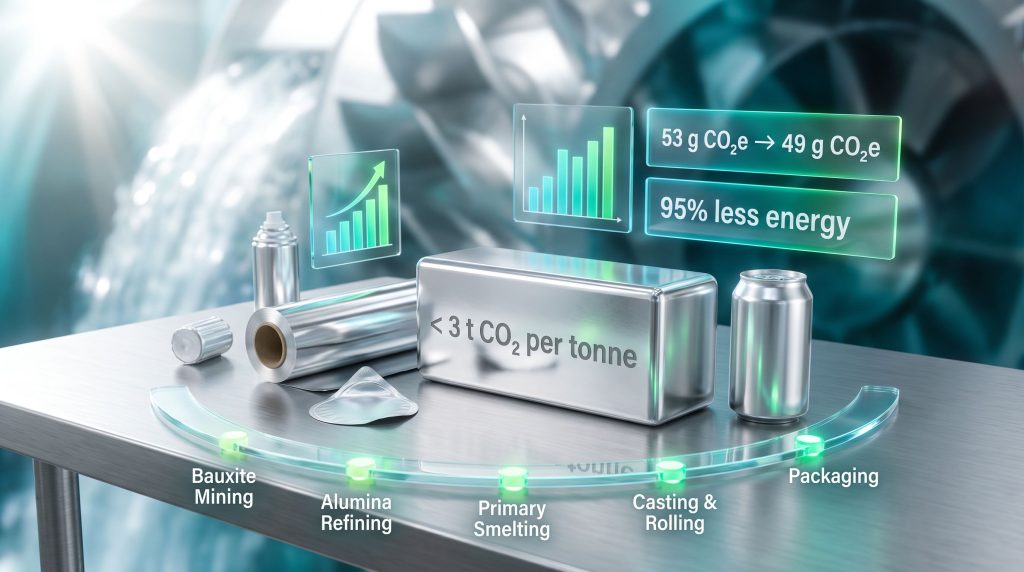
The production pathway for primary aluminium follows a sequence that progressively intensifies in energy demand. A bauxite production overview helps contextualise why the earliest stages of this chain matter so much:
- Bauxite mining extracts the raw ore, typically in tropical regions including Australia, Guinea, and Brazil.
- Alumina refining (the Bayer Process) converts bauxite into aluminium oxide, consuming significant thermal energy.
- Primary smelting via electrolysis (the Hall-Heroult Process) reduces alumina to metallic aluminium using direct electrical current, and represents the single most energy-intensive industrial process in the entire value chain.
- Casting, rolling, and converting shape the refined metal into foil, sheet, or can stock for downstream use.
When the electricity powering the electrolysis stage is derived from coal or gas-fired generation, the resulting metal carries a carbon footprint that can exceed 16 tonnes of CO₂ equivalent per tonne of primary aluminium produced. That figure is not attributable to the packaging design, the brand owner, or the consumer. It is baked into the material before it leaves the smelter gate.
Furthermore, the top aluminium producers operating globally are under increasing pressure to address this upstream intensity, particularly as Scope 3 reporting obligations tighten across major consumer markets.
This upstream carbon intensity means that although aluminium may represent only a fraction of a finished packaging product's physical mass, it can account for a disproportionately large share of that product's total lifecycle emissions. For brands with Science-Based Targets covering Scope 3 categories, this makes low-carbon aluminium sourcing a high-leverage intervention.
What Low-Carbon Aluminium in Packaging Actually Means
The Definitional Vacuum and Why It Matters
One of the more underappreciated structural challenges in this market is the absence of a single, universally ratified emissions threshold that defines aluminium as low carbon. Unlike certified organic food or recycled content claims, which have established audit frameworks and mandatory labelling regimes in many markets, the term low-carbon aluminium currently occupies a definitional grey zone. Different producers, converters, and certification bodies reference different thresholds, measured at different points in the value chain, using methodologies of varying rigour.
This fragmentation creates a market where competing claims are difficult to compare without deep due diligence, and where the risk of greenwashing remains non-trivial. According to the International Aluminium Institute's low-carbon factsheet, establishing common definitions is one of the sector's most pressing governance challenges.
The most widely referenced benchmarks currently in use are set out below:
| Framework / Body | Low-Carbon Threshold | Measurement Scope |
|---|---|---|
| Common Market Reference | ≤4 t CO₂e per tonne | Primary aluminium, cradle-to-gate |
| First Movers Coalition (FMC) | <3 t CO₂ per tonne | Cradle-to-gate, all upstream emissions |
| Fastmarkets Low Carbon Differential | <4 t CO₂e per tonne | Scope 1 & 2, ingot stage |
| Flexible Packaging (Foilstock) | ≤5.5 t CO₂e per tonne | Rolled foilstock, cradle-to-gate |
| Flexible Packaging (Ingot) | ≤4.0 t CO₂e per tonne | Ingot stage, cradle-to-gate |
Some converters operating in the flexible packaging space have begun establishing their own internal frameworks. One approach segments low-carbon aluminium foil into two distinct tiers: a first category covering aluminium produced with renewable electricity carrying emissions of 6.1 t CO₂e per tonne or less, and a more demanding second tier combining renewable electricity with recycled content to achieve emissions at or below 4.5 t CO₂e per tonne on a cradle-to-gate basis. Both measurements cover the full production pathway from raw material extraction through to rolled plain aluminium foil.
The Product Carbon Footprint (PCF) methodology, calculated on a cradle-to-gate basis and aligned with ISO 14067, is emerging as the preferred quantification framework. Traceability verification under ISO 22095, complemented by independent third-party auditing from bodies such as TÜV SÜD, is transitioning from a premium credential to a baseline market expectation.
What Gets Counted in a Cradle-to-Gate PCF
| Emission Category | Included in Cradle-to-Gate PCF? |
|---|---|
| Bauxite mining emissions | ✅ Yes |
| Alumina refining energy | ✅ Yes |
| Smelting electricity (Scope 2) | ✅ Yes |
| Direct process emissions (anode consumption) | ✅ Yes |
| Rolling and converting energy | ✅ Yes |
| Production waste emissions | ✅ Yes |
| End-of-life / recycling credit | ❌ Not included (gate boundary) |
The Three Technical Pathways to Lower Emissions
Renewable Electricity in Primary Smelting
Because electrolysis is the dominant source of emissions in primary aluminium production, switching from fossil-fuel-derived grid power to renewable sources, particularly hydroelectric generation, delivers the largest single reduction available anywhere in the value chain. Regions with abundant and consistently low-cost hydropower, including parts of Scandinavia, Canada, Iceland, and New Zealand, have become strategic sourcing locations for buyers prioritising carbon credentials in their aluminium supply chains.
It is worth noting that hydropower availability is not geographically uniform, and smelters in regions with coal-intensive grids face structural disadvantages that cannot easily be resolved through operational changes alone. This geographic dependency creates a sourcing premium for renewable-powered primary aluminium that is unlikely to disappear in the near term. Efforts such as Gladstone aluminium repowering illustrate how major producers are responding to this structural challenge at the facility level.
Recycled and Post-Consumer Content
Secondary aluminium production from recycled scrap requires approximately 95% less energy than primary smelting from bauxite ore. This is not a marginal efficiency gain; it is a transformational difference that makes recycled content the most carbon-efficient aluminium available at scale in most product categories.
Increasing post-consumer recycled (PCR) content in packaging applications delivers compounding benefits when combined with renewable-energy primary aluminium: the blended PCF of the resulting material can be significantly lower than either pathway achieves individually. However, the quality and form of recyclable aluminium scrap matters considerably. Thin gauge foil, for example, is more difficult to collect and process efficiently than can scrap or extrusion offcuts, creating a technical constraint on how rapidly recycled content can be increased in flexible packaging specifically.
Inert Anode and Carbon-Free Smelting Technology
Conventional primary smelting uses carbon-based anodes that are electrochemically consumed during the reduction process, generating direct CO₂ emissions as a process byproduct entirely separate from the electricity source. Even a smelter powered entirely by renewable electricity still produces direct process emissions through anode consumption under conventional technology.
Inert anode technology eliminates this mechanism by replacing consumable carbon anodes with non-reactive materials, producing oxygen as a byproduct rather than CO₂. Commercially significant developments in this space include:
- ELYSIS® technology, developed through collaboration between Alcoa and Rio Tinto, which has been used in the production of carbon-free aluminium for commercial packaging applications including an aerosol can manufactured using a blend of 50% ELYSIS aluminium and 50% post-consumer recycled content in a three-party collaboration also involving Unilever. The Alcoa low-carbon venture underscores how strategic partnerships are accelerating this technology's commercial reach.
- RUSAL's ALLOW INERTA technology, which was used in the production of Russia's first low-carbon beverage cans, combining 64% recycled content with inert anode smelting to achieve a verified carbon footprint of less than 3 t CO₂ per tonne, meeting the First Movers Coalition threshold for primary aluminium.
These are not pilot-scale demonstrations. Both represent commercial applications in finished consumer packaging, confirming that carbon-free smelting technology has crossed the threshold from research concept to market-ready solution, even if scale remains limited. Broader initiatives, such as the zero-carbon metals partnership involving Rio Tinto in Austria, further demonstrate how the industry is pursuing decarbonisation across multiple metal categories simultaneously.
Real-World Emissions Reductions Across Packaging Formats
The theoretical benefits of low-carbon aluminium in packaging translate into measurable outcomes across multiple packaging categories. The table below summarises documented reductions from commercial applications:
| Packaging Format | Baseline Footprint | Low-Carbon Footprint | Reduction Achieved |
|---|---|---|---|
| Liquid packaging carton (Elopak Pure-Pak®) | 53 g CO₂e per carton | 49 g CO₂e per carton | ~8% |
| Beverage can (RUSAL ALLOW INERTA, 64% PCR) | Conventional primary (~16 t CO₂/t) | <3 t CO₂/t | ~85%+ |
| Aerosol can (ELYSIS + 50% PCR) | Conventional primary | Near-zero carbon | Approaching 100% |
| Flexible packaging foilstock | Conventional primary | ≤5.5 t CO₂e/t | Significant reduction |
The Elopak case is instructive because the 8% reduction from 53 g to 49 g CO₂e per carton was achieved without any change to carton design, barrier specification, seal performance, or manufacturing process. The only variable was the sourcing designation of the aluminium component. For brands seeking Scope 3 reductions that do not require product reformulation or capital investment in new equipment, this represents a compelling commercial argument. Indeed, low-carbon aluminium is proving to be a gamechanger for the packaging industry more broadly, with converters increasingly treating it as a standard sourcing criterion rather than a premium option.
One of the most strategically significant aspects of low-carbon aluminium adoption is that it operates entirely upstream of the packaging line. Brands can reduce their verified supply chain emissions without reformulating products, retooling production lines, or altering consumer-facing specifications. The improvement is invisible to the end user and entirely traceable in the sustainability ledger.
How Chain-of-Custody Verification Actually Works
The Industrial Reality of Mixed-Stream Processing
A persistent misconception in this space is that low-carbon aluminium must be physically isolated throughout the supply chain to retain its certification status. In practice, the industrial processing of aluminium, particularly at the rolling and converting stages, involves co-processing of materials from multiple sources. Physical segregation at commercial scale is neither economically viable nor operationally practical.
The solution is mass balance chain-of-custody accounting, a methodology that tracks certified volumes through the supply system without requiring physical separation. Here is how it operates in practice:
- A converter purchases a verified quantity of certified low-carbon aluminium from an audited supplier.
- That material enters the production system and may be co-processed with conventional aluminium streams.
- The certified quantity is recorded in a documented accounting ledger maintained by the converter.
- An equivalent volume of finished product is allocated the low-carbon designation in sales documentation and customer-facing reporting.
- Independent auditors verify at defined intervals that the total certified inputs equal the total certified product outputs. Over-allocation is structurally prevented by the accounting system.
This approach is recognised under several international certification frameworks when the audit trail meets the required standard of independence and rigour. It mirrors methodologies already established in renewable energy certificate markets and certified sustainable forestry supply chains.
The Credibility Infrastructure Behind the Claim
What separates a credible low-carbon aluminium claim from a marketing statement is the verification infrastructure supporting it. The non-negotiable elements of a robust framework include:
- PCF calculation methodology aligned with ISO 14067 (product carbon footprint)
- Chain-of-custody documentation aligned with ISO 22095 (traceability)
- Independent third-party certification from a recognised body such as TÜV SÜD
- Cradle-to-gate scope coverage that includes all upstream emission categories
- Mass balance accounting systems with documented reconciliation processes
Converters and aluminium suppliers that can present all five elements are in a materially different position than those relying on supplier declarations alone. Elopak's recent adoption of low-carbon aluminium for liquid packaging cartons, for instance, was underpinned by precisely this kind of independently verified chain-of-custody framework.
The next major ASX story will hit our subscribers first
Supply Constraints, Market Dynamics, and Strategic Positioning
A Structural Supply Gap That Will Define the Market
The lowest-carbon primary aluminium currently available globally is estimated to be capable of meeting approximately one-third of total global demand. This is not a temporary imbalance attributable to demand surges. It reflects a structural constraint: the renewable energy capacity, hydropower infrastructure, and inert anode technology required to produce genuinely low-carbon primary aluminium at scale does not exist in sufficient volume today to satisfy even a fraction of the packaging industry's potential demand if all major brands simultaneously prioritised decarbonisation in their aluminium sourcing.
The practical implications are significant:
- Low-carbon aluminium commands a price premium that reflects genuine scarcity, not just differentiation.
- Availability, not willingness to pay, is often the binding constraint for packaging brands seeking to decarbonise their aluminium supply chains.
- Early movers who secure long-term supply agreements with verified low-carbon aluminium producers are likely to hold a structural advantage as regulatory and brand pressure intensifies.
Three Forces Shaping Adoption Over the Next Decade
-
Regulatory escalation: Extended Producer Responsibility frameworks and mandatory Scope 3 reporting requirements, particularly in the EU under the Corporate Sustainability Reporting Directive (CSRD), are moving supply chain carbon data from voluntary disclosure to compliance obligation. Packaging manufacturers that cannot provide independently verified PCF data for their aluminium inputs will face increasing difficulty meeting procurement qualification criteria from regulated brand owners.
-
Brand commitment cascade: Science-Based Targets commitments at major FMCG companies are propagating downstream into supplier qualification requirements. The mechanism is straightforward: a brand that commits to a 50% Scope 3 reduction by 2030 must embed emissions requirements into its packaging supplier contracts. Converters that cannot demonstrate verified reductions will be disqualified, regardless of price competitiveness.
-
Technology maturation: Commercial deployment of inert anode technology and continued expansion of renewable energy capacity in aluminium-producing regions is expected to progressively reduce the cost premium and expand the supply of low-carbon primary aluminium. The timeline is measured in years rather than months, but the directional trajectory is established.
Frequently Asked Questions: Low-Carbon Aluminium in Packaging
Does low-carbon aluminium perform differently from conventional aluminium?
No. The physical and chemical properties of aluminium, including barrier performance, corrosion resistance, formability, and recyclability, are determined by its atomic structure and alloy composition, not by the energy source used during its production. A foil produced with hydroelectric-powered smelting and one produced with coal-powered smelting are chemically and functionally identical. The difference exists entirely in the upstream emissions record, not in the material itself.
Is low-carbon aluminium still infinitely recyclable?
Yes. Aluminium remains 100% infinitely recyclable regardless of how it was produced. The sourcing credentials attached to the original primary production have no bearing on the recyclability of the finished packaging product. A beverage can made from ELYSIS carbon-free aluminium can be recycled, remelted, and recast into new aluminium just as readily as one made from conventional primary metal.
What is the practical difference between recycled aluminium and low-carbon aluminium?
These are related but distinct concepts. Recycled aluminium describes a production route, specifically the use of post-consumer or post-industrial scrap as feedstock, requiring approximately 95% less energy than primary production. Low-carbon aluminium is a broader performance category defined by a quantified PCF threshold, which can be achieved through renewable-energy primary production, high recycled content, or a combination of both. All recycled aluminium is likely to qualify as low-carbon aluminium, but not all low-carbon aluminium is recycled aluminium.
What carbon threshold qualifies as low carbon for aluminium in packaging?
There is no single mandatory global threshold. The most widely applied benchmarks are ≤4 t CO₂e per tonne at the ingot stage (used as the common market reference and by Fastmarkets in its low-carbon differential pricing), <3 t CO₂ per tonne (the First Movers Coalition definition for primary aluminium), and ≤5.5 t CO₂e per tonne for rolled foilstock in flexible packaging applications.
Disclaimer: This article is intended for informational purposes only and does not constitute financial or investment advice. Forecasts, projections, and market estimates referenced throughout are based on publicly available industry data and should not be relied upon as guarantees of future outcomes. Readers should conduct independent research and seek professional advice where appropriate.
Want to Track the ASX Companies Driving the Future of Low-Carbon Metals?
Discovery Alert's proprietary Discovery IQ model delivers real-time alerts on significant ASX mineral discoveries — including the bauxite, aluminium, and critical minerals sectors shaping the decarbonisation supply chain — turning complex market data into actionable investment insights. Explore Discovery Alert's dedicated discoveries page to understand how historic mineral discoveries have generated substantial returns, and begin your 14-day free trial today to position yourself ahead of the market.