July 20, 2026
When Crude Prices Fall and the Real Crisis Deepens
Commodity markets have a long history of sending misleading signals during periods of genuine structural stress. Investors anchored to headline crude prices as the primary barometer of energy security risk tend to misread the moment when the true fault line has already shifted somewhere else entirely. That is precisely the situation unfolding across the global oil refining industry today, where falling crude benchmarks are functioning less as a relief signal and more as a distraction from a far more consequential breakdown happening downstream.
Understanding why requires separating two fundamentally different markets: the market for crude oil, which is extracted from the ground, and the market for refined fuels, which are what households, factories, airlines, and logistics networks actually consume. These two markets are connected but not interchangeable. When the infrastructure that bridges them, meaning the global refinery network, is simultaneously damaged by geopolitical conflict, constrained by decades of underinvestment, and facing accelerating structural obsolescence, crude price relief offers no protection whatsoever from the fuel supply crunch that follows.
The global oil refining industry warning signs are now visible across multiple dimensions at once, and their convergence is producing a situation without close modern precedent. Furthermore, understanding the broader oil price movements at play is essential for contextualising why downstream stress has become so acute.
When big ASX news breaks, our subscribers know first
The Metric That Matters More Than Crude Benchmarks
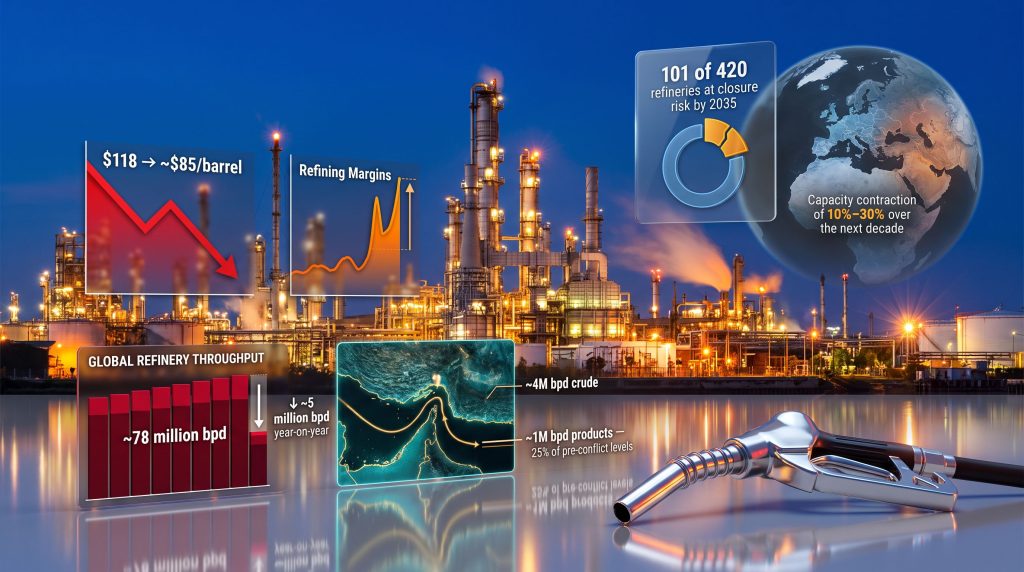
Benchmark crude prices retreating from approximately $118 per barrel at the height of the Iran conflict to around $85 per barrel has created a widespread perception that the worst of the energy shock has passed. This interpretation, however, contains a critical analytical error.
Crude oil in its unrefined state is industrially useless for the vast majority of end-use applications. Gasoline, diesel, jet fuel, heating oil, and petrochemical feedstocks are all derived from crude through energy-intensive refining processes. If those processes are disrupted at scale, crude price movements become largely irrelevant to the fuel availability question that actually governs economic activity.
The more revealing indicators right now are:
- Gasoline and diesel inventories, which are sitting near multi-year lows across key consuming regions
- Refining margins, which have surged to record levels, signalling that processed fuel is acutely scarce relative to demand
- Refinery throughput data, which shows a dramatic contraction in actual fuel production volumes
- Refined product export flows from the Persian Gulf, which remain a fraction of pre-conflict levels even as crude exports have partially recovered
Record-high refining margins are not evidence of a healthy industry capitalising on favourable economics. They are a market price signal indicating that the supply of processed fuels has fallen critically short of what consumers and industry require.
This distinction between margin expansion driven by operational efficiency versus margin expansion driven by scarcity is essential for any accurate reading of where energy stress currently sits. The current environment reflects the latter, not the former.
Throughput Collapse: The Numbers Behind the Crisis
According to International Energy Agency data, global refinery runs averaged approximately 78 million barrels per day (bpd) during the second quarter, representing a reduction of roughly 5 million bpd compared to the same period a year earlier. To contextualise that figure, the COVID-19 pandemic demand collapse of 2020 resulted in demand-driven throughput reductions, where refineries cut runs because people stopped travelling and consuming fuel.
The current situation is structurally different: throughput has been curtailed by supply-side disruptions to refinery infrastructure and crude feedstock availability, meaning the demand for refined products exists but cannot be met.
Regional Breakdown: Where Capacity Has Been Lost
| Region | Primary Disruption Driver | Estimated Output Impact |
|---|---|---|
| Middle East (Gulf States) | Strait of Hormuz closure; physical attacks on refineries | Major capacity offline across Saudi Arabia, Bahrain, Kuwait, UAE |
| Russia | Sustained Ukrainian drone strikes on refining infrastructure | Domestic fuel shortages; diesel export curbs imposed |
| China | Voluntary run cuts in response to import volume collapse | Significant throughput reduction to manage crude inventory |
| Broader Asia | Constrained crude supply from Gulf disruption | Forced operational reductions across regional refiners |
The compounding nature of these simultaneous regional disruptions is what makes the current throughput loss so severe. No single event drove the 5 million bpd reduction; it is the aggregate of multiple independent but interacting crises hitting at the same time. In addition, the trade war impact on oil markets has further complicated the recovery trajectory for affected regions.
The Hormuz Product Export Paradox
One of the most technically significant and least understood dynamics of the current crisis involves the asymmetric recovery of crude versus refined product flows through the Strait of Hormuz. Following the temporary U.S.-Iran ceasefire on June 17, Gulf producers moved rapidly to resume crude exports. According to Kpler shipping data, the region exported approximately 4 million bpd of crude during June. However, refined product exports from the same region reached only around 1 million bpd, representing just 25% of pre-conflict product export levels.
This gap exists for structural reasons that go beyond simple logistics. Crude tankers and product tankers are distinct vessel classes with different technical specifications, and the product tanker fleet requires separate deployment, scheduling, and berthing arrangements. More critically, refineries themselves cannot simply restart overnight after months of partial or complete shutdown.
Equipment that has been offline requires inspection, mechanical recommissioning, feedstock replenishment, and operational testing before producing saleable product. The lag between crude flow resumption and product flow normalisation typically spans several months under favourable conditions, and considerably longer when physical infrastructure has sustained damage.
The subsequent re-escalation of U.S.-Iran hostilities and renewed disruption to Hormuz traffic has effectively reset this recovery timeline, removing what limited optimism had existed for a near-term normalisation of product flows to Asian and Middle Eastern importers.
Refineries as Military Targets: An Underappreciated Risk Dimension
One of the less-discussed aspects of the current energy crisis is the deliberate targeting of refining infrastructure as a component of modern conflict strategy. Refineries represent high-value, difficult-to-replace industrial assets whose destruction generates immediate economic pressure on civilian populations and military logistics alike, making them rational targets for adversaries seeking to maximise economic disruption.
Major refining facilities in Kuwait, including the Mina Al Ahmadi and Mina Abdullah complexes, illustrate this vulnerability. These are among the most sophisticated integrated refining and petrochemical sites in the Persian Gulf, and their partial or complete removal from service creates product supply gaps that cannot be quickly filled by alternative sources.
Similarly, Russian oil trading sanctions and sustained Ukrainian drone campaigns have forced Moscow to impose diesel export restrictions to manage domestic price inflation caused by reduced domestic fuel production. The consequences of Russian oil trading sanctions extend well beyond Russia's borders, compressing global refined product availability at precisely the wrong moment.
The strategic logic of targeting refinery infrastructure is straightforward: crude oil in the ground or in transit is less immediately useful to an economy than the processed fuels that keep power stations, agricultural equipment, and logistics networks running day to day.
This dimension of energy warfare introduces a risk variable that traditional energy security frameworks, built around supply route disruption and crude price modelling, are not well equipped to account for.
The Long-Term Structural Erosion Beneath the Short-Term Shock
The geopolitical disruption narrative, serious as it is, sits on top of a pre-existing structural deterioration in global refining capacity that was already accelerating before the current conflict cycle began. Understanding both dimensions simultaneously is essential to forming an accurate view of where the industry is heading.
Warning Sign: Closure Risk Across the Global Fleet
Assessments of the global refinery fleet suggest that over 20% of existing capacity, approximately 101 out of 420 facilities worldwide, faces serious shutdown risk by 2035. According to Wood Mackenzie's global refinery closure outlook, the drivers converging to produce this closure wave are distinct from geopolitical disruption:
- Declining gasoline margins driven by electric vehicle penetration reducing long-run demand expectations
- Rising carbon emissions compliance costs, particularly under the EU Emissions Trading System
- Competition from newer, far more efficient refining complexes constructed in the Middle East and Asia
- Aging physical infrastructure in Western markets requiring capital expenditure that cannot be economically justified against a backdrop of projected demand decline
Geographic exposure to this closure wave is highly uneven. Europe faces the most acute structural risk, with assessments suggesting regional refining capacity could contract by 10% to 30% over the coming decade, depending on the pace of energy transition policy implementation and the competitive pressure from Gulf and Asian mega-refineries.
Warning Sign: Demand Peak and the Stranded Asset Problem
Oil demand is broadly forecast to reach a plateau or begin declining in the early 2030s, driven primarily by electric vehicle fleet penetration in major consuming economies and increasing biofuel substitution. This timeline is close enough that refinery investment decisions made today must account for the possibility that capital deployed in new or upgraded capacity may not recover its full economic return before demand erosion begins compressing margins structurally.
This creates a self-reinforcing feedback loop:
- Reduced long-run investment in refinery capacity maintenance and upgrades
- Accelerating physical deterioration of existing assets
- Rising operational failure risk and unplanned outages
- Increased vulnerability to the kind of geopolitical shocks currently being experienced
The paradox embedded in current energy transition policy is that regulations designed to accelerate the shift away from fossil fuels may be inadvertently tightening near-term fuel supply by incentivising early closure of refinery capacity before demand has sufficiently declined to make those closures economically benign.
Warning Sign: The New Global Refining Competitive Order
New, highly capitalised refining complexes constructed across the Middle East and parts of Asia represent a fundamental reshaping of the industry's competitive structure. These facilities benefit from co-location with crude supply, lower labour and regulatory costs, access to government-backed financing in their home markets, and superior energy efficiency from purpose-built integrated designs.
Consequently, they are progressively displacing older, less efficient plants in Europe and parts of North America from global product trade flows, compressing the margins available to legacy facilities and accelerating the economic case for their closure. A thorough geopolitical oil price analysis reveals how deeply these structural shifts intersect with current market tensions.
Crack Spreads and What They Tell Investors
For those seeking a more granular early warning metric than headline refining margins, crack spreads offer greater specificity. A crack spread measures the difference between the market price of a refined product (typically diesel or gasoline) and the cost of the crude input required to produce it. When crack spreads expand sharply and remain elevated, they signal that the market is pricing in genuine scarcity of the finished product relative to available crude.
Sustained high crack spreads have several important implications:
- Industrial users facing diesel cost increases that compress operational margins
- Agricultural operators with harvest-season fuel dependency experiencing heightened exposure to supply disruption at the worst possible timing
- Long-haul logistics and freight networks absorbing fuel cost inflation that eventually passes through into goods pricing across the broader economy
- Emerging market economies with limited strategic petroleum reserve capacity and high import dependency facing the most acute consumer-level exposure
The second-order inflationary transmission mechanism deserves particular attention. Refinery-level product scarcity translates into retail fuel price increases with an approximate 4 to 6 week lag, and the price response is asymmetric: pump prices rise faster than they fall during supply disruptions, a pattern consistently documented across historical refinery shock events including post-Hurricane Katrina in 2005 and the COVID recovery period of 2021-2022.
The next major ASX story will hit our subscribers first
Geographic Risk Concentration at a Glance
| Risk Category | Most Exposed Regions | Key Vulnerability Factor |
|---|---|---|
| Refinery infrastructure damage | Middle East, Russia | Active conflict zones; physical asset targeting |
| Product import dependency | South/Southeast Asia, East Africa | Limited domestic refining; Gulf supply reliance |
| Structural capacity decline | Western Europe | Regulatory costs; aging assets; new competition |
| Demand transition pressure | OECD economies broadly | EV adoption; policy-driven demand erosion |
Three Scenarios for What Comes Next
Scenario 1: Hormuz Stabilisation and Gradual Recovery
A sustained ceasefire enabling the safe reopening of Hormuz, combined with the gradual mechanical recommissioning of damaged Gulf refinery infrastructure, could begin normalising refined product flows over a 3 to 6 month horizon under optimistic assumptions. Residual risks include the physical repair timelines for infrastructure that has sustained direct damage, and the persistent probability of geopolitical re-escalation interrupting any recovery.
Scenario 2: Prolonged Disruption and Demand Destruction
An extended Hormuz closure forcing sustained product shortages across Asian and European import markets would eventually trigger demand destruction as the market's self-correcting mechanism. Industrial operators would cut fuel-intensive activity, governments in vulnerable markets would impose rationing frameworks, and coordinated International Energy Agency member releases of strategic petroleum reserves would provide partial but time-limited relief.
The important technical caveat here is that most strategic petroleum reserves are held in crude form rather than as refined products, meaning their utility during a refinery throughput crisis is inherently limited by the same refining capacity constraints driving the original shortage. Furthermore, OPEC's market influence over production policy decisions will play a critical role in determining how quickly supply-side conditions can stabilise across affected regions.
Scenario 3: Permanent Capacity Rationalisation
The most structurally significant long-term scenario involves the current geopolitical shock functioning as an accelerant for permanent capacity reduction across the marginal end of the global refinery fleet. Facilities that suspended operations during the conflict period may face a rational economic calculation against restarting if their pre-conflict margins were already insufficient to justify ongoing capital investment.
This would compress the long-run supply base more rapidly than energy transition models have typically projected, potentially creating a paradox of tightening fuel supply at the same time that demand erosion from electrification is supposed to be easing market conditions. The global oil refining industry warning signs embedded within this scenario represent some of the most consequential structural risks now facing energy planners and investors alike.
Key Data Summary
| Metric | Data Point | Significance |
|---|---|---|
| Global refinery throughput (Q2) | ~78 million bpd | Down ~5 million bpd year-on-year (IEA) |
| Gulf refined product exports (June) | ~1 million bpd | Only 25% of pre-conflict levels (Kpler) |
| Gulf crude exports (June) | ~4 million bpd | Partial recovery; products lagging significantly |
| Crude price retreat from peak | $118 to ~$85/barrel | Masks downstream product supply stress |
| Refineries at structural closure risk by 2035 | ~101 of 420 globally | Long-term capacity erosion already underway |
| Potential European capacity reduction | 10% to 30% over next decade | Structural competitive disadvantage vs. Gulf/Asia |
| Demand peak projection | Early 2030s | Accelerating stranded asset calculus |
The convergence of near-term geopolitical infrastructure damage with long-term structural erosion across the global refinery fleet represents a configuration of risk that conventional energy market analysis, focused primarily on crude supply and demand balances, is systematically underequipped to capture. Both the timing and the depth of the current global oil refining industry warning signs suggest that the period of maximum stress may still lie ahead rather than behind.
Readers seeking additional context on global energy market dynamics and refining sector developments can explore related data and analysis published by the International Energy Agency (IEA), Reuters Energy, and ETEnergyworld. All financial and market projections discussed in this article involve inherent uncertainty and should not be construed as investment advice.
Want to Stay Ahead of the Next Major Resource Discovery?
While the global refining sector navigates unprecedented structural stress, opportunities in the commodities space continue to emerge for investors who act on real-time information — Discovery Alert's proprietary Discovery IQ model scans ASX announcements daily, delivering instant alerts on significant mineral discoveries and turning complex market data into actionable insights. Explore historic discoveries and their returns or start your 14-day free trial today to position yourself ahead of the broader market.