
July 20, 2026
The Downstream Blind Spot That Could Trigger the Next Global Recession
Energy market crises have historically been framed around a single variable: the price of crude oil. When Brent surges, headlines follow. When crude retreats, analysts declare the emergency over. This framing is deeply misleading, and in 2026, it may be contributing to one of the most dangerous miscalculations in modern economic history.
The global oil refining crisis unfolding across the second half of 2026 exposes a structural vulnerability that crude price charts cannot capture. Economies do not run on barrels of crude. They run on gasoline, diesel, and jet fuel, and the industrial infrastructure required to convert one into the other has been quietly deteriorating for years, long before the first missile was fired.
When big ASX news breaks, our subscribers know first
Crude Prices vs. Refined Product Availability: Understanding the Critical Gap
Benchmark crude oil price trends, which peaked near $118 per barrel during the height of the Iran conflict, have since retreated to approximately $85 per barrel. To many market participants, this decline signals that the worst of the energy disruption has passed. However, that interpretation misses the more dangerous half of the equation.
Crude oil and refined fuel are not interchangeable economic signals. Crude is a raw material. Refined products are the functional output that powers agricultural machinery, freight networks, airlines, and industrial operations. A crude price decline can occur simultaneously with acute refined fuel scarcity if the refining infrastructure connecting the two has been damaged, destroyed, or taken offline.
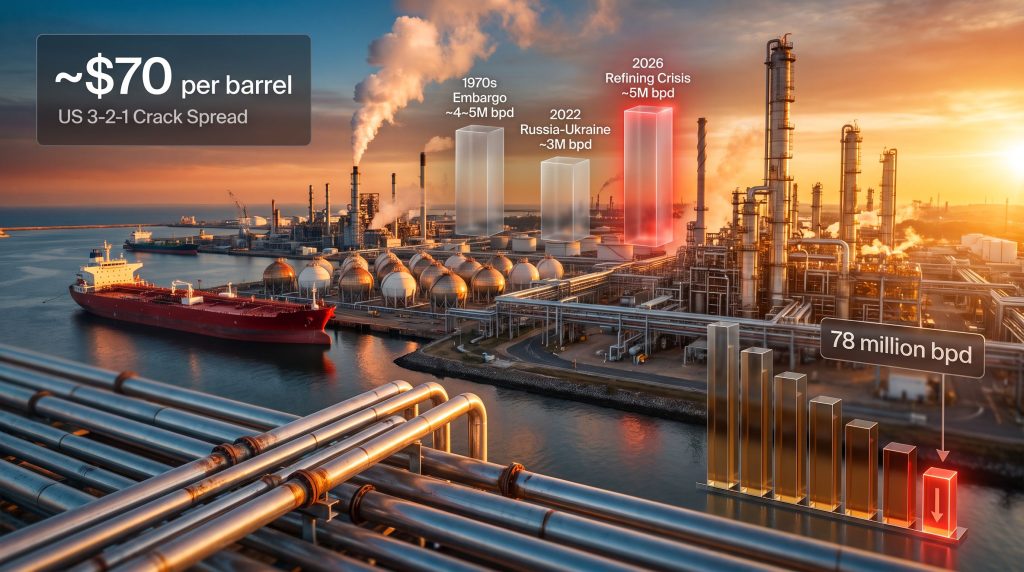
This is precisely the situation markets face today. The crack spread, the margin refiners earn by converting crude into finished fuels, is the more instructive metric. When the benchmark US 3-2-1 crack spread approaches $70 per barrel, an all-time record, it does not reflect refinery profitability in the conventional sense. It reflects consumers and businesses competing for a product that is not available in sufficient quantities. It is a distress signal masquerading as a profit metric.
A retreating crude price combined with a record-high crack spread is not a contradiction. It is precisely what a refinery-specific supply crisis looks like from the outside.
How Decades of Capacity Rationalization Left the System Defenceless
The 2026 global oil refining crisis did not emerge from a vacuum. Between 2019 and 2025, approximately 4.5 million barrels per day (bpd) of global refining capacity was permanently retired across Europe, Asia, and North America. These closures were rational individual decisions: aging facilities facing rising capital maintenance costs, energy transition policy uncertainty, ESG-driven capital allocation constraints, and long-run demand forecasts that made large-scale refinery investment difficult to justify in most OECD markets.
The aggregate consequence, however, was the systematic elimination of the global refining system's shock-absorption capacity. A network that once carried meaningful spare processing buffer entered the geopolitical disruption of 2026 already running lean. Furthermore, there was no cushion to absorb the shocks that followed.
Building new refinery capacity cannot solve this problem on any relevant timescale. Constructing a major refinery typically requires 5 to 10 years and billions of dollars in capital expenditure. Even in markets where the investment case might now be compelling, new capacity cannot arrive in time to address the current supply deficit.
The Three Fault Lines Behind the 2026 Refining Breakdown
The International Energy Agency has characterised the 2026 supply disruption as the largest in modern oil market history, with approximately 5 million bpd of global refining output removed in the second quarter compared with the same period one year earlier. Global refinery throughput averaged around 78 million bpd during Q2 2026, down roughly 10% from pre-conflict baselines. Three distinct fault lines drove this collapse.
Fault Line 1: The Strait of Hormuz as a Single Point of Failure
The Iran conflict, which escalated on February 28, triggered closure of the Strait of Hormuz, a waterway responsible for transporting approximately 19% of global seaborne refined fuel trade, equivalent to 5 to 6 million bpd of refined products. Major refining facilities across Saudi Arabia, Bahrain, Kuwait, and the United Arab Emirates were left either partially or entirely offline. Iranian retaliatory strikes are estimated to have damaged or destroyed between 30 and 40% of Gulf refining capacity.
What makes the Strait of Hormuz uniquely dangerous as a chokepoint, in a way that applies specifically to refined products rather than crude, is the complete absence of viable pipeline alternatives for finished fuels from Gulf producers. Crude oil has at least some alternative routing options. Refined products from the Gulf do not. The strait is a true single point of failure for this portion of global fuel supply.
A temporary reopening following the US-Iran ceasefire on June 17 offered brief relief, but the recovery in product flows was disproportionately weak. According to Kpler data, the Gulf region exported approximately 4 million bpd of crude in June 2026, but only 1 million bpd of refined products, representing just 25% of pre-war levels. Renewed US-Iran hostilities subsequently re-closed the strait, eliminating whatever recovery momentum had begun to build.
Fault Line 2: Russia's Refining Sector Under Sustained Drone Attrition
Ukrainian drone campaigns have forced up to 40% of Russian refining capacity offline at peak disruption periods. The domestic consequences inside Russia were severe enough to compel Moscow to restrict diesel exports, removing a historically significant supply source from global markets precisely when those markets could least afford to lose it.
Recovery timelines for Russian refining infrastructure are measured in months to years under any scenario that assumes no further strikes, a scenario that few analysts regard as credible. The cascading effect of Russian export restrictions simultaneously tightened diesel markets across Europe and Asia, compounding the Gulf refinery disruption. For additional context on how the 2025–2026 Russian fuel crisis unfolded, the broader historical record provides useful background.
Fault Line 3: Asian Refinery Cutbacks and China's Import Compression
China sharply reduced refinery throughput in response to a dramatic contraction in crude imports during the peak of the Iran conflict. Across broader Asia, constrained crude availability forced widespread operational reductions at regional refineries. The result was a multi-regional output contraction with no single geography positioned to compensate for the shortfalls emerging elsewhere. This pattern of oil market disruption has compounded an already fragile supply picture.
How These Disruptions Compare to Previous Energy Shocks
| Crisis Event | Estimated Supply Disruption | Primary Mechanism |
|---|---|---|
| 1970s Oil Embargo | ~4 to 5 million bpd crude | Export restriction |
| 2022 Russia-Ukraine Shock | ~3 million bpd crude | Sanctions and rerouting |
| 2026 Refining Crisis | ~5 million bpd refined output | Infrastructure damage and chokepoint closure |
The critical distinction between the 2026 crisis and its predecessors is the mechanism of disruption. The 1970s embargo and the 2022 Russia-Ukraine shock were primarily crude supply and pricing events. Crude could, at least partially, be rerouted via alternative tanker routes and supplier substitution. The 2026 crisis is a downstream infrastructure failure. Refinery capacity has been physically destroyed or forced offline. Rerouting crude does not help if there is nowhere functional to process it.
America's Role as the World's Refinery of Last Resort
The United States responded to the global supply shock by dramatically scaling up exports of crude, gasoline, diesel, and aviation fuel. Weekly US crude and product exports reached a record 14.2 million bpd in April 2026. By mid-July, weekly exports had retreated to 10.7 million bpd, the weakest reading since March, as domestic demand absorbed available supply.
The inventory data tells a stark story about how much capacity the US retains to continue playing this role. Tracking US crude inventories reveals just how depleted the buffer has become:
| US Inventory Category | Current Status |
|---|---|
| Crude (commercial and strategic reserve combined) | Lowest level since 1984 |
| Gasoline stocks | Thinnest seasonal level since 2012 |
| Diesel inventories | Only recently recovered from 20-year lows |
With domestic stockpiles under sustained pressure and summer fuel demand at its seasonal peak, the United States' capacity to function as a global swing supplier has become structurally constrained. This creates a political dimension as well as a market one: the administration faces intense pressure to avoid domestically visible fuel price spikes, but the warning signals from the refining system suggest the available policy levers are narrowing.
The next major ASX story will hit our subscribers first
Sector-by-Sector: What a Refined Fuel Famine Actually Costs
The economic consequences of sustained refinery output suppression extend well beyond pump prices. Each sector of the real economy carries a different exposure profile:
Agriculture and Food Supply Chains
- Diesel powers agricultural machinery, irrigation pumping systems, and food logistics networks across every major producing region
- Prolonged diesel scarcity creates direct upward pressure on food production costs and retail prices, triggering food inflation even in nations with no geographic proximity to the conflict zones
- This transmission mechanism between fuel markets and food prices is frequently underappreciated by policymakers focused on headline energy metrics
Industrial and Manufacturing Operations
- Heavy industry, mining, and manufacturing operations depend on diesel for on-site equipment, materials transport, and backup power generation
- Fuel rationing scenarios could force partial industrial shutdowns, with multiplier effects on employment and supply chains
Aviation and Passenger Transport
- Jet fuel and gasoline markets face simultaneous tightening as throughput remains suppressed
- Airlines already operating on thin margins face acute cost pressure with limited ability to pass costs through to consumers in a weakening demand environment
Macroeconomic Demand Destruction
- When inventories are exhausted and no supply-side response is available, price-driven demand destruction becomes the market's only balancing mechanism
- This process curtails economic activity across multiple sectors simultaneously and functions, in effect, as an involuntary economic contraction
- The recessionary implications of demand destruction at this scale are not trivial
Refining Margin Signals: What Northwest Europe and the US Are Telling Markets
The geography of refining margin distress provides additional insight into where the system is most acutely stressed. Northwest European refining margins climbed to approximately $30 per barrel at seasonal records, while European diesel margins reached approximately $65 per barrel. US gasoline margins hovered near the record levels last seen during the 2022 post-Ukraine invasion energy shock.
These figures are not isolated data points. They represent a convergent signal across multiple regions and multiple refined product categories simultaneously, a pattern that has no modern precedent in its combination of breadth and magnitude. In addition, the broader oil geopolitics analysis underpinning these market moves suggests the structural pressures are unlikely to resolve quickly.
When crack spreads reach historic highs across multiple geographies simultaneously, the market is communicating that consumers are in active competition for fuel that does not exist in sufficient supply. This is qualitatively different from a crude price spike driven by speculative positioning or supply rerouting.
Scenario Pathways: Three Possible Trajectories for the Global Oil Refining Crisis
Recovery timelines for the global oil refining crisis depend on three interlocking variables: the permanent reopening and stabilisation of the Strait of Hormuz, the pace of reconstruction for damaged Middle Eastern and Russian refinery infrastructure, and whether further military action disrupts facilities that remain operational.
Scenario 1: Rapid De-escalation (Low Probability)
- Hormuz reopens permanently and hostilities cease within approximately 60 days
- Gulf refineries begin phased restarts; Russian drone campaigns pause
- Global refinery runs recover toward 82 to 83 million bpd within two quarters
- Crack spreads normalise; inventory rebuilding begins ahead of the Northern Hemisphere winter
Scenario 2: Prolonged Stalemate (Base Case)
- Intermittent Hormuz access continues; Gulf refinery restarts remain partial and slow
- Russian refinery recovery proceeds at minimal pace amid continued drone threat
- Global refinery runs remain suppressed at 78 to 80 million bpd through late 2026
- Diesel and gasoline inventories remain critically thin entering the Northern Hemisphere winter, the highest-risk period for demand-supply imbalance
Scenario 3: Further Escalation (Tail Risk)
- Additional refinery infrastructure is targeted across multiple geographies
- US strategic reserve drawdowns accelerate; export capacity collapses
- Global refinery throughput falls below 75 million bpd
- Demand destruction becomes unavoidable; global GDP growth contracts materially
Frequently Asked Questions: Global Oil Refining Crisis 2026
What is a refining crack spread and why does it matter?
A crack spread represents the margin a refinery earns by processing crude oil into finished fuels. When the US 3-2-1 crack spread approaches $70 per barrel, it signals that refined fuel is acutely scarce relative to crude availability. It is the most direct market-based indicator of downstream supply stress, and its current levels have no historical precedent.
Why is the Strait of Hormuz so critical specifically for refined products?
Unlike crude oil, which has at least partial alternative routing options via pipeline and alternative tanker lanes, refined products from Gulf producers have no viable pipeline alternative for export. The strait carries approximately 19% of global seaborne refined fuel trade and functions as an irreplaceable chokepoint with no engineering workaround. Consequently, any disruption here has an outsized and immediate impact on global fuel availability.
Could demand destruction resolve the refined fuel shortage without a recession?
Demand destruction is the market's last-resort balancing mechanism when supply cannot be restored. While it would technically rebalance supply and demand over time, it does so by suppressing economic activity. At the scale required to compensate for current supply deficits, the recessionary risk is material. As the IEEFA has noted, the structural conditions holding back a full crisis have been eroding for some time.
What makes this crisis structurally different from the 2022 energy shock?
The 2022 disruption was primarily a crude supply and pricing event. Refined product markets tightened as a consequence, but the core problem was reroutable crude flows. In 2026, the core problem is physical destruction and forced idling of refinery infrastructure itself. Rerouting crude does not solve a problem caused by the absence of functional refinery capacity to process it.
Key Takeaways: What the Global Oil Refining Crisis Reveals
The global oil refining crisis of 2026 is not primarily an oil market story. It is a story about what happens when decades of infrastructure rationalisation, driven by energy transition expectations and capital discipline, are met by simultaneous geopolitical trade tensions across multiple refining regions. As Ian Verrender has reported for the ABC, the downstream supply crunch is reshaping how governments and markets think about energy security.
- The economy's real fuel vulnerability lies downstream, not in crude markets, a structural blind spot that policymakers and investors have consistently underweighted
- The Strait of Hormuz represents a true single point of failure for global refined product trade with no logistical alternative
- Record crack spreads across multiple geographies simultaneously represent a systemic warning, not a market opportunity
- Recovery will be measured in months to years regardless of diplomatic outcomes, because physical infrastructure cannot be rebuilt by ceasefire agreements alone
- The absence of new refinery investment in OECD markets, driven by entirely rational individual capital allocation decisions, has collectively produced a system with no resilience buffer at precisely the moment one was most needed
Disclaimer: This article contains forward-looking analysis, scenario projections, and market commentary based on publicly available data as of the time of writing. It does not constitute financial or investment advice. Energy market conditions, geopolitical developments, and supply chain dynamics are subject to rapid and unpredictable change. Readers should consult qualified advisers before making any investment or operational decisions based on information contained herein. Original reporting on this topic was published via Mining Weekly, which aggregates Reuters energy market analysis for the resources sector. The International Energy Agency's Oil Market Reports and Reuters provide ongoing quantitative tracking of global refinery throughput, inventory levels, and trade flow disruptions.
Want to Identify Resource Opportunities Before the Market Catches On?
The energy security vulnerabilities exposed by the 2026 refining crisis underscore how rapidly commodity supply dynamics can reshape investment landscapes — Discovery Alert's proprietary Discovery IQ model delivers real-time alerts on significant ASX mineral discoveries, ensuring subscribers can act on actionable opportunities the moment they emerge. Begin your 14-day free trial at Discovery Alert today and position yourself ahead of the broader market.