July 20, 2026
The Structural Paradox at the Heart of India's Aluminium Industry
There is a peculiar contradiction embedded in the economics of Indian aluminium manufacturing. The country possesses one of the largest installed extrusion capacities in Asia, a growing base of industrial consumers, and abundant bauxite reserves. Yet, despite these structural advantages, India imports roughly 15 lakh tonnes of downstream aluminium products every year. This is not a story about missing infrastructure. It is a story about misaligned policy.
The Aluminium Bharat policy reforms in India represent an industry-led attempt to resolve this contradiction through a focused, evidence-based advocacy framework. Understanding why this initiative matters requires unpacking the cost structures, trade dynamics, and decarbonisation imperatives that are reshaping the global aluminium value chain simultaneously. Furthermore, these dynamics are not unique to India; aluminium industry leaders globally are navigating comparable pressures around cost competitiveness and structural reform.
When big ASX news breaks, our subscribers know first
Why India's Extrusion Sector Is Trapped Below Its Potential
The Capacity Utilisation Crisis by the Numbers
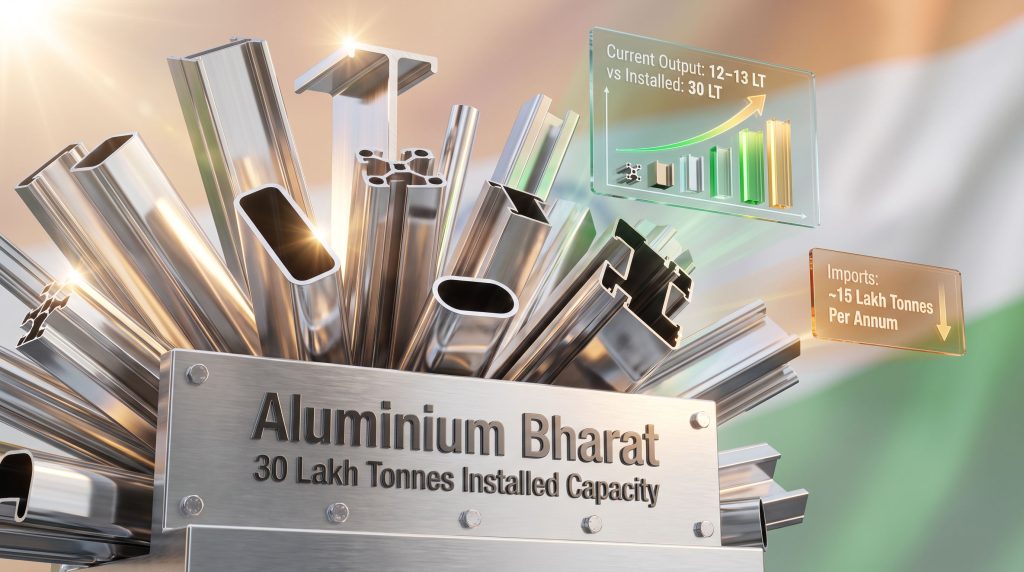
India's aluminium extrusion industry currently operates at a utilisation rate of approximately 43%, producing between 12 and 13 lakh tonnes per annum against an installed capacity of around 30 lakh tonnes per annum. The gap between physical capability and actual output is not a recent development. It reflects years of compounding structural disadvantages that domestic manufacturers have been unable to overcome through efficiency improvements alone.
To put the scale of this underperformance in perspective:
- Installed extrusion capacity: ~30 lakh tonnes per annum
- Current production output: 12-13 lakh tonnes per annum
- Annual import volume of downstream aluminium products: ~15 lakh tonnes
- Capacity utilisation rate: approximately 43%
The implication is striking. India is theoretically capable of satisfying nearly its entire downstream aluminium demand domestically, yet a combination of cost pressures and trade policy asymmetries has made foreign suppliers more competitive in the Indian home market than Indian manufacturers themselves.
The Multi-Variable Cost Burden Facing Indian Producers
The underutilisation problem is not attributable to a single cause. Indian aluminium manufacturers, particularly micro, small and medium enterprises (MSMEs), face a compounding set of cost disadvantages:
- Elevated interest rates that increase working capital costs relative to foreign competitors
- High energy expenses, particularly electricity duties applied to captive power plant operations
- Cascading input taxes across the supply chain
- A tariff architecture that taxes raw material imports while leaving finished goods imports largely unprotected
MSMEs are the most exposed segment of this value chain. Unlike vertically integrated primary producers, smaller fabricators and extruders lack the scale to absorb structural cost disadvantages through operational efficiency. When a foreign competitor can land a finished extrusion at an Indian port duty-free while the domestic manufacturer pays an effective duty exceeding 8% on primary aluminium inputs, the competitive arithmetic becomes deeply unfavourable.
What Is the Aluminium Bharat Initiative and What Does It Demand?
Origins, Leadership, and Timing
The Aluminium Bharat-2026 initiative was launched by the Aluminium Extrusion Manufacturers Association of India (ALEMAI) at a press conference in Mumbai ahead of Alumex India 2026, scheduled for September 26 to 29, 2026, at the Helipad Exhibition Centre in Gandhinagar, Gujarat. It is a private industry-led advocacy programme, not a government policy or spending commitment.
The initiative draws its conceptual alignment from two national frameworks: Atmanirbhar Bharat (self-reliant India) and Viksit Bharat 2047 (developed India by 2047). By anchoring its demands within these frameworks, ALEMAI is positioning its reform agenda as consistent with, rather than contrary to, the government's own stated industrial objectives.
The Four Reform Pillars
| Reform Pillar | Core Demand | Strategic Rationale |
|---|---|---|
| Tariff Rationalisation | Reduce primary aluminium duty to ≤5%; cap scrap duty at 2.5%; peg value-added product duties at 7.5-10% | Eliminate the structural cost disadvantage vs. import competition |
| Energy and Finance Cost Reduction | Rationalise electricity duty on Captive Power Plant units; allow CPP-to-IPP conversion | Reduce the operating cost burden on energy-intensive smelting and extrusion |
| Domestic Consumption Growth | Mandate low-emission aluminium quotas in public infrastructure projects | Expand the home market to absorb domestically produced output |
| Alignment with Global Manufacturing Trends | Shift strategic focus toward fabricated downstream products | Position India as a downstream exporter, not just a raw material processor |
The FTA Asymmetry Problem: A Structural Inversion of Competitive Logic
How Trade Agreements Have Inadvertently Disadvantaged Indian Manufacturers
The core policy problem driving ALEMAI's reform campaign is straightforward in principle, but deeply damaging in practice. Under Free Trade Agreements with ASEAN nations and the UAE, finished downstream aluminium products can enter India at zero or near-zero customs duty. At the same time, imports of primary aluminium attract a Basic Customs Duty of 7.5%, with the effective rate climbing above 8% once applicable surcharges are included.
This creates a structural inversion in competitive logic:
A foreign manufacturer can import primary aluminium at low cost, fabricate it into an extrusion or value-added product, and export the finished item into India duty-free. An Indian manufacturer attempting the same process pays a premium on the very raw materials that foreign competitors have already incorporated into their finished goods.
The result is that India's FTA framework, designed to expand trade and consumer access, has in practice created a cost structure that rewards importers of finished goods over domestic value-added manufacturers. This is precisely the dynamic that Aluminium Bharat seeks to reverse. In addition, aluminium sector restructuring observed in other markets demonstrates that resolving such structural distortions typically requires coordinated policy intervention rather than market forces alone.
The MSME Vulnerability Dimension
Large, integrated aluminium producers have a degree of insulation from this asymmetry. They control their own upstream raw material supply and can cross-subsidise downstream operations. MSMEs in the midstream and downstream segments have no such buffer. For a small extrusion manufacturer purchasing primary aluminium on the open market, the effective cost penalty embedded in the current tariff structure can be the difference between profitability and closure.
This vulnerability has a broader macroeconomic significance. India's MSME sector is the primary engine of manufacturing employment. Policy frameworks that systematically disadvantage MSMEs in favour of import competition have labour market consequences that extend well beyond the aluminium industry.
The Government's Own Vision: Ministry of Mines and NITI Aayog Frameworks
Production Targets, Recycling Goals, and Institutional Architecture
Separately from ALEMAI's advocacy, the Ministry of Mines has released a Vision Document for the aluminium sector under the Viksit Bharat framework. The ambition embedded in this document is substantial:
- Production target: Approximately a six-fold increase in aluminium output by 2047
- Domestic demand satisfaction: 100% by 2047
- End-of-Life Recycling Rate: 56% by 2047, aligned with international best-practice benchmarks
- Raw material security: 100% domestic bauxite and alumina supply by 2035
- Bauxite production scale-up: 150 million tonnes per annum (MTPA) by 2047
- Institutional mechanism: An Investment Promotion and Aluminium Strategy Implementation Cell (IP&ASIC) to coordinate reform progress
The alignment between ALEMAI's Aluminium Bharat demands and the Ministry of Mines' own stated targets is notable. Both frameworks converge on the same diagnosis: India's aluminium sector is structurally under-performing relative to its resource endowment and industrial capacity.
Calcined Pet Coke and the Raw Material Security Imperative
One element of the Ministry's framework that receives less attention than production targets is the role of Calcined Pet Coke (CPC) as a critical input for aluminium smelting. CPC is used in the production of anodes, which are consumed in the electrolytic reduction process that converts alumina into primary aluminium. The Ministry's vision explicitly facilitates CPC imports to support domestic smelting operations.
This matters because India currently imports a significant share of its CPC requirements. Ensuring reliable, cost-effective CPC access is foundational to the cost competitiveness of domestic primary aluminium production, which in turn determines raw material costs across the entire midstream and downstream value chain.
India's Decarbonisation Roadmap: Three Phases, Three Technologies
The NITI Aayog Framework for Green Aluminium
The NITI Aayog Decarbonisation Roadmap for the Aluminium Sector, published in 2026, provides the environmental policy layer underpinning India's long-term sector strategy. It outlines a phased transition across three distinct time horizons:
| Phase | Timeline | Key Transition Mechanism |
|---|---|---|
| Short-Term | Up to 2030 | Transition to Renewable Energy Round-the-Clock (RE-RTC) power supply for smelting operations |
| Medium-Term | 2030-2040 | Adoption of nuclear power via Small Modular Reactors (SMRs), enabled by the SHANTI Act, 2025 |
| Long-Term | 2040 onwards | Retrofit of legacy coal-fired assets with Carbon Capture, Utilisation, and Storage (CCUS) technology |
Why Decarbonisation and Competitiveness Are the Same Conversation
A common misconception is that environmental transition represents a cost burden on heavy industry. In the aluminium sector, this framing is increasingly obsolete. Green aluminium produced from renewable energy sources commands a meaningful price premium in international markets, particularly from European and North American buyers operating under carbon border adjustment mechanisms such as the EU's Carbon Border Adjustment Mechanism (CBAM).
India's ability to compete as a downstream aluminium exporter will depend substantially on the carbon intensity of its production base. Consequently, lower-carbon aluminium operations are already setting the international benchmark that Indian producers will need to meet. Renewable energy integration directly reduces operating costs over the long term, while simultaneously enabling access to premium export markets.
The Small Modular Reactor pathway referenced in the NITI Aayog roadmap is particularly significant. SMRs represent a relatively new deployment model for nuclear power that offers lower upfront capital requirements and greater siting flexibility than conventional large-scale nuclear plants. Their potential application to energy-intensive industries like aluminium smelting, where 24/7 baseload power is essential, positions them as a credible medium-term solution to both cost and emissions challenges simultaneously.
The next major ASX story will hit our subscribers first
China's Downstream Model and What It Reveals About India's Strategic Opportunity
The Value-Capture Shift That Reshaped Global Aluminium Trade
China's aluminium strategy provides the most instructive reference point for understanding what India could realistically achieve with effective policy reform. Over the past two decades, China progressively shifted its industrial focus from primary aluminium production toward fabricated and finished downstream products. This transition allowed Chinese producers to capture significantly higher value per tonne of aluminium processed, effectively monetising the same material multiple times through successive stages of fabrication.
ALEMAI explicitly references this model as a directional benchmark for India's industrial evolution. The implication is important: India's competitive opportunity does not lie in becoming a larger producer of primary aluminium ingot. It lies in moving up the value chain toward extrusions, rolled products, castings, and other fabricated forms that attract premium pricing in both domestic and export markets. However, achieving this requires the kind of supportive policy environment that currently underpins green metals production in more progressive regulatory frameworks abroad.
The Scenario If India Closes the Capacity Utilisation Gap
The numbers support a compelling scenario analysis:
- Current utilisation: approximately 43% of installed capacity
- Reform scenario utilisation: 70-75% of installed capacity
- Output at 70-75% utilisation: approximately 21-22 lakh tonnes per annum
- Import substitution potential: majority of the current 15 lakh tonne annual import demand satisfied domestically
- Export scenario: at or near full utilisation, India positioned as a net exporter of value-added aluminium products in regional markets
This scenario assumes successful implementation of tariff rationalisation, energy cost reduction, and domestic procurement mandates. It is inherently speculative and dependent on multiple policy and market variables. It should not be interpreted as a forecast.
The Circular Economy Dimension: Why Recycling Policy Is Industrial Strategy
Secondary Aluminium as a Competitive Weapon
Aluminium possesses a property that makes it uniquely valuable in the context of circular economy policy: it is infinitely recyclable without any degradation of its material properties. Secondary aluminium production, using recycled scrap as feedstock, requires approximately 95% less energy than primary smelting from bauxite and alumina. This energy intensity differential translates directly into cost competitiveness for recycling-intensive producers.
ALEMAI's reform agenda includes several proposals specifically targeting the recycling and scrap economy:
- Mandatory Extended Producer Responsibility (EPR) frameworks applied to aluminium-intensive sectors including automotive, construction, and consumer electronics
- A government-administered scrap exchange portal to formalise and improve the efficiency of aluminium scrap collection and trading
- Low-emission aluminium quotas embedded in public procurement and infrastructure projects to create guaranteed demand for recycled and green aluminium
The Strategic Logic of the Ministry of Mines Recycling Target
The Ministry of Mines' target of a 56% end-of-life recycling rate by 2047 is not merely an environmental aspiration. It is industrial strategy with direct economic consequences. A robust domestic scrap economy reduces India's reliance on primary aluminium imports, which in turn reduces exposure to the tariff asymmetries that currently disadvantage domestic manufacturers.
Put differently, scaling domestic recycling infrastructure is one of the most effective ways to reduce the raw material cost disadvantage that makes Indian manufacturers uncompetitive against FTA-enabled imports. Furthermore, the Aluminium Bharat policy reforms in India explicitly frame the recycling agenda and the tariff reform agenda as complementary rather than separate policy tracks. This integration also mirrors broader global approaches to green transition materials, where recycling and decarbonisation are increasingly treated as inseparable from industrial competitiveness.
Frequently Asked Questions: Aluminium Bharat Policy Reforms in India
What Is Aluminium Bharat?
Aluminium Bharat is a private industry initiative launched in 2026 by the Aluminium Extrusion Manufacturers Association of India (ALEMAI). It is an advocacy framework calling for specific government policy reforms to strengthen India's aluminium midstream and downstream manufacturing sector, aligned with the national goals of Atmanirbhar Bharat and Viksit Bharat 2047.
Is Aluminium Bharat an Official Government Policy?
No. Aluminium Bharat is not a government programme. It is an industry-led initiative designed to advocate for policy changes. Many of the reforms it calls for are consistent with the Ministry of Mines' Vision Document on the Aluminium Sector and NITI Aayog's Decarbonisation Roadmap, but it does not represent confirmed government commitment or funding.
What Are the Main Policy Reforms Being Demanded?
The four primary reform areas are: tariff rationalisation (reducing duties on raw materials while protecting value-added products from zero-duty import competition), energy and financing cost reduction, expansion of domestic consumption through mandated procurement of value-added aluminium, and strategic alignment with global downstream manufacturing trends. For a broader policy perspective, analysts tracking India's aluminium potential have highlighted these same bottlenecks as critical to unlocking sustainable sector growth.
Why Is the FTA Tariff Structure a Problem for Indian Manufacturers?
Under existing Free Trade Agreements with ASEAN countries and the UAE, finished downstream aluminium products can enter India at zero or near-zero customs duty. Primary aluminium imports attract an effective rate exceeding 8% after surcharges. This creates a cost structure where foreign manufacturers hold a meaningful competitive advantage over Indian domestic producers within their own home market.
What Is India's Aluminium Production Target by 2047?
The Ministry of Mines Vision Document targets approximately a six-fold increase in aluminium production by 2047, with 100% domestic demand satisfaction and a 56% end-of-life recycling rate by that year.
What Role Does Decarbonisation Play in India's Aluminium Strategy?
The NITI Aayog Decarbonisation Roadmap outlines a phased transition: renewable energy integration by 2030, nuclear power via Small Modular Reactors between 2030 and 2040, and Carbon Capture, Utilisation, and Storage deployment after 2040. Decarbonisation is strategically linked to both cost reduction and international market access for premium green aluminium products.
Key Takeaways: What Aluminium Bharat Means for India's Industrial Future
- India's aluminium extrusion sector operates at roughly 43% of installed capacity, with approximately 15 lakh tonnes of annual demand currently satisfied through imports
- The structural cause is a policy asymmetry: FTAs allow finished goods to enter duty-free while raw material imports remain subject to duties exceeding 8%, systematically disadvantaging domestic manufacturers
- ALEMAI's Aluminium Bharat initiative translates this structural problem into a concrete four-pillar reform agenda targeting tariffs, energy costs, domestic consumption, and downstream value-chain development
- The government's own Vision Document and NITI Aayog's Decarbonisation Roadmap provide a complementary policy architecture that converges on many of the same bottlenecks identified by industry
- Secondary aluminium recycling, requiring 95% less energy than primary smelting, represents both an environmental priority and a direct route to reducing the raw material cost disadvantage facing domestic manufacturers
- India's strategic opportunity mirrors the downstream value-capture model that transformed China into the world's dominant aluminium fabricator, but achieving this will require coordinated action on tariffs, energy, recycling infrastructure, and green manufacturing standards simultaneously
This article is intended for informational purposes only and does not constitute financial or investment advice. Scenario projections and forward-looking statements involve assumptions and uncertainties that may not materialise. Readers should conduct independent research before making decisions based on sector analysis.
Want to Track ASX Mineral Discoveries Before the Broader Market Does?
Discovery Alert's proprietary Discovery IQ model delivers real-time alerts on significant ASX mineral discoveries — turning complex data across 30+ commodities into clear, actionable investment insights for both short-term traders and long-term investors. Explore historic examples of major mineral discoveries and their returns, then start your 14-day free trial at Discovery Alert to position yourself ahead of the market.