July 20, 2026
The Hidden Architecture of Mineral Dependency: Why Refining Concentration Matters More Than Mining
When analysts discuss raw material scarcity, the conversation almost always gravitates towards reserves and extraction output. Yet the most strategically dangerous chokepoint in modern industrial supply chains is rarely the mine itself. It is the processing facility. The smelter. The refinery. The separation plant that transforms ore concentrate into a specification-grade material that battery manufacturers, motor producers, and grid infrastructure builders can actually use.
This distinction sits at the heart of IEA supply risks for France in the critical minerals sector, and understanding it reframes the entire debate about energy transition vulnerability. France does not lack geological ambition. What it lacks, in common with most Western European economies, is the downstream processing infrastructure that converts raw material potential into industrial reality.
The IEA's 2026 Global Critical Minerals Outlook provides the analytical framework that makes this vulnerability visible. Furthermore, its findings carry significant implications not only for French industrial policy but for the broader European transition architecture.
When big ASX news breaks, our subscribers know first
What the IEA's 2026 Critical Minerals Outlook Actually Reveals
A Market Inflection Point Across Six Mineral Categories
The IEA's annual monitoring framework tracks supply, demand, investment, and pricing dynamics for minerals considered essential to both energy systems and advanced manufacturing. The 2026 edition covers six categories under the most intensive scrutiny: cobalt, copper, graphite, lithium, nickel, and rare earth elements.
A defining feature of the current cycle is the price recovery observed across most of these minerals following a prolonged period of softness in 2023 and 2024. The rebound that materialised through 2025 and into early 2026 was not primarily demand-driven in the conventional sense. It was supply-driven, shaped by tightening production conditions, export policy interventions, and the structural consequences of underinvestment during the lower-price period.
| Mineral | Price Trend (2023-2024) | Recovery Signal (2025-2026) | Primary Risk Factor |
|---|---|---|---|
| Lithium | Sharp decline | Partial rebound | Long-term supply gap vs. 2035 demand |
| Rare Earths | Volatile | Price spike post-April 2025 restrictions | Chinese export controls |
| Nickel | Depressed | Modest recovery | Indonesian production dominance |
| Cobalt | Weak | Stabilising | Refining concentration |
| Copper | Relatively stable | Upward pressure | Investment shortfall |
| Graphite | Declining | Uncertain | Single-source dependency |
This distinction between short-term price recovery and long-term structural supply adequacy is critical. Markets can clear at higher prices in the near term while fundamental supply deficits continue to deepen beneath the surface. This dynamic creates false confidence among policymakers if they conflate price signals with supply security. The IEA's Global Critical Minerals Outlook provides a detailed breakdown of these diverging signals.
Why Supply Concentration Represents France's Most Acute Structural Vulnerability
The Refining Bottleneck: Indonesia, China, and the Geography of Processing Power
Over the two-year period covered by the IEA's analysis, China and Indonesia together accounted for more than three-quarters of all growth in refined mineral supply globally. This is a remarkable concentration of processing capacity, and it operates at a level downstream from raw ore extraction where Western economies have invested least.
The distinction between mining concentration and refining concentration matters enormously for risk assessment. Many critical minerals are extracted across a reasonably diversified geographic base. The Democratic Republic of Congo, Australia, Chile, and several other nations contribute meaningfully to upstream extraction of cobalt, lithium, and copper respectively.
However, once extracted material needs to be processed into battery-grade lithium carbonate, separated rare earth oxides, or high-purity nickel sulphate, the dependency funnel narrows sharply toward Chinese refining infrastructure. Europe's critical minerals supply chain faces this narrowing most acutely, given how little refining capacity sits within European borders.
For France specifically, this creates a structural asymmetry: the country's energy transition ambitions, which are among the most ambitious in the G7, depend on processed mineral inputs that flow predominantly through supply chains where geopolitical leverage is concentrated in the hands of a single nation.
The $6.5 Trillion Downstream Exposure Calculation
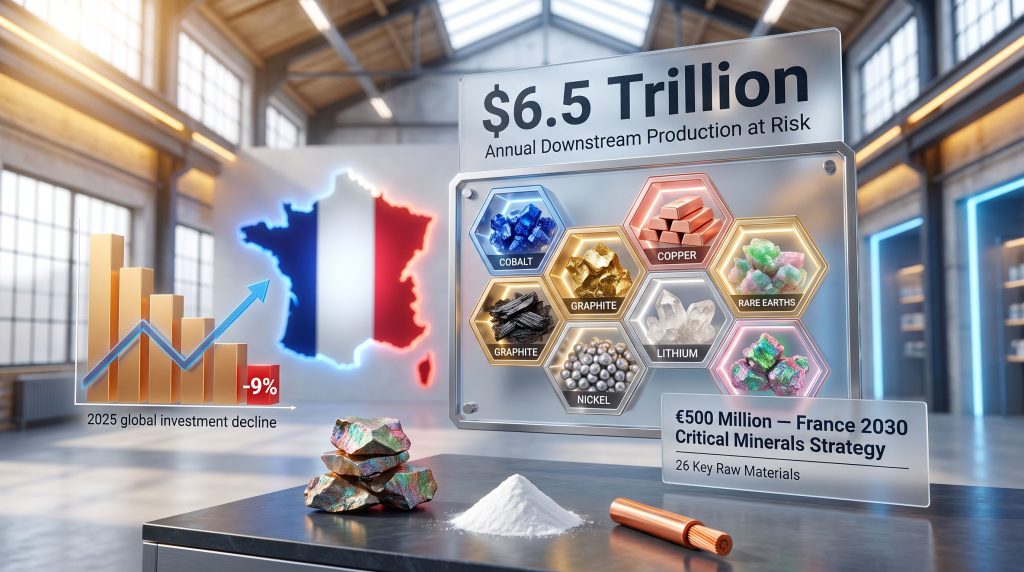
The IEA has quantified the scale of this vulnerability with a figure that commands attention across industrial policy circles. The agency estimates that up to $6.5 trillion in annual downstream industrial production located outside China could be exposed to disruption if Beijing were to expand its current export restriction framework beyond the scope introduced in April 2025.
This is not a catastrophe scenario. It is a stress-test calculation that maps what proportion of global manufacturing output in sectors including electric vehicles, wind turbines, consumer electronics, and grid infrastructure depends on Chinese-processed mineral inputs. The figure encompasses everything downstream of the refinery gate.
The $6.5 trillion exposure estimate underscores a fundamental point: supply concentration in critical minerals is no longer a theoretical policy concern. It has become a live constraint on industrial planning for economies running ambitious decarbonisation timelines.
French industries with the greatest exposure within this calculation include electric motor manufacturing for vehicles and industrial applications, permanent magnet production for wind turbines, battery cell manufacturing for both mobility and stationary storage, and the grid infrastructure buildout required to support renewable energy integration.
How China's April 2025 Export Restrictions Reshaped the Risk Landscape
From Policy Instrument to Market Disruption
The export licensing regime China introduced for rare earth materials in April 2025 marked a qualitative shift in how supply risk manifests in practice. Previous discussions of Chinese rare earth dominance had remained largely theoretical for most Western industrial planners. The April 2025 restrictions transformed that theoretical exposure into operational reality for manufacturers in affected supply chains.
China's rare earth export restrictions have proven particularly disruptive for companies dependent on neodymium and dysprosium, which are used in high-performance permanent magnets. Some manufacturers reduced production rates while others suspended output temporarily while attempting to qualify alternative sources or deplete strategic inventory positions.
What makes export licensing regimes particularly disruptive compared to simple price movements is their unpredictability. A manufacturer can hedge against price volatility using financial instruments. No analogous mechanism exists for hedging against sudden access restrictions to processed materials with few qualified substitutes. The IEA has noted these escalating risks in detailed commentary on how new export controls transform supply concentration risks from theory into reality.
Emerging Challengers to Refining Dominance
The IEA's findings note that the United States and Malaysia have both initiated development of alternative rare earth refining capacity. This represents a meaningful shift in direction, but the honest assessment of timelines suggests that near-term relief is limited.
Rare earth separation is an extraordinarily complex hydrometallurgical process. Qualified facilities require years of commissioning to achieve consistent specification-grade output. The gap between announced capacity and operational delivery in this sector is typically measured in half-decades rather than years. For France, this means that multilateral diversification efforts, while strategically necessary, will not materially reduce exposure within a three to five year planning window.
Global Investment Contraction: The Supply Crisis That Is Still Being Built
Understanding the 9% Investment Decline of 2025
Global investment in critical mineral mining and refining fell by 9% in 2025, ending a multi-year expansion trend. The reversal is particularly concerning given the lead times inherent in this industry. A mining project that fails to receive capital commitment today will typically not reach production for five to ten years depending on deposit type, jurisdiction, and processing complexity.
The IEA attributes the investment contraction to a combination of factors:
- Geopolitical uncertainty creating hesitancy around long-duration capital commitments in politically sensitive jurisdictions
- Commodity price volatility during 2023 and 2024 reducing the economic attractiveness of new project financing
- Tightening credit conditions making project finance more expensive for exploration and development stage companies
- Permitting delays and regulatory complexity extending pre-production timelines in Western democracies
The long lead time problem is the critical analytical point here. Supply deficits that will constrain France's energy transition in the 2032 to 2037 period are being determined by investment decisions made, or not made, between 2025 and 2030. The investment decline of 2025 has consequently extended the timeline for a cohort of projects that will not now enter production when originally scheduled.
Public Capital Stepping Into the Private Investment Gap
Against this backdrop of private sector retreat, public financing commitments for critical mineral projects more than quadrupled between 2023 and 2025. State-backed financing institutions in multiple Western economies have recognised that market mechanisms alone are failing to generate sufficient capital allocation to secure strategic mineral supply chains.
| Financing Dimension | 2023 Baseline | 2025 Level | Key Observation |
|---|---|---|---|
| Public financing commitments | Baseline reference | More than 4x increase | Significant but insufficient to offset private capital retreat |
| Private sector investment | Growth trajectory | -9% decline | Geopolitical uncertainty cited as primary driver |
| Long-term supply adequacy | Moderate concern | Elevated concern | Investment gap widens for lithium and graphite |
The limitation of public financing is not commitment level but deployment speed and structural reach. Government-backed facilities can anchor large-scale refinery and processing projects, but they operate more slowly than private capital markets. They also often struggle to reach the exploration-stage companies where early capital has the greatest leverage over future supply. The European critical raw materials facility framework represents one structural attempt to address this gap at a supranational level.
Workforce Gaps: The Supply Risk Multiplier Nobody Discusses
The IEA's analysis identifies a compounding factor that receives far less attention than commodity prices or export controls: workforce shortages across the critical minerals sector. Skilled labour gaps in mining engineering, hydrometallurgy, and mineral processing represent a structural constraint that cannot be resolved through financing alone.
France faces this challenge within its domestic strategy. Developing geothermal lithium extraction in Alsace or operating a rare earth separation facility in Normandy requires specialist technical competencies that take years to build through educational pipelines. The workforce development dimension of mineral security is a decade-long investment with payoff horizons that extend well beyond typical policy planning cycles.
France's €500 Million Strategic Response: Architecture and Ambition
The France 2030 Critical Minerals Framework
France launched a €500 million (approximately $571.76 million) critical minerals strategy in 2023 under the France 2030 investment umbrella. The strategy targets reduced external dependency across 26 key raw materials and is structured around three strategic pillars:
- Domestic extraction capacity development targeting both conventional and novel geological sources
- Processing and refining infrastructure expansion to capture value within the domestic supply chain
- Circular economy and recycling systems to maximise recovery from existing material stocks
Extraction Initiatives: The Alsace Geothermal Lithium Opportunity
Among the more technically distinctive elements of France's domestic strategy is the development of lithium recovery from geothermal brines beneath the Alsace region. The Upper Rhine Graben, a geological rift valley straddling France and Germany, hosts deep saline aquifers with lithium concentrations that have attracted increasing industrial interest.
Geothermal brine lithium extraction differs fundamentally from conventional hard rock or brine evaporation pond mining. The process leverages existing geothermal energy infrastructure, circulating subsurface fluids through direct lithium extraction technology that selectively adsorbs lithium ions before returning the depleted brine to the subsurface. This methodology produces minimal surface disturbance and generates substantially lower carbon intensity per tonne of lithium carbonate equivalent compared to conventional extraction routes.
Lithium de France and Imerys are both advancing extraction strategies within the French context, leveraging existing geological access and industrial expertise respectively. Imerys, in particular, brings significant advantages in mineral processing competency from its industrial minerals heritage.
Processing Capacity: Closing the Refining Gap
The refining dimension of France's strategy is arguably its most strategically significant component:
-
Carester is developing a rare earth separation facility in Normandy, targeting the hydrometallurgical processing of mixed rare earth concentrates into separated oxides suitable for permanent magnet production. This facility, if delivered on schedule, would represent a meaningful addition to European rare earth refining capacity outside of China.
-
Eramet, headquartered in Paris, is expanding manganese refining operations in Dunkirk. Eramet brings extensive metallurgical expertise from its global manganese and nickel operations, providing a credible industrial foundation for domestic processing scale-up.
The strategic logic of prioritising refining capacity over extraction capacity reflects a sophisticated understanding of where France's actual vulnerability lies. Securing access to processed materials is more immediately valuable than developing new extraction sources, particularly given global trade in mineral concentrates.
Urban Mining: Recycling as Strategic Infrastructure
France's circular economy pillar targets the recovery of lithium, cobalt, and nickel from end-of-life battery systems. An urban mining strategy of this kind frames existing material stocks as a domestic resource to be systematically recovered rather than discarded. Veolia and SUEZ are the principal operators developing battery material recovery capabilities within this framework.
The urban mining concept is strategically sound but faces a near-term feedstock constraint. The volume of end-of-life lithium-ion batteries available for recycling is currently limited by the deployment timeline of first-generation electric vehicles. The major wave of battery end-of-life volumes will begin to materialise in the late 2020s and accelerate through the 2030s. Getting the infrastructure built ahead of the feedstock wave is the correct sequencing, but it requires sustained policy support during a period when financial returns are limited.
The next major ASX story will hit our subscribers first
France's Mineral Risk Profile: A Category-by-Category Assessment
| Mineral | Short-Term Risk (2025-2027) | Long-Term Risk (2030-2035) | France-Specific Exposure |
|---|---|---|---|
| Rare Earths | High (export controls active) | High | Motor manufacturing, wind turbines |
| Graphite | High (single-source dependency) | Severe | Battery anode supply chains |
| Lithium | Moderate (recent output acceleration) | Severe | EV battery and grid storage |
| Nickel | Moderate | Moderate | Battery cathode materials |
| Cobalt | Moderate | Moderate | Battery chemistry |
| Copper | Low-moderate | Moderate | Grid infrastructure expansion |
The New Caledonia Factor: France's Own Mineral Assets Under Pressure
France's territorial relationship with New Caledonia adds a unique dimension to its mineral security calculus. The islands host world-class laterite nickel deposits and have historically contributed to French industrial supply chains. However, the severe price depression caused by Indonesian nickel production growth has placed New Caledonian operations under intense financial stress.
The situation illustrates a counterintuitive dimension of mineral security: even direct territorial ownership of mineral resources provides limited protection when global commodity markets are distorted by low-cost competition. Indonesia's aggressive expansion of nickel pig iron and mixed hydroxide precipitate production has structurally depressed global nickel prices to levels where many higher-cost producers cannot sustainably operate, including assets within France's own territorial sphere.
Geopolitical Coordination and the European Policy Architecture
G7 Mechanisms and Multilateral Traceability
France has engaged with G7 partners to develop joint crisis anticipation frameworks in coordination with the IEA. These efforts include the development of traceability and provenance verification systems that can document mineral supply chain origins across multiple processing stages.
Traceability infrastructure serves multiple strategic functions simultaneously. It enables procurement managers to verify compliance with sustainability and due diligence requirements. It creates the evidentiary foundation for trade policy instruments that distinguish between supply chains based on processing location and conditions. Furthermore, it provides the data architecture necessary for collective supply security monitoring.
The EU Critical Raw Materials Act as Strategic Context
France's national strategy operates within the broader framework of the EU Critical Raw Materials Act, which establishes European-level benchmarks for domestic extraction, processing, and recycling capacity relative to consumption. The Act creates a structural incentive for member states to develop domestic capabilities while establishing the framework for coordinated external supply partnerships.
The combination of national strategy and EU-level framework represents a layered approach to supply security that no single European economy could achieve independently. However, the tension within this architecture lies in execution speed: the supply risk timeline is accelerating faster than the policy response machinery can operate.
Strategic Outlook: Three Scenarios for France's Mineral Security Trajectory
The central tension in France's mineral security challenge is a race between the demand acceleration of the energy transition and the build-out timeline of diversified supply chains. Investment decisions made between 2025 and 2030 will shape supply availability through the critical 2035 to 2040 peak demand period.
Three scenarios bracket the range of plausible outcomes:
-
Optimistic scenario: Domestic extraction (Alsace geothermal brines, Imerys hard rock lithium), European refining capacity (Carester, Eramet), and G7 diversification efforts collectively deliver sufficient supply chain independence to reduce France's vulnerability to geopolitical disruption by the early 2030s. Urban mining feedstock volumes ramp in time to contribute meaningfully from approximately 2028 onward.
-
Base case scenario: Partial dependency reduction is achieved across several mineral categories, particularly in refining where Carester and Eramet investments mature. However, graphite and rare earth vulnerabilities persist beyond 2030, and lithium demand growth outpaces domestic supply development, maintaining significant import dependency.
-
Stress case scenario: Geopolitical escalation involving expanded export restrictions outpaces strategy execution timelines. Private investment contraction deepens further, compressing the pipeline of projects available to reach production before 2035. France's energy transition faces material constraints in specific supply chains, most acutely in battery anode materials and permanent magnets.
The IEA's findings make clear that the cost of the stress case scenario, measured in downstream industrial disruption, is vastly greater than the cost of the strategic investments required to prevent it. The $6.5 trillion downstream exposure figure provides the arithmetic justification for France's €500 million strategic commitment, and arguably suggests that even this substantial allocation may need to be scaled further as the risk landscape evolves.
The IEA supply risks for France in the critical minerals sector are not a future problem awaiting resolution. They are present constraints that are actively shaping industrial planning decisions today. The question is not whether France can achieve complete supply independence — no single economy can. The question is whether the current pace of strategic investment is proportionate to the speed at which the risk environment is deteriorating.
This article contains forward-looking analysis and scenario projections based on publicly available IEA data and independent research. Readers should note that mineral market dynamics, geopolitical conditions, and investment environments are subject to rapid change. Nothing in this article constitutes investment advice. For further context on global critical mineral market dynamics and IEA findings, additional reporting is available via Mining Technology at mining-technology.com.
Want to Track ASX Mineral Discoveries Before the Broader Market Does?
As global critical mineral supply chains face mounting geopolitical pressure and investment shortfalls, Discovery Alert's proprietary Discovery IQ model delivers real-time alerts on significant ASX mineral discoveries, turning complex mineral data into actionable insights for both short-term traders and long-term investors — explore historic examples of exceptional discovery outcomes and begin your 14-day free trial today to position yourself ahead of the market.