July 20, 2026
The Slow Unravelling of an Industrial Dependency
For much of the 20th century, the United States was a meaningful participant in the global aluminium production chain. Smelters hummed across the Pacific Northwest, refineries processed imported ore along the Gulf Coast, and the country's appetite for bauxite was a genuine force in global commodity trade. That era has not simply faded; it has structurally collapsed. What remains today is a hollowed-out supply chain kept alive largely by one ageing refinery and a fast-growing scrap economy. Understanding United States declining bauxite imports in 2025 requires looking beyond a single year's data and into the deeper industrial logic that has been reshaping American aluminium for decades.
When big ASX news breaks, our subscribers know first
The Geology Problem That Never Got Solved
Why Domestic Reserves Have Never Been Enough
The United States does possess bauxite deposits. Concentrations exist across Arkansas, Alabama, and Georgia, and their existence has been documented since the 19th century. The problem has never been geological discovery; it has been economic viability at scale.
American bauxite formations are generally characterised by lower aluminium oxide (Al₂O₃) content and higher silica reactivity compared to the high-grade deposits found in Guinea, Australia, or the Caribbean. Silica content is a critical quality metric because siliceous bauxite consumes significantly more caustic soda during the Bayer process, the dominant industrial method for refining bauxite into alumina. Higher reagent consumption translates directly into higher operating costs per tonne of alumina produced, making domestic U.S. ore uncompetitive against seaborne bauxite from deposit-rich nations. For broader context on bauxite's importance across global supply chains, the picture becomes even clearer.
The result is a structural reality that has persisted for generations: the U.S. accounts for less than 1% of global bauxite production, a position it has held since the mid-20th century and shows no credible path to changing. Domestic geology, processing economics, and the global cost curve have conspired to make large-scale domestic mining commercially impractical without extraordinary subsidy or price dislocation.
Two Decades of Refinery Closures: The Numbers Tell the Story
The more consequential driver of declining bauxite demand is not geology but industrial policy, or more precisely, the absence of it. U.S. alumina refining capacity stood at approximately 5 million tonnes per annum at the turn of the millennium. By 2025, that figure had contracted to roughly 600,000 tonnes, a reduction exceeding 88% over 25 years.
This is not a cyclical dip. Refineries do not close and reopen the way a mine might reduce output during a price trough. The capital expenditure required to construct or recommission an alumina refinery runs into the billions of dollars, and the operating economics must compete against highly efficient, large-scale facilities in Australia, Brazil, and India. Once a refinery closes, its return is almost never commercially justifiable in isolation.
The erosion of domestic alumina processing infrastructure over two and a half decades has fundamentally restructured the country's import calculus, compressing what was once a multi-million tonne industrial appetite into a fraction of its former scale.
Today, Atlantic Alumina's Gramercy plant in Louisiana stands as the sole operational alumina refinery in the United States. Critically, it is not running at full capacity; current operating rates sit at approximately one-third of nameplate, yielding between 500,000 and 600,000 tonnes of alumina annually. This single facility now effectively defines the ceiling for domestic bauxite import demand, an extraordinary concentration of industrial dependency in one location.
What the 2025 Import Data Reveals
Annual Headline: A Significant Contraction
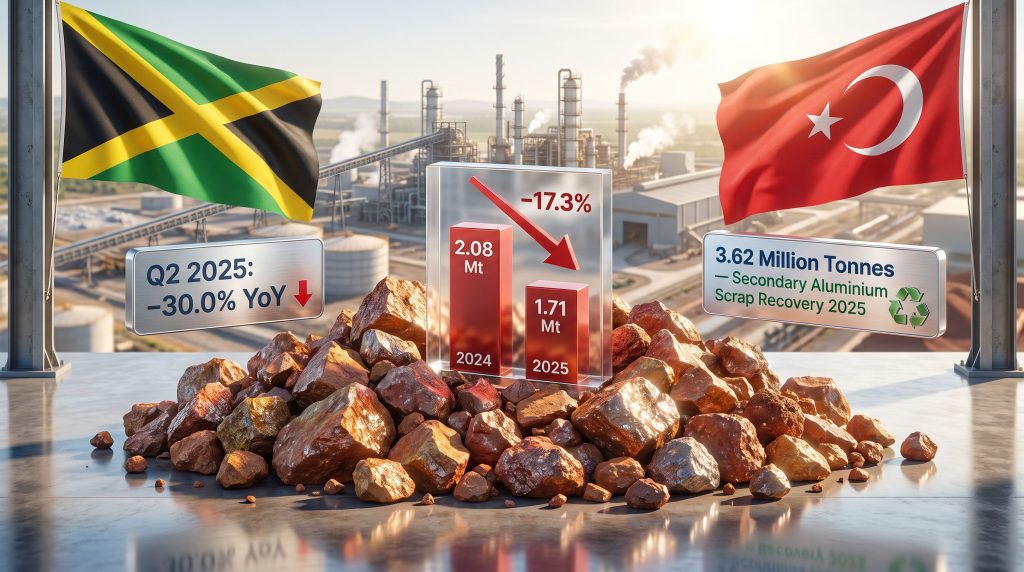
Total U.S. bauxite imports in 2025 reached 1.71 million tonnes, down from 2.08 million tonnes in 2024. That represents a year-on-year decline of 17.3%, continuing a multi-year downward trajectory rather than representing an isolated shock. Furthermore, according to data from Mysteel, H1 2025 volumes fell 17.6% below H1 2024 levels, confirming the breadth of this contraction.
Quarterly Breakdown: Pinpointing the Damage
The annual decline was not evenly distributed across quarters. The data reveals a sharp deterioration concentrated in the middle of the year, with partial but insufficient recovery in the second half.
| Quarter | 2025 Volume | QoQ Change | YoY Change vs. 2024 |
|---|---|---|---|
| Q1 2025 | ~480,000 t | n/a | -4.2% |
| Q2 2025 | 369,000 t | -23.1% | -30.0% |
| Q3 2025 | 403,000 t | +9.2% | -27.0% |
| Q4 2025 | 459,000 t | +13.9% | Below 2024 levels |
Q2 2025 was the single most damaging period, with volumes falling 30% compared to Q2 2024. The first half aggregate of approximately 1.03 million tonnes came in 17.6% below H1 2024 levels. Although Q3 and Q4 showed sequential improvement, neither quarter came close to matching its 2024 equivalent, meaning the partial recovery was arithmetically incapable of closing the annual gap.
2025 Summary: United States declining bauxite imports resulted in just 1.71 million tonnes received in 2025, a 17.3% decline from 2.08 million tonnes in 2024. The steepest quarterly fall occurred in Q2 2025, when volumes dropped 30% year-on-year. The contraction reflects structural reductions in domestic alumina refining capacity and a sustained migration toward secondary aluminium production.
Three Forces Converging: Why Imports Fell
The Scrap Economy as a Structural Substitute
Perhaps the most underappreciated driver of declining bauxite demand is the rapid maturation of the U.S. secondary aluminium sector. By the end of 2025, U.S. secondary aluminium scrap recovery reached 3.62 million tonnes, a figure that dwarfs the country's entire bauxite import volume for the year.
The economic logic is straightforward. Recycling aluminium requires only about 5% of the energy needed to produce primary aluminium from bauxite through the Bayer and Hall-Heroult processes. As energy costs have remained elevated and sustainability pressures have intensified, manufacturers across automotive, packaging, and construction sectors have aggressively expanded their scrap utilisation rates. This feedstock substitution is not temporary; it is supported by decades of infrastructure investment, established collection networks, and growing regulatory emphasis on recycled content in manufactured goods.
What is less commonly understood is that secondary aluminium, while excellent for many applications, has inherent quality limitations. High-purity aluminium required for aerospace components, electrical conductors, and certain high-specification alloys cannot always be sourced from recycled streams. Tramp elements, particularly copper, iron, and zinc accumulated through mixed scrap collection, impose a ceiling on secondary aluminium's ability to fully substitute primary inputs. Consequently, residual bauxite demand will persist in specialised industrial segments even as scrap recovery scales further.
Trade Policy as an Accelerant
Increased tariffs on bauxite-related imports contributed meaningfully to the H1 2025 contraction, amplifying the structural decline already underway from industrial capacity attrition. The broader implications of Trump's 2025 tariff measures on steel and aluminium have reverberated across multiple commodity chains, and bauxite has proved no exception. Trade policy friction, in this context, did not create the decline but accelerated the timing of volume reductions that structural forces were already driving.
The 2025 experience illustrates an important dynamic in commodity trade: when structural demand erosion coincides with policy-driven price friction, the combined effect can produce disproportionate short-term volume drops, as buyers accelerate destocking and defer procurement decisions. This appears to explain the severity of the Q2 2025 contraction relative to what underlying structural trends alone would have predicted. In addition, the impact of US aluminium tariffs on market behaviour has been well documented and deserves consideration alongside these import figures.
Who Still Supplies U.S. Bauxite?
A Two-Country Dependency with Concentrated Risk
The supplier geography of U.S. bauxite imports is strikingly concentrated. Two countries account for more than 98% of all volumes.
| Supplier | Estimated Share | 2025 Volume Trend |
|---|---|---|
| Jamaica | ~81% | 1.06 million tonnes (9-month figure); -19.7% YoY |
| Turkey | ~17% | Significant reduction in H1 2025 |
| All Other Origins | ~2% | Collapsed -67.2% between Q1 and Q2 2025 |
Jamaica's dominance reflects decades of established trade infrastructure, geographic proximity, and the historical integration of Jamaican bauxite into U.S. Gulf Coast refinery supply chains. The island's bauxite is predominantly a gibbsite-type ore, which requires lower digestion temperatures in the Bayer process compared to boehmite or diaspore bauxites more common in European or Asian supply chains. This mineralogical characteristic historically made Jamaican ore particularly well-suited to the technical specifications of U.S. refineries.
Despite this structural alignment, Jamaican export volumes to the U.S. fell to approximately 1.06 million tonnes over nine months of 2025, itself down nearly 20% year-on-year. The contraction reflects not a loss of market share to competitors but a shrinking of the total addressable market for bauxite within the U.S. When reviewing global bauxite production leaders, it becomes apparent how modest U.S. import volumes have become relative to broader international trade flows.
The near-total collapse of third-country supply, down 67.2% between Q1 and Q2 2025 alone, signals how thin the margin of alternative supplier participation has become. When the total import market is small and concentrated, minor demand shifts produce outsized percentage movements in minor supplier categories.
The next major ASX story will hit our subscribers first
Is This Decline Structural or Reversible?
The Case for Permanence
The evidence strongly favours interpreting United States declining bauxite imports as a structural rather than cyclical phenomenon:
- The refinery closure trajectory spans 25 years and has continued regardless of commodity price cycles
- Recommissioning or constructing new alumina refining capacity would require capital investment of several billion dollars per facility and a sustained, predictable aluminium price environment to justify
- Secondary aluminium infrastructure is being actively expanded, not contracted, across the U.S. industrial base
- U.S. primary aluminium smelting, the downstream consumer of domestically refined alumina, has been in secular decline since the 1980s due to energy cost disadvantages
Scenarios That Could Alter the Trajectory
Three hypothetical scenarios could theoretically reverse the trend, though each faces significant barriers:
- Industrial policy intervention at scale: A government-backed initiative to rebuild domestic alumina refining capacity would need to overcome the fundamental economics that drove closure decisions in the first place, including high energy costs and global competition from more efficient producers.
- Secondary scrap supply shock: A structural shortage of aluminium scrap, perhaps driven by competing international demand for recyclable feedstock, could force manufacturers back toward primary aluminium inputs. This scenario is plausible in the long term as emerging markets develop their own scrap collection infrastructure.
- Geopolitical supply disruption: A significant disruption to Jamaican or Turkish supply would create acute import diversification pressure. The near-complete absence of alternative supplier relationships makes this scenario particularly difficult to manage in the short term.
Near-term reversal of the U.S. bauxite import decline is structurally unlikely without a combination of significant policy intervention and fundamental shifts in secondary aluminium economics.
Supply Chain Security and the Aluminium Paradox
Growing Consumption, Shrinking Primary Infrastructure
Aluminium consumption across U.S. downstream sectors, including electric vehicles, renewable energy infrastructure, aerospace, and defence, has been growing steadily. This creates a paradox at the heart of U.S. aluminium supply chain policy: end-use demand is expanding while the domestic infrastructure to produce primary aluminium from raw ore is contracting almost to the point of elimination.
The United States is increasingly reliant on imported aluminium metal, particularly from Canada, which accounts for a substantial portion of U.S. primary aluminium supply through energy-advantaged smelters in Quebec and British Columbia. The declining bauxite import figures thus represent not just a shift in one commodity's trade flow but a deeper structural transformation in how the U.S. sources the materials underpinning its industrial economy. For instance, reviewing the top aluminium mining companies in 2025 underscores how far the centre of gravity for primary production has shifted away from North America.
Concentration Risk and Strategic Vulnerability
A supply base of two countries providing more than 98% of a commodity input, even one whose domestic demand has contracted sharply, represents a meaningful strategic concentration. Any disruption to Jamaican or Turkish export capacity, whether from weather events, labour disputes, or geopolitical friction, would leave U.S. bauxite consumers with extremely limited short-term alternatives.
The long-term investment case for U.S. aluminium sector participants increasingly involves navigating this tension: the economics of domestic primary production remain challenging, scrap-based production is expanding but limited in quality ceiling, and import dependency on a narrow supplier base creates asymmetric risk exposure that is difficult to hedge at the individual firm level.
Key Data Points at a Glance
- 1.71 million tonnes of bauxite imported in 2025, the lowest level in recent memory and 17.3% below 2024
- One operational alumina refinery remains in the U.S., running at approximately one-third of nameplate capacity
- 3.62 million tonnes of secondary aluminium scrap recovered in 2025, systematically displacing primary input demand
- Jamaica and Turkey together supply more than 98% of all U.S. bauxite imports, a profound concentration risk
- Q2 2025 recorded a 30% year-on-year quarterly decline, the single largest drag on the annual figure
- 88%+ contraction in domestic alumina refining capacity since 2000, from 5 million tonnes to approximately 600,000 tonnes
Frequently Asked Questions
Why Did U.S. Bauxite Imports Fall in 2025?
Three converging forces drove the decline: the contraction of domestic alumina refining capacity to approximately 600,000 tonnes, the expansion of secondary aluminium scrap recovery to 3.62 million tonnes, and trade policy friction that amplified H1 2025 volume reductions.
Which Countries Supply the Most Bauxite to the United States?
Jamaica supplies approximately 81% of U.S. bauxite imports, with Turkey accounting for roughly 17%. All other supply origins collectively represent less than 2% of total volumes.
Can Secondary Aluminium Fully Replace Bauxite-Derived Primary Aluminium?
Not entirely. Scrap-based production accumulates tramp elements that limit the purity achievable in recycled aluminium. High-specification applications in aerospace, electrical conductors, and defence manufacturing continue to require primary aluminium inputs derived from bauxite.
What Is the Significance of Jamaican Bauxite's Mineralogy?
Jamaican bauxite is predominantly gibbsite-type ore, which processes at lower digestion temperatures in the Bayer refining process. This characteristic historically made it particularly compatible with U.S. Gulf Coast refinery infrastructure, underpinning the long-standing trade relationship.
Is the U.S. Bauxite Import Decline Likely to Reverse?
The structural evidence points strongly toward continued decline. With domestic refinery capacity at historic lows, no major new refining investment on the horizon, and secondary aluminium infrastructure actively expanding, a sustained reversal would require extraordinary policy or market intervention.
Disclaimer: This article contains forward-looking analysis, scenario projections, and structural assessments based on available industry data. These should not be construed as investment advice. Commodity markets are subject to rapid change, and actual outcomes may differ materially from those described.
Want to Stay Ahead of Significant ASX Mineral Discoveries Before the Broader Market Does?
Discovery Alert's proprietary Discovery IQ model delivers real-time alerts on significant ASX mineral discoveries across more than 30 commodities — including aluminium and bauxite-adjacent opportunities — instantly translating complex data into actionable insights for both short-term traders and long-term investors. Explore Discovery Alert's discoveries page to understand how historic mineral discoveries have generated substantial returns, and begin your 14-day free trial today to secure a market-leading advantage.