July 20, 2026
The Refining Chokepoint: Why Mining Sovereignty Is an Illusion Without Processing Power
The history of industrial power has always been written not by those who find raw materials, but by those who transform them. In the 19th century, nations that could smelt iron and refine steel built empires. In the 20th century, control over oil refineries and petrochemical infrastructure proved just as decisive as control over oilfields. Today, a structurally identical dynamic is reshaping the global economy, this time through the lens of critical minerals. Understanding who controls critical minerals requires dismantling a persistent misconception: that reserve ownership equals strategic leverage.
It does not. The true leverage point in every critical mineral supply chain sits not in the ground, but inside refining plants, chemical separation facilities, and advanced materials processing infrastructure. Furthermore, in nearly every category that matters to the energy transition, digital economy, and modern defence, that leverage is concentrated in ways that most governments and investors are only beginning to fully reckon with. The critical minerals demand outlook makes this concentration even more urgent to understand.
When big ASX news breaks, our subscribers know first
Reserves, Production, and Refining: Three Very Different Forms of Control
Analysing who controls critical minerals through a single lens produces a dangerously incomplete picture. A rigorous assessment requires examining three distinct layers of the supply chain independently, because dominance in one layer does not automatically translate to dominance in another.
- Reserves: The geological endowment of a nation, representing what sits underground in economically recoverable form.
- Production: The active extraction of minerals from the ground, measured in tonnes per year.
- Refining and processing: The conversion of raw ore or concentrate into a chemically pure, specification-grade material suitable for industrial application.
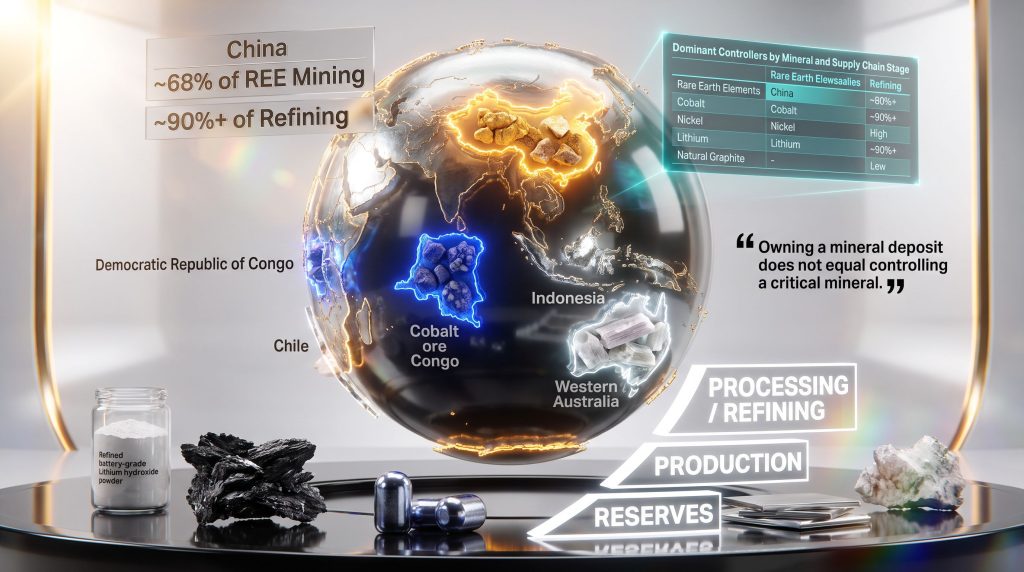
The table below illustrates just how differently these layers are distributed across the global critical minerals landscape:
| Mineral | Largest Reserve Holder | Dominant Producer | Dominant Refiner |
|---|---|---|---|
| Rare Earth Elements | China, Vietnam, Russia | China (~68% of mining) | China (~90%+ of refining) |
| Cobalt | DRC (~55% of reserves) | DRC (~74% of production) | China (~70% of refining) |
| Nickel | Indonesia (~42% of reserves) | Indonesia (~54% of production) | China (~65% of refining) |
| Lithium | Chile (reserves), Australia (production) | Australia | China (~60% of refining) |
| Natural Graphite | China | China | China (~100% of refining) |
| Heavy Rare Earths | China and Myanmar | China and Myanmar | China (~100% of refining) |
What this table reveals is a consistent pattern: regardless of where minerals are physically extracted, the downstream refining and processing stage overwhelmingly flows through a single nation. The geopolitical implications of this pattern are profound and underappreciated.
Minerals extracted in the Democratic Republic of Congo, Western Australia, or the Chilean Atacama routinely travel to Chinese processing facilities before re-entering global supply chains as battery-grade or magnet-grade materials. The country of mining origin provides minimal insulation from this dependency.
China's Vertical Integration: A Supply Chain Architecture Decades in the Making
China's position in critical mineral supply chains did not emerge from geological luck alone. It reflects decades of deliberate industrial policy, coordinated state investment, and strategic acquisition of both domestic and overseas mineral assets. The result is a vertically integrated ecosystem that few rival nations have come close to replicating.
Consider the rare earth supply chain as a case study in industrial completeness:
- China mines approximately 68% of global rare earth output annually.
- It refines more than 90% of the world's rare earth supply into separated oxides.
- Chinese facilities process those oxides into rare earth alloys and metals.
- Those metals are used to manufacture sintered neodymium-iron-boron (NdFeB) permanent magnets, the performance-critical component inside EV motors, wind turbine generators, and precision-guided munitions.
- China accounts for more than 80% of the global rare earth magnet market and approximately 92% of REE magnet manufacturing capacity.
This vertical integration means that disrupting China's role at any one stage of this chain creates cascading shortfalls throughout the entire downstream ecosystem. No other nation has built anything approaching this degree of mineral-to-magnet integration.
Heavy Rare Earths: The Most Acute Strategic Vulnerability
Within the rare earth category, a further distinction demands attention. Rare earth elements are not a monolithic group. They divide into light rare earths (such as cerium, lanthanum, and neodymium) and heavy rare earths (including dysprosium, terbium, and holmium). The heavy rare earths carry disproportionate strategic weight because they are essential for high-performance permanent magnets that must function in demanding thermal environments, exactly the application required in EV drive systems, military hardware, and offshore wind turbines.
China controls approximately 90% of global heavy rare earth supply. Myanmar accounts for a significant share of the remaining global heavy rare earth mining output, but Chinese companies maintain substantial operational influence across Myanmar's supply chains as well. This means that for practical purposes, heavy rare earths exist within a near-total Chinese sphere of industrial control.
For light rare earths, the concentration is somewhat less extreme but still significant, with approximately 58% of global light rare earth production remaining China-controlled.
The Refining Chokepoints Across Every Major Category
The rare earth picture is not an anomaly. Across virtually every mineral critical to the energy transition and advanced technology sectors, Chinese refining dominance is the structural constant:
- Natural graphite: China conducts close to 100% of global refining, making it the sole source of the battery-grade spherical graphite used in lithium-ion anode materials.
- Dysprosium: Near-complete Chinese control over the refining of this heavy rare earth, which is irreplaceable in high-performance EV motor magnets.
- Cobalt: Approximately 70% of global cobalt refining capacity sits within China, despite the DRC holding the majority of physical reserves.
- Nickel: Around 65% of global nickel refining for battery-grade applications is China-based.
- Lithium: Roughly 60% of global refining for battery-grade lithium hydroxide and lithium carbonate flows through Chinese facilities.
The Export Control Lever: How Refining Dominance Becomes Policy Leverage
China's refining dominance is not merely an economic advantage. It has been codified into a policy instrument. The Export Control Law (ECL), enacted in 2020, gives Chinese authorities statutory power to restrict the export of critical minerals and to extend those restrictions to foreign-manufactured goods incorporating Chinese-sourced inputs. China's rare earth export restrictions have already been activated in practice, with controls applied to gallium, germanium, graphite, and rare earth processing technologies in recent years.
Processing sovereignty converts geological resources into geopolitical leverage. Nations that refine critical minerals hold the ability to restrict supply, extract diplomatic concessions, or selectively disadvantage downstream competitors.
The three nations holding the largest rare earth reserves globally are China, Vietnam, and Russia. Together, they account for roughly 70% of global rare earth reserves. China holds the dominant share within that group, but the geographic concentration of both reserves and processing capacity in politically non-aligned nations presents a structural challenge for Western supply chain planners. The IEA has highlighted how these export controls are making supply concentration risks a tangible reality.
The Resource-Rich But Refining-Poor: DRC, Indonesia, and the Downstream Dependency Trap
Two of the world's most important critical mineral producers illustrate the gap between geological endowment and industrial control with particular clarity.
The DRC's Cobalt Paradox
The Democratic Republic of Congo holds approximately 55% of global cobalt reserves and produces roughly 74% of annual global cobalt output. By any measure of geological abundance, it is the world's cobalt superpower. Yet the DRC captures a structurally limited share of the economic value embedded in cobalt's journey from ore to finished battery cell.
The reason is straightforward: the DRC possesses minimal domestic cobalt refining capacity. Raw ore and hydroxide concentrate leave the country in largely unprocessed form and travel to Chinese smelters for conversion into battery-grade cobalt sulphate. The nation that holds the geological asset is not the nation that controls the industrial product.
Indonesia's Nickel Rise and Its Chinese Entanglement
Indonesia has undergone a rapid transformation into the world's dominant nickel producer, holding approximately 42% of global nickel reserves and producing roughly 54% of annual global nickel supply. Its laterite nickel deposits have become the primary feedstock for nickel-manganese-cobalt (NMC) battery cathode chemistries powering much of the EV industry.
However, the processing infrastructure built to convert Indonesian nickel ore into battery-grade nickel sulphate has been substantially financed and operated by Chinese industrial groups. This means that Indonesian nickel production, while geographically sovereign, is operationally and financially integrated into Chinese-aligned supply chains at the refining stage.
Australia and Chile: Lithium's Dual Producers
Australia leads global lithium production by volume, primarily through hard-rock spodumene mining concentrated in Western Australia. Chile holds some of the world's largest lithium brine reserves within the Atacama Salt Flat ecosystem, alongside substantial copper endowments. Despite their production dominance, both nations depend significantly on Chinese refining facilities to convert spodumene concentrate and lithium brine into battery-grade materials required by cell manufacturers.
Vietnam, meanwhile, holds the second-largest rare earth reserves globally, a strategic asset that remains largely undeveloped at commercial scale. Russia's rare earth reserves place it among the top three globally by endowment, though its geopolitical isolation following 2022 has substantially complicated any role it might play in Western-aligned supply chain architecture.
Corporate Concentration: Compounding the Geopolitical Risk
Geographic concentration of critical mineral production is amplified by a parallel problem at the corporate level. In lithium, five companies globally control approximately 61% of total output. In cobalt, five companies account for approximately 56% of annual production. This degree of corporate concentration means supply disruptions can propagate rapidly through global supply chains.
Outside the United States and European Union, critical mineral assets are predominantly controlled by government entities rather than privately owned corporations. Chinese state-owned enterprises have systematically acquired equity positions in mineral projects across Africa, Latin America, and Southeast Asia. This overseas investment strategy effectively extends China's operational influence well beyond the reserve statistics that domestic geology alone would suggest. Consequently, the question of who controls critical minerals cannot be answered by looking at national borders alone.
The United States' Critical Mineral Dependency: What the Numbers Actually Reveal
The U.S. government has formally classified 50 minerals as critical to economic and national security. For 21 of those 50 minerals, the United States maintains zero domestic production, making it entirely dependent on imports. Heavy rare earth elements represent the most acute exposure, with near-complete reliance on supply chains that flow through Chinese processing infrastructure. The US critical minerals tariff landscape is one policy response to this structural vulnerability, though its effectiveness remains a subject of ongoing debate.
Disclaimer: Supply chain dependency figures and mineral classification lists are subject to periodic revision by government agencies. Investors and analysts should verify current data against the most recent publications from the U.S. Geological Survey and relevant government departments.
The next major ASX story will hit our subscribers first
Pathways to Reducing Dependency: Four Strategic Scenarios
Recognising who controls critical minerals is only the first step. The more consequential question is how import-dependent nations can realistically reduce that dependency, and on what timeline.
Scenario 1: Domestic Production and Refining Buildout
Building processing infrastructure from scratch is the most durable solution but also the most capital-intensive. Chemical separation plants, smelters, and advanced materials facilities require sustained investment over 10 to 20 years before meaningful processing independence can be achieved at scale.
Scenario 2: Multilateral Mineral Security Alliances
Frameworks such as the Minerals Security Partnership aim to coordinate investment flows among allied nations, linking resource-rich democracies with technology-consuming economies through bilateral offtake agreements and co-investment structures. Progress has been slower than political announcements suggest, constrained by competing national interests and coordination complexity. In addition, the proposed European raw materials facility represents another coordinated attempt to build allied processing capacity at scale.
Scenario 3: Technology-Driven Demand Reduction
Battery chemistry evolution offers a partial structural exit from certain dependencies. Lithium iron phosphate (LFP) chemistries eliminate cobalt entirely. Sodium-ion batteries reduce lithium demand. Magnet designs that minimise dysprosium loading are advancing in research settings. Furthermore, recycling and urban mining of end-of-life batteries and electronics represent a nascent but growing secondary supply channel. Analysts at the Council on Foreign Relations have explored how technology pathways might help Western economies leapfrog Chinese dominance in specific mineral categories. None of these substitutes have yet scaled to a degree that materially reduces the overall dependency picture.
Scenario 4: Managed Dependency With Risk Mitigation
The realistic near-term trajectory for most Western economies involves diversifying supplier relationships at the margins while accepting structural reliance on Chinese refining capacity. Strategic stockpiling, long-term offtake contracts, and diplomatic mineral partnership agreements represent the principal risk management instruments available within this framework.
Declaring mineral security as a policy priority and actually building the physical infrastructure to achieve it are separated by a decade of capital expenditure, permitting, workforce development, and technical execution. The gap between these two things is where most Western mineral security strategies currently reside.
Frequently Asked Questions About Critical Mineral Control
Which country controls the most critical minerals overall?
China holds the most comprehensive and structurally complete control over the global critical minerals ecosystem. Its dominance is rooted not primarily in geological reserves, but in its unmatched capacity to refine, process, and manufacture across virtually every category of strategic mineral.
Does the DRC actually control cobalt?
The DRC controls the geological endowment and raw extraction of cobalt, accounting for approximately 74% of global annual production. However, China controls the industrial transformation of that cobalt into battery-grade materials, holding roughly 70% of global refining capacity. The DRC has geological control; China has industrial control.
Why can't Western nations simply mine their own deposits?
Many Western countries do have mineral deposits at various stages of exploration and development. The critical bottleneck is not finding minerals but transforming them into specification-grade industrial inputs. Building a rare earth chemical separation plant or a nickel sulphate refinery is an entirely different undertaking from constructing a mine, requiring specialised chemistry expertise, environmental management systems, and sustained capital commitment over many years.
What minerals pose the greatest dependency risk for the United States?
Heavy rare earth elements, dysprosium, terbium, natural graphite, and processed cobalt represent the highest-vulnerability categories, all essential to defence systems, EV motors, and advanced electronics, and all predominantly flowing through Chinese-controlled processing infrastructure.
Are there any minerals where Chinese control is weaker?
Indonesia holds genuine sovereignty over nickel production volumes, and the DRC dominates cobalt extraction. However, in both cases, the downstream refining of those minerals into battery-ready materials is predominantly controlled by Chinese industrial capacity, meaning upstream mining geography provides limited practical independence from Chinese processing dependency.
Key Takeaways
Understanding who controls critical minerals requires moving beyond simplistic reserve maps and production statistics. The following points define the structural reality of the global critical minerals landscape:
- Processing sovereignty, not reserve ownership, is the decisive form of critical mineral control.
- China has constructed a vertically integrated ecosystem spanning extraction, refining, alloy production, magnet manufacturing, and advanced component supply across nearly every strategically important mineral category.
- The DRC, Indonesia, Australia, and Chile each hold significant upstream positions but remain structurally dependent on Chinese downstream processing for the conversion of raw materials into industrial-grade products.
- For 21 of the 50 minerals formally classified as critical by the U.S. government, domestic production is currently zero.
- Corporate concentration in lithium and cobalt amplifies the geopolitical risks already embedded in geographic production concentration.
- Building genuine processing independence requires a decade-plus timeline of sustained infrastructure investment, meaning policy announcements and operational supply chain sovereignty are separated by years of physical construction work.
This article is intended for informational purposes only and does not constitute financial or investment advice. Statistics, forecasts, and market share figures referenced throughout are based on publicly available data and industry research, which are subject to revision. Readers are encouraged to conduct independent research and consult qualified advisors before making investment decisions related to critical mineral markets.
Want to Know When the Next Major Mineral Discovery Hits the ASX?
Discovery Alert's proprietary Discovery IQ model delivers real-time alerts the moment significant ASX mineral discoveries are announced, turning complex mineral data into clear, actionable insights for investors at every experience level — explore historic examples of exceptional discovery returns and begin your 14-day free trial today to position yourself ahead of the market.