July 20, 2026
When the Illusion of Oil Abundance Ends
For much of the early 2020s, a prevailing assumption governed energy markets: the world was well-supplied, shale output was robust, and geopolitical disruptions were temporary noise rather than structural signal. That assumption has now collapsed. The mechanism through which it collapsed is the Strait of Hormuz, and the conflict reshaping the Middle East's energy geography is making its effects felt in benchmark prices, import bills, and inflation projections simultaneously across multiple continents.
Understanding why Brent breaks $90 after Iran war escalation requires looking past the headline and into the architecture of global oil supply, the psychology of risk pricing, and the irreversible consequences of a conflict that markets initially treated as containable. Furthermore, crude oil volatility trends from earlier in the decade provide important context for just how unusual the current repricing truly is.
When big ASX news breaks, our subscribers know first
The $90 Level: What It Actually Represents in Energy Market Psychology
Price thresholds in commodity markets carry meaning beyond their numerical value. The $90 per barrel level for Brent crude is one that traders, macro economists, and central bankers treat as a psychological pivot point — the boundary above which inflation transmission into consumer economies becomes more severe and central bank credibility is tested.
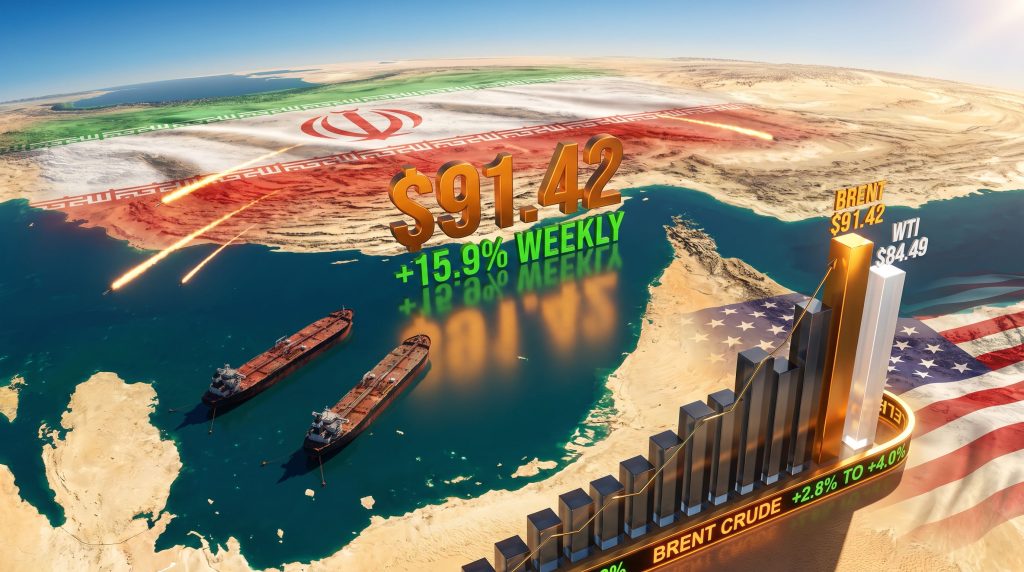
On July 20, 2026, Brent touched an intraday high of $91.42, its highest reading since June 11 of the same year, before retreating to approximately $88.64 as U.S. markets opened. WTI crude reached a peak of $84.49 before pulling back to around $82.67. The intraday range itself tells a story: the initial surge reflected genuine physical fear, while the retreat reflected the temporary sedative effect of diplomatic language.
| Benchmark | Intraday Peak | Retreat Level | Approximate Daily Move |
|---|---|---|---|
| Brent Crude | $91.42 | ~$88.64 | +2.8% to +4.0% |
| WTI Crude | $84.49 | ~$82.67 | +2.4% |
Critically, this breach did not emerge from speculation alone. It followed a 15.9% weekly gain in the prior period, one of the steepest seven-day advances in modern oil market history outside of pandemic-era volatility. A move of that magnitude in a single week signals that the market is repricing a structural condition, not responding to a passing headline.
The Three Forces Behind the Surge
A Nine-Night Military Campaign With No Clear End Date
U.S. Central Command confirmed it conducted its ninth consecutive night of strikes against Iranian military infrastructure on July 20, 2026, targeting coastal surveillance systems, air defense networks, and Revolutionary Guard Corps assets. Each successive wave of strikes has done two things simultaneously: it has degraded Iranian military capacity while also extending the conflict arc in ways that markets had not initially priced.
The political cost of de-escalation on the U.S. side has risen sharply. The confirmation of a third American service member killed in recent operations, combined with Secretary of State Marco Rubio's public position that strikes would continue as long as Iran targets vessels in international waterways, has effectively reduced the near-term probability of a ceasefire. Markets are now pricing in duration, not just intensity.
The Strait of Hormuz: The World's Most Critical Energy Chokepoint
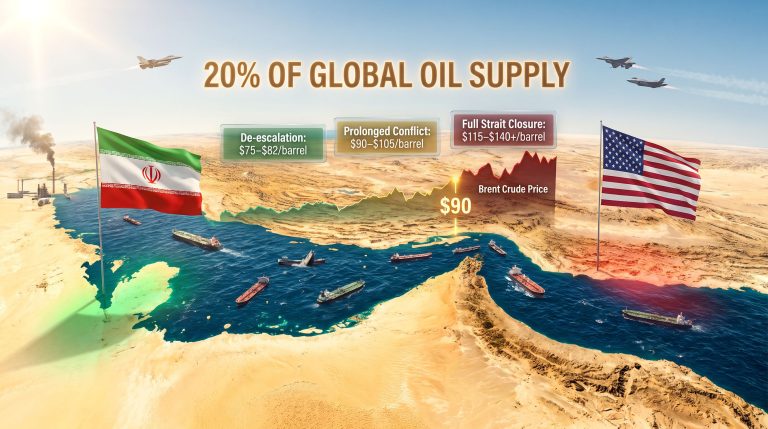
No single geographic feature has greater leverage over global energy prices than the Strait of Hormuz. Approximately 20% of the world's crude oil transits this narrow passage between Iran and Oman, alongside a significant portion of global LNG supply. When transit activity stalls, there is no immediate alternative routing capable of absorbing the shortfall.
| Metric | Status as of July 20, 2026 |
|---|---|
| Global crude oil share via Hormuz | ~20% |
| Hormuz tanker transits | At a standstill |
| LNG shipments through Hormuz | Near-total halt reported |
| IMO advisory | Urging avoidance of Hormuz transits |
| IEA warning horizon | Weeks to avoid economic shock |
Two oil tankers were reportedly immobilised after attempting to navigate the southern lane near Oman, which Iran declared unsafe. The International Maritime Organization formally urged all vessel operators to avoid Hormuz transits, and Japan's trade ministry declared the strait effectively off-limits for Japanese-flagged vessels. These are not speculative threats: they are operational realities reshaping shipping behaviour in real time.
Hardened U.S. Resolve and the Diplomacy Premium That Follows
The partial price retreat seen during the July 20 session illustrated a recurring dynamic throughout this conflict: diplomatic signals, even vague ones, can temporarily suppress the geopolitical risk premium. Iran's foreign ministry indicated some openness to negotiations, and the announcement from U.S. Central Command that its weekend wave of strikes had concluded provided just enough cover for traders to partially unwind risk positions.
This pattern — sharp gains in early Asian trade followed by moderate retreat as U.S. markets open — has now become a structural feature of oil price behaviour throughout the conflict. Sophisticated traders have begun positioning around it as a near-predictable weekly cycle. These geopolitical oil price pressures are, however, far from a new phenomenon in energy markets.
How the Hormuz Closure Is Cascading Through Global Supply Chains
The downstream effects of Hormuz disruption are not confined to crude oil. They flow through refined products, LNG, and shipping logistics simultaneously, creating compounding pressures across multiple energy-importing economies. In addition, OPEC's market influence has become increasingly relevant as member nations assess their strategic response to the crisis.
Country-by-Country Impact Assessment
-
India: The country's crude oil import bill surged approximately 60% as a direct result of the price escalation. The government urged shipowners to avoid deploying nationals on Hormuz voyages, raised diesel and jet fuel export taxes, and faces structural exposure given its heavy reliance on Middle Eastern crude.
-
Japan: Japan's trade ministry declared Hormuz effectively off-limits. Simultaneously, the country's leading LNG import company is exploring a U.S. IPO as part of an accelerated effort to diversify supply chains away from Hormuz-dependent routes.
-
South Korea: Pivoting to Red Sea routing as Hormuz disruptions persist, a strategy that carries its own risks given prior Houthi activity in that corridor.
-
Pakistan: Now paying the highest spot LNG prices seen in four years as Qatari supply lines face disruption, and planning emergency LNG purchases amid the ongoing shutdown.
-
China: Pursuing long-term LNG contracts explicitly structured to reduce Hormuz exposure. Beijing's LNG buying spree is actively tightening global gas markets, creating secondary price pressure for all other importers.
Europe: A Separate But Related Energy Crunch
European markets are navigating a parallel stress that intersects with but is distinct from the Hormuz crisis. Diesel inventories across the continent are trending toward multi-year lows, a shortage driven partly by reduced Russian refined product availability and compounded by summer heatwave conditions driving higher energy demand. Jet fuel supply chains remain strained despite earlier projections that a shortage would be avoided.
Structural Risk Alert: When crude oil disruption, LNG supply tightening, and refined product shortages occur simultaneously across multiple continents, the event has ceased to be a regional geopolitical episode. It has become a systemic supply shock with compounding feedback loops that are increasingly difficult to reverse quickly.
What Brent Futures Structure Is Telling Us
Beyond spot price movements, the structure of the futures curve provides a more reliable signal of genuine supply stress. Brent and WTI futures have flipped into backwardation — a market condition where near-term contracts trade at a premium to longer-dated ones.
Backwardation is significant because it indicates that physical buyers are willing to pay more for immediate delivery than for future delivery, which only occurs when the market perceives genuine near-term scarcity rather than speculative positioning. This structural shift is a more credible indicator of supply tightness than any single day's price movement.
In practical terms, backwardation discourages oil storage, incentivises immediate drawdown of inventories, and signals that the market cannot easily wait out the disruption. It is the futures market's way of saying that the physical supply shortage is real and immediate.
Scenario Analysis: Where Could Brent Go From Here?
Scenario 1: Diplomatic Stabilisation (Moderate Case)
If U.S.-Iran negotiations make meaningful progress and Hormuz transit activity begins recovering, Brent would likely stabilise in the $82 to $88 range. However, a return to pre-conflict levels of approximately $70 per barrel appears structurally unlikely in the near term, given that the underlying risk premium has been permanently repriced by the demonstrated willingness to use the strait as a weapon.
Scenario 2: Prolonged Strait Closure (Elevated Risk Case)
If the Hormuz threat persists without resolution, analyst consensus places Brent price targets in the $95 to $100 range. Extended closure scenarios carry projections of $105 to $108, at which level the global inflation implications become severe enough to force central bank responses across multiple major economies. This oil market disruption scenario is consequently one that policymakers worldwide are monitoring closely.
Scenario 3: Dual-Corridor Shutdown (Tail Risk)
Iran has reportedly instructed Houthi forces to prepare for renewed Red Sea shipping attacks. If coordinated, this would mean both major Middle Eastern maritime transit corridors are simultaneously under threat. A dual-corridor closure would represent an energy supply shock with no modern historical precedent and no rapid offsetting mechanism.
| Historical Disruption | Peak Brent Impact | Duration |
|---|---|---|
| 1973 Arab Oil Embargo | ~400% price increase | ~6 months |
| 1990 Gulf War | ~+130% intraday peak | ~7 months |
| 2022 Russia-Ukraine Invasion | ~+70% from pre-war levels | ~12 months |
| 2026 Iran-U.S. Conflict (current) | ~+28% from ~$70 base | Ongoing |
The next major ASX story will hit our subscribers first
How Major Producers Are Responding
Iraq as a Bypass Strategy
Iraq has emerged as a focal point for long-term routing alternatives. BP and ConocoPhillips are advancing a partnership on Iraq's giant oilfield development, signalling continued long-term production investment despite regional instability. Chevron is simultaneously moving closer to securing access to Iraq's largest oil asset, and a strategic Iraq-Syria pipeline initiative backed by the U.S. is being pursued as a structural Hormuz bypass route.
However, Iraq's own Khor Mor gas field has been shut down amid security threats, illustrating the paradox of using a conflict-adjacent country as a supply diversification vehicle.
Russia and Libya: Marginal Offsets With Their Own Constraints
Russia's oil export surge has run into what analysts describe as a 135-million-barrel traffic jam, with logistical bottlenecks limiting how quickly additional supply can reach global markets. Ukraine's intensified attacks on Russian tankers in the Black Sea add further complexity. Libya's recent declaration of a major oil discovery as commercial represents a long-term positive for supply, but its current production scale is insufficient to materially offset Hormuz-driven shortfalls.
Gulf Producers: High Prices, Strategic Tension
Gulf oil exporters face an uncomfortable dynamic. Higher prices benefit state revenues in the short term, but sustained prices above $95 risk accelerating both demand destruction and energy transition investment globally. Saudi Arabia and other Gulf producers have relaunched competition for Asian market share as supply route uncertainty reshapes buyer preferences — a development that could structurally alter long-standing oil trade relationships.
The Inflation Transmission Mechanism
The journey from a Brent price spike to consumer pain follows a well-understood but underappreciated pathway. Crude oil feeds directly into gasoline, diesel, jet fuel, heating oil, and petrochemicals. When crude rises sharply, refiners face higher input costs, and those costs move downstream within days to weeks, not months.
U.S. gasoline prices were projected to approach $4 per gallon within days of the escalation. Heating oil prices surged 1.91% in a single session. India's government-level response — including raising diesel and jet fuel export taxes — reflects official acknowledgement that the price shock has moved from the commodity market into the broader consumer economy.
Jeff Currie, one of the most closely watched commodity strategists in global markets, has argued publicly that the narrative of oil market abundance that suppressed prices through much of the early 2020s has fundamentally ended. The structural assumption of a well-supplied world has been replaced by a geopolitical risk premium that may prove persistent regardless of individual diplomatic signals. (Source: OilPrice.com, July 2026)
The IEA's warning that the world has only weeks to avoid a Hormuz-driven economic shock underscores the systemic nature of what is unfolding. This is no longer a forecast risk: it is an active supply emergency with a narrowing window for resolution.
Frequently Asked Questions
Why did Brent break $90 per barrel on July 20, 2026?
Brent breaks $90 after Iran war escalation following the ninth consecutive night of U.S. military strikes on Iranian military infrastructure, combined with Iran's immobilisation of two tankers attempting Hormuz transit and ballistic missile attacks on U.S. military assets across the region. The convergence of direct military escalation and physical shipping paralysis drove a sharp risk premium into near-term crude contracts.
What makes the Strait of Hormuz so critical to oil prices?
The strait is a narrow waterway through which roughly one in five barrels of globally traded crude oil passes, along with a substantial share of LNG supply. There is no alternative transit route capable of quickly absorbing that volume. When Hormuz access is impaired, the physical supply shortfall is immediate and cannot be offset through rerouting alone.
Could Brent reach $100 per barrel?
Analyst projections place Brent at $95 to $100 if the Hormuz threat persists, with extended closure scenarios carrying estimates of $105 to $108. A dual-corridor shutdown involving both Hormuz and the Red Sea would represent a supply shock scenario with no modern precedent. Furthermore, Brent's recent retreat below $90 on peace hopes has done little to resolve the underlying structural tensions.
Why did prices pull back after the initial spike?
The retreat reflected two concurrent signals: Iran's foreign ministry indicating openness to diplomatic engagement, and U.S. Central Command confirming the conclusion of its weekend wave of strikes. Markets interpreted these as short-term de-escalation indicators, though the structural conflict and transit paralysis remain unresolved.
Who is most exposed to the Hormuz disruption?
Countries most dependent on Middle Eastern crude imports face the sharpest near-term pain. India, Japan, South Korea, and Pakistan all have acute exposure through crude oil and LNG import costs. European consumers face compounding pressure from crude price increases layered on top of independently declining diesel inventories.
Disclaimer: This article is intended for informational purposes only and does not constitute financial or investment advice. Oil price forecasts and scenario projections involve significant uncertainty and should not be relied upon as predictions of future market outcomes. Past price behaviour during geopolitical events is not necessarily indicative of future results.
Want to Track the Investment Opportunities Emerging From Energy Market Disruptions?
When commodity shocks reshape global markets, mineral discovery opportunities often follow — and Discovery Alert's proprietary Discovery IQ model instantly alerts subscribers to significant ASX mineral discoveries, turning complex market signals into clear, actionable insights. Explore historic discoveries and their returns or start your 14-day free trial today to position yourself ahead of the next major market move.