July 20, 2026
When Two Chokepoints Close at Once: The Structural Risk Reshaping Arabian Peninsula Trade
Global commodity markets have long operated on the assumption that maritime chokepoints are temporary disruptions rather than permanent features of the trading landscape. The Suez Crisis of 1956, the tanker wars of the 1980s, and the 2021 Ever Given blockage all tested this assumption — and each time, trade eventually normalised. What makes the current configuration in the Middle East fundamentally different is the simultaneous degradation of two critical waterways, creating a dual-chokepoint scenario with no clean historical parallel.
The Houthi navigation ban on Saudi steel imports, declared on 20 July 2026, is not simply another escalation in a prolonged regional conflict. It is a stress test for the supply chains underpinning one of the world's most ambitious industrial transformation programmes, arriving at precisely the moment when Saudi Arabia's import dependency on Asian steel is most exposed.
When big ASX news breaks, our subscribers know first
The Geography of Vulnerability: Why Saudi Arabia's Steel Supply Chain Runs Through Contested Waters
Bab el-Mandeb and the Suez Canal: Asymmetric Risk Corridors
Saudi Arabia sits at the intersection of two maritime corridors, and the risk profile of each could not be more different right now. Steel cargoes arriving from Chinese coastal export hubs — including Tangshan and Caofeidian, which together account for a substantial share of the China steel market — must transit the Bab el-Mandeb strait before reaching Red Sea ports such as Jeddah and King Abdullah Port.
Bab el-Mandeb is a 29-kilometre-wide chokepoint connecting the Gulf of Aden to the Red Sea. At its narrowest navigable channel, vessels operate within close proximity to the Yemeni coastline — precisely the geography that gives Houthi forces their leverage. This is not a theoretical vulnerability: since late 2023, the Houthis have demonstrated a credible capability to target commercial shipping using anti-ship missiles and one-way attack drones, interdicting dozens of vessels and forcing a large-scale rerouting of global container and bulk cargo away from the Red Sea corridor.
Mediterranean-origin steel cargoes face a structurally different risk profile. Vessels entering from the western Mediterranean transit through the Suez Canal and enter the Red Sea from the north, bypassing Bab el-Mandeb entirely. Under the current declaration's most restrictive interpretation, these cargoes carry lower immediate exposure — though the Houthis have previously demonstrated willingness to expand target scope beyond initial declarations.
How Yemen's Conflict Has Progressively Eroded Commercial Normalcy
The Houthi maritime campaign did not begin in July 2026. Its escalation follows a clear trajectory that commercial operators have been navigating, with increasing difficulty, since late 2023:
- Late 2023: Houthis declared an embargo on vessels linked to Israel, triggering the first major wave of Red Sea rerouting via the Cape of Good Hope
- 2024 to 2025: The campaign broadened to encompass Western-affiliated shipping, dramatically increasing the cost of Red Sea transits and pushing Baltic exchange freight indices to multi-year highs
- July 2026: A Saudi-specific navigation ban introduces a new target category, with enforcement intent backed by explicit escalation warnings
Each iteration has recalibrated commercial operator risk tolerance upward, meaning the market's response to the latest declaration may be faster and more decisive than responses to earlier announcements. Furthermore, the broader geopolitical metals landscape continues to amplify uncertainty across global commodity supply chains.
The Mechanics of the "Siege for Siege" Declaration
What the 20 July 2026 Ban Actually Says — and What It Leaves Ambiguous
The Houthi group framed its 20 July declaration as a direct reciprocal measure, characterising Saudi Arabia's conduct toward Yemen — including what it described as an ongoing blockade and recent military strikes on Sanaa International Airport — as the trigger for the ban. According to reporting from Middle East Monitor, the group indicated the restriction would take effect immediately and warned that further Saudi military action would prompt additional escalation.
What the declaration does not clearly specify is its precise scope. A critical legal and operational ambiguity remains unresolved:
Key Policy Ambiguity: Whether the navigation restriction applies exclusively to Saudi-flagged vessels or extends to all commercial ships bound for Saudi Red Sea ports remains unresolved. A broader interpretation would dramatically expand the economic footprint of the ban across global commodity flows.
This ambiguity is not incidental. It is a well-documented feature of asymmetric maritime coercion: vague target definitions maximise deterrence by forcing all commercial operators to assume worst-case exposure, even where enforcement capacity may be limited.
Comparing This Ban to Previous Houthi Maritime Declarations
Understanding how previous declarations translated into enforcement outcomes provides the most useful empirical baseline for assessing current risk.
| Declaration Type | Year | Scope | Enforcement Outcome |
|---|---|---|---|
| Anti-Israel shipping ban | 2023–2024 | Israel-linked vessels | Active interdictions, multiple attacks |
| Broader Red Sea disruption campaign | 2024–2025 | Western-affiliated shipping | Significant rerouting via Cape of Good Hope |
| Saudi-specific navigation ban | July 2026 | Saudi Red Sea ports | Enforcement outcome pending |
A pattern emerges from this comparison: Houthi enforcement has historically been most aggressive against the most clearly defined target categories. The Saudi-specific ban consequently represents the most targeted declaration to date, potentially making enforcement more focused and credible than the broader campaigns of 2024 and 2025.
Saudi Arabia's Steel Import Dependency: The Numbers Behind the Exposure
Volume, Trend, and Supplier Concentration
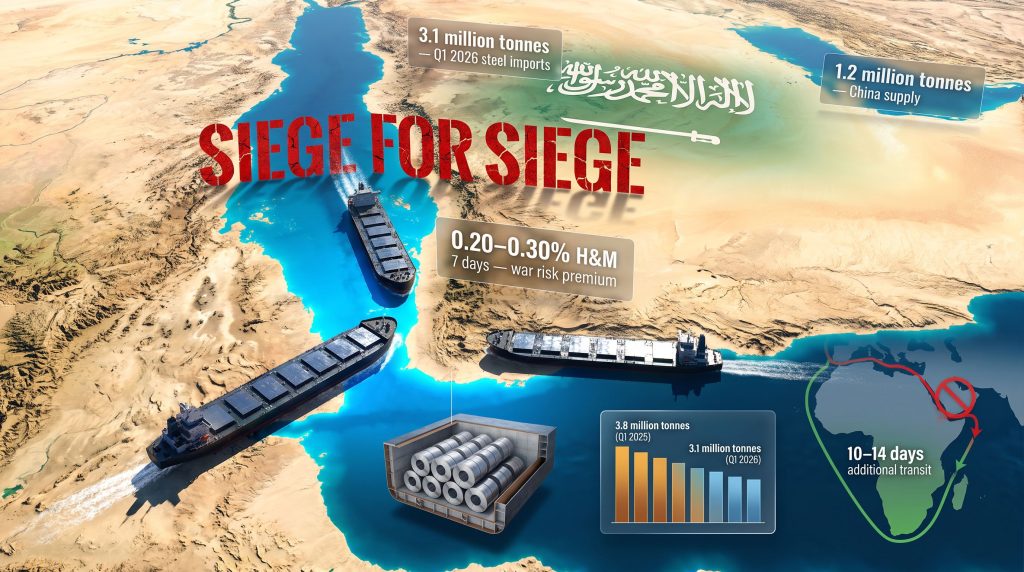
Saudi Arabia imported approximately 3.1 million tonnes of steel products during the first quarter of 2026, already representing a year-on-year decline of roughly 18.4% from the 3.8 million tonnes recorded in Q1 2025, according to Global Trade Tracker data. This contraction preceded the navigation ban entirely — meaning the kingdom's steel supply position was already tightening before a new disruption variable was introduced.
China dominates Saudi Arabia's steel import profile, contributing around 1.2 million tonnes in Q1 2026 alone. The composition of that supply reveals which product categories carry the highest disruption risk:
| Steel Product Category | Volume (Q1 2026) |
|---|---|
| Hot-rolled coil (HRC) | ~667,000 tonnes |
| Hot-dipped galvanised steel | ~140,000 tonnes |
| Semi-finished products (slabs and billets) | ~132,000 tonnes |
| Cold-rolled coil (CRC) | ~21,000 tonnes |
| Other steel products | Remainder of 1.2mn t total |
Source: Global Trade Tracker (GTT)
Which Downstream Sectors Face the Greatest Input Cost Pressure?
Hot-rolled coil and semi-finished products — the two largest volume categories — are the foundational inputs for Saudi Arabia's construction, infrastructure, and light manufacturing sectors. Saudi Arabia's Vision 2030 programme has generated sustained demand for structural steel across giga-project development, residential construction, and industrial zone expansion. Any sustained increase in landed steel costs flows directly into project budgets across these sectors.
- Construction and infrastructure: Flat steel price increases translate into higher rebar and structural section costs, compressing contractor margins on fixed-price contracts
- Industrial fabrication: Cold-rolled and galvanised products feed manufacturing supply chains where import cost escalation cannot always be passed through to end buyers quickly
- Downstream processing: Saudi steel service centres holding limited inventory buffers face potential restocking cost inflation if import disruption extends beyond weeks
Live Vessel Movements as Real-Time Enforcement Indicators
Steel Cargo Ships Caught Mid-Transit
As of the ban's announcement, at least two China-origin steel cargo vessels were en route to King Abdullah Port without having yet crossed Bab el-Mandeb, according to vessel-tracking data from Kpler:
- The Better Victory (55,561 DWT), loaded with steel from Tangshan, China
- The Dato Success (56,860 DWT), departing from Caofeidian, China
Neither vessel had shown signs of course deviation or reversal at the time of reporting. This initial posture reflects a wait-and-see approach that is commercially rational in the short term but carries escalating risk if enforcement actions materialise before these ships reach Bab el-Mandeb.
Tanker Behaviour as a Leading Indicator
Perhaps more telling than steel cargo vessel movements is the behaviour of crude tanker owners in the days before the formal declaration. Sophisticated tanker operators — who typically have access to better geopolitical intelligence than bulk cargo owners — had already begun acting on escalation risk. In addition, the trade war economic impact on global freight patterns has further complicated commercial decision-making for vessel operators navigating contested corridors.
Market Signal: The fact that VLCC operators executed course reversals three days before the formal ban announcement suggests that professional maritime risk assessors had already priced in the escalation. For steel cargo operators still transiting as of 20 July, this divergence in behaviour is a critical warning signal.
Specifically, vessel-tracking data from Kpler shows:
- The VLCC VL Pioneer executed a U-turn in the Red Sea on 17 July — three days before the formal ban — shifting to an eastward ballast route rather than continuing toward the Saudi crude export terminal at Yanbu
- The VLCC Farhah, which had loaded crude at Yanbu on 10 July, reversed course at Bab el-Mandeb on 17 July and returned to Yanbu rather than completing its outbound voyage
The fact that other vessels continued transiting during the same period illustrates the fragmented, risk-differentiated decision-making that characterises maritime operator responses to ambiguous threat environments.
The Dual-Chokepoint Problem: Hormuz Compounds Red Sea Risk
A Simultaneous Squeeze on Arabian Peninsula Trade
The Houthi navigation ban arrives against a backdrop of concurrent disruption at the Strait of Hormuz, where Iranian-linked activity has reduced commercial vessel traffic to approximately 22% of pre-conflict levels as of mid-July 2026, according to data from Windward. Of 18 Hormuz transits recorded on 15 July, 13 vessels used the northern, Iranian-controlled lane, with only one transiting the US-supported southern corridor — a bifurcation reflecting the waterway's effective partition into geopolitically aligned transit routes.
For Saudi Arabia, which sits between both chokepoints, the convergence creates a uniquely constrained trade environment. Crude exports exit primarily via Yanbu on the Red Sea and Ras Tanura on the Gulf — one now under Houthi threat, the other accessible only through a Hormuz strait operating at a fraction of normal capacity. Steel imports face mirror-image exposure.
The Cape of Good Hope Rerouting Scenario
If Asian steel cargoes are forced to bypass both Bab el-Mandeb and the Strait of Hormuz, the only commercially viable alternative routing runs around the Cape of Good Hope. However, the implications for the global crude steel outlook extend well beyond Saudi Arabia's borders, with rerouting costs potentially reshaping export economics for Asian producers more broadly.
Scenario Analysis: A full Africa circumnavigation adds approximately 10 to 14 days of transit time on the Asia-to-Saudi Arabia route and significantly increases fuel consumption and charter costs per voyage. On a large bulk carrier, additional fuel costs alone can represent tens of thousands of dollars per voyage, with the full freight cost uplift flowing directly into the landed price of steel in Saudi Arabia.
The economic implications cascade across the steel value chain:
- Higher freight costs increase the cost-and-freight price of Chinese steel at Saudi ports
- War risk insurance premium escalation adds a further layer of landed cost inflation
- Extended transit times reduce effective inventory coverage, forcing buyers to either build buffers or accept supply uncertainty
- Saudi construction and manufacturing sectors absorb margin compression on input costs
The next major ASX story will hit our subscribers first
War Risk Insurance: The Market Mechanism That Makes Routes Commercially Unviable
Current Premium Levels and Escalation Pathways
War risk insurance premiums serve as one of the most responsive real-time price signals in maritime risk markets, recalibrating almost immediately as threat environments shift. As of mid-June 2026, premiums for Bab el-Mandeb transits were priced at approximately 0.20 to 0.30% of hull and machinery value for a seven-day coverage period, with a 50% no-claim bonus applied — a relatively manageable cost that most commercial operators could absorb.
A formal navigation ban backed by declared missile and drone enforcement threats would historically trigger rapid upward repricing. For smaller vessel operators with higher leverage ratios and tighter operating margins, premium escalation above certain thresholds can render a route commercially unviable even without a physical interdiction occurring.
| Risk Scenario | Estimated Premium Range | Likely Commercial Impact |
|---|---|---|
| Status quo (pre-ban, mid-June 2026) | 0.20–0.30% H&M value / 7 days | Manageable; most operators transiting |
| Active ban with sporadic enforcement | 0.50–1.00%+ H&M value / 7 days | Selective rerouting; freight cost uplift |
| Confirmed vessel attacks on Saudi-bound ships | 1.50%+ or coverage withdrawal | Mass rerouting; severe supply disruption |
A less widely understood dynamic in war risk insurance markets is that underwriter withdrawal — where insurers decline to offer coverage at any price — can be more disruptive than premium escalation alone. During the peak of the 2024 Red Sea campaign, several London market underwriters temporarily restricted coverage for certain Red Sea voyages, effectively making those routes commercially impossible regardless of operator risk appetite.
Saudi Arabia's Strategic Policy Options
Near-Term Import Diversification
Mediterranean-sourced steel transiting via the Suez Canal represents the most immediately accessible lower-risk import pathway, bypassing Bab el-Mandeb entirely. However, European steel producers cannot substitute for Chinese supply at equivalent scale or price point. European hot-rolled coil is typically priced at a significant premium to Chinese material, and European mills do not carry the spare export capacity required to absorb a multi-million tonne demand shift from Saudi Arabia.
Domestic Production as a Structural Buffer
Saudi Arabia's domestic steel industry provides partial insulation against import disruption, though its capacity constraints are well-documented. Domestic producers can address some shortfalls in long steel products such as rebar, but the kingdom remains heavily import-dependent for flat steel products — particularly the hot-rolled coil that feeds its construction and manufacturing sectors. Sustained import route vulnerability may consequently accelerate the domestic capacity investment agenda embedded within Vision 2030's industrial localisation priorities.
Furthermore, the China steel outlook for flat steel exports remains a critical variable: any demand destruction in Saudi Arabia caused by route disruption could depress Chinese export volumes precisely when Chinese mills are navigating their own overcapacity pressures.
The Escalation Feedback Loop
A particularly complex dimension of Saudi Arabia's response options is that the Houthis explicitly framed the ban as a retaliatory measure, warning of further escalation should Saudi Arabia continue military operations in Yemen. This creates a policy feedback loop where each potential Saudi response carries embedded escalation risk — constraining the kingdom's freedom of action in ways that a conventional naval blockade scenario would not.
Frequently Asked Questions
What exactly did the Houthis announce on 20 July 2026?
Yemen's Houthi group declared an immediate prohibition on maritime navigation connected to Saudi Arabia on 20 July 2026, characterising the move as a reciprocal response to what the group described as Saudi Arabia's blockade of Yemeni territory and military strikes against Yemen, including against Sanaa International Airport.
Which shipping routes carry the highest risk under the ban?
Vessels travelling from Asian ports through the Bab el-Mandeb strait toward Saudi Red Sea ports face the greatest direct exposure. Cargoes arriving from Mediterranean ports via the Suez Canal bypass Bab el-Mandeb and currently carry lower immediate risk under a narrow reading of the ban's scope.
How much steel does Saudi Arabia import from China?
Saudi Arabia imported approximately 3.1 million tonnes of total steel products in Q1 2026, with China accounting for around 1.2 million tonnes of that volume. Chinese supply is concentrated in hot-rolled coil, galvanised steel, and semi-finished products including slabs and billets.
Could the ban drive up domestic steel prices in Saudi Arabia?
A sustained enforcement of the Houthi navigation ban on Saudi steel imports would increase freight costs, war risk insurance premiums, and effective transit times for Asian steel cargoes. These additional costs would flow through to higher landed prices at Saudi ports, with downstream pressure on construction, manufacturing, and industrial fabrication sectors. The magnitude of price impact would depend directly on enforcement intensity and rerouting scale.
Is the Houthi ban enforceable under international maritime law?
The declaration operates entirely outside conventional international maritime law frameworks. It carries no legal standing under the United Nations Convention on the Law of the Sea or established rules of naval blockade. Its practical enforceability depends wholly on the Houthis' military capacity and willingness to interdict vessels — factors that have varied considerably across their previous maritime declarations.
This article contains forward-looking analysis and scenario assessments based on publicly available data as of late July 2026. Maritime risk environments can change rapidly, and readers should not rely on this content as the basis for commercial or investment decisions without consulting current primary sources. Vessel movement data referenced in this article is sourced from Kpler and Windward analytics platforms.
Want to Track the Commodity Opportunities Emerging From Geopolitical Supply Chain Disruptions?
When chokepoints close and supply chains fracture, resource markets reprice rapidly — and Discovery Alert's proprietary Discovery IQ model scans ASX announcements in real time to identify significant mineral discoveries before the broader market reacts, delivering actionable insights across more than 30 commodities to both short-term traders and long-term investors. Begin your 14-day free trial at Discovery Alert today and position yourself ahead of the next major market-moving announcement.