
June 18, 2026
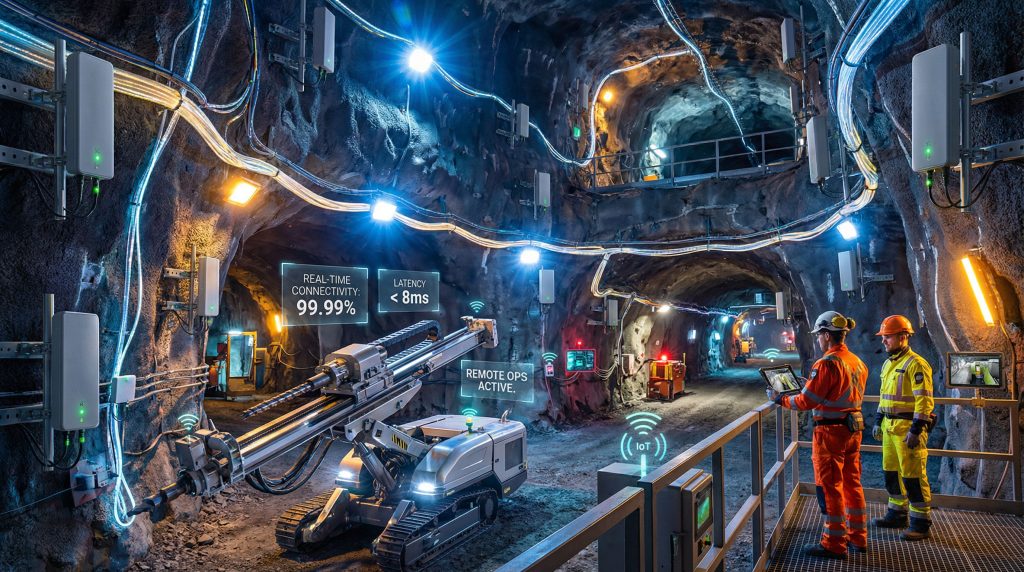
The 5G network for underground mining represents a revolutionary advancement in industrial communication technology, fundamentally transforming how mining operations manage equipment coordination, worker safety, and real-time decision-making. The convergence of ultra-reliable low-latency communication protocols with specialized industrial applications has created unprecedented opportunities for operational efficiency across demanding environments where traditional connectivity solutions have historically fallen short.
Understanding 5G's Technical Advantages Over Legacy Mining Communication Systems
Modern 5G network for underground mining deployments deliver substantial performance improvements over conventional communication infrastructure, establishing new benchmarks for operational reliability and response times. The technical specifications underlying these improvements reflect years of development specifically targeting mission-critical industrial applications, driving AI in mining operations to new levels of sophistication.
Network Performance Metrics That Matter in Underground Environments
Ultra-Reliable Low-Latency Communication (URLLC) specifications establish the foundation for advanced mining automation systems. Current 5G implementations achieve latency targets of 1 millisecond with 99.9999% reliability for mission-critical applications, representing a dramatic improvement over 4G LTE systems that typically deliver 50-100 milliseconds latency under optimal conditions.
Peak data transmission capabilities further distinguish 5G infrastructure from legacy alternatives. Modern 5G networks support data rates up to 20 Gbps downlink and 10 Gbps uplink in optimal configurations, compared to 4G LTE's practical maximum of 1 Gbps downlink. These throughput advantages become particularly significant during simultaneous multi-device operations involving vehicle telemetry, high-definition video feeds, and distributed sensor arrays.
The reliability differential becomes critical during peak automation activities when multiple systems require simultaneous network access. While 4G networks typically support 50-100 concurrent connected devices with stable performance, 5G architectures can manage 100+ devices with enhanced quality-of-service guarantees, ensuring consistent connectivity during intensive operational periods.
Signal propagation through geological formations presents unique challenges for underground wireless systems. Research indicates that 5G millimeter-wave frequencies experience 20-30 dB additional attenuation through rock formations compared to sub-6 GHz frequencies. However, sub-6 GHz 5G implementations (600 MHz – 6 GHz range) provide superior penetration through geological structures compared to millimeter-wave alternatives, making them more suitable for deep underground applications.
Overcoming Traditional Connectivity Challenges in Deep Mining
Underground mining environments create severe RF propagation challenges that legacy communication systems struggle to address effectively. Rock interference and signal degradation issues compound as mining operations extend deeper underground, with typical granite and limestone formations causing significant signal attenuation across all frequency bands.
Line-of-sight limitations in complex tunnel networks create coverage gaps that traditional Wi-Fi mesh systems cannot reliably address. The branching nature of modern mining operations, with multiple levels and lateral extensions, requires communication infrastructure capable of maintaining connectivity across three-dimensional coverage areas extending several kilometres from surface installations.
Coverage gaps in multi-level mining operations have historically required extensive cable infrastructure investments. The New Afton Mine implementation demonstrates how advanced wireless networks can address these challenges, where operators previously faced 50-minute commutes each way to reach the deepest operational areas. This 100-minute round-trip requirement per shift exemplifies the logistical complexity that reliable wireless communication can eliminate.
Bandwidth bottlenecks during peak operational periods represent another critical challenge for legacy systems. Underground mining involves fluctuating network demand patterns, with periods of intensive video streaming for 3D mapping uploads alternating with lightweight telemetry from distributed sensor networks. Advanced 5G network slicing technology enables prioritisation of critical safety communications over non-essential data transfers, ensuring consistent latency performance for essential operations.
When big ASX news breaks, our subscribers know first
What Are the Core Applications of 5G in Underground Mining Operations?
5G network for underground mining applications extend far beyond traditional communication requirements, enabling sophisticated automation systems that fundamentally transform operational methodologies and safety protocols whilst supporting the data-driven mining future.
Remote Equipment Control and Automation Systems
Autonomous equipment coordination represents the most significant application of advanced wireless infrastructure in modern mining operations. Tele-remote vehicle operations enable operators positioned at surface facilities to control subsurface equipment with precision matching direct operator control, while eliminating personnel exposure to hazardous underground conditions including gas pockets, unstable geology, and equipment collision risks.
The New Afton Mine's implementation of remote Sandvik vehicle operations in their C-Zone demonstrates practical applications of this technology. Sandvik produces specialised articulated haul vehicles and drilling equipment designed specifically for underground block caving operations, requiring coordination capabilities that traditional communication systems cannot reliably support.
Real-time machinery synchronisation across distributed mining zones demands sub-10 millisecond response times for safety-critical operations. Equipment collision avoidance systems require immediate response capabilities where communication delays could create significant safety hazards. The millisecond-level latency requirements for autonomous drilling coordination exceed the capabilities of legacy 4G and Wi-Fi mesh networks.
Integration challenges with existing hydraulic and electrical systems require communication protocols capable of interfacing with diverse equipment manufacturers' control systems. Modern mining operations utilise equipment from multiple vendors, each with proprietary communication protocols that advanced wireless networks must accommodate through standardised interfaces.
Safety Enhancement Technologies
Collision avoidance radar systems benefit significantly from ultra-low latency communication capabilities, enabling millisecond response times for automatic equipment shutdown or course correction. These systems continuously monitor equipment proximity and trajectory, requiring constant data transmission between mobile equipment and centralised safety monitoring systems.
Proximity detection systems for personnel and equipment utilise real-time geolocation capabilities enabled by advanced positioning systems. The Intelligent Positioning System (iPS) implementation at New Afton provides precise tracking of personnel and equipment locations, essential for block caving method optimisation where extraction timing across multiple zones requires precise coordination.
Smart monitoring systems for structural integrity enable continuous surveillance of critical infrastructure components. These systems transmit data from distributed sensor networks monitoring ground stability indicators, atmospheric composition, and ventilation system performance. Underground mining requires continuous monitoring of methane, carbon dioxide, and oxygen levels, with sensor networks transmitting readings at optimal intervals without centralised wired infrastructure.
Emergency communication protocols benefit from the redundancy and reliability improvements offered by private wireless networks. Push-to-Talk communication capabilities ensure seamless coordination among workers during normal operations and emergency situations, with network reliability specifications supporting mission-critical safety communications.
High-Bandwidth Operational Applications
High-definition video transmission from multiple camera arrays requires substantial bandwidth allocation and consistent network performance. Real-time HD video streams demand minimum bandwidth requirements of:
- 5-15 Mbps per 1080p HD video stream
- 25-50 Mbps for 4K video feeds
- Network buffering capabilities to handle underground RF signal variation
- Compression algorithm optimisation for bandwidth efficiency
3D mapping and surveying applications generate massive point cloud datasets, often exceeding 100 GB per comprehensive mine scan. Advanced wireless infrastructure enables near-real-time data transmission from LiDAR and RGB-D sensor arrays, supporting rapid 3D model generation for geological analysis and block stability assessment.
IoT sensor networks for environmental monitoring represent a critical application requiring distributed, low-power sensors capable of continuous atmospheric monitoring. These networks monitor pressure and temperature variations, ventilation system performance, and ground stability indicators across extensive underground areas.
Predictive maintenance data collection benefits from the improved connectivity reliability and device capacity offered by advanced wireless infrastructure. Continuous monitoring of equipment performance parameters enables machine learning algorithms to identify potential failures before they occur, reducing unplanned downtime and maintenance costs.
How Do Private 5G Networks Compare to Alternative Mining Communication Solutions?
Comprehensive analysis of communication technologies available for underground mining operations reveals significant performance differentials across latency, scalability, reliability, and cost considerations, particularly as the mining industry evolution demands increasingly sophisticated connectivity solutions.
| Technology | Latency Performance | Device Capacity | Reliability Rating | Initial Investment | Annual Operating Costs |
|---|---|---|---|---|---|
| Private 5G | <10ms guaranteed | 100+ concurrent devices | Excellent with infrastructure | $500k-$2M | 10-15% of capex |
| 4G/LTE | 30-50ms typical | 50-75 devices | Good in optimal conditions | $200k-$800k | 15-20% of capex |
| Wi-Fi Mesh | 20-100ms variable | 30-50 devices | Poor under heavy load | $100k-$400k | $50k-$150k annually |
| Leaky Feeder | <5ms voice only | Voice communications | Excellent for voice | $150k-$600k | 5-10% of capex |
Deployment Architecture Considerations
Small cell placement strategies in underground tunnel systems require careful consideration of RF propagation characteristics and coverage overlap requirements. Optimal cell spacing ranges from 300-500 metres in open tunnel sections, with reduced spacing of 100-200 metres in branching tunnel networks where RF shadowing creates coverage challenges.
Femtocell deployment at equipment concentration points, including loading stations and maintenance areas, provides enhanced coverage for high-device-density locations. Coverage planning must account for three-dimensional expansion including depth increases, lateral tunnel extensions, and vertical stoping faces characteristic of modern mining operations.
Fiber optic backbone infrastructure represents a critical component of private 5G deployments, requiring redundant pathways from surface installations to main underground distribution nodes. Furthermore, typical implementations require:
- 10-50 km of fiber optic cable installation
- Minimum 100 Mbps aggregate capacity for small cell backhauling
- Redundant pathways for network reliability
- Power supply provisioning at each small cell location
Edge computing integration enables local processing capabilities that reduce dependence on surface-based computing resources. Co-located computing nodes with radio access network equipment support real-time video analytics for safety systems, local machine learning model inference, and data aggregation before cloud transmission.
Redundancy planning for critical operations requires multiple communication pathways and backup power systems. Underground mining operations cannot tolerate communication failures during safety-critical activities, necessitating comprehensive backup systems and failover protocols.
What Implementation Challenges Must Mining Operations Address?
5G network for underground mining implementations face unique technical and operational challenges that require specialised solutions and careful planning to ensure successful deployment and ongoing operation, particularly given current mining consolidation trends affecting resource allocation.
Technical Infrastructure Requirements
Power distribution systems in underground environments must accommodate the electrical requirements of distributed small cell installations while meeting safety regulations for hazardous underground conditions. Typical small cell installations require 120V or 240V AC power, with battery backup systems for continued operation during power interruptions.
Environmental protection requirements for sensitive electronic equipment in underground conditions include humidity control, temperature regulation, and protection from dust and water intrusion. Mining environments expose communication equipment to extreme conditions that surface installations never encounter, requiring specialised enclosures and environmental controls.
Integration challenges with legacy cable and communication systems require careful planning to ensure compatibility with existing infrastructure investments. Many mining operations have substantial investments in copper cable networks that must continue operating during transition periods, requiring hybrid communication architectures.
Maintenance accessibility in confined underground spaces presents ongoing operational challenges. Communication equipment installed in underground locations must remain accessible for routine maintenance and emergency repairs, whilst complying with safety regulations that limit personnel access to certain areas.
Operational Integration Complexities
Staff training requirements for new communication protocols extend beyond basic equipment operation to include troubleshooting, emergency procedures, and integration with existing operational workflows. Personnel must understand both the capabilities and limitations of advanced communication systems to utilise them effectively.
Workflow adaptation for remote operations requires fundamental changes in how mining operations coordinate equipment and personnel. Traditional direct-supervision models must adapt to remote monitoring and control methodologies that rely heavily on communication system reliability.
Data security considerations in connected mining environments require comprehensive cybersecurity frameworks addressing both network security and operational system protection. Connected mining operations create new attack vectors that traditional isolated systems never faced, requiring specialised security protocols.
Phased deployment strategies minimise operational disruption while enabling systematic validation of communication system performance. The New Afton implementation demonstrates this approach through their three-phase strategy: C-Zone LTE remote operations, underground coverage expansion, and surface communication enhancement across mountainous terrain.
Which Global Mining Operations Are Leading 5G Adoption?
Advanced wireless communication adoption in mining operations varies significantly across different mining methodologies, with certain specialised techniques driving early implementation of 5G network for underground mining solutions. However, these deployments require an ai efficiency boost to maximise their operational potential.
Large-Scale Commercial Deployments
Multi-level tunnel coverage systems demonstrate the scalability potential of private wireless networks, with successful implementations supporting operations extending beyond 1.5 kilometres in depth. These deployments require careful planning of coverage overlap and signal hand-off procedures to maintain connectivity as equipment moves throughout extensive underground networks.
Autonomous equipment fleets utilising 5G coordination represent the most advanced implementations currently operational. These systems coordinate multiple autonomous vehicles, drilling equipment, and material handling systems through centralised control systems that depend entirely on reliable, low-latency communication.
Integrated safety and productivity monitoring platforms combine multiple communication-dependent systems into unified operational dashboards. These platforms aggregate data from collision avoidance systems, environmental monitoring networks, personnel tracking systems, and equipment performance sensors.
Cross-site connectivity for mining conglomerates enables centralised monitoring and control of multiple mining operations through unified communication networks. Large mining companies benefit from standardised communication platforms that enable operational expertise sharing and centralised safety monitoring across multiple sites.
Specialised Mining Method Applications
Block caving operations require particularly sophisticated communication capabilities due to the precision coordination demands of this mining method. Block caving involves controlled subsidence of large rock masses, requiring precise timing coordination between multiple extraction points and continuous monitoring of structural stability.
The New Afton Mine's specialisation in block caving demonstrates the communication requirements for this advanced mining technique. Block caving operations used in only a small number of mines globally require real-time adjustment of draw rates from different zones, integrated equipment synchronisation across multi-level operations, and continuous subsidence monitoring.
Longwall mining applications benefit from communication systems supporting shearer remote control systems and longwall face monitoring. These operations require continuous communication along extensive working faces where traditional point-to-point communication systems prove inadequate.
Open-pit to underground transition zones present unique communication challenges requiring seamless coverage across diverse operational environments. Mining operations transitioning from surface to underground methods need communication systems supporting both operational methodologies during transition periods.
Hazardous material extraction operations minimise human presence through remote operation capabilities enabled by reliable communication systems. These applications represent some of the most demanding communication requirements in mining, where system failures could create serious safety hazards.
How Does 5G Enable Advanced Mining Analytics and Predictive Operations?
Advanced wireless infrastructure enables sophisticated data analytics and predictive operational capabilities that were previously impossible with legacy communication systems, transforming how mining operations optimise equipment utilisation and operational efficiency.
Real-Time Data Processing Capabilities
Edge computing integration provides immediate decision-making capabilities without dependence on external cloud processing resources. Local computing nodes co-located with communication infrastructure process video analytics for collision detection, implement machine learning model inference for equipment optimisation, and perform data aggregation before transmission to central management systems.
Machine learning integration for equipment optimisation utilises continuous data streams from distributed sensors monitoring equipment performance, environmental conditions, and operational parameters. These systems identify patterns indicating potential equipment failures, optimise operational parameters for maximum efficiency, and recommend maintenance scheduling based on actual equipment condition rather than predetermined schedules.
Geolocation precision capabilities enable resource tracking with accuracy levels previously achievable only through manual surveying methods. Modern positioning systems integrated with wireless communication networks provide real-time location data for personnel, equipment, and extracted materials, supporting optimisation of material flow and logistics coordination.
Environmental condition monitoring and automated alert systems continuously assess atmospheric composition, structural stability indicators, and ventilation system performance. These systems generate immediate alerts when conditions approach safety thresholds, enabling proactive responses to potential hazards.
Operational Efficiency Metrics
Predictive maintenance capabilities reduce equipment downtime through early identification of potential failures before they impact operations. Continuous monitoring of equipment performance parameters enables maintenance scheduling based on actual equipment condition, reducing both planned and unplanned maintenance costs.
Extraction precision improvements result from real-time monitoring and control capabilities that enable immediate adjustments to extraction parameters based on geological conditions and material quality assessments. These capabilities reduce waste generation and improve recovery rates for valuable minerals.
Worker productivity enhancement through remote operations eliminates the time requirements for personnel transport to remote operational areas. The New Afton example demonstrates significant productivity gains by eliminating 100-minute round-trip commutes for each work shift, enabling operators to focus on value-added activities rather than transportation logistics.
Logistics and material flow optimisation benefits from real-time tracking of material movement throughout mining operations. Communication-enabled tracking systems provide visibility into material location, quality characteristics, and processing status, enabling optimisation of material handling and processing workflows.
The next major ASX story will hit our subscribers first
What Are the Economic Implications of 5G Underground Mining Networks?
Financial analysis of 5G network for underground mining implementations requires comprehensive evaluation of capital investments, operational cost impacts, and productivity improvements to determine overall economic viability.
Investment Analysis Framework
Capital expenditure requirements for private 5G network infrastructure vary significantly based on mine size, geological characteristics, and coverage requirements. Typical deployments range from $500,000 to $2,000,000 for mid-sized mining operations, including small cell equipment, fiber optic infrastructure, and central processing equipment.
The cost structure differs substantially from legacy communication alternatives, with private 5G networks characterised by high initial capital requirements but relatively low ongoing operational costs. Annual operating expenses typically represent 10-15% of initial capital expenditure, compared to Wi-Fi mesh systems that require $50,000-$150,000 in annual maintenance costs due to frequent equipment replacement needs.
Operational cost reduction opportunities through automation and remote operations provide significant ongoing savings. Reduced personnel transportation requirements, improved equipment utilisation rates, and decreased maintenance costs through predictive monitoring contribute to operational cost reductions that can offset initial infrastructure investments.
Safety-related cost avoidance calculations include reduced insurance premiums, decreased accident-related costs, and improved regulatory compliance. Mining operations with advanced safety monitoring and remote operation capabilities typically achieve lower accident rates, reducing both direct costs and regulatory compliance burdens.
Return on Investment Considerations
Payback period calculations for different mining operation sizes vary based on production volume, operational complexity, and existing infrastructure investments. Large-scale operations with high equipment utilisation rates typically achieve faster payback periods due to higher productivity gains and operational cost reductions.
Scalability benefits for multi-site deployments provide economies of scale that improve return on investment calculations. Mining companies operating multiple sites can leverage standardised communication platforms, centralised monitoring capabilities, and shared operational expertise to maximise infrastructure investments.
Technology lifecycle and upgrade pathway planning require consideration of equipment obsolescence and technology evolution. Modern 5G infrastructure provides upgrade pathways that enable adoption of new capabilities without complete system replacement, protecting initial infrastructure investments.
Competitive advantages in operational efficiency provide long-term benefits that extend beyond direct cost savings. Mining operations with advanced communication and automation capabilities can respond more quickly to market conditions, optimise production based on commodity prices, and maintain operational flexibility during market volatility.
Future Developments in Underground Mining Connectivity
Emerging technologies and industry standardisation efforts will continue transforming how 5G network for underground mining applications evolve, creating new opportunities for operational optimisation and safety enhancement.
Emerging Technology Integration
Artificial intelligence and machine learning applications will increasingly leverage advanced communication infrastructure to implement autonomous decision-making systems. These applications require continuous data streams from distributed sensors and real-time processing capabilities that current 5G implementations enable.
Augmented reality applications for hazard visualisation and operational training represent emerging applications that require high-bandwidth, low-latency communication capabilities. AR systems can overlay safety information, equipment status indicators, and geological data onto operators' visual fields, enhancing safety and operational efficiency.
Drone integration for gas detection and mapping applications requires sophisticated communication systems supporting autonomous flight operations in confined underground spaces. Communication-enabled drone systems can access areas too dangerous for human personnel while providing real-time environmental monitoring and mapping capabilities.
Advanced robotics for hazardous area operations will increasingly depend on reliable communication systems for remote control and autonomous operation. These applications represent some of the most demanding communication requirements in mining, where system failures could create significant safety and operational impacts.
Industry Standardisation and Best Practices
Communication protocol standardisation efforts are developing industry-wide standards for mining communication systems, enabling interoperability between different equipment manufacturers and communication platforms. These standards will reduce deployment complexity and improve equipment compatibility across different mining operations.
Safety certification requirements for underground communication networks are evolving to address the unique safety considerations of mining operations. Regulatory frameworks are adapting to address communication system reliability requirements for safety-critical applications in underground environments.
Interoperability guidelines for equipment manufacturers are establishing standards for communication interfaces between mining equipment and wireless networks. These guidelines will enable more seamless integration of communication capabilities into mining equipment designs.
Cybersecurity frameworks for connected mining operations are developing specialised security protocols addressing the unique security challenges of mining operations. These frameworks address both network security and operational system protection requirements specific to underground mining environments.
Investment Disclaimer: The analysis presented in this article is for informational purposes only and should not be considered as investment advice. Mining technology investments carry inherent risks, and readers should conduct their own research and consult with qualified financial advisors before making investment decisions. Past performance of mining operations and technology implementations does not guarantee future results.
Ready to Invest in the Next Major Mineral Discovery?
Discovery Alert instantly alerts investors to significant ASX mineral discoveries using its proprietary Discovery IQ model, turning complex mineral data into actionable insights. Understand why historic discoveries can generate substantial returns by exploring Discovery Alert's dedicated discoveries page, showcasing exceptional market outcomes from major mineral finds.