July 31, 2026
The Hidden Complexity Inside Junior Mining Joint Venture Exits
Most investors tracking junior mining companies focus on drill results, resource grades, and commodity price tailwinds. Far fewer scrutinise the structural mechanics of joint venture agreements and what happens when a junior miner moves to consolidate full ownership. Yet it is precisely these structural moments, when ownership percentages shift and payment obligations crystallise, that often determine whether a project advances smoothly toward feasibility or becomes entangled in competing interests, royalty complications, and governance friction.
The architecture of a JV exit agreement reveals more about a company's development trajectory than almost any single exploration result. Performance-linked milestone payments, royalty escalation clauses, and equity reversion mechanisms are not boilerplate details. They are the contractual framework within which a project either builds momentum or stalls. Understanding how these structures work is essential context for evaluating the Abitibi Metals B26 full ownership deal with SOQUEM, finalised in mid-2026.
When big ASX news breaks, our subscribers know first
What Makes B26 Worth Consolidating in the First Place
VMS Geology and Why Polymetallic Systems Command a Premium
Volcanogenic massive sulphide deposits form on or near ancient seafloors where hydrothermal fluids discharge metal-rich solutions into cold seawater. The rapid quenching of these fluids causes metals to precipitate in concentrated bands, often producing stacked lenses of high-grade mineralisation across copper, zinc, gold, and silver simultaneously. The multi-metal nature of VMS systems is both a geological feature and an economic one: when prices for one commodity soften, revenue from co-products can sustain project economics in ways that single-commodity deposits cannot.
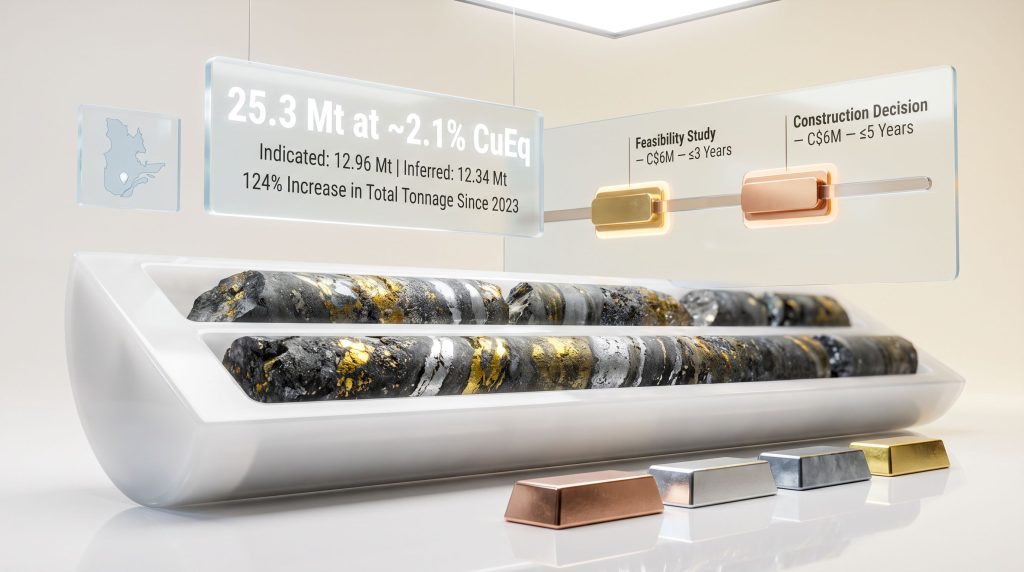
B26 exhibits precisely this characteristic, hosting a total resource of 25.3 million tonnes at approximately 2.1% copper equivalent as of the January 1, 2026 effective date. The indicated portion alone carries 1.19% copper, 1.16% zinc, 0.44 g/t gold, and 30.8 g/t silver across 12.96 million tonnes, while the inferred component is notably copper-rich at 1.60% copper across 12.34 million tonnes.
Key Resource Snapshot (Effective January 1, 2026)
| Category | Tonnes (Mt) | CuEq (%) | Cu (%) | Zn (%) | Au (g/t) | Ag (g/t) |
|---|---|---|---|---|---|---|
| Indicated | 12.96 Mt | 2.08% | 1.19% | 1.16% | 0.44 | 30.8 |
| Inferred | 12.34 Mt | 2.20% | 1.60% | 0.16% | 0.68 | 8.1 |
| Total | 25.3 Mt | ~2.1% | — | — | — | — |
The Selbaie Camp Context and Resource Growth
B26 is positioned within the Selbaie Mining Camp in northwestern Quebec, located approximately 7 kilometres southeast of the historically productive Selbaie Mine, which operated as a significant base metal producer before closing. District proximity to past-producing mines matters in junior mining because it validates the geological prospectivity of the surrounding terrain and often implies existing infrastructure familiarity.
What is particularly notable from a resource trajectory perspective is that B26's total tonnage has grown by 124% since Abitibi Metals first optioned the project in 2023. That rate of resource expansion in under three years is uncommon even in active VMS camps, and it signals that the deposit remains open to further growth — a factor the current drill programme is designed to test systematically. You can find further detail on the B26 deposit directly from Abitibi Metals.
How the Abitibi Metals B26 Full Ownership Deal With SOQUEM Was Structured
Tracing the Ownership Progression
Abitibi Metals did not acquire B26 in a single transaction. The company's pathway to full ownership followed a staged option structure, moving from an initial interest to 80% ownership through exploration expenditure commitments and milestone payments, before the June 2026 agreement secured the remaining 20% from SOQUEM Inc., a subsidiary of Investissement Québec.
This staged approach is common in Canadian junior mining, particularly when state-affiliated bodies like SOQUEM are involved. SOQUEM functions as a project generator, identifying and acquiring prospective ground across Quebec, incubating exploration activity, and then transitioning assets into joint ventures with private companies willing to fund development work. The mechanics of how a private junior exits these structures — and specifically how mining joint venture exits are negotiated — carries significant implications for long-term project economics.
Breaking Down the Consideration
Deal Economics at a Glance
| Payment Component | Amount | Timing | Form |
|---|---|---|---|
| Cash (gross) | C$5 million | Within 90 days of closing | Cash |
| Shares | C$2 million | At closing | Abitibi Metals equity |
| Estimated net cash (post-audit) | ~C$3.2 million | Post-SOQUEM audit | Cash |
| Estimated net upfront total | ~C$5.2 million | — | Mixed |
The reduction from C$5 million gross to approximately C$3.2 million net cash reflects an offset mechanism tied to exploration expenditures Abitibi incurred on behalf of the joint venture that were attributable to SOQUEM's 20% interest. This is a technically important detail: under the JV agreement, Abitibi was funding 100% of exploration costs while SOQUEM's interest diluted more slowly. The offset essentially credits Abitibi for overspending relative to its ownership share, reducing the effective cash outlay at closing.
The Royalty Simplification
SOQUEM retains a 1% net smelter return royalty on B26 production following the transfer of its 20% equity interest. This replaces the royalty that existed under the prior JV framework, which terminated upon closing. The transition to a clean 1% NSR from a more complex joint venture royalty structure is meaningful: NSR royalties are straightforward to model, widely understood by institutional analysts, and impose a predictable cost on future revenue rather than the more opaque profit-sharing mechanics that JV structures can embed.
For a deposit of B26's scale and grade profile, a 1% NSR royalty sits comfortably within the range that sophisticated project finance lenders and offtake partners regard as manageable. Royalties above 2% on large polymetallic systems can begin to compress project-level returns to the point where financing becomes more expensive or complex.
Milestone Deadlines and the Default Penalty Framework
Two-Tranche Deferred Payment Architecture
The deferred component of the Abitibi Metals B26 full ownership deal with SOQUEM consists of two separate C$6 million payments, each split 50% cash and 50% shares, tied to clearly defined operational milestones.
Milestone Payment Schedule
| Milestone | Payment | Deadline | Payment Split |
|---|---|---|---|
| Feasibility Study Completion | C$6 million | Within 3 years of closing | 50% cash / 50% shares |
| Construction Decision | C$6 million | Within 5 years of closing | 50% cash / 50% shares |
The structure serves multiple purposes. From SOQUEM's perspective, it aligns its remaining economic exposure to moments when the project's value has been demonstrably de-risked: a completed definitive feasibility study and a confirmed construction decision both represent substantial increases in project valuation and confidence. From Abitibi's perspective, the deferred structure reduces upfront cash burden and spreads consideration across a timeline that corresponds to the natural development arc of a deposit at this stage.
What Happens if Deadlines Are Missed?
The default framework is the most structurally unusual aspect of this agreement and deserves careful investor attention.
Default Penalty Framework
| Default Event | NSR Royalty Impact | Equity Returned to SOQUEM | Resulting Structure |
|---|---|---|---|
| Missed 3-year feasibility deadline | +1% (total: 2% NSR) | 12% project interest | Re-formed JV |
| Missed 5-year construction deadline | +0.5% (total: 1.5% NSR) | 6% project interest | Re-formed JV |
| Royalty repurchase option | C$2 million buyback right | N/A | Abitibi retains full interest |
The equity reversion mechanic is particularly notable. A failure to deliver a feasibility study within three years would not simply trigger a financial penalty; it would structurally unwind the ownership consolidation, returning 12% of the project to SOQUEM and re-establishing a joint venture with a higher royalty burden. This is a conditional ownership structure, not an unconditional transfer.
For investors, the critical question is whether the current development programme timeline is credible relative to these deadlines. With a PEA targeted for Q1 2027 and an active drill programme underway, the three-year feasibility window appears achievable, though not without execution dependency. A project feasibility study typically requires two to three years from PEA completion, which would place delivery comfortably within the deadline if the PEA proceeds on schedule.
Funding the Path to Feasibility
Treasury Position and Strategic Investment
Abitibi Metals entered this phase of development with a materially strengthened treasury. As of June 15, 2026, the company held approximately C$44 million in cash, bolstered by a private placement of roughly C$31 million through which Discovery Silver acquired a 9.9% equity stake. A strategic investor of Discovery Silver's profile taking a near-10% position provides more than capital; it provides a form of technical validation that carries weight with the broader institutional investment community.
The 80,000-Metre Drill Programme
Development Programme Milestones
| Work Stream | Status | Target Completion |
|---|---|---|
| 80,000m drill programme | Active, 3 rigs on site | Results through end-2026 and into 2027 |
| Stage 2 metallurgical testing | In progress | Feeds PEA |
| Geotechnical work | In progress | Feeds PEA |
| Updated resource estimate | Planned | Q1 2027 |
| Preliminary Economic Assessment (PEA) | Planned | Q1 2027 |
Furthermore, the scope of this large-scale drill programme — up to 80,000 metres across 2026 and 2027 — is substantial for an exploration-stage junior. With three rigs active and scope to add a fourth and fifth depending on rig availability, the pace of data generation is designed to support both an updated resource estimate and the technical inputs required for a credible PEA. Stage two metallurgical testing is particularly important for a polymetallic VMS system, as the recoveries achievable across copper, zinc, gold, and silver simultaneously determine a significant proportion of the project's economic value.
The Wagosic and Carheil ROFR: A District Thesis in Formation
What the Right of First Refusal Actually Represents
Alongside the 20% interest acquisition, Abitibi secured a 10-year right of first refusal over SOQUEM's wholly owned Wagosic and Carheil properties. Both are located within the Selbaie Mining Camp. SOQUEM completed 18,000 metres of drilling at Wagosic during the prior winter season, meaning the adjacent ground is no longer conceptual: it carries a meaningful exploration dataset.
A 10-year ROFR over adjacent, drilled ground in an established VMS camp is genuinely rare in Canadian junior mining deal structures. It does not obligate Abitibi to acquire the properties, but it prevents SOQUEM from transacting with any third party without first offering Abitibi the opportunity to match terms. In a district where B26 is already demonstrating strong grades and resource growth, the option value of that adjacent ground could prove material. A comprehensive overview of how Abitibi consolidated 100% of B26 and why full ownership is considered a development prerequisite is available for further reading.
The Joint Technical Committee and Combined Metallurgical Testing
The establishment of a joint technical committee to advance B26 and Wagosic concurrently represents a concrete step toward evaluating a combined development scenario. Combined metallurgical test work using blended material from both projects is already underway, which signals that the operating hypothesis is not simply about two separate deposits but about whether they could be processed together, potentially sharing infrastructure, processing facilities, and capital costs.
The district-scale framing that emerges from combining B26 resource growth, the Wagosic ROFR, and joint technical committee activities suggests Abitibi Metals is constructing a development thesis that extends well beyond a single deposit. If Wagosic demonstrates compatible metallurgy with B26 material, the combined processing scenario could meaningfully alter the capital efficiency assumptions that would underpin any future feasibility study.
The next major ASX story will hit our subscribers first
How This Deal Compares to Broader Canadian Junior Mining JV Structures
Benchmarking Against Market Norms
Comparison Framework: JV Buyout Structures in Canadian Junior Mining
| Deal Feature | B26 / SOQUEM Structure | Typical Market Range |
|---|---|---|
| Upfront consideration | ~C$5.2M net | Varies widely by resource size |
| Retained royalty (seller) | 1% NSR | 0.5%–2% NSR common |
| Deferred milestone payments | 2 tranches, C$6M each | Single or multi-tranche structures |
| Default equity reversion | Yes (6%–12%) | Less common; project-specific |
| ROFR on adjacent ground | 10 years | Rare; high strategic value |
The equity reversion mechanism embedded in the default terms is the least standard feature of this deal relative to typical Canadian junior mining JV exits. Most structured acquisitions include royalty escalation as a penalty mechanism, but the combination of royalty escalation and equity reversion into a reconstituted JV is a more sophisticated construct. It reflects SOQUEM's institutional experience in structuring mining joint ventures across its decades-long portfolio of Quebec exploration assets.
Performance-Linked Structures and What They Signal
The increasing use of performance-linked deferred payments in Canadian junior mining deals reflects a broader shift in how sophisticated vendors, particularly state-affiliated project generators, structure exits. Rather than accepting a fixed upfront price that may undervalue a project at an early stage, vendors like SOQUEM can effectively participate in development success through milestone-linked payments while reducing their operational exposure.
For the acquirer, however, these structures introduce execution risk as a contractual obligation rather than simply a strategic uncertainty. Investors evaluating the Abitibi Metals B26 full ownership deal with SOQUEM should consequently frame the milestone deadlines not as threats but as planning anchors. A well-funded company with a credible technical programme and a clear PEA target date has strong structural alignment with the three-year feasibility window. The risk materialises primarily if metallurgical complexity, permitting delays, or capital market deterioration forces a slowdown in the technical work programme.
Frequently Asked Questions: Abitibi Metals B26 Full Ownership Deal With SOQUEM
What did Abitibi Metals acquire from SOQUEM under the June 2026 agreement?
Abitibi Metals acquired SOQUEM's remaining 20% stake in the B26 polymetallic deposit in northwestern Quebec, bringing its total ownership to 100%. The upfront consideration comprised approximately C$5 million in cash and C$2 million in Abitibi shares, with the net cash component estimated at roughly C$3.2 million after accounting for exploration expenditure offsets attributable to SOQUEM's prior joint venture interest.
What royalty does SOQUEM retain after selling its B26 interest?
SOQUEM retains a 1% net smelter return royalty on B26 production. This replaces the royalty arrangement that existed under the prior joint venture, which was terminated upon closing. Abitibi holds the right to repurchase any additional royalty triggered by a milestone default for C$2 million.
What are the consequences of missing the feasibility or construction milestone deadlines?
A failure to meet the three-year feasibility study deadline results in a 1% increase to SOQUEM's NSR royalty, bringing it to 2%, and the return of a 12% project interest to SOQUEM. Missing the five-year construction decision deadline adds 0.5% to the royalty, bringing it to 1.5%, and returns a 6% project interest. In both scenarios, the parties re-establish a joint venture structure.
What is the current resource size at B26?
As of the January 1, 2026 effective date, B26 hosts a total resource of 25.3 million tonnes at approximately 2.1% copper equivalent, comprising 12.96 million tonnes in the indicated category and 12.34 million tonnes in the inferred category. This represents a 124% increase in total tonnage since Abitibi first optioned the project in 2023.
When is the Preliminary Economic Assessment expected?
Both an updated resource estimate and a PEA are targeted for the first quarter of 2027, supported by ongoing stage two metallurgical testing, geotechnical work, and a fully funded drill programme of up to 80,000 metres across 2026 and 2027.
What is the Wagosic and Carheil right of first refusal?
As part of the B26 ownership agreement, Abitibi secured a 10-year right of first refusal over two adjacent SOQUEM-owned properties, Wagosic and Carheil, both located within the Selbaie Mining Camp. A joint technical committee has been formed to advance B26 and Wagosic concurrently, and combined metallurgical testing is underway to evaluate a potential blended development scenario.
This article contains forward-looking statements and analysis based on publicly available information. It does not constitute financial advice. Readers should conduct independent due diligence before making investment decisions. Forecasts, timelines, and development outcomes described herein are subject to material risks and uncertainties. Further analysis of Abitibi Metals and the B26 project is available at Crux Investor.
Want to Be First When the Next Major Polymetallic Discovery Hits the ASX?
Discovery Alert's proprietary Discovery IQ model scans ASX announcements in real time, instantly identifying significant mineral discoveries — including copper-rich polymetallic systems like B26 — and translating complex multi-commodity data into clear, actionable insights. Explore Discovery Alert's discoveries page to see how historic finds have generated substantial returns, and begin your 14-day free trial today to position yourself ahead of the broader market.