July 31, 2026
The Metal That Powers the Machine: Understanding AI-Driven Copper Demand in Australia
Commodity cycles have always reflected the technological priorities of their era. The steel boom of the twentieth century mirrored industrialisation. The rare earth surge of the 2010s tracked the rise of consumer electronics. Today, a new technological transformation is leaving its own unmistakable fingerprint on global metal markets, and the element at the centre of it is not exotic or obscure. It is copper, and the force reshaping its demand profile is artificial intelligence.
AI-driven copper demand in Australia is emerging as one of the most consequential intersections between technology infrastructure and resource economics in the country's modern history. Understanding why requires looking beyond the headline numbers and into the physical architecture of the digital economy itself.
When big ASX news breaks, our subscribers know first
Why the Physical Footprint of AI Is So Metal-Intensive
There is a common misconception that the digital economy is weightless, a world of software, algorithms, and intangible data flows. In reality, every AI-generated output, every large language model inference, and every training run for a frontier model requires physical infrastructure operating at extraordinary power densities and thermal loads.
The transition from general-purpose cloud computing to AI-optimised workloads has fundamentally altered the engineering requirements of data centre design. Conventional cloud infrastructure is already copper-intensive, but the move to hyperscale AI training facilities introduces a new class of complexity.
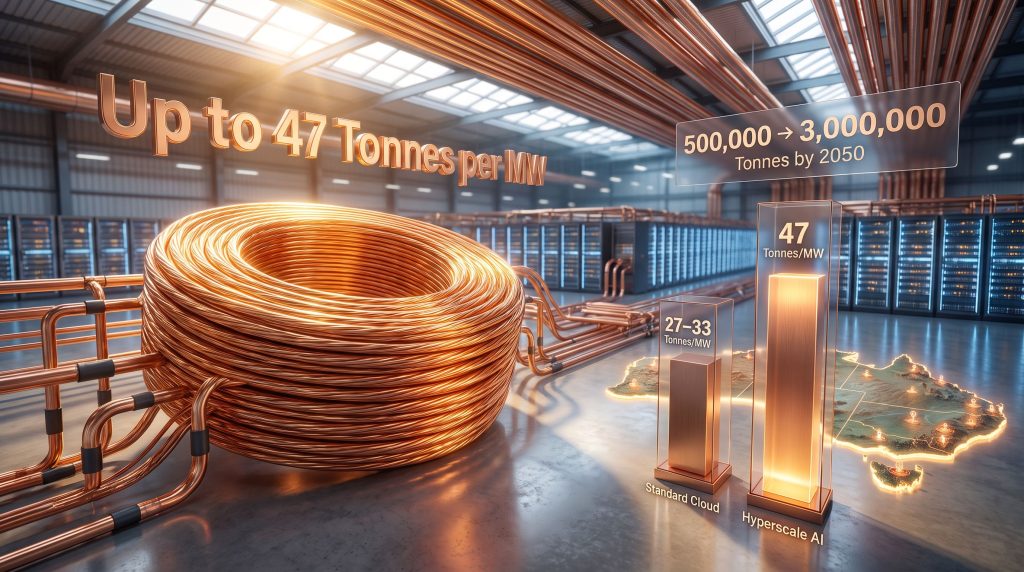
According to structural analysis by S&P Global Market Intelligence, a standard cloud data centre requires between 27 and 33 tonnes of copper per megawatt (MW) of installed power capacity. Hyperscale AI training facilities, by contrast, require up to 47 tonnes of copper per MW, driven by the demands of advanced processor clusters, liquid cooling architectures, and high-frequency power distribution networks.
Standard Cloud vs. Hyperscale AI: Copper Intensity Compared
| Infrastructure Type | Copper Intensity (Tonnes/MW) | Primary Demand Drivers |
|---|---|---|
| Standard Cloud Data Centre | 27–33 tonnes/MW | Basic power distribution, networking hardware |
| Hyperscale AI Training Facility | Up to 47 tonnes/MW | Liquid cooling, dense GPU/TPU arrays, redundant power systems |
| Intensity Premium | ~42–74% higher | Thermal complexity, advanced power conversion |
Source: S&P Global Market Intelligence
This intensity premium is not incidental. It reflects the specific physics of AI hardware. Dense GPU and TPU clusters generate heat at a scale that air cooling cannot manage efficiently, requiring copper-heavy liquid cooling loops and heat exchanger systems. High-frequency power conversion units rely on copper busbars. Redundant grid connections and uninterruptible power supplies multiply per-MW copper requirements further still.
The shift from cloud computing to AI workloads is not simply an upgrade in processing power. It is a structural change in the metal intensity of the entire digital economy, with copper sitting at the centre of that transformation.
How Large Could AI-Driven Copper Demand Actually Become?
The scale of projected demand growth is where the copper narrative shifts from interesting to genuinely consequential for investors and policymakers alike. Furthermore, understanding the copper price growth drivers at play helps contextualise why producers and policymakers are paying such close attention to these forecasts.
BHP has projected that global data centre copper consumption will expand approximately sixfold, rising from roughly 500,000 tonnes per year currently to around 3 million tonnes annually by 2050. S&P Global Market Intelligence has separately estimated that AI and data centre growth could add 2 million metric tonnes of cumulative copper demand between 2025 and 2040 alone.
Copper Demand Projections: AI and Data Centre Sector
| Metric | Current Baseline | 2050 Projection | Cumulative 2025–2040 Addition |
|---|---|---|---|
| Global Data Centre Copper Demand | ~500,000 tonnes/year | ~3,000,000 tonnes/year | +2,000,000 metric tonnes |
| Growth Multiple | – | 6x | Significant new demand vector |
Sources: BHP corporate projections; S&P Global Market Intelligence
Near-Term Acceleration vs. Long-Term Structural Growth
It is important to distinguish between near-term demand acceleration and the longer structural arc. In the near term, the global race among hyperscalers to build gigawatt-scale AI campuses is creating concentrated, rapidly materialising copper demand that procurement teams and mining companies are already responding to.
In the longer term, the compounding effect of grid upgrades, facility expansions, and the proliferation of AI inference infrastructure at the edge of networks will sustain demand growth well beyond the initial construction phase.
AI vs. EVs and Renewables: The Real Copper Demand Debate
A nuanced point worth addressing directly: AI data centres are not the dominant volume driver of copper demand growth in absolute terms. Electric vehicles and renewable energy infrastructure, particularly grid-scale solar, wind, and transmission networks, currently represent larger aggregate contributions to demand growth projections.
However, AI data centre construction is distinguished by two characteristics that make it analytically significant:
- It was largely absent from long-range copper forecasts published before 2022, meaning current supply models have not fully priced it in.
- Its demand is considered structurally inelastic, because there are no viable near-term substitutes for copper in power distribution and thermal management at the scales required.
This combination of novelty and inelasticity makes AI-driven copper demand a material new variable in what was already a tightening supply picture. Indeed, the broader copper supply crunch was already well underway before the AI demand wave began to compound existing pressures.
Australia's Strategic Position in the Global Copper Supply Chain
Australia holds the world's second-largest proven copper reserves, a geological endowment that positions it as a critical long-term supplier to global AI infrastructure buildout. Copper has also been reclassified domestically as a Strategic Material, a designation that elevates its national economic significance and signals policy recognition of its role in the global energy and technology transition.
The scale of Australia's opportunity is further reinforced by examining the largest copper mines globally, as this geographic context underscores just how significant Australia's reserve position truly is in a tightening market.
The Supply Gap Problem: Why New Mines Cannot Respond Quickly
One of the most underappreciated dynamics in the copper market is the structural mismatch between demand timelines and supply response capacity.
New copper mine development typically requires between 10 and 20 years from initial discovery through to full production. AI-driven demand, by contrast, is accelerating on a technology investment cycle measured in months and years, not decades.
This timeline mismatch creates a durable price-supportive environment for existing copper operations. Key supply-side constraints include:
- Multi-year exploration and resource definition programs before economic assessment can begin
- Feasibility studies and environmental impact assessments that can individually span several years
- Permitting and regulatory approval processes that vary in duration across jurisdictions
- Construction and commissioning phases that add further years before first production
- Ramp-up periods before nameplate capacity is achieved
For Australian producers with assets already in production or in advanced development, this structural lag is commercially significant. It means the demand shock from AI infrastructure is likely to arrive well before the supply response can meaningfully offset it.
How Major Miners Are Responding
The capital reallocation underway among Tier 1 miners provides a telling signal. Both BHP and Rio Tinto (RIO) are actively increasing their copper exposure, with RIO's recent entry into Argentina's Vicuña copper district, a region where BHP and Lundin Mining already hold significant positions, illustrating the competitive urgency major mining companies feel to secure future copper supply chains.
This strategic pivot is drawing sustained foreign capital and business investment into the Australian industrial sector, with the effects expected to persist well into the next decade.
Copper, Export Earnings, and the Macroeconomic Feedback Loop
The implications of AI-driven copper demand in Australia extend beyond the mining sector into the architecture of the national economy and, perhaps counterintuitively, into the living rooms of Australian mortgage holders. In addition, the country's resource export earnings paint a vivid picture of just how intertwined commodity strength and domestic economic conditions have become.
According to the June 2026 Resources and Energy Quarterly published by the Department of Industry, Science and Resources (DISR), national resource export earnings are forecast to reach $405 billion in the current financial year, rising to $416 billion in 2026–27. This represents a $42 billion upward revision from estimates published six months prior, with an expanded gold export market forecast at $73 billion contributing alongside elevated global energy prices.
The Monetary Policy Paradox
Strong resource export revenues create a structural tension for the Reserve Bank of Australia. Export earnings do not remain isolated in corporate balance sheets. They transmit into the domestic economy through:
- Elevated corporate tax receipts flowing to government expenditure
- Dividend distributions to shareholders, including domestic superannuation funds
- Sustained capital expenditure programs in mining and infrastructure
- Wage competition in resource-heavy states maintaining upward pressure on engineering, construction, and logistics salaries
The result is a bifurcated economy. Household discretionary spending is being compressed by the weight of sustained interest rates. Yet a significant portion of the industrial economy remains highly stimulated by commodity revenues that are largely insulated from domestic consumption trends.
For Australian households waiting for interest rate relief, the nation's resource success is simultaneously a macroeconomic shield and a friction force that delays the conditions necessary for monetary easing.
As long as AI-driven copper demand and broader commodity strength keep export revenues above the $400 billion threshold, the domestic economy retains enough underlying heat to keep inflation stickier than it would otherwise be, complicating the RBA's path to rate cuts.
Copper vs. Other Future-Facing Metals in the AI Economy
It is worth contextualising copper's role relative to other metals that are often discussed in the same breath as the AI and energy transition themes. Consequently, the critical minerals demand picture that is emerging globally places copper firmly alongside lithium and rare earths as a defining commodity of the coming decade.
| Metal | Primary AI Infrastructure Role | Australia's Reserve Position | AI Demand Growth Trajectory |
|---|---|---|---|
| Copper | Power distribution, cooling systems, cabling | 2nd largest proven reserves globally | High, 6x data centre demand by 2050 |
| Lithium | Battery storage, UPS backup systems | Largest reserves globally | Moderate, indirect AI role |
| Nickel | Server hardware, specialty alloys | Significant producer | Moderate |
| Gold | Semiconductor connectors | Major producer | Low volume, high unit value |
What distinguishes copper from battery metals like lithium is the directness of its relationship to AI infrastructure. Lithium's AI-adjacent demand is primarily mediated through energy storage applications. Copper's role is embedded in the core physical architecture of every AI facility, scaling directly and proportionally with installed power capacity.
This direct scaling relationship makes copper's AI demand profile more analytically predictable and less exposed to technology substitution risk, a characteristic that is increasingly attracting a new class of technology-sector and ESG-aligned investors to copper assets.
The next major ASX story will hit our subscribers first
Is Australia's Copper Sector Positioned to Scale for the AI Supercycle?
Australia's reserve endowment is not in question. The more pressing issue is whether the sector's development pipeline, regulatory frameworks, and infrastructure capacity can scale quickly enough to fully capture the opportunity that AI-driven copper demand is creating.
Key Scaling Challenges
- Exploration and approvals bottlenecks: Regulatory assessment timelines and environmental review processes remain material constraints on the pace of new copper development, even as demand signals intensify.
- Infrastructure co-investment requirements: Port capacity, rail logistics, and energy supply in copper-producing regions will require coordinated public and private investment to support meaningful production increases.
- Workforce availability: Competition for skilled geologists, mining engineers, and construction professionals is a constraint shared across the resources sector, not unique to copper.
The Investor Thesis
For investors, the convergence of inelastic AI-driven demand, long mine development timelines, and Australia's tier-one reserve position creates a compelling structural backdrop. Elevated price forecasts and scarcity narratives are improving project economics for exploration-stage copper assets, while producing operations stand to benefit from a sustained price floor underpinned by structural demand growth.
Copper is increasingly framed alongside lithium and rare earths as a defining future-facing commodity of the AI era, a framing that is broadening its investor base and deepening the capital available for Australian copper development. For a broader perspective on how this dynamic is unfolding, the BetaShares analysis on the AI-driven supercycle in energy transition metals offers a compelling read.
Disclaimer: This article is intended for informational purposes only and does not constitute financial advice. Forecasts and projections referenced are sourced from third-party research and are subject to material uncertainty. Readers should seek independent financial advice before making investment decisions.
Want to Stay Ahead of the Next Major Copper Discovery on the ASX?
Discovery Alert's proprietary Discovery IQ model scans ASX announcements in real time, instantly identifying significant mineral discoveries — including copper — and delivering actionable insights to subscribers before the broader market reacts. Explore historic examples of major mineral discoveries and their extraordinary returns, then start your 14-day free trial to ensure you're positioned at the forefront of Australia's AI-driven copper supercycle.