July 31, 2026
Why Copper Concentration at the Top of Global Mining Is Reshaping How Investors Think About Scale
The architecture of a mining company's executive team rarely generates headline attention. Yet when two of the world's most significant diversified miners combine forces, the composition of the resulting leadership structure becomes one of the clearest signals available to the market about strategic intent, operational priorities, and long-term value creation. The Anglo Teck executive leadership team, announced in late July 2026, is precisely that kind of signal.
Understanding who sits at the top of a newly formed mining giant matters not just for institutional analysts, but for anyone tracking where large-scale capital is flowing within the global metals complex. The nine-member C-suite formed from the merger of Anglo American and Teck Resources tells a coherent story about copper dominance, decentralised operations, and a deliberate approach to post-merger integration.
When big ASX news breaks, our subscribers know first
Anglo Teck Executive Leadership Team: Full Roster at a Glance
The combined leadership team draws talent from both legacy organisations, with roles assigned to reflect both operational continuity and the strategic demands of running a multi-jurisdictional metals business spanning six countries.
| Executive | Title |
|---|---|
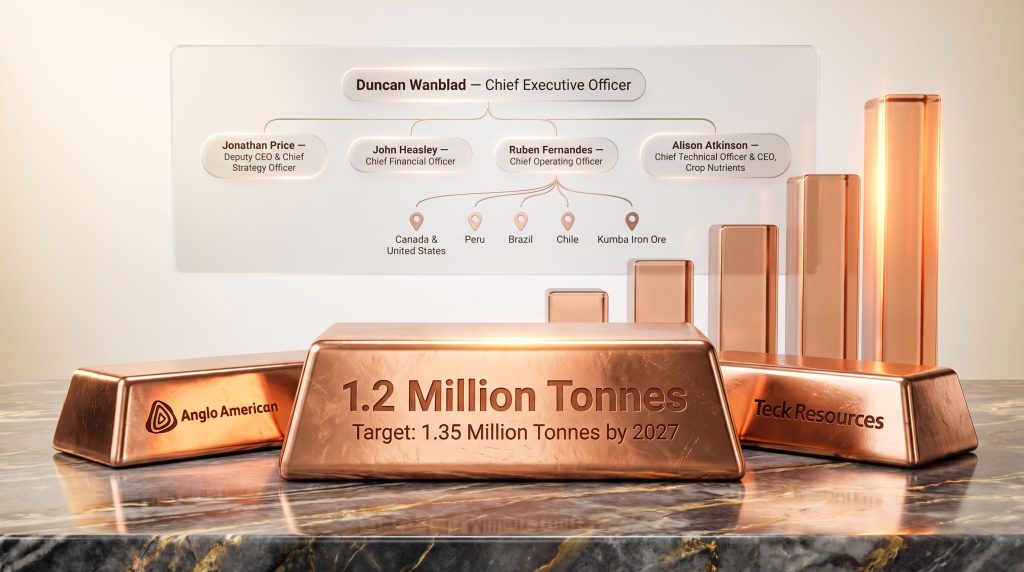
| Duncan Wanblad | Chief Executive Officer |
| Jonathan Price | Deputy CEO and Chief Strategy Officer |
| John Heasley | Chief Financial Officer |
| Ruben Fernandes | Chief Operating Officer |
| Ian Anderson | Chief People Officer |
| Lyndon Arnall | Chief Legal and Sustainability Officer |
| Alison Atkinson | Chief Technical Officer and CEO, Crop Nutrients |
| Karla Mills | Chief Projects Officer |
| Matt Walker | CEO, Marketing |
Nolitha Fakude will continue her existing responsibilities as Chair of the South Africa Management Board, reporting directly to CEO Duncan Wanblad. The leadership structure is designed to become operational upon formal merger completion, which is expected to occur between September 2026 and March 2027.
Duncan Wanblad as CEO: Continuity Over Disruption
Why an Operational Leader Was Chosen to Head Anglo Teck
The selection of Duncan Wanblad as Chief Executive Officer is one of the most instructive decisions embedded in the Anglo Teck announcement. Wanblad has served as CEO of Anglo American since 2022 and brings a career built on operational execution within complex, multi-asset mining environments. His background traverses copper, platinum group metals, and iron ore operations across multiple continents.
Choosing an operational leader rather than a financial engineer or dealmaker at the helm reflects a particular philosophy: the priority during this phase is not portfolio restructuring, but rather extracting performance from an already substantial asset base while managing the complexity of integration.
This is a merger where both sides brought genuinely valuable assets to the table. The CEO appointment suggests that Anglo Teck's board views cultural cohesion and operational delivery as higher near-term risks than strategic repositioning.
What Wanblad's Appointment Signals to Investors
For investors, a continuity-first CEO appointment carries distinct implications:
- It reduces the probability of significant near-term asset divestments purely for financial engineering purposes
- It prioritises throughput improvement and cost discipline at existing operations over transformational acquisitions
- It suggests the board views operational risk, particularly across jurisdictions like Peru, Chile, and South Africa, as the primary management challenge
- It signals confidence in the existing asset quality without needing to dramatically reframe the portfolio story
The Deputy CEO Structure: Strategy and Integration as Inseparable Functions
Jonathan Price's Dual Mandate
Jonathan Price occupies a genuinely unusual position within the Anglo Teck leadership hierarchy. As both Deputy CEO and Chief Strategy Officer, he holds responsibility not just for corporate direction but for translating that direction into near-term action during the most sensitive phase of the merger lifecycle. Furthermore, the Anglo Teck executive leadership team structure places both the Chief Integration Officer, Jeff Hanman, and the Chief Corporate Development Officer, Nic Hooper, reporting directly to him.
This design choice reflects a deliberate decision to treat integration execution and longer-term corporate development as functionally inseparable rather than parallel workstreams.
In post-merger environments, companies that separate integration management from strategic planning frequently encounter misalignment between short-term execution and long-term positioning. Anglo Teck's structure explicitly addresses this risk.
What This Architecture Tells Us About the Transition Period
The dual-reporting arrangement under Price is one of the lesser-discussed but analytically significant features of the Anglo Teck leadership design. It suggests the organisation has anticipated a specific failure mode common to large mining mergers: the tendency for integration teams to optimise for operational continuity while strategic teams pursue a future-state vision that the organisation is not yet equipped to execute.
By concentrating both functions under a single deputy, Anglo Teck creates accountability alignment that is relatively uncommon among tier-one miners at this scale.
Ruben Fernandes and the Decentralised Operational Model
Regional CEOs: A Six-Jurisdiction Command Structure
As Chief Operating Officer, Ruben Fernandes will oversee a regional leadership layer that spans some of the most consequential mining geographies in the world. Upon merger completion, five regional CEOs and the head of Kumba Iron Ore will report directly into his function.
| Regional CEO | Geography |
|---|---|
| Brock Gill | Canada and United States |
| Tony Power | Peru |
| Ana Sanches | Brazil |
| Dale Webb | Chile |
| Mpumi Zikalala | Kumba Iron Ore |
This regional architecture is not merely administrative. It reflects the operational reality of managing assets subject to vastly different regulatory environments, community relations requirements, labour frameworks, and geological profiles. The porphyry copper deposits of Chile and Peru, for instance, carry entirely different technical and social licence challenges compared to the metallurgical coal and operating copper mines in Canada.
Why Decentralisation Makes Sense for a Multi-Continent Miner
Centralised decision-making in geographically dispersed mining operations has historically been associated with slower response times to on-the-ground operational issues, regulatory friction, and community relations failures. Anglo Teck's decentralised COO structure acknowledges that local expertise and jurisdictional familiarity are genuine competitive advantages, particularly in politically sensitive operating environments.
Peru, for example, has seen repeated operational disruptions at major copper mines in recent years due to community protests and permitting disputes. Having a dedicated regional CEO with deep in-country relationships is a meaningful risk mitigation measure, not just a governance formality.
Financial Architecture, Legal Risk, and ESG Governance
John Heasley as CFO: The Capital Discipline Imperative
John Heasley's appointment as Chief Financial Officer brings the financial oversight function into sharp focus at a time when the combined entity will need to manage substantial capital allocation decisions. Anglo Teck's copper-heavy portfolio includes some of the world's largest and longest-life copper assets, including operations in Chile's Atacama region and the Quebrada Blanca complex, which require ongoing sustaining capital and brownfield investment to maintain and grow production.
The CFO's primary challenge will be balancing the growth investment required to reach the stated 1.35 million tonne copper production target by 2027 against shareholder expectations for capital returns during a period of high interest rates and variable commodity pricing. Indeed, the Chile copper outlook will play a significant role in shaping those capital allocation decisions.
Lyndon Arnall: Sustainability Embedded at the C-Suite Level
The decision to combine the Chief Legal Officer and Chief Sustainability Officer functions under a single executive, Lyndon Arnall, is architecturally significant. It signals that Anglo Teck views sustainability not as a communications exercise but as an area of genuine legal and fiduciary risk requiring executive-level oversight.
This is increasingly the direction of travel among sophisticated mining companies. Regulatory frameworks governing emissions reporting, water usage, tailings management, and biodiversity offsets are growing in complexity across all of Anglo Teck's key jurisdictions. Embedding legal accountability for these obligations at the C-suite level creates clearer escalation pathways when regulatory risk materialises.
The next major ASX story will hit our subscribers first
Alison Atkinson's Dual Mandate: Technical Leadership and Portfolio Diversification
What the Crop Nutrients Dual Role Actually Means
One of the most analytically interesting appointments in the Anglo Teck leadership structure is Alison Atkinson's dual role as both Chief Technical Officer and CEO of Crop Nutrients. This combination is rarely seen in large-cap mining governance and carries a specific strategic message.
The Crop Nutrients business, anchored by Anglo American's Woodsmith polyhalite project in the United Kingdom, represents a long-duration growth option that sits outside the copper-dominant narrative. Polyhalite is a multi-nutrient fertiliser mineral that offers exposure to global agricultural demand, which is driven by population growth and soil degradation dynamics entirely separate from the energy transition narrative underpinning copper growth drivers.
Giving the CTO responsibility for this business unit ensures that technical rigour is applied to a project that remains at an early stage of commercial development. It also prevents the Crop Nutrients division from being deprioritised within an organisation whose primary identity will be defined by copper.
Technical Leadership as a Differentiator in Critical Minerals
Beyond Crop Nutrients, the CTO function at a company like Anglo Teck carries responsibility for process innovation, mineral recovery optimisation, and the application of emerging technologies across the ore processing chain. Copper recovery rates from low-grade porphyry deposits are a genuine competitive variable. As global copper ore grades continue their long-term declining trend, averaging below 0.6% copper at many large operations compared to grades above 2% that were common in earlier decades, technical leadership in concentration and hydrometallurgy becomes a direct driver of unit cost competitiveness. This is particularly relevant given the well-documented copper supply crunch now facing the global market.
People, Projects, and Markets: Completing the C-Suite Picture
The Three Remaining Executive Functions
The final three C-suite appointments address the human, capital delivery, and commercial dimensions of the business:
- Ian Anderson as Chief People Officer carries the considerable challenge of integrating two organisational cultures that, while both rooted in global mining, evolved under different management philosophies, geographic centres of gravity, and workforce compositions. Cultural integration failure is one of the most commonly cited causes of value destruction in large mining mergers, and the CPO role exists precisely to manage this risk systematically.
- Karla Mills as Chief Projects Officer takes responsibility for capital project delivery at a time when Anglo Teck is entering a growth phase. Delivering major mining projects on schedule and within budget is notoriously difficult; Anglo American's own history includes significant project cost overruns on assets like Minas-Rio in Brazil, making disciplined project governance a particularly salient focus area.
- Matt Walker as CEO of Marketing oversees the commercial positioning of Anglo Teck's output in global commodity markets. Marketing, in the mining context, encompasses not just sales but also hedging strategy, customer relationship management across steel mills, smelters, and refiners, and the optimisation of product mix to maximise realised prices across copper concentrate, cathode, and by-products.
Nolitha Fakude and South African Operations
Why South Africa Warrants Dedicated Board-Level Governance
Nolitha Fakude's continued role as Chair of the South Africa Management Board, reporting directly to Wanblad, reflects the unique governance complexity of operating in South Africa. The country's mining sector operates under the Mineral and Petroleum Resources Development Act framework and is subject to the Mining Charter, which mandates specific ownership, procurement, and employment equity requirements.
Kumba Iron Ore, Anglo Teck's flagship South African asset, is one of the world's highest-quality iron ore producers, consistently delivering iron ore with grades above 64% Fe, which commands premium pricing in export markets. Maintaining the operational and stakeholder relationships that underpin Kumba's performance requires dedicated executive attention at the most senior level.
Anglo Teck's Copper Thesis: The Numbers Behind the Investment Case
Production Scale and the 2027 Growth Target
Anglo Teck currently produces approximately 1.2 million tonnes of copper per annum, making it one of the largest copper producers globally. The stated growth target of approximately 10%, reaching 1.35 million tonnes by 2027, is significant not just in absolute terms but in what it implies about the asset pipeline.
Reaching that target requires production ramp-ups at assets including Quellaveco in Peru and Quebrada Blanca Phase 2 in Chile, both of which represent multi-billion dollar capital investments now entering sustained production phases. The leverage to copper price at this production scale is substantial. Consequently, understanding the right copper investment strategies is increasingly relevant for those seeking exposure to Anglo Teck's growth trajectory.
The 70% Copper Exposure Thesis
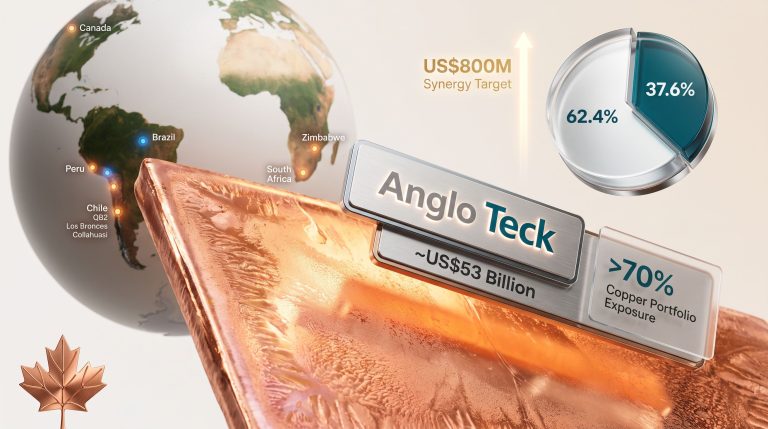
Anglo Teck's stated positioning offers investors more than 70% exposure to copper within the combined portfolio. This is a distinctive characteristic among large-cap diversified miners, most of whom carry significant exposure to iron ore, coal, or aluminium that dilutes the copper thesis.
For investors constructing portfolios around the energy transition, copper is arguably the most important single commodity. Electric vehicles require roughly four times more copper than internal combustion engine vehicles. Grid-scale battery storage, offshore wind infrastructure, and solar installations all carry substantial copper intensity. The structural demand case for copper is broadly accepted across the industry, though the timing and magnitude of demand growth remains subject to genuine uncertainty.
How Anglo Teck's Governance Model Compares to Global Peers
| Feature | Anglo Teck | BHP | Rio Tinto | Glencore |
|---|---|---|---|---|
| CEO Background | Operational | Operational | Financial | Trading |
| Regional COO Structure | Yes | Partial | Yes | Commodity-based |
| Dedicated Integration Role | Yes | N/A | N/A | N/A |
| Crop Nutrients in Portfolio | Yes | No | No | No |
| Copper as Primary Focus | Yes | Partial | Partial | Yes |
| Standalone Sustainability Officer | Combined Legal/ESG | Separate | Separate | Combined |
The most structurally distinctive features of Anglo Teck's governance design relative to peers are the dedicated Chief Integration Officer role reporting to the Deputy CEO, the combined legal and sustainability function, and the dual CTO/divisional CEO mandate. Each of these reflects a specific strategic calculation about where the highest management risk resides during the current phase of the company's development.
Merger Completion Timeline and Integration Risk
What Must Occur Before the Leadership Team Is Activated
The Anglo Teck executive leadership team is structured to take effect upon merger completion, which has been communicated as expected between September 2026 and March 2027. The six-month window reflects the range of conditions precedent that must be satisfied, including regulatory approvals across multiple jurisdictions, shareholder votes, and the completion of any required structural separations.
The conditions precedent for a transaction of this scale typically include competition clearance from authorities in jurisdictions including Canada, the European Union, China, and potentially others, depending on market share thresholds in specific commodity segments. Each jurisdiction operates under its own timeline and review framework.
Where Integration Risk Concentrates
The variables most likely to influence whether the timeline lands closer to September 2026 or March 2027 include:
- The pace of regulatory review in China, which is a critical end-market for both companies' copper output and has historically taken longer than Western jurisdictions to complete competition assessments for large mining transactions
- The complexity of separating or retaining legacy balance sheet instruments, including hedging programmes and project financing arrangements at individual asset level
- The speed at which IT system integration planning can be completed, which is a frequently underestimated source of delay in large industrial mergers
- Labour relations and union consultation requirements, particularly in jurisdictions like Chile and South Africa where workforce representation is embedded in regulatory frameworks
Frequently Asked Questions: Anglo Teck Executive Leadership
Who is the CEO of Anglo Teck?
Duncan Wanblad has been appointed Chief Executive Officer of the combined Anglo Teck entity, bringing his operational background from his tenure leading Anglo American.
When does the Anglo Teck leadership team take effect?
The executive leadership structure is expected to become active upon merger completion, anticipated between September 2026 and March 2027.
How many executives are in the core Anglo Teck C-suite?
Nine C-suite members make up the core executive team, supported by five regional CEOs and dedicated integration and corporate development officers reporting to the Deputy CEO.
What is Anglo Teck's copper production target?
Current annual copper production stands at approximately 1.2 million tonnes, with a growth target of around 10% targeting approximately 1.35 million tonnes by 2027.
Who oversees Anglo Teck's South African operations?
Nolitha Fakude serves as Chair of the South Africa Management Board, reporting directly to CEO Duncan Wanblad.
What is Jonathan Price's role at Anglo Teck?
Jonathan Price serves as Deputy CEO and Chief Strategy Officer, with both the Chief Integration Officer and the Chief Corporate Development Officer reporting into his function.
Key Takeaways: What the Anglo Teck Leadership Architecture Tells the Market
- The nine-member C-suite reflects a deliberate balance of talent drawn from both Anglo American and Teck Resources, avoiding the dominance of either legacy culture
- A dedicated Chief Integration Officer reporting to the Deputy CEO signals that post-merger cohesion is treated as a board-level strategic priority, not a back-office function
- Alison Atkinson's dual mandate as CTO and CEO of Crop Nutrients signals that portfolio diversification beyond copper into agricultural inputs is protected at the highest organisational level
- Regional CEO appointments across six distinct jurisdictions reflect a decentralised operating philosophy suited to politically and geologically diverse asset management
- The more than 70% copper exposure thesis is the defining commercial narrative for investor positioning within the combined entity
- The legal and sustainability dual mandate under Lyndon Arnall reflects the growing regulatory complexity of large-scale mining and the board's view of ESG as a genuine fiduciary risk category
For the latest developments across the global mining sector and ongoing coverage of Anglo Teck's merger progress, visit Australian Mining.
Want to Capture the Next Major Mineral Discovery Before the Broader Market Does?
Discovery Alert's proprietary Discovery IQ model delivers real-time alerts on significant ASX mineral discoveries, transforming complex mineral data into actionable insights for both short-term traders and long-term investors — explore historic discovery returns to understand the scale of opportunity, then begin your 14-day free trial at Discovery Alert to position yourself ahead of the market.