June 6, 2026
Argentina's Investment Regime and the New Logic of Precious Metals Development
Large-scale mining investment has always followed a predictable hierarchy of priorities: geological merit, infrastructure access, metallurgical recovery, and jurisdiction risk. For decades, Argentina occupied an uncomfortable position in that final category, despite holding world-class mineral endowments across its Andean provinces. The introduction of the Régimen de Incentivo para Grandes Inversiones, known widely as RIGI, has begun reshaping that calculus in ways that are now producing tangible, approved investment outcomes. The AbraSilver Diablillos RIGI investment in gold and silver, formalised through Resolution 562/2026 of Argentina's Ministry of Economy, represents the most concrete test yet of whether Argentina can convert policy reform into construction-ready capital commitment.
When big ASX news breaks, our subscribers know first
Understanding RIGI: The Fiscal Framework Rewriting Argentina's Mining Competitiveness
Argentina's RIGI framework was designed to address a structural problem that had persistently deterred long-cycle investment: sovereign uncertainty. Large mining projects require capital commitments that play out over decades, and investors have historically demanded significant risk premiums to deploy capital in jurisdictions where fiscal terms could shift mid-project.
RIGI targets this problem directly by offering qualifying large-scale investment projects a package of stabilised fiscal treatment, customs benefits, and improved foreign exchange access. Critically, the regime's protections are not conditional on commodity price performance or political cycles in the way that standard regulatory environments can be. For a project like Diablillos, where total capital expenditure exceeds USD 760 million, this kind of fiscal certainty materially changes the risk-return equation that underpins any investment decision.
The foreign exchange dimension deserves particular attention. Argentina has historically imposed capital controls that created friction for mining companies seeking to repatriate profits or service foreign currency debt. RIGI's improved foreign exchange access provisions directly address this pain point, making project financing structures more viable and reducing the effective cost of capital for developers. Furthermore, Argentina mining opportunities extend well beyond a single commodity, reinforcing why the RIGI framework carries such broad strategic significance for the region.
The 20% regional procurement minimum under RIGI sets a baseline, but AbraSilver's 55% commitment signals that the framework can catalyse genuine economic integration rather than simply securing investment on paper.
The Diablillos Resource: Scale, Grade, and Geological Context
Situated on the border between Salta and Catamarca provinces in Argentina's northwest (NOA) region, Diablillos is not a marginal discovery seeking validation. It carries a Measured and Indicated resource of 73.1 million tonnes at silver and gold grades that position it firmly among the significant undeveloped precious metals inventories in the Latin American development pipeline.
| Resource Category | Tonnage | Silver Grade | Gold Grade | Contained Silver | Contained Gold |
|---|---|---|---|---|---|
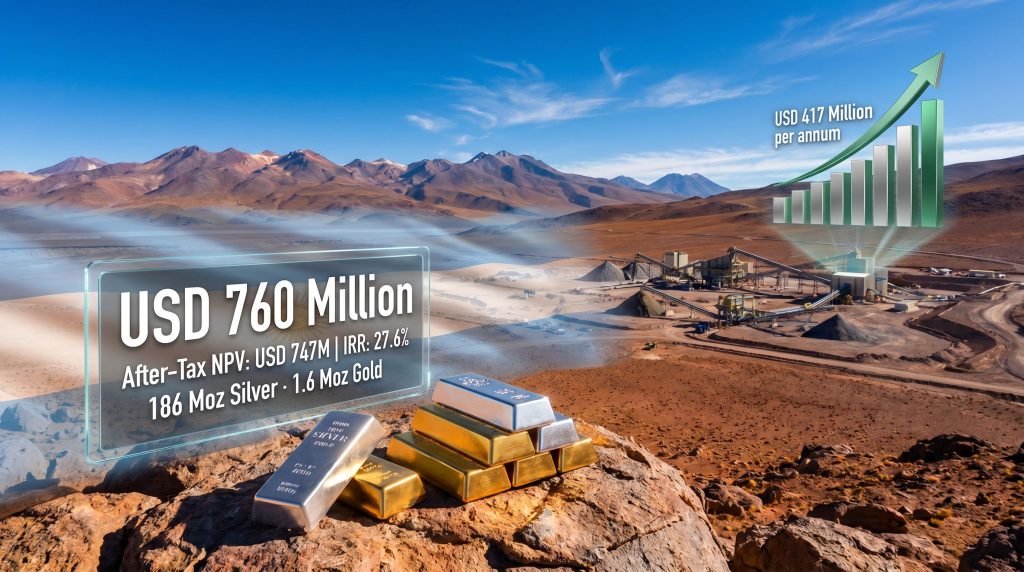
| Measured and Indicated | 73.1 Mt | 79 g/t | 0.66 g/t | ~186 Moz | ~1.6 Moz |
To contextualise the grade profile: 79 grams per tonne silver with 0.66 g/t gold represents a genuinely high-grade silver-dominant system. Many large silver operations globally process ore at grades well below this threshold, particularly open-pit operations where lower cut-off grade economics are required to justify the bulk mining approach. A 79 g/t silver head grade entering a 3.15 million tonne per annum processing plant delivers substantial contained metal per unit of ore processed.
The gold component, while secondary in grade terms, adds meaningful economic ballast. At a silver-to-gold price ratio of approximately 80:1, the 1.6 million ounces of contained gold represents a gold-equivalent contribution that materially reduces the project's dependence on any single commodity price pathway. This dual-metal structure is not incidental — it is what elevates Diablillos from a silver project to a precious metals system with built-in price diversification.
Why Epithermal Systems in the NOA Region Matter
The NOA provinces of Salta, Catamarca, and Jujuy sit within a geological corridor that has produced some of South America's most prolific precious metals mineralisation. High-sulphidation and low-sulphidation epithermal systems in this belt are characterised by their capacity to host high-grade silver and gold at relatively shallow depths, a geological configuration that significantly reduces early-stage mining costs and stripping ratios compared to deep porphyry-style deposits. Diablillos fits within this broader metallogenic context, which explains why the NOA region is attracting increasing exploration and development capital across multiple commodities simultaneously.
Project Economics: What the Pre-Feasibility Numbers Reveal
The economic case for Diablillos, as outlined in the project's pre-feasibility study, is substantive across multiple scenarios. The base case and spot price case economics are summarised below:
| Economic Metric | Base Case | Spot Price Case |
|---|---|---|
| After-Tax NPV (5% discount rate) | USD 747 million | USD 1.291 billion |
| After-Tax IRR | 27.6% | 39.3% |
| Total Capital Investment | USD 760 million+ | N/A |
| Estimated Annual Export Value | USD 417 million | N/A |
A 27.6% after-tax IRR in the base case is notably strong for a project of this capital intensity. Many large mining developments are sanctioned at IRRs in the 15–20% range, reflecting the risk premium investors demand for long-cycle capital. An IRR approaching 28% in a conservative scenario suggests that even with cost overruns, schedule delays, or commodity price softness, the project retains meaningful economic viability.
The USD 1.291 billion NPV at spot prices is particularly instructive for understanding why RIGI approval represents an inflection point rather than a routine regulatory milestone. At this valuation, the project's net present value substantially exceeds its total capital requirement, meaning the margin of safety for investors and financing parties is unusually wide by development-stage standards.
An after-tax NPV that exceeds the project's total capital cost is a rare configuration in large-scale mining development. It signals that Diablillos is not merely viable but potentially exceptional from a capital allocation perspective, subject to the commodity price assumptions underpinning the model holding through the project's life.
Disclaimer: Pre-feasibility study economics are estimates based on assumed commodity prices, cost structures, and operational parameters. Actual project performance may differ materially from these projections. Readers should not treat these figures as guarantees of financial outcomes.
Infrastructure Development: Building a Mine from the Puna Plateau Up
The construction programme approved under Resolution 562/2026 encompasses a comprehensive suite of infrastructure that reflects the scale and remoteness of a high-altitude Andean project. The processing plant, rated at a nominal capacity of 3.15 million tonnes per annum, forms the operational centrepiece, but the supporting infrastructure list is equally significant for understanding project complexity and capital allocation.
Key infrastructure components approved under Resolution 562/2026:
- Processing plant rated at 3,150,000 tonnes per year nominal throughput
- Dedicated access road network connecting the site to regional transport corridors
- Waste rock management and tailings storage facilities designed to site-specific conditions
- On-site water supply systems and energy infrastructure for sustained operations
- Operational camp, laboratory, and workshop facilities for construction and operational workforces
- Stockpile areas for ore management and processing continuity
The energy and water infrastructure components deserve specific attention. High-altitude Andean projects in the Puna region face genuine challenges around water availability, given the arid climate of the altiplano. Similarly, grid connectivity in the border regions of Salta and Catamarca is not assumed, meaning energy supply infrastructure may incorporate a combination of grid connection, diesel generation, and potentially renewable capacity to manage operating costs over the mine's life.
Construction Timeline and Critical Path
The project schedule is structured around two definitive milestones:
- Construction commencement: July 2026 — mobilisation of construction contractors and site preparation activities
- First production target: July 2029 — a 36-month construction and commissioning window from groundbreaking to initial ore processing
A 36-month construction timeline for a project of this capital intensity and complexity is achievable but demands disciplined project management, reliable contractor access, and no major regulatory or logistical disruptions. For context, comparably sized Latin American precious metals projects have experienced construction timelines ranging from 30 months to over 60 months depending on site conditions, contractor availability, and permitting continuity.
Employment and Regional Economic Impact
One of the most scrutinised dimensions of any large mining project in Latin America is its contribution to local and regional employment. The Diablillos project carries a total employment footprint of 2,013 direct and indirect positions across construction and operational phases.
What distinguishes the employment profile here is not just the headline number but the regional procurement commitment that underpins it. AbraSilver has formalised a commitment to source 55% of all goods, services, and construction works from regional suppliers, a figure that sits at nearly three times the 20% minimum mandated under RIGI regulations.
| Procurement Benchmark | Percentage |
|---|---|
| RIGI Regulatory Minimum | 20% |
| AbraSilver Diablillos Commitment | 55% |
| Multiple Above Regulatory Minimum | ~2.75x |
This is not an immaterial distinction. Regional procurement at scale creates a supply chain development effect that extends well beyond the direct employment count. Local civil contractors, logistics providers, equipment maintenance firms, laboratory services, and hospitality businesses all benefit when a major mine sources the majority of its operational inputs within the regional economy.
The NOA provinces of Salta and Catamarca have both been actively positioning themselves as mining-friendly jurisdictions, and a project that exceeds procurement benchmarks by this margin strengthens the credibility of that positioning. The USD 417 million annual export value attributable to Diablillos's gold and silver output further contextualises the macroeconomic significance of this investment. For Argentina, a project generating nearly half a billion dollars in annual export receipts from a single site represents a meaningful contribution to the country's balance of payments over its operational life.
The next major ASX story will hit our subscribers first
Argentina's Competitive Position in the Latin American Mining Landscape
The RIGI framework positions Argentina differently from its regional peers in ways that are worth examining directly. Chile and Peru have historically dominated Latin American mining investment flows, owing to their established regulatory frameworks, skilled workforces, and track records of honouring long-term fiscal arrangements with foreign investors.
| Factor | Argentina Post-RIGI | Chile | Peru |
|---|---|---|---|
| Fiscal Stability Mechanism | RIGI framework | Moderate, sector-specific | Moderate, sector-specific |
| Foreign Exchange Access | Enhanced under RIGI | High flexibility | High flexibility |
| Large Project Incentive Regime | RIGI (active and expanding) | No direct equivalent | No direct equivalent |
| Key Commodities | Gold, Silver, Copper, Lithium | Copper, Lithium | Copper, Gold, Silver |
| Jurisdiction Risk History | Elevated, improving | Low | Moderate, elevated recently |
Argentina's disadvantage has historically been its jurisdiction risk score, driven by a well-documented history of policy reversals, capital controls, and macroeconomic instability. The RIGI framework attempts to insulate approved projects from precisely these risks through contractual fiscal stabilisation. Whether this insulation proves durable across electoral cycles is the central long-term question for investors monitoring the Argentine mining investment thesis.
Chile's political environment has itself grown more complex in recent years, with proposed reforms to copper royalties creating investor uncertainty in a previously stable jurisdiction. Peru has experienced episodic community conflict and regulatory turbulence that has delayed or suspended several significant projects. In this shifting competitive landscape, Argentina's RIGI — if consistently implemented — offers something neither Chile nor Peru currently provides: a purpose-built, legislatively anchored regime specifically designed to neutralise large-project investment risk.
Silver's Industrial Demand Profile and Its Implications for Diablillos
Understanding the long-term strategic value of a silver-dominant project requires engaging with silver's unique demand structure. Unlike gold, which derives the vast majority of its value from monetary and financial demand, silver's dual demand profile encompasses a substantial and growing industrial consumption base that sets it apart from other precious metals.
Photovoltaic solar panel manufacturing is currently the most significant structural driver of incremental silver demand. Each standard solar panel contains approximately 20 milligrams of silver in its conductive paste, and as global solar installation capacity scales toward terawatt-level deployment, the aggregate silver demand from this single application is projected to grow substantially. Electric vehicle manufacturing, advanced electronics, medical devices, and 5G infrastructure all contribute additional industrial demand vectors that have no direct equivalent in the gold market.
This dual demand profile — monetary store of value on one side, essential industrial input on the other — creates a more complex and arguably more resilient demand structure for silver than for gold alone. For a project like Diablillos, which carries 186 million ounces of contained silver, this industrial demand tailwind enhances the long-term strategic value of bringing new supply to market, independent of traditional precious metals investment sentiment cycles. Indeed, gold and silver supply trends suggest that new large-scale sources of both metals will be increasingly difficult to develop in the years ahead.
Key Risk Factors and Strategic Watchpoints
No investment of this scale and complexity is without meaningful risk. However, three strategic watchpoints stand out for investors and industry observers monitoring the Diablillos development trajectory:
- Resolution implementation fidelity: Resolution 562/2026 establishes the legal basis for RIGI benefits, but the translation of regulatory approval into operational fiscal certainty requires consistent administrative application. Any deviation from the approved terms would represent a material change in the project's risk profile.
- Final investment decision and financing structure: Construction commencement in July 2026 requires that a final investment decision and financing package are in place. Whether AbraSilver funds the USD 760 million capital requirement through debt facilities, equity raises, streaming arrangements, or a combination of these mechanisms will significantly influence the project's financial structure and shareholder dilution risk.
- RIGI as a replicable template: The Diablillos approval establishes a precedent. If Resolution 562/2026 delivers the fiscal certainty it promises and construction proceeds on schedule, it creates a credible reference case that other large mining developers can point to when evaluating their own RIGI applications in the NOA region and beyond.
Political Continuity and the Durability of Pro-Investment Policy
Argentina's mining investment climate has historically been vulnerable to policy discontinuity across electoral cycles. The current administration's push to attract large-scale capital through RIGI is a genuine structural shift, but investors should assess not just the policy as written but the institutional depth supporting its long-term implementation. Projects with 20-year operational horizons will experience multiple government transitions, and the legal durability of RIGI's fiscal stability provisions will ultimately be tested by those transitions rather than by the regime that created them.
This section contains forward-looking observations about political and regulatory risk. These represent analytical perspectives, not forecasts or guarantees of regulatory outcomes. Investors should conduct independent due diligence on jurisdiction risk before making investment decisions.
Global Context: Where Diablillos Sits in the Development Pipeline
Placing 186 million ounces of contained silver within the global development pipeline context reveals why projects of this scale attract significant attention. Global silver mine supply has faced structural headwinds, with many existing operations approaching the end of their mine lives and the development pipeline failing to fully replace depletion at historical production rates.
According to data published by the Silver Institute, global silver mine production has oscillated within a relatively narrow band in recent years, with new large supply sources increasingly difficult to identify and advance. A single project carrying 186 million ounces of measured and indicated silver resource, combined with 1.6 million ounces of gold, processing at 3.15 million tonnes annually, represents a supply contribution that would be visible at the global market level upon reaching steady-state production.
For context, the majority of producing silver mines globally generate between 5 and 20 million ounces of silver annually. A project of Diablillos's resource scale, properly developed, could position itself among the more significant silver operations worldwide. Consequently, the AbraSilver Diablillos RIGI investment in gold and silver is attracting attention from capital markets well beyond Argentina's immediate investor community.
Frequently Asked Questions: AbraSilver Diablillos and Argentina's RIGI Framework
What is the Diablillos project?
Diablillos is a 100% owned silver-gold development project operated by AbraSilver Resource Corp, located on the Salta-Catamarca provincial border in northwest Argentina. It holds a Measured and Indicated resource of 73.1 million tonnes at 79 g/t silver and 0.66 g/t gold, containing approximately 186 million ounces of silver and 1.6 million ounces of gold. The project comprises fifteen contiguous and overlapping mining concessions.
What is RIGI and how does it benefit Diablillos specifically?
RIGI is Argentina's Large Investment Incentive Regime, a framework providing qualifying large-scale projects with long-term fiscal stability, customs benefits, and improved foreign exchange access. For Diablillos, RIGI approval through Resolution 562/2026 reduces sovereign risk, improves project economics, and creates a more predictable operating environment for a multi-decade investment commitment. A definitive feasibility study will further sharpen these economic parameters as the project advances toward construction.
What is the total capital investment commitment?
The total investment commitment for Diablillos exceeds USD 760 million, covering construction of the processing plant, supporting infrastructure, and operational ramp-up through to first production in July 2029.
What are the pre-feasibility study economics?
The pre-feasibility study reports an after-tax NPV of USD 747 million at a 5% discount rate with a 27.6% IRR in the base case. At spot metal prices, these figures increase to USD 1.291 billion NPV and a 39.3% IRR.
How many jobs will the project create?
Diablillos is projected to generate 2,013 direct and indirect employment positions across its construction and operational phases, with 55% of goods, services, and construction works to be sourced from regional suppliers.
What is the project's annual export contribution?
The project carries an estimated annual export value of USD 417 million in gold and silver, representing a material addition to Argentina's precious metals export base.
Diablillos as a Benchmark for Argentina's Precious Metals Ambitions
The formalisation of AbraSilver's RIGI approval through Resolution 562/2026 marks a transition point for both the project and for Argentina's broader investment narrative. A project that has moved from exploration asset to nationally approved major investment — with a construction start date, a first production target, and a formalised employment and procurement framework — is no longer a thesis. It is a scheduled programme of work with defined economic parameters.
For the NOA provinces, and for Argentina's mining sector more broadly, the signal transmitted by this approval is that RIGI is operational, that the process from application to resolution is navigable, and that projects meeting the regime's requirements can obtain the fiscal certainty that long-cycle capital demands. Whether Diablillos remains on its July 2026 construction schedule and delivers first production in July 2029 will be watched closely, not just as a standalone project milestone, but as evidence of whether Argentina's investment reform architecture can deliver on its foundational promise.
The combination of world-class resource scale, strong pre-feasibility economics, a purpose-built fiscal incentive framework, and growing structural demand for silver's industrial applications creates a convergence of factors that would be difficult to replicate elsewhere in the Latin American development landscape. Furthermore, analysts covering the sector — including commentary from sector specialists at MOI Global — have highlighted Diablillos as a standout within the current precious metals development cycle. The AbraSilver Diablillos RIGI investment in gold and silver is, by any objective measure, among the most significant single mining investment commitments made in Argentina in the current cycle, and its execution will define the credibility of the country's next chapter in precious metals development.
This article is intended for informational purposes only and does not constitute financial or investment advice. All pre-feasibility study figures, economic projections, and timeline references are sourced from publicly available project documentation and should be verified independently. Investors should seek professional advice before making investment decisions related to any mining development project or jurisdiction discussed in this article.
Want to Track the Next Major Precious Metals Discovery Before the Market Does?
Discovery Alert's proprietary Discovery IQ model delivers real-time alerts on significant ASX mineral discoveries — instantly transforming complex resource data into actionable investment insights for both short-term traders and long-term investors. Explore historic examples of major mineral discoveries and their exceptional returns, then begin your 14-day free trial at Discovery Alert to position yourself ahead of the next significant find.