
June 6, 2026
The Hidden Architecture of Energy Sovereignty: Why Fracking in Mexico Is No Longer Just a Political Question
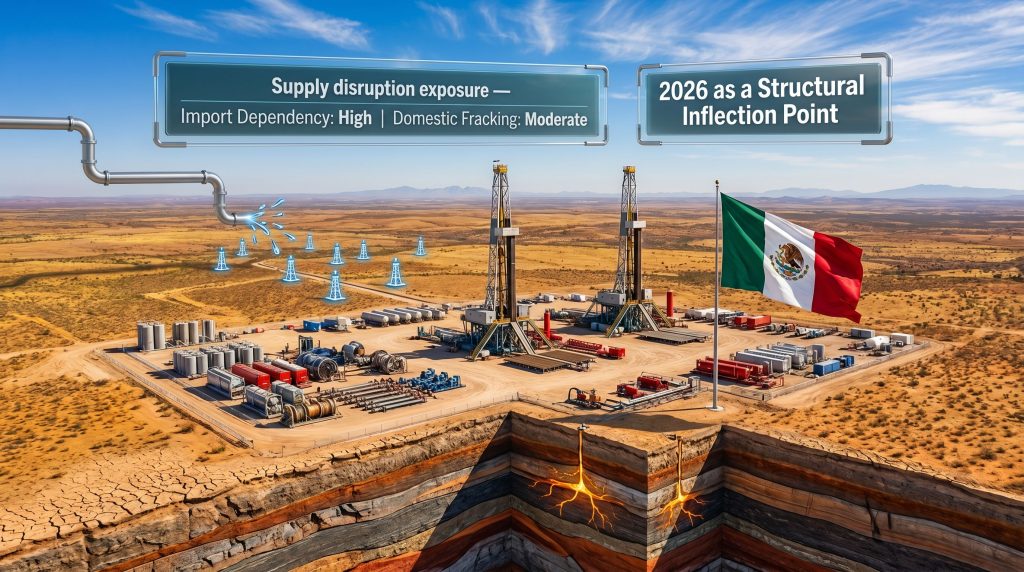
Across the global energy landscape, nations that once framed unconventional hydrocarbon development as an ideological battleground are quietly repositioning it as a national security imperative. The shift is not driven by a sudden change in the science of hydraulic fracturing, nor by a fundamental reassessment of its environmental footprint. It is driven by something far more immediate: the economic and geopolitical costs of energy dependency are becoming impossible for resource-rich nations to rationalise. Mexico sits precisely at this inflection point, and the decisions being made in 2026 around fracking in Mexico for energy security will shape the country's upstream production architecture for at least the next two decades.
When big ASX news breaks, our subscribers know first
Mexico's Import Dependency: A Structural Vulnerability Hidden in Plain Sight
Mexico imports a substantial share of its domestic natural gas supply from the United States via pipeline infrastructure that, while operationally functional, creates a layered set of exposures. Price volatility indexed to U.S. market conditions, cross-border supply reliability risk, and the fundamental compromise of energy sovereignty are all embedded in this arrangement. The U.S. gas price forecast for 2025 and beyond underscores why this dependency carries increasing financial risk. The strategic logic has consequently evolved: fracking in Mexico for energy security is increasingly framed as an import-substitution strategy rather than purely a commercial drilling decision.
The core tension this creates can be mapped across competing risk scenarios:
| Risk Category | Import Dependency Scenario | Domestic Unconventional Development |
|---|---|---|
| Supply disruption exposure | High (U.S. pipeline reliance) | Moderate (distributed domestic wells) |
| Price volatility | High (indexed to U.S. markets) | Lower (domestic pricing control) |
| Environmental risk | Low (offshore) | High (water, methane, land) |
| Regulatory complexity | Low | High |
| Long-term fiscal benefit | None | Significant (Pemex revenues, royalties) |
What this table reveals is not that unconventional development is risk-free, but that import dependency carries its own category of strategic risk that is frequently understated in policy debates dominated by environmental considerations alone.
What Mexico's Unconventional Resource Base Actually Contains
Mexico's northeastern basin formations, including the Burgos Basin and adjacent tight gas and shale plays that mirror productive U.S. formations across the border, have been geologically characterised for decades. The resource potential is not a new discovery. What has been absent is not geological knowledge, but the institutional architecture required to convert that knowledge into production.
Why Unconventional Development Is Fundamentally Different From Conventional Operations
This distinction carries significant practical consequences that are frequently overlooked in policy discussions. Conventional oil and gas production resembles artisanal extraction: each well is a discrete, high-value asset requiring individual engineering attention. Unconventional development operates on an entirely different logic, closer to an industrial manufacturing process characterised by:
- Standardised well designs repeated across multi-well pad developments
- Repeatable hydraulic fracturing completion techniques that improve with operational experience
- Continuous, multi-year drilling programmes where cumulative production aggregates across hundreds or thousands of individual wells
- Significant learning curve economics, where cost-per-well declines materially as operators accumulate programme-level experience
This manufacturing model analogy has critical consequences for capital allocation. Rather than discrete project financing, unconventional programmes require sustained multi-year investment commitments. Individual well production rates are lower than conventional wells, but the aggregate output across a well-developed programme can be transformational at the national production level. Pemex has deep operational experience with conventional reservoirs but lacks the specific institutional muscle memory that unconventional development demands, which is precisely why private sector partnership is not optional but structurally necessary.
The Vaca Muerta Blueprint: What Argentina's Success Actually Teaches
Argentina's Vaca Muerta formation has become the most consequential reference point for unconventional development outside North America, and its relevance to Mexico's strategic calculus is direct. Critically, the conditions that unlocked Vaca Muerta were not primarily geological. The basin's resource potential was understood long before large-scale commercial development commenced.
The decisive enabling factors were institutional. Research on energy and environment in Vaca Muerta highlights how policy design, rather than geology, determined outcomes. These factors included:
- Long-term fiscal stability provisions that gave investors multi-decade certainty on tax treatment
- A clear, enforceable legal framework governing operator rights and obligations
- Structured mechanisms for private sector participation alongside the national oil company, including farmout arrangements that allowed international operators to bring capital and technology without requiring full privatisation of state assets
The Vaca Muerta case establishes a principle of direct relevance to Mexico: geology is a necessary but insufficient condition for unconventional resource development. The investment environment, encompassing regulatory predictability, fiscal design, and contractual architecture, is the decisive variable in determining whether resources translate into actual production.
A comparative view of where Mexico currently stands against the Vaca Muerta policy model reveals the gap that must be closed:
| Policy Dimension | Vaca Muerta (Argentina) | Mexico (Current State) |
|---|---|---|
| Fiscal incentive framework | Long-term tax stability provisions | Underdeveloped for unconventional plays |
| Private sector participation | Open farmout and JV structures | Limited to seven mixed contracts |
| Regulatory certainty | Established and enforced | Evolving, politically sensitive |
| Foreign investment openness | Actively courted | Restricted by state-centric model |
| Social licence framework | Formalised engagement processes | Nascent and inconsistent |
Mexico's Contractual Model: Seven Mixed Contracts and a Structural Gap
As of early 2026, Pemex has executed seven mixed contracts with private sector partners, all with domestic Mexican companies. This represents genuine institutional progress but also exposes a critical structural limitation: these contracts are focused on existing conventional fields where Pemex already has operational familiarity. They have not been designed to address the capital intensity, multi-well programme structure, extended investment recovery timelines, or specific risk profile of hydraulic fracturing programmes.
The implication is that Mexico's contractual architecture has advanced, but not in the direction that unconventional development requires. Adapting contractual and commercial vehicles to properly reflect the complexity of fracking programmes is a prerequisite, not a follow-on refinement.
Why Farmout Structures Could Be the Critical Unlock
Farmout agreements, where an operator earns an interest in a licence by funding and executing a defined work programme, offer a structurally superior model for unconventional development for several reasons:
- They allow Pemex to retain strategic ownership while transferring operational execution risk to technically capable partners with proven unconventional expertise
- They create direct alignment between investment performance and partner returns, incentivising efficiency and technological innovation at the programme level
- They provide a commercially credible pathway for international operators to participate without requiring full privatisation of state energy assets
- They enable government to concentrate its attention on providing legal and regulatory certainty rather than managing day-to-day operational complexity
More open partnership models of this kind would provide greater certainty for investment decisions, particularly for international players who require a clear risk-reward structure before committing the capital intensity that unconventional programmes demand. A fairer distribution of risks and benefits between Pemex and private partners who hold the necessary technology and capital is not a weakening of state control; it is a more sophisticated expression of it.
Long-Term Regulatory Predictability as a Capital Magnet
Investors in unconventional programmes operate on investment cycles of 15 to 25 years. Regulatory frameworks that cannot provide enforceable certainty beyond a single political cycle create a risk premium that either deters investment entirely or demands compensating financial returns that reduce the fiscal benefit to the Mexican state. A dedicated unconventional resources regulatory framework is not a bureaucratic nicety but a capital attraction mechanism. Furthermore, broader commodity market volatility in 2025 has reinforced why regulatory stability matters enormously to long-horizon energy investors.
Environmental and Social Risks: The Non-Negotiable Governance Challenges
Water Stress and Groundwater Integrity
Hydraulic fracturing requires significant water volumes for fracturing fluid preparation, creating direct competition with agricultural, municipal, and ecological users in regions that already face water scarcity pressures. Mexico's northeastern basins, where unconventional resources are most concentrated, are not water-abundant. The risk of groundwater contamination through well casing failures, surface spills, or improper wastewater disposal is a documented challenge in global unconventional development programmes, requiring robust well integrity standards and continuous monitoring regimes that must be mandated rather than left to operator discretion.
Methane Emissions and Mexico's Climate Obligations
Unconventional development programmes generate fugitive methane emissions from wellheads, gathering systems, and processing infrastructure. Without active controls, these emissions can substantially erode the climate advantage of natural gas relative to higher-carbon fuels. Mexico carries international climate obligations under the Paris Agreement and faces increasing scrutiny from trade partners. Advanced leak detection and repair programmes, vapour recovery systems, and green completion technologies exist and are deployable at scale, but they require regulatory mandates and investment incentives rather than voluntary adoption. Ember Energy's analysis of renewables and Mexico's energy security further illustrates the broader energy transition context within which these emissions decisions must be made.
The Ejido Problem: Why Social Licence Is More Complex in Mexico Than Texas
This is perhaps the least discussed but most operationally significant challenge for fracking in Mexico for energy security purposes. In Texas, private land ownership and mineral rights frameworks create relatively direct operator-landowner relationships. Mexico's ejido communal land tenure system, combined with the geographic diversity of rural and Indigenous communities in resource-bearing regions, creates a stakeholder landscape of fundamentally different complexity.
Issues that initially appear manageable in community engagement processes can evolve in unpredictable directions, ultimately threatening entire development programmes. This is not a hypothetical risk; it is a pattern with documented precedents across Mexico's extractive sectors.
Delegating social licence management entirely to private operators without active government facilitation creates a structural accountability gap. The state's role in framing community engagement, arbitrating disputes, and providing credible oversight is essential. Free, prior, and informed consent processes with Indigenous communities are not optional compliance exercises; they are risk management foundations for multi-decade development programmes.
The difference between Texas and Mexico in this context is not a matter of regulatory sophistication but of property regime architecture. Ejido land cannot simply be negotiated with individual title holders. Government facilitation is structurally required, and benefit-sharing mechanisms that direct a defined share of production revenues to affected communities are not ideological concessions but practical instruments for sustainable programme development.
The next major ASX story will hit our subscribers first
The Political Transition: From Ideological Constraint to Operational Pragmatism
The previous administration's ideological opposition to hydraulic fracturing created a multi-year policy gap during which Mexico's unconventional resource potential remained undeveloped while competitors accelerated. The current institutional environment reflects a measurable change in discourse. Both Pemex and Mexico's energy ministry SENER engaged more openly with unconventional development frameworks throughout 2025.
Expert consensus within the petroleum engineering community has consolidated around a clear position: countries with unconventional resource endowments that decline to develop them are not exercising environmental prudence but forfeiting public finance, supply security, and trade leverage simultaneously. The broader LNG supply outlook for 2025 further reinforces why domestic gas development is becoming a strategic priority for import-dependent nations.
Industry analysis characterises 2026 as a structural decision window rather than a production growth year. The frameworks being defined now, across contract models, regulatory design, fiscal architecture, and community engagement protocols, will determine whether Mexico's unconventional resources remain a theoretical balance sheet entry or become a functioning component of the national energy system.
Critically, deferring these decisions does not preserve policy optionality. It progressively narrows the available space for action and reduces the probability of achieving meaningful unconventional production within the timeframe relevant to Mexico's energy security planning horizon. In addition, the trade war impacts reshaping global energy trade flows in 2025 have added further urgency to Mexico's need for supply independence.
A Four-Pillar Policy Framework for Responsible Unconventional Development
Pillar 1: Contractual Architecture Reform
- Expand mixed contracts to explicitly accommodate unconventional resource characteristics, including extended investment recovery timelines and multi-well programme structures
- Introduce farmout mechanisms enabling international operator participation with technology transfer and local content requirements
- Design performance-based fiscal terms that align operator incentives with production outcomes and environmental compliance metrics
Pillar 2: Long-Term Regulatory Certainty
- Establish a dedicated unconventional resources regulatory framework providing enforceable certainty for investment cycles of 15 or more years
- Align environmental monitoring requirements with international best practice, including methane quantification, water use accounting, and seismic monitoring
- Create an independent technical review body for transparent, evidence-based permitting decisions
Pillar 3: Government-Led Social Licence Management
- Mandate government-facilitated community engagement for unconventional programmes in ejido and Indigenous territory regions
- Establish benefit-sharing mechanisms directing a defined share of production revenues to affected communities
- Deploy dedicated facilitation resources to support consultation processes and prevent localised conflicts from escalating to programme-level threats
Pillar 4: Environmental Technology Incentives
- Create fiscal incentives for operators deploying reduced-water completion designs, closed-loop fluid management systems, and advanced methane detection infrastructure
- Integrate environmental performance metrics into contract renewal criteria, creating ongoing incentives for investment in emissions reduction and water management innovation
Frequently Asked Questions
What makes fracking in Mexico for energy security strategically important?
Mexico currently imports a significant portion of its natural gas from the United States, creating dependency on cross-border supply reliability and U.S. market pricing. Developing domestic unconventional resources through hydraulic fracturing would reduce this exposure, generate Pemex revenues, and strengthen Mexico's position in trade negotiations. The strategic case is fundamentally about import substitution and supply sovereignty rather than purely commercial economics. Furthermore, geopolitical resource risks globally are reinforcing the case for domestic energy self-sufficiency.
How does the ejido land system complicate unconventional development?
Unlike Texas, where mineral rights are privately owned and negotiated directly between operators and landowners, Mexico's ejido communal land tenure system requires engagement with collective decision-making structures and, in many regions, Indigenous communities with formal free, prior, and informed consent rights. This creates a more complex, government-dependent stakeholder management process that cannot be delegated to private operators alone.
Why is the Vaca Muerta model relevant but not directly replicable?
Argentina's Vaca Muerta demonstrates that long-term fiscal stability, open private participation models including farmouts, and regulatory certainty are more decisive than geology in converting unconventional resource endowments into production. Mexico's state-centric model, limited mixed contract scope, and evolving regulatory environment mean significant institutional design work remains before the conditions that unlocked Vaca Muerta can be replicated.
What are the primary environmental risks of large-scale fracking programmes in Mexico?
The four primary risk categories are: groundwater contamination through well integrity failures; water consumption competition in water-stressed northeastern basin regions; fugitive methane emissions from wellheads and gathering infrastructure; and cumulative land disturbance from multi-well pad development. Each is manageable with appropriate regulatory mandates and technology deployment but requires proactive governance architecture rather than reactive oversight.
Disclaimer: This article contains forward-looking analysis, scenario projections, and policy assessments based on publicly available information and industry expert commentary as of early 2026. It does not constitute financial, investment, or legal advice. Readers should conduct independent research before making decisions related to energy sector investments or policy positions.
Want to Stay Ahead of the Next Major Resource Discovery?
Discovery Alert's proprietary Discovery IQ model delivers real-time alerts on significant ASX mineral discoveries across more than 30 commodities — instantly converting complex geological data into actionable investment insights for both short-term traders and long-term investors. Explore how historic mineral discoveries have generated exceptional returns and begin your 14-day free trial today to secure a market-leading advantage before the broader market moves.