
June 6, 2026
Why Investment Demand, Not Mining Fundamentals, Drives Platinum Prices
Commodity markets are often analysed through the lens of physical supply and demand: how much material is being mined, how much is being recycled, and how much industry requires. For most raw materials, this framework tells most of the story. However, platinum ETF investment demand and price rise dynamics behave differently, and understanding this distinction is essential for any serious market participant.
Econometric research consistently identifies changes in the level and direction of investment demand as the primary determinant of precious metals prices. For a broader precious metals market analysis, this applies across gold and silver, and equally to platinum group metals (PGMs). Treating investment demand as a separate category is not an oversight — it is a deliberate elevation of the variable with the greatest explanatory power.
When big ASX news breaks, our subscribers know first
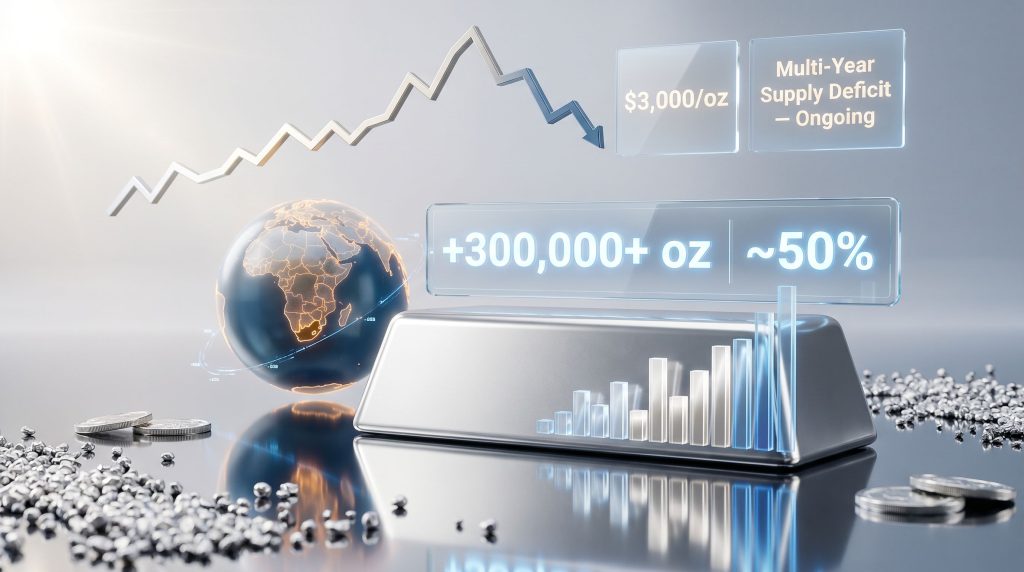
The Mechanics Behind Platinum's ~50% Price Surge
Between mid-2024 and January 2025, platinum prices climbed approximately 50%, reaching their highest point in over a decade. To understand why, it is necessary to look at where the demand impulse originated. Mine production during this period was broadly flat. Secondary supply from recycling showed no meaningful increase. Industrial and fabrication demand remained stable.
What changed was investor behaviour. During this window, platinum ETF holdings expanded by an estimated 300,000+ ounces of physical platinum, accumulated through exchange-traded products that give institutional and retail investors access to physically-backed metal. This surge in ETF accumulation was the primary driver of the price rally.
How Does the Reflexive Mechanism Work?
The mechanism was reflexive in nature. Rising prices attracted new buyers into platinum ETFs. Those purchases tightened available supply, which pushed prices higher still, attracting further buying. This self-reinforcing feedback loop is structurally identical to momentum accumulation phases observed in gold and silver ETF markets during periods of elevated investor interest.
The same investment dynamic that accelerates a price rally contains the seeds of its own reversal. When momentum drives accumulation, profit-taking eventually becomes the dominant force, and the market corrects through the same channel it rallied through.
Furthermore, understanding these safe-haven investment trends helps contextualise why platinum price moves of this magnitude are possible even when physical supply fundamentals remain unchanged.
South African Institutional Investors: A Structural Driver Often Overlooked
One of the less widely understood features of the 2024-2025 platinum ETF accumulation phase is its geographic concentration. Approximately half of the ETF purchasing activity during this period originated from South African institutional investors, a detail that adds important context to the demand story.
South African institutions manage portfolios benchmarked against the Johannesburg Stock Exchange (JSE), where listed platinum mining companies carry significant index weighting. Platinum is deeply embedded in the South African economy, representing a major source of mining employment, export revenue, and foreign exchange earnings.
Consequently, institutional managers operating within a JSE-benchmarked framework must maintain meaningful exposure to platinum as an asset class. Many institutions have migrated toward ETFs as proxy vehicles for platinum price exposure, meaning a significant portion of platinum ETF demand is driven by equity portfolio management decisions rather than speculative metal bets.
| Demand Category | 2024-2025 Trend | Price Impact |
|---|---|---|
| Mine production | Broadly flat | Neutral |
| Secondary supply (recycling) | Broadly flat | Neutral |
| Industrial/fabrication demand | Broadly flat | Neutral |
| ETF investment demand | +300,000+ oz surge | Primary upside driver |
| South African institutional ETF flows | ~50% of total ETF activity | Structural support |
The Profit-Taking Phase: When the Same Mechanism Reverses
After platinum approached the $3,000 per ounce threshold in early 2025, the reflexive dynamic that had driven prices higher began operating in reverse. Estimates suggest that approximately two-thirds of the ETF ounces accumulated during the prior six-month rally were liquidated over the subsequent three to four months.
This pattern is a predictable feature of ETF-driven precious metals rallies. Investors who chased the upside become motivated sellers once gains reach a threshold that triggers profit realisation. CME Group analysis has estimated that approximately 170,000 ounces of ETF selling will factor into the 2026 platinum market balance, with outflows likely concentrated during periods of price strength.
Despite the scale of this liquidation, the platinum price has not collapsed. Several factors help explain why ETF outflows have not produced a sharper correction:
- Stronger-than-expected demand from physical bar-and-coin investors has partially absorbed the selling pressure
- Jewellery fabrication demand has provided a degree of offset
- Exchange inventory accumulation has provided a buffer, reducing urgency in physical procurement
- The World Platinum Investment Council has noted that ETF liquidation is unlikely to materially close the platinum market's ongoing multi-year supply deficit
Historical Context: Before Platinum ETFs Existed
To appreciate how significantly ETFs have transformed platinum price dynamics, it helps to understand what large-scale platinum investment looked like before these instruments existed. Prior to the introduction of platinum and palladium ETFs, accessing physical platinum as an investment was restricted to high-net-worth investors and specialised hedge funds.
These participants purchased platinum in sponge form, stored in specialist vaulting facilities, including at Zurich Kloten Airport in Switzerland. It was operationally complex, expensive, and accessible only to a narrow institutional elite. In addition, the creation of platinum ETFs fundamentally changed the market architecture, democratising access and dramatically expanding the potential investor base.
For investors exploring accessible routes into the space, an exchange-traded commodities guide provides a useful framework for understanding how these instruments are structured and traded.
Platinum vs. Gold and Silver ETF Markets: Key Structural Differences
Platinum ETF markets operate differently from their gold and silver counterparts in ways that matter for price analysis. Gold and silver ETF markets are characterised by deep global liquidity, broad retail participation across multiple continents, and a much larger absolute scale of assets under management.
Platinum ETF markets, by contrast, are smaller, more institutionally concentrated, and more sensitive to the decisions of a relatively narrow group of large investors. The JSE-linked institutional dynamic introduces a correlation between platinum ETF flows and South African equity market conditions that has no direct equivalent in gold or silver ETF analysis.
Furthermore, understanding the broader platinum and palladium market dynamics reveals that palladium faces an even more acute version of these dynamics. As a smaller market with lower global investor attention, palladium is disproportionately exposed to the risk of investor disengagement.
Scenario Analysis: Where Does Platinum Go From Here?
Bullish Case
Platinum has been operating in a sustained multi-year supply deficit, a structural condition that provides a fundamental price floor. If the macroeconomic and geopolitical environment deteriorates further, institutional and retail investors may re-enter precious metals broadly. In a deficit market, new ETF inflows would compress available above-ground supply more rapidly than in a balanced or surplus environment.
Bearish Case
If the cohort of ETF holders who accumulated during the 2024-2025 rally continues to reduce exposure, the overhang of potential selling could cap recovery attempts. Palladium's recent breakdown below key support levels in the $1,350-$1,380 range serves as a cautionary parallel. Platinum prices are currently testing the support zone that first emerged in late May and early June 2024, and platinum ETF selling data confirms that a sustained break below that level would carry meaningful technical significance.
Key Variables to Monitor
- Weekly ETF holdings data across London-listed, Zurich-listed, and JSE-listed platinum ETFs for real-time accumulation or distribution signals
- JSE platinum mining index performance as a leading indicator of South African institutional rebalancing behaviour
- Macro sentiment indicators including geopolitical risk indices, US dollar strength, and real interest rates
- Physical bar-and-coin demand trends as a gauge of retail investor re-engagement
- Exchange inventory levels and lease rates to distinguish speculative momentum from structurally supported physical demand
The next major ASX story will hit our subscribers first
A Framework for Analysing Platinum ETF Investment Demand
For investors seeking to apply these insights practically, the following analytical approach provides a structured starting point:
- Separate investment demand from fabrication demand in any platinum supply-demand model. These categories behave differently and respond to different variables.
- Track ETF holdings on a weekly basis across major platforms in London, Zurich, and Johannesburg. Identifying accumulation or distribution phases early provides a significant informational edge.
- Monitor JSE platinum mining index performance as a leading indicator. When mining equities underperform, institutional rotation into ETFs tends to follow.
- Overlay broad macro sentiment indicators. Investment demand in precious metals is highly sensitive to geopolitical risk, currency dynamics, and real interest rate environments.
- Compare ETF flow direction with physical market tightness. Rising ETF demand accompanied by tightening exchange inventories and elevated lease rates signals structurally supported demand.
- Recognise reflexive feedback loops early. When price gains are driven primarily by momentum buying, reversal risk is materially higher.
Analytical note: A price rally driven entirely by ETF momentum accumulation, against a backdrop of flat mine supply, recycling, and fabrication, carries significantly higher reversal risk than one supported by concurrent tightening across multiple demand categories simultaneously.
The Broader Investment Demand Thesis in One Framework
| Factor | Current Status | Implication for Price |
|---|---|---|
| Mine supply | Flat | Neutral |
| Recycling/secondary supply | Flat | Neutral |
| Industrial/fabrication demand | Flat | Neutral |
| Multi-year supply deficit | Ongoing | Structural price support |
| ETF holdings trend | Post-peak liquidation phase | Near-term headwind |
| South African institutional flows | JSE-correlated | Swing factor |
| Macro/geopolitical environment | Elevated uncertainty | Potential demand catalyst |
| Physical bar-and-coin demand | Stronger than expected | Partial offset to ETF outflows |
| Palladium market signal | Breaking key support levels | Caution indicator for PGMs broadly |
Frequently Asked Questions
What is the relationship between platinum ETF demand and platinum prices?
Platinum ETF flows represent the most measurable and responsive component of investment demand, which research consistently identifies as the primary driver of platinum price direction. When ETF holdings expand rapidly, prices tend to rise. When holders liquidate, prices face downward pressure. The relationship is direct but not linear, as the speed and scale of flows relative to available above-ground supply determines the magnitude of the price response.
Why do South African investors play such a large role in platinum ETF markets?
South African institutional investors manage portfolios benchmarked to the JSE, where platinum mining companies carry significant index weight. Because listed platinum miners have delivered variable financial returns over time, many institutions have shifted toward platinum ETFs as a more reliable proxy for platinum price exposure. This makes South African institutional behaviour a structurally important and recurring variable in global platinum ETF demand analysis.
Can platinum ETF outflows coexist with a rising platinum price?
Yes. If ETF selling is offset by stronger demand from other investor categories, including physical bar-and-coin buyers, over-the-counter institutional purchasers, or exchange stock accumulation, net investment demand can remain positive even as ETF holdings decline. The World Platinum Investment Council has noted that ETF liquidation alone is unlikely to materially close the platinum market's underlying supply deficit.
What is the significance of the platinum market's multi-year supply deficit for ETF investors?
A sustained supply deficit means that above-ground stocks are being drawn down progressively over time, providing a structural price floor. For investors, this implies that even during ETF liquidation phases, the fundamental backdrop limits downside risk. It also means that any renewed accumulation phase occurs against a tighter physical market backdrop, potentially amplifying price gains.
How does platinum ETF investment demand and price rise potential compare to gold?
Gold ETF markets are significantly larger, more liquid, and characterised by broader retail participation globally. Platinum ETF markets are smaller and more institutionally concentrated, with a meaningful share of activity driven by JSE-linked portfolio management in South Africa. This concentration makes platinum ETF flows more sensitive to a smaller number of large institutional decisions, increasing the potential for sharp directional shifts. Furthermore, understanding central bank metals demand provides additional context for how institutional buying shapes broader precious metals pricing dynamics.
Disclaimer: This article is intended for informational and educational purposes only and does not constitute financial advice. Forecasts, scenario analysis, and market projections discussed in this article involve inherent uncertainty and should not be relied upon as the basis for investment decisions. Past price behaviour is not indicative of future performance. Readers should conduct their own independent research and consult a qualified financial adviser before making any investment decisions.
Want To Stay Ahead of the Next Major Commodity Discovery?
Discovery Alert's proprietary Discovery IQ model delivers real-time alerts on significant ASX mineral discoveries, transforming complex market data into actionable investment insights for both short-term traders and long-term investors. Explore how historic discoveries have generated substantial returns on Discovery Alert's dedicated discoveries page, and begin your 14-day free trial today to position yourself ahead of the broader market.