June 6, 2026
Frontier Leasing and the Capital Allocation Problem
When hydrocarbon-rich frontier regions consistently fail to attract commercial investment, the explanation rarely lies in the ground beneath them. It lies in the layers of risk that surround the path from lease acquisition to first production. Political instability, environmental litigation, infrastructure deficits, and shifting capital mandates within institutional investment portfolios can collectively transform a theoretically attractive resource into an effectively uninvestable one. The Arctic National Wildlife Refuge coastal plain has become one of the most instructive case studies of this phenomenon in modern energy markets.
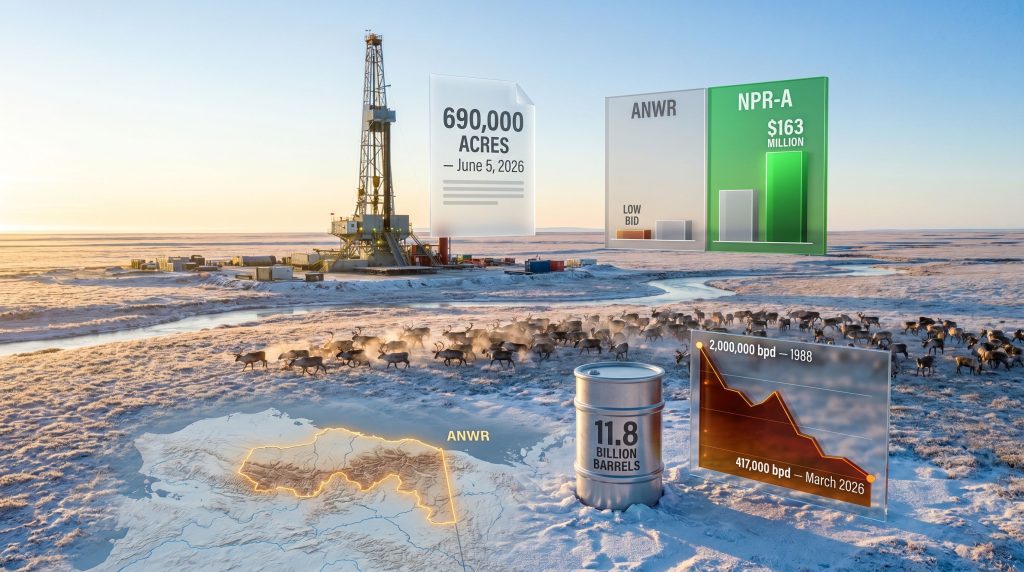
The June 5, 2026 Arctic Refuge oil lease sale bids drew participation from only two entities, against a backdrop of an estimated 11.8 billion barrels of recoverable oil, according to the U.S. Bureau of Land Management. Understanding why this happened requires moving well beyond surface-level policy commentary and examining the structural investment calculus that governs how major operators allocate exploration capital across competing jurisdictions.
When big ASX news breaks, our subscribers know first
What the ANWR Coastal Plain Lease Programme Actually Represents
From Protected Wilderness to Mandated Auction Schedule
The legislative arc behind ANWR's leasing programme spans more than four decades. Energy development within the refuge was effectively prohibited from the early 1980s through to the first Trump administration, when legislation finally opened the coastal plain to commercial leasing. The protected area occupies a section of northeastern Alaska roughly equivalent in size to South Carolina, encompassing some of the continent's most ecologically sensitive and geologically prospective terrain simultaneously.
The current mandatory leasing framework derives from President Trump's tax-and-spending legislation, the One Big Beautiful Bill Act, which legally obligates the federal government to conduct a minimum of four lease sales covering at least 400,000 acres each within the coastal plain by 2035. The June 5, 2026 auction was the first of these four required sales, making its commercial outcome a critical early indicator of market appetite for Arctic frontier acreage under the current regulatory environment.
A Recurring Pattern Across Three Administrations
The results of this first mandated sale did not emerge in isolation. Examining the complete leasing history reveals a consistent pattern of institutional capital abstention that predates any single political configuration.
| Auction Date | Administration | Participating Bidders | Commercial Outcome |
|---|---|---|---|
| January 2021 | Trump (first term, outgoing) | Two oil developers plus Alaska state agency | Limited uptake; major integrated operators absent |
| January 2025 | Biden | Zero | No bids received |
| June 5, 2026 | Trump (second term) | AIDEA plus Hex Energy | Five tracts leased; major IOCs absent again |
Three consecutive lease sales spanning two presidential administrations and five years have failed to attract participation from any major integrated oil company. This is not a policy anomaly. It is a persistent market verdict.
The January 2025 result under the Biden administration was attributed in part to lease terms that industry representatives and Alaska officials argued were deliberately structured to minimise commercial interest. However, the June 2026 auction under a more permissive regulatory posture still produced only two participants, suggesting the barrier is structural rather than administrative. The broader Trump administration policy impact on frontier energy leasing has, furthermore, done little to shift institutional investor sentiment in the near term.
Who Actually Participated, and What Their Involvement Reveals
The Alaska Industrial Development and Export Authority
The Alaska Industrial Development and Export Authority, commonly known as AIDEA, is a state-owned economic development agency rather than a commercial oil operator. Its participation in the June 2026 auction mirrors its involvement in the January 2021 sale, establishing a clear pattern of Alaska's state apparatus functioning as a bidder of last resort to keep the leasing programme technically active.
This dynamic carries important analytical weight. When a state agency rather than a commercial entity is required to maintain participation in federal lease sales, it signals that the private sector risk-reward calculation for the underlying acreage has not cleared the investment threshold required to attract discretionary capital. AIDEA's role is to preserve optionality for the state's long-term resource development ambitions, not to generate near-term returns on exploration risk.
Hex Energy: A Local Operator With a Different Risk Profile
Hex Energy, the Anchorage-based private operator that joined AIDEA as the only other participant, represents a structurally different type of investor relative to a multinational oil major. Locally based independent operators carry several characteristics that make them more willing to engage with politically contested acreage:
- They are less exposed to global ESG pressures on resource projects from institutional investment platforms
- They carry deeper operational familiarity with Alaskan conditions and permitting environments
- Their capital structures typically involve less dependence on the ESG-screened bond and equity markets that constrain larger public companies
- They face lower reputational costs from Arctic engagement relative to companies with internationally visible brand exposure
Together, AIDEA and Hex Energy acquired leases across five tracts through the June 2026 auction. The identity and profile of these two participants tells as much about the broader market's absence as it does about their own participation.
Why Major Oil Companies Stayed Away: A Four-Factor Risk Decomposition
Political Cycle Risk and the Stranded Investment Problem
Perhaps the most analytically significant deterrent facing major operators is what energy policy analysts describe as political cycle risk: the probability that drilling permits issued under one administration will be suspended or cancelled by its successor. This risk is not hypothetical for ANWR. The leasing programme has effectively been activated, deactivated, and reactivated across consecutive administrations, and the pattern is embedded in institutional memory.
A senior fellow at the Atlantic Council Global Energy Center has argued publicly that the prospect of permit cancellation under a future administration is particularly acute for ANWR because it represents a low-cost, high-visibility signal for incoming governments seeking to demonstrate environmental commitment. This observation captures a structural asymmetry: the political benefit of cancelling Arctic drilling permits is immediate and highly visible, while the cost of doing so falls primarily on private operators rather than on the government itself.
For companies operating on 10 to 20-year capital planning horizons, this asymmetry creates an almost unbridgeable risk premium. Exploration wells in Arctic frontier environments can cost hundreds of millions of dollars before any commercial determination is made. Committing that capital to a jurisdiction where the regulatory foundation could be dismantled within a single electoral cycle is incompatible with the fiduciary obligations of most publicly listed energy companies.
ESG Capital Constraints and Institutional Investor Pressure
Since approximately 2021, the upstream energy sector has faced intensifying pressure from institutional shareholders, including pension funds, sovereign wealth funds, and ESG-mandated investment vehicles, to restrict capital allocation toward high-carbon, high-controversy frontier projects. Arctic drilling in a federally designated wildlife refuge sits at the intersection of every criterion that ESG screening frameworks are designed to flag.
This creates a de facto financial barrier that operates independently of the underlying economics. Even if an operator's internal modelling supported positive risk-adjusted returns from ANWR exploration, the act of acquiring leases in the refuge would trigger ESG exclusion reviews, institutional divestment threats, and reputational consequences that could affect the company's cost of capital across its entire portfolio. The marginal return on ANWR acreage cannot compensate for a system-wide increase in the cost of capital.
Logistical Cost Structure and Break-Even Economics
The ANWR coastal plain presents operational challenges that are extreme even by Arctic standards. Key cost drivers include:
- Permafrost drilling conditions requiring specialised equipment and seasonal operational windows
- Absence of existing pipeline infrastructure connecting the coastal plain to the Trans-Alaska Pipeline System
- Remote location relative to processing facilities, supply bases, and workforce accommodation
- Seasonal access limitations that compress the operational calendar and extend project timelines
Alaska's broader production history illustrates the trajectory facing any developer. Output peaked at 2 million barrels per day in 1988, representing approximately one quarter of total U.S. crude production at the time. Current production stands at approximately 417,000 barrels per day as of March 2026, according to the U.S. Energy Information Administration, representing a decline of nearly 80% from peak levels. The EIA projects a modest recovery to 450,000 bpd in 2026 and 500,000 bpd by 2027, driven by new North Slope developments currently entering production.
Comparative Opportunity Cost: The NPR-A Contrast
The most powerful evidence that ANWR's low participation reflects specific rather than general disinterest in Alaskan acreage comes from a lease sale held just three months earlier. In March 2026, a lease sale in the National Petroleum Reserve-Alaska (NPR-A) generated a record $163 million in competitive bids, attracting participants including ConocoPhillips, ExxonMobil, and a Shell-Repsol partnership that secured more than 40 leases.
The contrast between these two outcomes, separated by less than a quarter, is analytically decisive.
| Metric | ANWR Coastal Plain (June 2026) | NPR-A (March 2026) |
|---|---|---|
| Total bid entities | 2 | Multiple major operators |
| Approximate total bid value | Minimal (undisclosed) | Record $163 million |
| Major IOC participation | None | ConocoPhillips, ExxonMobil, Shell-Repsol |
| Existing pipeline infrastructure | Minimal | Established |
| Political controversy level | Extreme | Moderate |
| Indigenous opposition | Significant (Gwich'in) | Less pronounced |
| Tracts secured by Shell-Repsol alone | N/A | 40+ |
The NPR-A is a federally designated energy development zone with a less contentious political history, established operational infrastructure, and clearer long-term permitting certainty. Major operators are not avoiding Alaska as an investment destination. They are specifically avoiding the ANWR coastal plain because its risk profile cannot be adequately priced into standard commercial frameworks. Indeed, the broader geopolitical risk landscape shaping resource investment decisions in 2025 and 2026 reinforces this selectivity among institutional capital allocators.
Environmental and Indigenous Dimensions: Two Perspectives on the Same Landscape
Ecological Sensitivity as an Investment Risk Multiplier
Environmental opposition to ANWR development is longstanding, organised, and legally sophisticated — characteristics that collectively translate into investment risk through the mechanism of litigation-driven permitting delays. The coastal plain provides habitat for a range of Arctic species, including polar bears, caribou, Arctic foxes, musk oxen, and extensive migratory bird populations.
The League of Conservation Voters has explicitly stated that any company considering drilling in the Arctic Refuge would be acting contrary to the position held by the majority of Americans who support protecting the landscape. This framing is strategically significant because it positions commercial engagement not merely as environmentally questionable but as politically isolated from mainstream public opinion — a reputational risk that compounds the direct legal challenges that environmental organisations have historically mounted against ANWR permitting.
For a publicly listed major operator, the combination of litigation risk, permitting delay probability, and the public reputational cost of being identified as the company drilling in Alaska creates a multidimensional exposure that financial modelling alone cannot adequately capture.
Indigenous Community Perspectives: A Divided Stakeholder Landscape
The indigenous stakeholder landscape around ANWR development is not monolithic, and understanding its divisions is important for accurately assessing the social licence dimension of any future development programme.
The Gwich'in people regard the coastal plain as a sacred landscape with deep cultural and subsistence connections to the Porcupine caribou herd that calves there seasonally. Their opposition to development is both spiritual and practical, extending across decades of advocacy. According to Earthjustice, the Trump administration's offer of vast tracts within the refuge to oil drilling has drawn significant condemnation from environmental and indigenous rights organisations alike.
In contrast, residents of Kaktovik, the only permanent settlement within the refuge boundary, have broadly supported energy development, citing the economic necessity of resource revenue for community services, infrastructure, and long-term viability. This internal division among indigenous stakeholders creates a complex social licence environment that operators would need to navigate carefully, adding further transaction cost and reputational complexity to any development programme.
Alaska's Production Trajectory and the Limits of ANWR's Near-Term Relevance
A Declining Baseline and the Search for New Supply
Alaska's upstream production profile provides essential context for understanding why ANWR development, even under optimistic assumptions, cannot materially alter the state's near-term output trajectory.
| Year | Alaska Crude Production | Context |
|---|---|---|
| 1988 (historical peak) | ~2,000,000 bpd | Approximately 25% of total U.S. output |
| March 2026 (current) | ~417,000 bpd | EIA-reported figure |
| 2026 (EIA projection) | ~450,000 bpd | New North Slope developments |
| 2027 (EIA projection) | ~500,000 bpd | Continued ramp-up from existing projects |
The projected recovery toward 500,000 bpd by 2027 is driven by existing North Slope developments entering production, not by any new exploration in contested frontier areas. ANWR development — from a standing start of lease acquisition through exploration, appraisal drilling, development planning, infrastructure construction, and first production — would require a minimum of a decade under favourable conditions. This timeline makes ANWR irrelevant to Alaska's near-term production recovery regardless of how many leases are ultimately acquired.
The next major ASX story will hit our subscribers first
What Happens Next: Mandatory Auctions Through 2035
The Statutory Obligation and Its Commercial Implications
The One Big Beautiful Bill Act creates a legally binding requirement for the federal government to conduct at least three additional lease sales in the ANWR coastal plain before 2035, regardless of commercial interest levels. This raises a scenario that has no real precedent in federal leasing history: a government potentially obligated to conduct auctions that attract no commercially meaningful participation.
The January 2025 Biden-era auction, which produced zero bids, demonstrated that this outcome is not merely theoretical. As environmental groups have noted, the absence of any bids in that earlier sale reflected deep market scepticism that has not fundamentally resolved. Each subsequent mandated auction will function as a recurring market sentiment indicator, testing whether the convergent barriers have shifted sufficiently to alter major operators' investment calculus.
Three Scenarios for Future Participation
Scenario A: Continued Minimal Participation
If oil prices remain range-bound, ESG capital constraints persist, and the political cycle risk premium remains elevated, subsequent auctions are likely to mirror the 2026 outcome. State agencies and locally anchored independents may continue to acquire selective acreage, but institutional capital will remain absent.
Scenario B: Conditional Mid-Tier Entry
A sustained period of elevated oil prices above approximately $90 to $100 per barrel, combined with meaningful infrastructure investment commitments and demonstrated permitting durability across an administration transition, could lower the risk-adjusted barrier sufficiently to attract mid-tier independent operators with higher risk tolerance than the majors.
Scenario C: Policy Reversal
A change in federal administration could result in suspension of the remaining mandated auctions or cancellation of existing leases, effectively validating the precise concern that currently deters institutional investment. This scenario would likely cement ANWR's status as commercially uninvestable for another electoral cycle.
The mandatory auction schedule through 2035 means the market will be tested repeatedly. Each sale is effectively a referendum on whether the structural barriers to Arctic frontier development have shifted. So far, the market's answer has been consistent.
Frequently Asked Questions: Arctic Refuge Oil Lease Sale Bids
How many bidders participated in the June 2026 ANWR lease sale?
Only two entities submitted bids in the June 5, 2026 auction: the Alaska Industrial Development and Export Authority, a state-owned economic development agency, and Hex Energy, an Anchorage-based private operator. Together, they acquired leases across five tracts within the coastal plain.
Why did major oil companies avoid the Arctic Refuge lease sale?
Major integrated operators avoided the auction due to a combination of political cycle risk, institutional investor pressure related to ESG commitments, the high operational cost structure of Arctic frontier development, and the availability of lower-controversy alternatives such as the NPR-A. A sound capital allocation framework at the major-operator level simply cannot justify the convergent risk exposure that ANWR currently represents.
How does the NPR-A compare to ANWR as an investment destination?
The National Petroleum Reserve-Alaska has established operational infrastructure, a less politically contested history, and clearer long-term permitting pathways. Its March 2026 lease sale attracted $163 million in competitive bids from ConocoPhillips, ExxonMobil, and a Shell-Repsol partnership. By every commercial metric, the NPR-A currently represents a structurally superior investment proposition relative to the ANWR coastal plain.
How many lease sales are legally required in ANWR by 2035?
The One Big Beautiful Bill Act mandates a minimum of four lease sales covering at least 400,000 acres each within the coastal plain by 2035. The June 2026 auction was the first of these four required sales.
What is Alaska's current crude oil production level?
Alaska crude production stood at approximately 417,000 barrels per day in March 2026, according to the U.S. Energy Information Administration, down sharply from a historical peak of around 2 million barrels per day in 1988. The EIA projects output will recover to approximately 450,000 bpd in 2026 and 500,000 bpd in 2027 as new North Slope developments come online.
Key Takeaways
The June 2026 Arctic Refuge oil lease sale bids produced an outcome that was disappointing in commercial terms but entirely coherent when viewed through the lens of multi-factor investment risk analysis. Several conclusions stand out:
- The resource potential of ANWR is not disputed, with the 11.8 billion barrel estimate representing one of the largest undeveloped hydrocarbon accumulations on U.S. territory
- What is genuinely in question is whether that resource can be commercially developed given the convergent barriers of political cycle risk, ESG capital constraints, logistical cost structure, and comparative opportunity cost
- Three consecutive auctions across multiple administrations without major IOC participation indicates that institutional capital has effectively priced ANWR out of its investment universe under current conditions
- Alaska's near-term production recovery depends entirely on NPR-A activity and existing North Slope developments, making ANWR commercially irrelevant to the state's output trajectory for at least a decade
- The mandatory auction schedule through 2035 will generate recurring market signals, with each sale functioning as a test of whether structural conditions have shifted sufficiently to alter the investment calculus
This article is intended for informational purposes only and does not constitute financial or investment advice. Projections regarding future lease auction participation, oil prices, and production volumes are speculative and subject to significant uncertainty. Readers should conduct independent research before making any investment decisions.
For further reading on U.S. Arctic energy policy and Alaska's upstream production landscape, World Oil's Arctic topic coverage is available at worldoil.com/topics/arctic.
Want to Identify the Next Major Resource Discovery Before the Market Does?
While institutional capital continues to navigate the complex barriers of frontier energy investment, Discovery Alert's proprietary Discovery IQ model instantly alerts subscribers to significant ASX mineral discoveries — transforming complex data across more than 30 commodities into clear, actionable insights for both traders and long-term investors. Explore historic discoveries and the substantial returns they generated, then begin your 14-day free trial at Discovery Alert to position yourself ahead of the broader market.