July 9, 2026
Egypt's Eastern Desert and the Gold Corridor the World Has Largely Ignored
Africa's gold mining narrative has long been dominated by the West African Birimian greenstone belts, home to some of the continent's most prolific producing mines. Yet a parallel gold province has existed for millennia beneath Egypt's Eastern Desert, one that predates the modern mining industry by thousands of years. Pharaonic civilisations extracted gold from this terrain at industrial scale, and yet in contemporary terms, the region remains one of the most underexplored gold-bearing corridors on the African continent. That paradox is now beginning to resolve itself, and the Abu Marawat gold project in Egypt sits at the centre of that resolution.
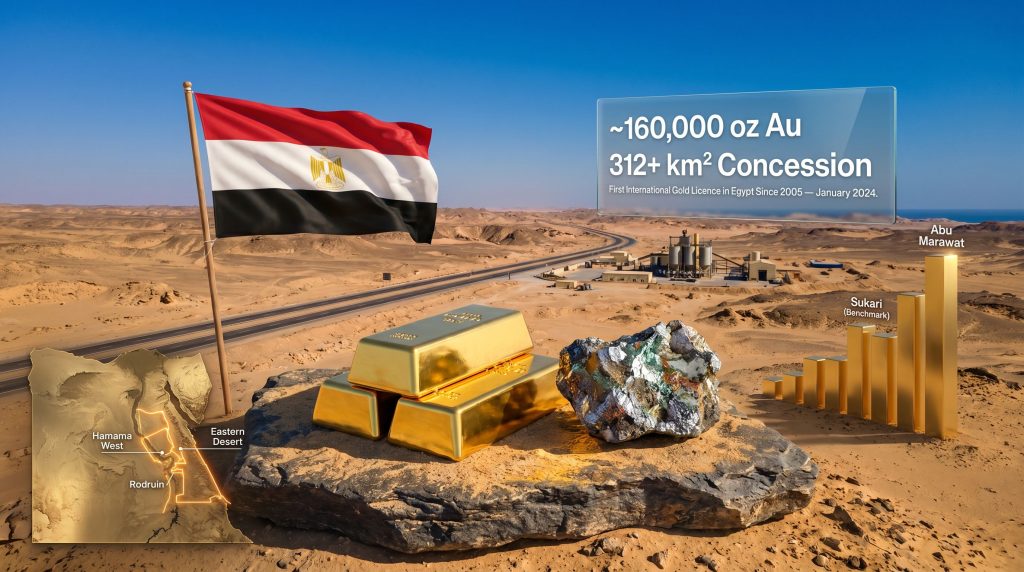
The geological foundation underpinning Abu Marawat is the Arabian-Nubian Shield, a Precambrian rock formation stretching across northeastern Africa and the Arabian Peninsula. This shield is characterised by structurally controlled gold mineralisation, where precious metals concentrate along ancient fault systems and shear zones created over hundreds of millions of years. It is the same geological architecture that hosts Centamin's Sukari mine, Egypt's only currently operating large-scale gold mine, which has produced multiple millions of ounces since commencing output in 2009. Abu Marawat sits approximately 200 kilometres north of Sukari, placing it squarely within the same prospective geological corridor.
What has historically suppressed exploration activity in Egypt's Eastern Desert is not geological scarcity but a combination of regulatory opacity, limited foreign mining frameworks, and geopolitical conservatism around resource extraction. The policy environment that governed Egypt's mineral sector for much of the late twentieth century was not structured to attract risk capital from international junior miners. That calculus began shifting in the mid-2000s, setting the stage for what would become a nearly two-decade development journey. Understanding the mineral exploration importance of regions like this helps contextualise why global interest is now accelerating.
When big ASX news breaks, our subscribers know first
The Geography and Scale of the Abu Marawat Concession
The Abu Marawat project occupies a strategically positioned footprint within the Central Eastern Desert, straddling zones governed by both the Red Sea and Qena governorates. The concession is not a single uniform block but a layered structure comprising distinct operational components.
| Concession Component | Area |
|---|---|
| Exploitation Zone (Hamama West + Rodruin) | 57+ km² |
| Retention Areas (Abu Marawat / South Safaga) | 255 km² |
| Total Project Footprint | 312+ km² |
What distinguishes this project from many comparable African frontier developments is its infrastructure proximity. Unlike remote bush projects in central or equatorial Africa that require greenfield road, power, and water construction, Abu Marawat's concession overview confirms the project sits adjacent to:
- A four-lane highway providing direct heavy haulage access
- A 220kV power transmission corridor capable of supporting industrial-scale processing
- A railway corridor that connects to broader Egyptian logistics networks
- A water pipeline offering industrial water supply without fully bespoke infrastructure
In frontier mining, infrastructure proximity is often a more decisive variable than ore grade when assessing real-world capital intensity. Building a road through remote terrain or constructing a standalone power facility can add tens of millions of dollars to a project's capital expenditure before a single tonne of ore is processed. Abu Marawat's positioning largely sidesteps that burden.
Two Decades in the Making: The Development Timeline
From Concession Award to Exploitation Lease
The Abu Marawat story is fundamentally a study in long-cycle resource development. The timeline is instructive for investors and analysts who evaluate frontier mining projects on short-horizon frameworks.
- 2007 – Aton Resources secures the Abu Marawat concession, establishing the foundational legal position
- 2009 – Active exploration commences; systematic drilling campaigns begin delineating the mineralised system
- 2024 (January) – Exploitation lease formally issued, representing the first internationally granted gold mining licence in Egypt since 2005
- 2026 – Original commercial production target confirmed by Egypt's Ministry of Petroleum and Mineral Resources
- 2027 – Revised production commencement window referenced in ministerial statements, reflecting updated project scheduling
The January 2024 exploitation lease was not merely an administrative milestone. It represented Egypt's first internationally issued gold production licence in nearly two decades, signalling a structural shift in how the country positions itself toward foreign mining capital.
The near-nineteen-year span from concession award to anticipated first production is not unusual in frontier mining, but it demands a particular investor temperament. Projects in politically stable, infrastructure-rich jurisdictions with established regulatory frameworks routinely move from discovery to production in seven to ten years. Egypt, during this period, represented a longer-cycle proposition.
The Deposits: What Lies Within the Concession
Abu Marawat is not a single-deposit project. The concession hosts a sequence of mineralised targets at various stages of development:
- Hamama West: The primary production target, first scheduled for commercial extraction; defined resource base underpinning the near-term production case
- Rodruin: An advancing high-grade deposit sequenced as the second development stage; its structural complexity adds geological upside
- Abu Marawat Polymetallic Zone: A multi-mineral occurrence hosting gold alongside silver, copper, and zinc, adding by-product revenue streams that improve project economics
- West Garida: An exploration target within the broader concession where high-grade sampling has returned values of up to 99.6 grams of gold per tonne, a figure that significantly exceeds typical open-pit mining grades
- 16+ additional exploration targets identified across the full concession area
Furthermore, interpreting gold drill results from these targets correctly is critical to understanding their true economic significance. The mineralisation at Abu Marawat is characterised as Sukari-style, meaning it is structurally controlled along shear zones and fault corridors rather than disseminated through bulk-tonnage, low-grade porphyry systems.
The project's confirmed resource currently stands at approximately 160,000 ounces of gold, established through extensive drilling campaigns conducted over more than a decade. Within the African mid-tier gold development pipeline, this places Abu Marawat at the smaller end of the spectrum. However, resource size is only one lens through which to evaluate a project's merits.
The Joint Venture Architecture: EMRA and Aton Resources
Understanding the 50/50 State-Private Partnership
The ownership structure governing Abu Marawat follows the 50/50 joint venture model that has become the standard template for Egypt's strategic mineral concessions. Understanding each partner's role is essential for contextualising project governance.
Egyptian Mining Resources Authority (EMRA) functions as the sovereign partner, regulatory interface, and custodian of national resource interests. EMRA Chairman Yasser Ramadan has publicly positioned Abu Marawat as a viable model for Egypt's broader strategy to develop contemporary mining operations that balance resource utilisation with environmental protection, enhancing value added to the national economy, as documented by Egypt's State Information Service.
Aton Resources (Canada) serves as the technical operator, exploration driver, and capital allocator. The company has been the project's engine since 2007, committing exploration expenditure across multiple commodity cycles and navigating a regulatory environment that required as much institutional patience as geological expertise.
The concession agreement underwent amendments in 2026 that recalibrated certain terms between state and private investor. In addition, the specifics of those amendments reflect an ongoing negotiation of risk-return balance that characterises long-cycle frontier mining JVs globally.
Minister of Petroleum and Mineral Resources Karim Badawi has characterised Egypt's mining sector as a critical pillar of economic development, with EMRA reaffirming its commitment to providing operational facilitation and overcoming project challenges in alignment with the highest technical and environmental standards.
The Real Cost of Frontier Mining: Regulatory Navigation as a Core Competency
Why Geology Is Only Half the Story
The mining industry has a long institutional memory of technically sound projects that failed not because the ore was uneconomic but because the operating environment proved intractable. Aton Resources' journey through Egypt's regulatory landscape over nearly two decades provides a granular case study in what frontier mining actually demands beyond drilling. The mining permitting realities encountered in such environments underscore just how complex this process can become.
As reported by the Canadian Mining Journal, the late Aton CEO Mark Campbell acknowledged that the company's time in Egypt had required navigating regulatory delays, mining law revisions, and the structural friction inherent to developing in an emerging market framework. The company persisted because of fundamental confidence in the geology and an observable trajectory of institutional reform.
Peter Marrone, CEO of Allied Gold Corporation, has articulated the core investor concern plainly: Egypt's geological endowment attracts attention, but the surrounding system — encompassing governance standards, regulatory consistency, and institutional engagement — introduces friction that even technically straightforward projects cannot escape. His view, as reported, is that rule consistency over time is the foundational requirement for sustained foreign investment in any mining jurisdiction.
Regulatory risk in frontier mining is not binary. It exists on a spectrum, and projects that survive long development cycles typically do so because their operators develop institutional fluency alongside geological competency.
The capabilities required to succeed in Egypt's mining environment include:
- Deep cultural understanding of Egyptian inter-agency relationships and decision-making hierarchies
- Multi-year fiscal discipline that insulates the company from capital pressure during regulatory delays
- Legal and technical teams capable of navigating mining law amendments without losing concession position
- Relationship capital with both EMRA and the Ministry of Petroleum and Mineral Resources
What the 2024 Lease Signals About Egypt's Evolving Mining Climate
The January 2024 issuance of the exploitation lease is the single most important regulatory data point in Abu Marawat's history. For investors assessing Egypt as a mining jurisdiction, it represents observable evidence that the system can deliver internationally recognised production licences for foreign-operated projects. That evidence did not exist prior to 2024 for this project.
The trajectory since 2007 shows measurable reform: the regulatory environment that Aton entered in the late 2000s was materially different from the one that issued a commercial mining licence in 2024. However, friction points remain, and the production timeline revision from 2026 to 2027 reflects the reality that even after licence issuance, execution in frontier environments rarely follows linear scheduling. Consequently, regional exploration licensing trends across the broader Middle East and North Africa region provide additional context for how such frameworks are evolving.
Abu Marawat Within Egypt's National Economic Context
Mineral Diversification as a Strategic Imperative
Egypt's economy has historically depended on hydrocarbons, Suez Canal revenues, and tourism as primary foreign currency earners. Each of these income streams carries vulnerability: oil and gas are subject to commodity cycles, canal revenues are sensitive to global trade volumes, and tourism is exposed to security perception and geopolitical events. Mining, particularly gold, offers a diversification mechanism that generates hard currency earnings through an entirely different economic pathway.
The projected economic contribution of the Abu Marawat gold project in Egypt extends beyond direct gold revenue:
- Direct employment in Red Sea and Qena governorates across mining, processing, and site operations
- Indirect employment across supply chain, logistics, maintenance, and services sectors
- Foreign direct investment attraction signalling for subsequent international mining capital
- Technology and skills transfer from Canadian technical operators to Egyptian mining professionals
Abu Marawat's role as a potential proof-of-concept for Egypt's broader Eastern Desert mining programme should not be underestimated. If the project delivers commercial production on its revised 2027 timeline with the environmental standards embedded in its ESIA, it substantially strengthens Egypt's credibility as a destination for future international mining JV capital.
Environmental Standards Embedded in the Project Design
The Abu Marawat project's Environmental and Social Impact Assessment mandates a set of operational standards that increasingly function as prerequisites for international mining finance:
- 100% process water recycling as a core operational commitment, critical in a desert environment where water scarcity is a fundamental constraint
- Advanced eco-friendly extraction technology requirements built into the project's technical design
- Comprehensive waste management and tailings handling protocols aligned with international standards
- Community engagement frameworks designed to maintain the social licence to operate throughout the mine life
The next major ASX story will hit our subscribers first
Comparative Analysis: Where Abu Marawat Sits in the African Gold Landscape
Benchmarking Against Regional Peers
| Metric | Abu Marawat (Egypt) | Sukari Mine (Egypt) | Typical West African Mid-Tier |
|---|---|---|---|
| Resource Estimate | ~160,000 oz Au | Multi-million oz | 500,000 to 2M oz |
| Concession Size | 312+ km² | ~160 km² | Varies |
| JV Structure | 50/50 State/Private | 50/50 State/Private | Varies |
| Production Status | Pre-production (2026/27) | Producing | Varies |
| Infrastructure Access | High (highway, rail, power) | Moderate | Often limited |
A critical insight that escapes surface-level resource comparisons is that infrastructure-advantaged smaller deposits can generate superior risk-adjusted returns compared to larger deposits in logistically constrained jurisdictions. The capital expenditure differential between a project with existing highway, power, and water access versus one requiring bespoke infrastructure construction can be decisive for project economics at the 100,000 to 200,000-ounce resource scale.
The Arabian-Nubian Shield also remains substantially underexplored relative to West Africa's Birimian greenstone belts, where decades of systematic exploration have delineated known resource inventories comprehensively. The Eastern Desert's exploration history is comparatively shallow in modern terms, meaning that the 16-plus additional targets identified within Abu Marawat's concession represent genuine upside optionality rather than residual low-priority ground. A definitive feasibility study across these targets would be the logical next step to converting that optionality into quantified resource value.
Frequently Asked Questions: Abu Marawat Gold Project
When Will the Abu Marawat Gold Project Begin Production?
Commercial production was originally targeted for 2026, with Egypt's Ministry of Petroleum and Mineral Resources subsequently referencing a 2027 commencement window. The exploitation lease was formally issued in January 2024. For further context, Mining Weekly reported on Aton receiving the licence in detail.
What Minerals Does the Abu Marawat Project Produce?
The primary output is gold, with by-product minerals including silver, copper, and zinc, making Abu Marawat a polymetallic project with multiple concurrent revenue streams.
Who Are the Joint Venture Partners at Abu Marawat?
The project is structured as a 50/50 joint venture between Egypt's Egyptian Mining Resources Authority (EMRA) and Aton Resources, a Canadian mining company that has operated in Egypt since 2007.
How Large Is the Abu Marawat Concession Area?
The exploitation zone covers approximately 57 km², with an additional 255 km² of retention areas, bringing the total project footprint to over 312 km².
What Makes the Abu Marawat Location Geologically Significant?
The project sits within the Arabian-Nubian Shield, a Precambrian geological formation hosting structurally controlled gold mineralisation consistent with the same shield that hosts Sukari, Egypt's only currently producing commercial gold mine.
What Is the Confirmed Resource Estimate?
Approximately 160,000 ounces of gold have been delineated through extensive drilling. High-grade sampling at West Garida has returned values of up to 99.6 g/t Au, indicating potential resource upside beyond the current estimate.
Key Takeaways
The Abu Marawat gold project in Egypt encapsulates several dynamics that define modern frontier mining investment:
- A nearly two-decade development cycle reaching commercial inflection, demonstrating that patience in frontier markets carries a genuine premium for those who endure
- The January 2024 exploitation lease as Egypt's most significant mining regulatory signal since 2005, providing observable proof of institutional progress
- Infrastructure advantages that structurally differentiate Abu Marawat from comparable African frontier projects and reduce real-world capital intensity
- The demonstrated reality that geological expertise and regulatory endurance are equally weighted competencies in frontier gold development
- Abu Marawat's potential to function as a replicable template for future international mining joint ventures across Egypt's substantially underexplored Eastern Desert
This article contains forward-looking statements regarding production timelines, resource estimates, and project development schedules. These are based on publicly available information and should not be construed as financial advice. Mining projects carry significant execution, regulatory, and market risks. Readers should conduct independent due diligence before making any investment decisions.
Want to Discover the Next Major Gold Find Before the Market Does?
Discovery Alert's proprietary Discovery IQ model delivers real-time alerts the moment significant ASX mineral discoveries are announced, turning complex geological data into actionable investment insights for both short-term traders and long-term investors — explore historic discoveries and their exceptional returns to understand what's possible, then begin your 14-day free trial at Discovery Alert to position yourself ahead of the broader market.