
July 9, 2026
When Scale Meets Timing: The Economics Behind Australia's Next Major Gold Development
Few moments in the life cycle of a mining project carry as much weight as a completed prefeasibility study paired with a materially upgraded resource estimate. These two milestones, arriving simultaneously, compress years of speculative value into a single definable investment thesis. For Minerals 260 and its Bullabulling gold project in Western Australia, the Minerals 260 Bullabulling gold resource expansion has arrived, and the numbers it has produced deserve careful examination.
When big ASX news breaks, our subscribers know first
Understanding the Bullabulling Resource Expansion in Context
From Dormant Ground to 6.2 Million Ounces in 15 Months
The Bullabulling gold project sits within the Eastern Goldfields of Western Australia, a geological province responsible for a significant proportion of Australia's historical gold production. The region's Archaean greenstone belts, which host the famous Kalgoorlie Golden Mile among other world-class deposits, are characterised by shear-zone hosted gold mineralisation that can persist across considerable strike lengths and depth extensions.
Bullabulling itself sat largely underexplored since the last major drilling campaign concluded in 2011. When Minerals 260 acquired the project approximately 15 months ago, the asset carried a resource base that had not been subjected to modern systematic drilling or resource optimisation. That context makes the subsequent transformation all the more striking.
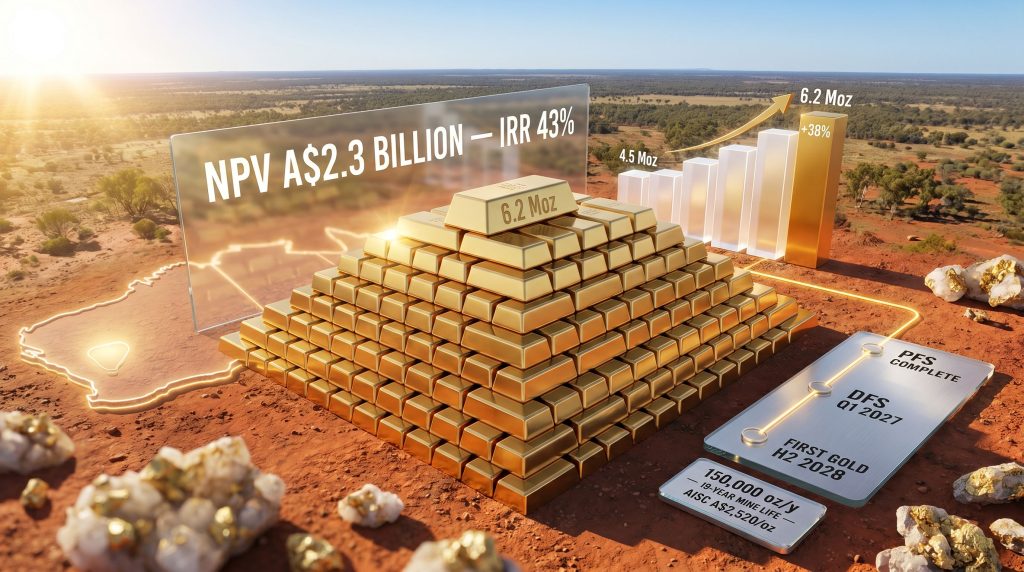
Since acquisition, the company executed approximately 78,000 metres of drilling across the project area, representing the first intensive exploration campaign in over a decade. The result is an updated mineral resource estimate totalling 190 million tonnes grading 1 gram per tonne gold for 6.2 million ounces, a 38% expansion representing 1.7 million additional ounces above the December 2025 estimate.
Resource Classification Table: Understanding the Confidence Upgrade
| Resource Metric | December 2025 MRE | July 2026 MRE | Change |
|---|---|---|---|
| Total Ounces | ~4.5 Moz | 6.2 Moz | +38% (+1.7 Moz) |
| Total Tonnes | ~130 Mt | 190 Mt | +46% |
| Average Grade | 1.0 g/t Au | 1.0 g/t Au | Stable |
| Indicated Classification | Baseline | +47% increase | Significant upgrade |
| Indicated % of Total MRE | — | ~71% | High confidence milestone |
The grade stability across this expansion is a notable geological signal. It suggests the new drilling did not dilute the resource by adding lower-quality peripheral material. Instead, the mineralised system extended along strike and at depth while maintaining consistent gold content, a characteristic associated with structurally controlled, orogenic gold deposits.
Why 71% Indicated Classification Matters to Investors
In Australian mining reporting, the JORC Code governs how mineral resources are categorised. The classification hierarchy moves from Inferred (least geological confidence) through Indicated to Measured (highest confidence). The distinction carries practical implications:
- Inferred resources cannot be used in mining reserve calculations under JORC 2012 without supporting technical justification
- Indicated resources can support pre-feasibility and feasibility studies and can be converted to probable ore reserves
- Measured resources underpin proven ore reserves, typically required for project financing at institutional scale
Having 71% of a 6.2 million ounce resource classified as Indicated means that the majority of Bullabulling's resource base can feed directly into the upcoming definitive feasibility study ore reserve calculation. This substantially reduces the technical risk profile of the project at this stage of development.
Deposit-Level Contributions Across an 8.5-Kilometre Corridor
The resource sits across five named deposits: Dicksons, Phoenix, Bacchus, Kraken and Gibraltar. Drilling confirmed extensions at depth across all five, and the mineralised system now spans an 8.5-kilometre strike corridor. This is a critical dimension, as larger strike lengths in orogenic gold systems tend to support long-life, bulk-tonnage operations rather than high-grade, narrow vein mining.
High-grade intercepts from the drilling programs added important definition to the resource envelope. The Bacchus deposit returned standout results including 7 metres at 7.2 g/t Au, while broader intersections delivered 28 metres at 1.7 g/t Au with internal zones reaching 22.6 g/t Au. These figures sit well above the 1.0 g/t resource average, indicating that localised high-grade lenses exist within the broader bulk-tonnage system.
The existence of high-grade pods within a bulk-tonnage resource often provides mine planners with scheduling flexibility, allowing operators to selectively sequence higher-grade ore early in a mine life to accelerate payback, a strategy that could be particularly relevant given the two-year payback period already projected by the PFS.
Importantly, the system remains open at depth. Furthermore, additional drilling may extend the mineralised corridor beyond its current defined boundaries, meaning the 6.2 million ounce estimate could grow again before the definitive feasibility study concludes.
Breaking Down the Prefeasibility Study Economics
PFS Financial Summary at a Glance
| Economic Metric | PFS Outcome |
|---|---|
| Net Present Value (NPV) | A$2.3 billion |
| Internal Rate of Return (IRR) | 43% |
| Payback Period | 2 years |
| Annual Free Cashflow | A$330 million |
| Annual EBITDA | A$510 million |
| Annual Production Rate | 150,000 oz/y |
| Processing Plant Capacity | 5 Mtpa |
| All-In Sustaining Cost (AISC) | A$2,520/oz |
| Operating Life | 19 years |
What a 43% IRR Signals in the Current Gold Market
For context, mining industry analysts generally consider projects with IRRs above 20% to be economically robust, while IRRs above 30% are considered exceptional, particularly for large-scale open-pit operations with multi-billion dollar capital requirements. A 43% IRR places Bullabulling firmly in the upper tier of Australian gold development economics.
The current gold price outlook further strengthens the investment case for projects of this calibre. It is worth noting that prefeasibility studies carry a level of estimation uncertainty, typically expressed as a plus or minus 25% accuracy range on capital and operating cost estimates. The DFS process, which commenced in May 2026, will refine these figures considerably. Investors should treat PFS economics as indicative rather than definitive, with the DFS expected to provide investment-grade confidence by Q1 2027.
The All-In Sustaining Cost Position
The AISC of A$2,520 per ounce deserves consideration against the prevailing gold price environment. With gold trading above US$3,000 per ounce (approximately A$4,600 to A$4,700 at current exchange rates), Bullabulling's projected cost structure implies a substantial operating margin of over A$2,000 per ounce at current prices. This margin buffer provides meaningful downside protection if gold prices soften from current elevated levels.
AISC is the mining industry's most comprehensive cost metric, encompassing:
- Direct mining and processing costs
- Site general and administrative expenses
- Sustaining capital for equipment replacement and mine development
- Royalties
- Reclamation and closure cost provisions
It does not include growth capital, exploration costs, or corporate overhead, which is why it should be read alongside the capital structure analysis.
Capital Structure and Development Pathway
A Three-Tier Capital Approach
Minerals 260 has structured Bullabulling's development capital across three distinct phases:
-
Pre-FID Capital: A$180 million covering village construction, water infrastructure, long-lead equipment procurement, detailed engineering design, administration buildings, and communications infrastructure. These activities have already commenced.
-
Post-FID Infrastructure Capital: A$560 million representing the core construction programme for the processing plant and associated mine infrastructure.
-
Pre-Production Mining and Commissioning: A$115 million covering the mining fleet mobilisation, ore stockpile build-up, and plant commissioning costs.
The total development capital across all three phases amounts to approximately A$855 million. Against an annual free cashflow projection of A$330 million and a two-year payback period, the capital intensity, while significant, appears manageable relative to the asset's projected earnings capacity.
The Franco-Nevada Streaming Agreement
A notable component of Bullabulling's financing structure is a streaming arrangement with Franco-Nevada, providing an A$220 million financing package. Streaming agreements, in which a financing party provides upfront capital in exchange for the right to purchase a percentage of future gold production at a predetermined price, are a well-established mechanism in the mining sector. They allow project developers to access non-dilutive capital without the interest rate exposure of traditional debt.
For Minerals 260, the Franco-Nevada arrangement provides a cornerstone financing anchor ahead of a full FID, consequently reducing the equity capital required from shareholders.
The Strategic Case for a Staged Development Approach
Minerals 260 is actively evaluating a staged development model to identify the most capital-efficient construction pathway. Staged development in gold mining typically involves building initial processing capacity at a lower tonnage rate, generating early cashflow, and then expanding throughput using internally generated funds. This approach reduces peak funding requirements and can compress the time to first production, although it may also lower initial production rates relative to a single-stage build.
The Path to a Final Investment Decision
DFS Timeline and Key Milestones
| Milestone | Target Date |
|---|---|
| DFS Workstreams Commenced | May 2026 |
| DFS Completion Target | Q1 2027 |
| Updated Ore Reserve Release | Q1 2027 |
| Board FID Consideration | Following DFS completion |
| First Gold Production Target | H2 2028 |
The Q1 2027 DFS completion target is an aggressive timeline for a project of this scale. Achieving it will require concurrent workstreams across metallurgical testing, geotechnical studies, environmental and social impact assessment, detailed engineering design, and infrastructure planning. The fact that pre-FID construction activities have already commenced suggests the company is managing critical path items proactively.
The updated ore reserve, also expected in Q1 2027, will convert the JORC-classified indicated resources into economically mineable proved and probable reserves, which is the technical threshold required for institutional project financing and final board approval.
Key Risks and Considerations
What Investors Should Monitor Carefully
While Bullabulling's development trajectory is compelling, however, several risk factors warrant consideration:
-
Capital execution risk: Managing approximately A$855 million in total development capital in an environment of elevated construction costs and labour competition across the Western Australian resources sector presents genuine execution challenges. Cost inflation has affected multiple large Australian mining projects over recent years.
-
Gold price sensitivity: The PFS economics are built on specific gold price assumptions. The relationship between gold price and mining equities means that if Australian dollar gold prices revert meaningfully from current elevated levels, project economics would be affected. The A$2,520/oz AISC provides a buffer, but margin compression remains a scenario to model.
-
DFS outcome risk: PFS estimates carry significant uncertainty ranges. The DFS may revise capital or operating cost estimates upward or downward. Any material upward revision to capital costs would affect the IRR and NPV calculations presented in the PFS.
-
Permitting and regulatory pathways: Western Australia maintains a structured environmental and mining approval process. While the state has a mature regulatory framework for gold mining, approvals for large-scale operations require thorough environmental impact assessment and stakeholder consultation.
-
Water and village infrastructure timing: The decision to commence pre-FID construction on village and water infrastructure is an early-mover strategy. While this could accelerate first production, it commits capital before the DFS confirms project viability at investment-grade confidence.
Disclaimer: This article does not constitute financial advice. All economic projections referenced are derived from the Minerals 260 prefeasibility study and carry inherent estimation uncertainty. Investors should conduct their own due diligence and seek qualified financial advice before making investment decisions.
The next major ASX story will hit our subscribers first
Frequently Asked Questions: Minerals 260 Bullabulling Gold Project
What is the current total gold resource at Bullabulling?
The updated mineral resource estimate, published in July 2026, totals 190 million tonnes grading 1 gram per tonne gold for 6.2 million ounces.
What were the key findings of the Bullabulling PFS?
The prefeasibility study returned an NPV of A$2.3 billion, an IRR of 43%, a two-year payback period, annual free cashflow of A$330 million, and an AISC of A$2,520 per ounce over a 19-year mine life.
When is the Bullabulling DFS expected to be completed?
The definitive feasibility study commenced in May 2026 and is targeted for completion in Q1 2027.
What is the all-in sustaining cost at Bullabulling?
The PFS estimates an AISC of A$2,520 per ounce, which represents a substantial discount to current Australian dollar gold prices.
How much has Minerals 260 drilled at Bullabulling since acquiring the project?
Approximately 78,000 metres of drilling has been completed since acquisition, representing the first major exploration campaign at Bullabulling since 2011.
What is the expected annual gold production from Bullabulling?
The PFS designs a production rate of 150,000 ounces per year from a five million tonne per annum processing plant.
When could Bullabulling reach first gold production?
Subject to DFS completion, a positive final investment decision, and construction execution, first gold production is targeted for H2 2028.
From Exploration Asset to Emerging Producer: Bullabulling's Development Arc
The Minerals 260 Bullabulling gold resource expansion story is, at its core, a study in the compounding effect of systematic drilling on a structurally prospective but historically underexplored land package. In 15 months, the project has moved from a dormant legacy asset to a 6.2 million ounce resource with a prefeasibility study demonstrating economics that rank among the stronger project-level metrics currently visible in Australian gold mining stocks and development plays.
What the upcoming DFS must confirm extends beyond headline numbers. Metallurgical recovery rates, geotechnical parameters for pit design, water supply certainty in a semi-arid environment, environmental approval pathways, and a refined capital estimate will all determine whether the PFS economics translate into a bankable project. Each of these workstreams carries its own technical risk, and the Q1 2027 DFS timeline will be the definitive test of the company's execution capability.
For observers of the Australian gold sector, Bullabulling is now a project that demands attention — not just for what it has demonstrated, but for what the next 18 months of development work may reveal about its potential to enter the ranks of Australia's next generation of large-scale gold producers. For instance, the recent resource expansion announcement provides additional technical detail on the extensional and infill drilling that underpinned the upgraded estimate.
Readers seeking broader context on Western Australian gold development projects and ASX-listed gold producers can explore related industry coverage through the World Gold Council, which provides ongoing data and analysis across the global gold sector.
Want to Identify the Next Major ASX Gold Discovery Before the Market Does?
Discovery Alert's proprietary Discovery IQ model delivers real-time alerts on significant ASX mineral discoveries, instantly converting complex geological data into actionable investment insights for both short-term traders and long-term investors. Explore Discovery Alert's dedicated discoveries page to understand the historic returns major mineral discoveries have generated, and begin your 14-day free trial today to position yourself ahead of the broader market.