
June 10, 2026
The Geological Convergence Reshaping Where Rare Earths Get Mined
Rare earth supply chains are built on geology first and geopolitics second. For decades, the dominant narrative was straightforward: ionic adsorption clay deposits in southern China's Jiangxi province produced the world's most commercially accessible magnet rare earth elements, and no other jurisdiction came close to replicating the combination of mineralogical richness, low processing costs, and established infrastructure that made those deposits so formidable. That geological monopoly translated directly into a market monopoly, one that Western manufacturing industries are now urgently trying to dismantle.
What makes the current exploration cycle genuinely different from previous rare earth booms is that geologists and junior miners are no longer just looking for any rare earth deposit. They are specifically hunting for IAC-style mineralisation in jurisdictions that can mirror the Chinese template at a structural level, not simply in terms of element concentrations, but in terms of the entire geological and metallurgical package. Northern Tasmania has quietly emerged as one of the most credible candidates for that role outside of East Asia, and the ABx Group rare earth exploration licence activity unfolding across the region in 2026 is a direct expression of that emerging recognition.
When big ASX news breaks, our subscribers know first
Why Ionic Adsorption Clay Deposits Are the Prize Worth Pursuing
To understand what separates an IAC rare earth project from a conventional hard-rock REE deposit, it helps to start with the formation process itself. IAC mineralisation does not occur in primary igneous or metamorphic rocks. Instead, it develops over geological timescales through intense chemical weathering of rare earth-bearing granites, syenites, or volcanic rocks under warm, humid conditions. As those parent rocks break down, rare earth elements are liberated from their original mineral hosts, typically fluorapatite, allanite, or zircon, and migrate downward through the soil profile before being electrostatically adsorbed onto the surfaces of secondary clay minerals, principally kaolinite and halloysite.
This mechanism has two commercially critical consequences. First, the resulting mineralisation is physically soft, shallow, and amenable to simple leaching extraction methods rather than energy-intensive pyrometallurgical processing. Second, and more importantly for market value, the weathering and re-adsorption process preferentially concentrates the heavier, more magnetically functional rare earth elements: neodymium, praseodymium, dysprosium, and terbium. These are precisely the elements that go into the permanent magnets powering electric vehicle motors and offshore wind turbine generators.
Furthermore, the rare earth processing challenges associated with hard-rock alternatives make IAC deposits even more commercially attractive by comparison.
"The commercial advantage of IAC deposits is not just their lower processing cost. It is that they naturally deliver a higher-value rare earth basket than most hard-rock alternatives, making the economics more robust even at modest scale."
The extraction pathway for IAC ores typically involves either heap leaching with a dilute ammonium sulfate or magnesium sulfate solution, or in-situ recovery where the leachant is injected directly into the orebody. Both methods require significantly less energy and fewer reagents than cracking monazite or bastnäsite concentrates, which are the primary ore types from hard-rock REE mines in Australia, Africa, and North America.
Tasmania's Geological Credentials as an IAC Rare Earth Province
Northern Tasmania's credentials as an IAC rare earth district rest on a specific suite of geological attributes. The region hosts extensive exposures of Devonian-age granitic rocks that have undergone prolonged weathering under historically humid temperate conditions, producing deep lateritic and saprolitic profiles enriched in secondary clay minerals. This weathering architecture is directly analogous to the granitic terranes of Jiangxi and Guangdong provinces in China, where IAC mineralisation was first commercially developed.
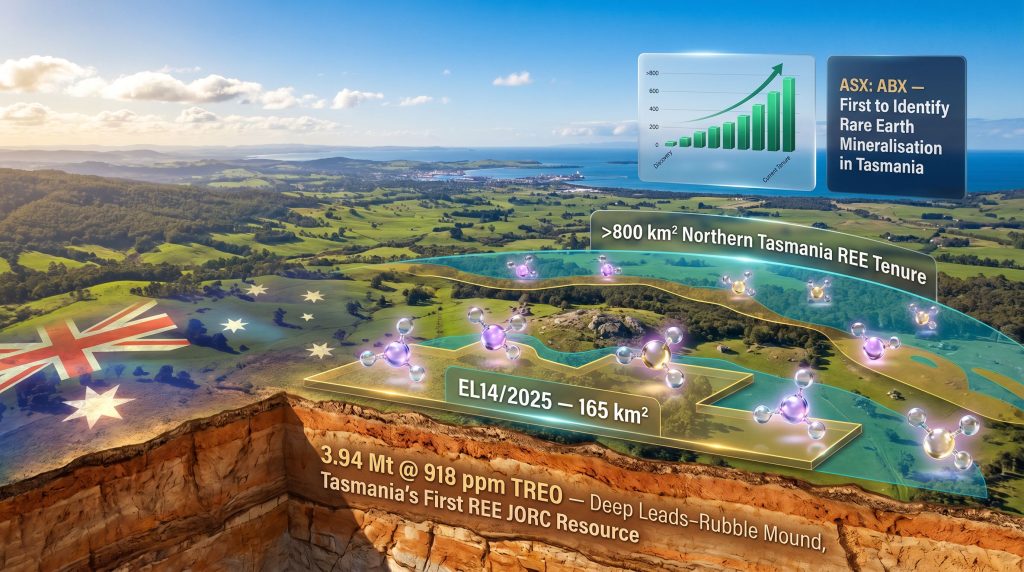
ABx Group (ASX: ABX) established the proof of concept for Tasmanian IAC mineralisation when it defined the Deep Leads-Rubble Mound JORC-compliant mineral resource of 3.94 million tonnes grading 918 parts per million Total Rare Earth Oxide (TREO). That resource, located near Launceston, holds the distinction of being the first REE JORC Resource ever declared in Tasmania, a milestone that transformed northern Tasmania from a geological curiosity into a recognised exploration district.
The newly granted exploration licence, designated EL14/2025, covers approximately 165 square kilometres situated roughly 30 kilometres north of the Deep Leads resource. Its grant by Mineral Resources Tasmania, the state's statutory exploration tenure authority, brings ABx's total prospective rare earth ground in northern Tasmania to more than 800 square kilometres, a tenure position that places the company in a structurally advantaged position within the district.
Understanding the Significance of 918 ppm TREO
For investors and analysts unfamiliar with REE grade benchmarks, context is important. Total Rare Earth Oxide grades in IAC deposits globally typically range from around 500 ppm to 1,500 ppm TREO. However, raw TREO grade is only part of the valuation equation. What matters commercially is the MREO fraction, meaning the proportion of total rare earth content attributable to magnet rare earth oxides: neodymium oxide, praseodymium oxide, dysprosium oxide, and terbium oxide.
IAC deposits in productive Chinese districts can carry MREO fractions of 30% to 50% of total TREO, which means a 900 ppm TREO deposit with a 40% MREO fraction is delivering roughly 360 ppm of high-value magnet rare earths per tonne of ore. That metric frequently outperforms the basket value of larger, higher-grade hard-rock REE deposits that are dominated by lanthanum and cerium, elements that currently command very little commercial premium.
ABx Group's Expanded Tenure and What It Means Operationally
The strategic logic behind the EL14/2025 licence grant is straightforward when viewed through the lens of how IAC districts tend to mature. Because IAC mineralisation is controlled by the distribution of weathered granitic parent rocks and the depth of the regolith profile, the most productive exploration strategy in an established district involves systematic testing of geologically analogous ground adjacent to and along strike from confirmed resources.
ABx's approach has followed exactly this pattern. The new licence area to the north of Deep Leads shares the same broad geological framework: Devonian granites, deep weathering profiles, and clay-rich regolith sequences. The 30-kilometre separation from the existing resource is not a barrier in IAC exploration terms. District-scale IAC systems in China and emerging provinces elsewhere routinely extend over tens to hundreds of kilometres along strike.
Key parameters of ABx's current northern Tasmania tenure position are summarised below:
| Parameter | Detail |
|---|---|
| Existing JORC Resource | Deep Leads-Rubble Mound: 3.94 Mt at 918 ppm TREO |
| New Licence Designation | EL14/2025 |
| New Licence Area | ~165 km² |
| Distance from Deep Leads | ~30 km north |
| Total Northern Tasmania REE Tenure | Over 800 km² |
| August 2026 Field Program | AI-assisted target generation + geochemical sampling |
| Market Capitalisation (June 2026) | ~A$17.59 million |
AI-Assisted Target Generation: More Than a Buzzword
The integration of artificial intelligence tools into ABx's August 2026 exploration campaign deserves careful interpretation rather than reflexive enthusiasm. AI in mineral exploration can add genuine value in the context of IAC work by simultaneously processing multiple data layers, including airborne geophysical surveys, soil geochemistry grids, regolith depth models, and remote sensing imagery, to identify zones where the full suite of mineralisation preconditions converges.
This matters because IAC deposits are not always flagged by a single obvious geochemical anomaly. The interplay between parent rock composition, weathering depth, topographic position, and clay mineralogy creates a multi-variable targeting problem that conventional sequential interpretation struggles to resolve efficiently. AI-assisted pattern recognition can compress that analytical workflow substantially, translating into faster identification of high-priority drill targets and lower per-metre discovery costs.
The August 2026 program will run concurrently with ongoing metallurgical test work at Deep Leads, including extraction and leach trials that will generate data critical to any future scoping or prefeasibility study. This parallel-track approach, advancing both exploration and metallurgical understanding simultaneously, is characteristic of well-managed junior explorer programs where capital efficiency is paramount.
The Demand Landscape Driving ABx Group Rare Earth Exploration in Tasmania
The investment case for Tasmanian IAC rare earth exploration cannot be separated from the structural demand forces reshaping global rare earth markets. Several concurrent trends are converging to elevate the commercial urgency of non-Chinese magnet REE supply.
| End-Use Sector | Key Rare Earth Elements | Current Supply Chain Risk |
|---|---|---|
| Electric Vehicle Motors | Neodymium, Praseodymium (NdPr) | Approximately 90% sourced from China |
| Offshore Wind Turbines | Dysprosium, Terbium | Highly geographically concentrated |
| Defence and Aerospace | Samarium, Gadolinium | Subject to Chinese export controls |
| Consumer Electronics | Lanthanum, Cerium | Moderate diversification underway |
China's export restrictions, including those applied in 2025, have materially accelerated Western government interest in alternative supply chains. The EU Critical Raw Materials Act, the US Inflation Reduction Act, and Japan's strategic materials programs all create demand-pull incentives for non-Chinese IAC rare earth production from allied nations. Australia's free trade agreements with the US, EU, Japan, and South Korea create a commercially advantaged export pathway for any future Tasmanian REE output, positioning the district within a favourable international trade architecture.
It is important to note, however, that these policy frameworks represent broader industry tailwinds rather than project-specific support commitments for ABx's operations. The distinction matters for investors assessing the commercialisation timeline.
Competitive Positioning Within Australia's Emerging IAC Landscape
Northern Tasmania is not the only Australian jurisdiction attracting IAC rare earth exploration capital, but it holds several structural advantages over competing districts. Consequently, understanding the rare earth geopolitics driving capital allocation helps explain why Tasmania is increasingly in focus.
| Metric | Northern Tasmania (ABx) | WA Clay REE Projects | Queensland IAC Targets |
|---|---|---|---|
| JORC Resource Status | Confirmed at Deep Leads | Multiple at various stages | Largely early-stage |
| Total Tenure Scale | Over 800 km² | Variable | Variable |
| Infrastructure Proximity | Near Launceston port corridor | Remote, logistics-intensive | Mixed |
| Regulatory Jurisdiction | MinRes Tasmania (stable) | DMIRS WA | DNRME QLD |
| IAC Mineralisation Confirmed | Yes | Select projects | Emerging evidence |
The proximity of northern Tasmania's exploration ground to established port infrastructure near Launceston is a materially underappreciated advantage. Logistics costs represent a meaningful component of operating expenditure for any future rare earth processing operation, and the ability to access deep-water shipping without the overland haulage burden faced by remote Western Australian or Queensland projects improves the economic parameters of Tasmanian REE development at a fundamental level.
The next major ASX story will hit our subscribers first
Risk Factors Investors Should Weigh Carefully
A balanced assessment of ABx's position requires honest acknowledgment of the material risks inherent to its current stage of development.
- Exploration-stage uncertainty: EL14/2025 is early-stage tenure. Whether mineralisation continuity extends northward from Deep Leads remains an open question until field data confirms it.
- Commodity price volatility: NdPr oxide prices are sensitive to Chinese production policy decisions and the pace of global EV adoption. Significant price corrections have occurred historically and remain a realistic scenario.
- Community and landowner relations: Previous licence applications in the Selbourne area encountered landowner objections, a reminder that social licence is a non-trivial consideration in Tasmanian exploration.
- Capital constraints: With a market capitalisation of approximately A$17.59 million as at June 2026, ABx operates in the realm where sustaining a systematic 800+ km² exploration program requires careful capital management and potentially future equity raises.
- Processing pathway maturity: While IAC processing technology is well-established in China, its commercial application in Australian regulatory and environmental contexts carries execution risk that is not yet fully resolved for the Tasmanian context.
"This article does not constitute financial advice. Readers should conduct independent research and consult a licensed financial adviser before making any investment decisions related to ASX-listed securities."
Catalysts and Milestones Worth Monitoring Through 2027
For investors and analysts tracking the ABx Group rare earth exploration licence story in Tasmania, the following milestones represent the most meaningful near-term value inflection points:
- August 2026: Commencement of field program across EL14/2025, including geochemical soil sampling and regolith profiling, as outlined in ABx's recent announcements.
- H2 2026: Initial AI-assisted target generation outputs and preliminary geochemical sampling results from the new licence area.
- Ongoing through 2026: Metallurgical test work results from Deep Leads leach trials, with implications for processing route selection and future economic studies.
- 2026–2027: Potential maiden resource estimates for new licence areas if drilling results support resource definition, subject to capital availability and drilling outcomes.
- Ongoing: District-level geological understanding development, with each new data set incrementally refining the exploration model across the full 800+ km² tenure package. Further coverage has also emerged through industry reporting highlighting the significance of the expanded northern Tasmania footprint.
Northern Tasmania's trajectory from peripheral exploration target to recognised IAC rare earth district has followed the pattern seen in other emerging critical mineral provinces globally: a single credible discovery establishes geological proof of concept, systematic tenure acquisition follows, and the real district-scale potential is progressively revealed through subsequent exploration cycles. The August 2026 field program on EL14/2025 represents the next substantive test of whether that pattern holds true for one of Australia's most geologically compelling rare earth provinces.
Want to Capitalise on the Next Major Rare Earth Discovery Before the Market Does?
Discovery Alert's proprietary Discovery IQ model scans ASX announcements in real time, instantly identifying significant mineral discoveries — including rare earth developments like those unfolding across northern Tasmania — and translating complex geological data into actionable investment insights for subscribers. Explore historic examples of major mineral discoveries and their remarkable market returns, then begin your 14-day free trial at Discovery Alert to position yourself ahead of the broader market.