July 24, 2026
The Hidden Architecture of Global Rare Earth Dependency
Most commodity markets move in response to price signals. Rare earth markets move in response to something far more complex: the intersection of industrial necessity, geopolitical strategy, and the near-total concentration of processing expertise within a single country's borders. Understanding why China rare earth exports climb to four-month high territory in May 2026 requires looking well beyond the headline tonnage figures and into the structural forces that make these 17 minerals unlike any other traded commodity on earth.
When big ASX news breaks, our subscribers know first
Why Rare Earths Occupy a Unique Position in the Critical Minerals Landscape
Rare earths are not particularly rare in geological terms. Several of these elements exist in the earth's crust at concentrations comparable to copper or zinc. What makes them strategically irreplaceable is the combination of their physical properties and the extraordinary difficulty of separating and refining them to industrial-grade purity.
Neodymium and praseodymium are essential for the permanent magnets that power electric vehicle motors and direct-drive wind turbines. Dysprosium and terbium allow those magnets to maintain performance under high-temperature operating conditions. Lanthanum and cerium underpin fluid catalytic cracking in petroleum refining and phosphor applications in lighting technology. Europium and terbium are critical for display technologies and precision optics used in defence systems, including targeting and navigation hardware.
The diversity of end-use applications creates a demand base that is structurally inelastic. There are no substitutes for neodymium-iron-boron magnets in high-torque, low-weight motor applications. There are no alternatives to dysprosium for high-temperature magnet performance. This is not a market where buyers can switch suppliers based on price alone. They are, in many cases, locked into specifications that require specific rare earth compositions. Furthermore, rare earth supply chains are increasingly viewed by policymakers as strategic national security assets.
China's Processing Monopoly: More Than Just Mining
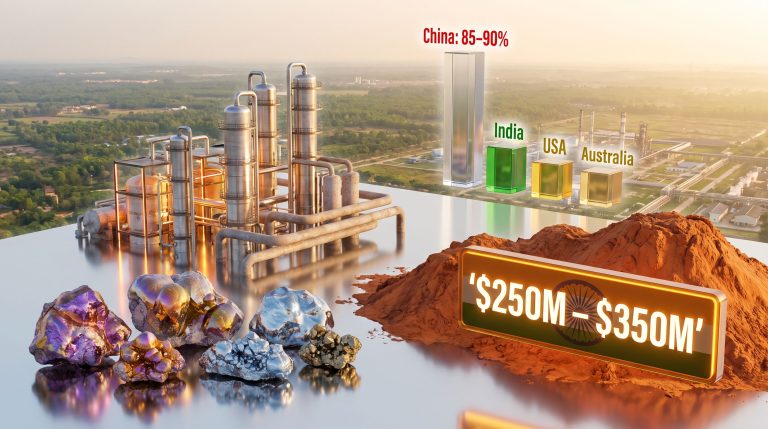
A common misconception in mainstream rare earth commentary is that China's dominance stems primarily from its mining output. This misses the more strategically significant reality. While China does account for roughly 60% of global rare earth mining, its share of processing and refining capacity sits at an estimated 85 to 90% of global supply, according to widely cited industry assessments.
This distinction matters enormously. A country can mine rare earth ore, but without the downstream hydrometallurgical expertise to separate individual elements from mixed concentrates and refine them to magnet-grade purity, that ore has limited industrial value. China has spent decades developing and consolidating this processing expertise, and the rest of the world is still in the early stages of attempting to replicate it.
| Region | Estimated Share of Global Processing Capacity | Primary Constraints |
|---|---|---|
| China | ~85-90% | Policy-driven; dominant at all value chain stages |
| Australia | Emerging | Limited domestic refining; most ore shipped overseas |
| United States | Early-stage | Dependent on third-party processing intermediaries |
| Europe | Nascent | High capital requirements; regulatory lead times |
| Canada | Developing | Resource-rich but infrastructure gaps remain |
Decoding the May 2026 Customs Data: What the Numbers Actually Reveal
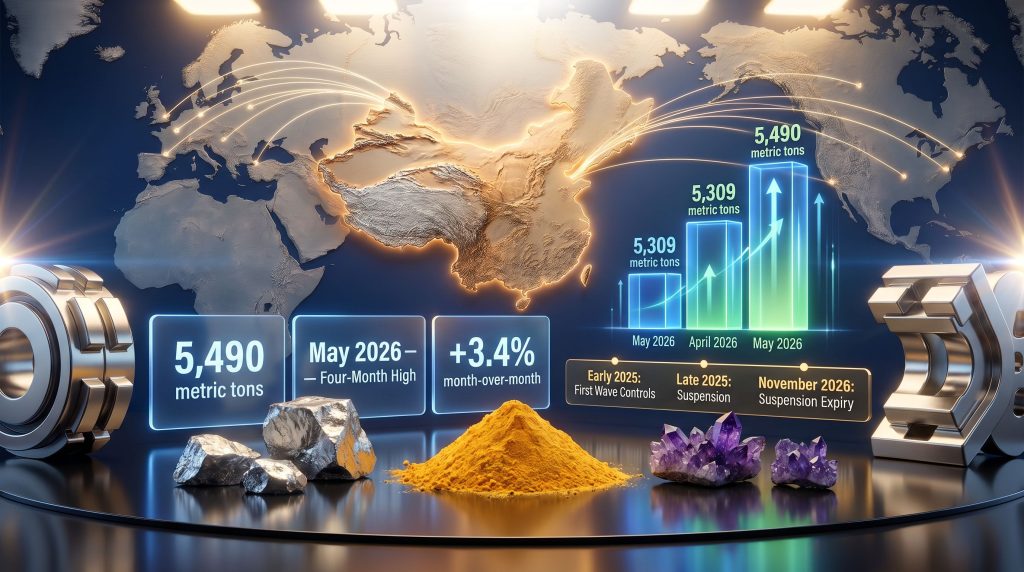
China's export restrictions have reshaped the baseline against which all monthly data is now measured. China's General Administration of Customs reported that the country exported 5,490 metric tons of rare earths in May 2026, representing a 3.4% increase from April's figure of 5,309 metric tons. This placed May at its highest single-month export level since January 2026, making it a four-month high.
The headline numbers, however, carry important nuance that rewards careful interpretation.
| Metric | Value |
|---|---|
| May 2026 Export Volume | 5,490 metric tons |
| Month-over-Month Change | +3.4% |
| April 2026 Volume | 5,309 metric tons |
| May 2025 Volume | 5,864 metric tons |
| Year-over-Year Change (May) | -6.4% |
| Jan-May 2026 Cumulative Exports | 25,378 metric tons |
| Jan-May 2025 Cumulative Exports | ~24,832 metric tons |
| YTD Year-over-Year Change | +2.2% |
The month-over-month improvement tells one story. The year-over-year comparison tells quite another. According to mining.com, May 2026 volumes were actually 6.4% below May 2025 levels, meaning that despite the four-month high designation, the absolute volume of exports remains compressed relative to the pre-control era. The supply environment, in other words, is tighter than the headline reading implies.
The cumulative year-to-date figure of 25,378 metric tons reflects a modestly improved export environment compared to early 2026, but the year-over-year gain of 2.2% must be read against a 2025 baseline that was itself disrupted by the introduction of China's initial export control measures.
The Pre-Summer Restocking Dynamic: Why Buyers Front-Load Purchases
The seasonal architecture of rare earth procurement is not well understood outside specialist circles. Industrial buyers across the electric vehicle, wind energy, defence, and consumer electronics supply chains have historically concentrated their procurement activity in the April through June window. The logic is straightforward: manufacturing output in China and across Asian supply chains tends to slow meaningfully in July and August due to the combination of summer shutdowns, maintenance periods, and reduced logistics throughput.
Buyers who rely on consistent rare earth feedstock delivery cannot afford to be caught short during this seasonal trough. The result is a predictable but frequently misread pattern in Chinese customs data, where export volumes spike in late spring before moderating through summer.
The industries most aggressively front-loading inventory ahead of the 2026 summer lull include:
- Electric vehicle motor and battery manufacturers managing neodymium-iron-boron magnet supply continuity
- Wind turbine component producers with long lead-time procurement cycles for permanent magnet generators
- Defence supply chain intermediaries operating under strategic stockpiling mandates
- Consumer electronics assembly operations requiring precision phosphors and specialty alloys
What amplifies this seasonal behaviour in 2026 is the overlay of genuine policy uncertainty. Overseas buyers are not just managing a seasonal inventory cycle. They are managing against the risk of a regulatory cliff edge.
China's Export Control Architecture: The Two-Wave Policy Intervention
To fully contextualise the May 2026 export data, it is essential to understand the regulatory framework that preceded it. China's rare earth trade strategy has evolved through two distinct waves of export controls introduced in 2025, as documented by the European Parliament.
| Period | Regulatory Action | Market Effect |
|---|---|---|
| Early 2025 | First wave of export controls introduced | Initial supply disruption; price volatility across heavy rare earth categories |
| Mid-2025 | Second wave of controls announced | Accelerated Western stockpiling; procurement strategies restructured |
| Late 2025 | Second wave temporarily suspended | Partial market stabilisation; some export flow normalisation |
| November 2026 | Suspension expiry deadline | Renewed procurement urgency building ahead of potential reinstatement |
The temporary suspension of the second wave of controls was a significant development, but it introduced a new form of uncertainty rather than resolving the underlying tension. The November 2026 expiry date now functions as a procurement countdown for Western manufacturers. Every month that passes without a negotiated extension or alternative supply arrangement increases the urgency of inventory accumulation.
This is the structural backdrop against which the May 2026 export surge must be read. Consequently, the 3.4% month-over-month increase is not evidence of a relaxing supply environment. It is, however, evidence of demand-side urgency operating against a constrained and policy-sensitive supply base.
The next major ASX story will hit our subscribers first
Geographic Divergence: Why Europe and the U.S. Are on Different Recovery Paths
One of the less-discussed dimensions of the current rare earth trade environment is the divergence in recovery trajectories between European and American supply chains. European buyers have, in aggregate, moved more quickly to rebuild inventory buffers and restore procurement normalcy following the 2025 disruptions.
Several factors explain this divergence:
- Trade architecture: Europe has maintained more active bilateral dialogue with China across critical mineral categories, providing slightly more visibility into near-term supply availability.
- Logistics infrastructure: European supply chains have deeper integration with Southeast Asian processing intermediaries, providing alternative routing options when direct Chinese supply is constrained.
- Policy coordination: European industrial policy has moved more rapidly to incentivise rare earth stockpiling at the national and bloc level, reducing individual manufacturer exposure.
America's rare earth dependence on Chinese-processed materials creates a more challenging position. The United States currently lacks domestic rare earth processing capacity at commercial scale, and the processing facilities that do exist rely heavily on Chinese-refined intermediates. If China's second wave of export controls is reinstated in November 2026 without a negotiated extension, U.S. manufacturers in the electric vehicle, wind, and defence sectors could face a supply gap measured in months rather than weeks.
The Processing Bottleneck: Why Mining Alone Cannot Solve the Problem
The most common misframing in Western policy discussions about rare earth independence is the focus on mining as the solution. Multiple countries, including Australia, Canada, and the United States, hold significant rare earth mineral resources. However, resource ownership is not the same as supply chain independence.
The genuine bottleneck is processing. The rare earth processing challenges involved are substantial — ore must be subjected to complex multi-stage chemical separation and refining processes to produce the individual oxides, metals, and alloys that industrial users actually require. These processes are chemically intensive, environmentally regulated, and require decades of accumulated operational expertise.
Building a rare earth processing facility from greenfield status to commercial-scale operation is widely estimated to require a minimum of seven to ten years under favourable conditions, combined with capital investment that typically exceeds several hundred million dollars for a single separation facility.
The gap between current non-Chinese processing capacity and the volumes required to meaningfully offset Chinese supply is substantial, and it will not be closed within the current policy cycle. The IEA's Global Critical Minerals Outlook 2025 reinforces this concern, highlighting that processing concentration risks remain a central vulnerability in the global clean energy transition.
Procurement Strategy in the Age of Geopolitical Supply Risk
The rare earth procurement landscape of 2026 looks fundamentally different from the just-in-time model that prevailed before 2025. Industrial buyers across all major rare earth-consuming sectors have been forced to adopt a just-in-case philosophy, accepting higher inventory carrying costs as the price of supply continuity.
This shift has several important implications for market dynamics:
- Price floor support: Structural stockpiling behaviour by Western buyers creates a persistent demand signal that supports pricing even during periods of modest export volume.
- Inventory distortion risk: Aggressive front-loading can mask genuine demand trends, making it difficult to distinguish true consumption growth from procurement timing effects.
- Supplier concentration leverage: As long as China controls the dominant share of processing capacity, the negotiating leverage of downstream buyers remains structurally limited regardless of the volume of non-Chinese mining output.
The November 2026 suspension expiry is expected to sustain elevated procurement activity through the third quarter of 2026, meaning the seasonal lull that typically suppresses export volumes through July and August may be shallower than historical norms this year.
Frequently Asked Questions: China Rare Earth Exports
What are rare earths and why are they considered critical minerals?
Rare earths are a group of 17 elements that share similar chemical properties. They are classified as critical minerals by most major industrial economies because they are essential inputs for high-technology manufacturing with no viable substitutes, and their supply is geographically concentrated in ways that create strategic vulnerability.
Why did China rare earth exports climb to a four-month high in May 2026?
The primary driver was overseas restocking activity ahead of the traditional summer procurement lull that begins in July. This seasonal front-loading behaviour was amplified by buyer urgency related to the approaching November 2026 expiry of the temporary suspension of China's second wave of rare earth export controls.
What is the summer lull and how does it affect rare earth trade flows?
The summer lull refers to the seasonal slowdown in manufacturing and logistics activity that typically begins in July across Asian supply chains. Industrial buyers respond by accelerating purchases in the April to June window, creating export spikes in Chinese customs data that can be misread as structural demand improvements.
How have China's 2025 export controls changed global rare earth supply chains?
The two waves of controls introduced in 2025 fundamentally restructured Western procurement strategies. Buyers shifted from lean inventory management to active stockpiling, procurement lead times extended, and the policy risk premium embedded in rare earth supply agreements increased substantially.
Which industries are most exposed to rare earth supply disruptions?
Electric vehicle manufacturers, wind turbine producers, defence contractors, and consumer electronics assemblers carry the highest exposure. Each relies on rare earth inputs for which there are no cost-competitive substitutes at current technology levels.
Is the world reducing its dependence on Chinese rare earths?
Progress is being made, but the timeline is measured in decades rather than years. Processing capacity, not mining output, is the binding constraint, and building that capacity outside China requires substantial capital, regulatory approvals, and technical expertise that takes years to develop.
Key Takeaways: Reading the Road Ahead from May's Export Data
The May 2026 customs figures offer a useful lens for understanding the current rare earth trade environment, but only when interpreted against the full policy and structural backdrop:
- The 3.4% monthly volume increase reflects demand-side urgency driven by seasonal and regulatory factors, not a structural easing of supply constraints
- Year-over-year volumes remain below May 2025 levels, confirming that the overall export environment is still tighter than pre-control norms
- The November 2026 suspension expiry is likely to sustain elevated procurement activity through the third quarter, potentially muting the usual summer export trough
- Geographic divergence between European and U.S. recovery trajectories reflects the critical role of trade architecture and processing infrastructure access in determining supply chain resilience
- Processing capacity, not raw material availability, remains the defining constraint on Western rare earth independence and will continue to be so for the foreseeable future
This article is intended for informational purposes only and does not constitute financial, investment, or commodity trading advice. Forecasts, scenario projections, and supply chain assessments contained herein are based on publicly available data and carry inherent uncertainty. Readers should conduct independent research before making any investment or procurement decisions related to rare earth commodities or associated equities.
Want to Stay Ahead of the Next Major Mineral Discovery on the ASX?
Discovery Alert's proprietary Discovery IQ model delivers real-time alerts on significant ASX mineral discoveries — including critical minerals and rare earths — instantly translating complex data into actionable investment insights for traders and long-term investors alike. Explore historic examples of major discovery returns and begin your 14-day free trial today to position yourself ahead of the broader market.