July 24, 2026
When Processed Metals Become a Rare Earth Compliance Problem
The global rare earth conversation tends to fixate on dedicated mining projects, processing facilities, and the well-documented dominance of a handful of supplier nations. What rarely enters that discussion is the quieter, more structurally complex question of what happens when rare earth elements travel invisibly within other commodity streams. Not as intentional exports, not as declared shipments, but as trace constituents embedded in processed metals that were never supposed to carry strategic mineral content at all.
This is precisely the situation now unfolding across Indonesia's export terminals. The Indonesia rare earth export checks currently disrupting alumina and nickel pig iron shipments are not a response to Indonesia becoming a rare earth producer overnight. They are a response to the recognition that rare earth elements do not respect commodity category boundaries, and that a nation with Indonesia's mining footprint generates substantial REE byproduct exposure whether it intends to or not.
When big ASX news breaks, our subscribers know first
The Invisible Mineral Problem: How Rare Earths Travel Inside Other Commodities
To understand why Indonesia's customs authorities are now flagging shipments of alumina and nickel pig iron, it helps to understand the geochemistry involved. Rare earth elements are not typically found in isolation. They occur as trace constituents within a wide range of mineral assemblages, and the refining or smelting of host ores does not necessarily eliminate them. In some cases, it concentrates them.
The most instructive example within Indonesia's context is monazite, a phosphate mineral that forms as a natural byproduct of heavy mineral sand processing and, critically, of tin mining operations. Monazite is one of the most significant natural hosts for light rare earth elements including cerium, lanthanum, neodymium, and praseodymium, as well as thorium, which carries radioactive classification. Indonesia's tin sector, historically one of the world's largest producers, generates substantial monazite volumes as a processing residue.
For decades, monazite from Indonesian tin operations was largely treated as a waste product or low-value residue rather than a recoverable strategic resource. The shift in global rare earth awareness, accelerated by supply chain vulnerabilities exposed during the 2010s and again during pandemic-era disruptions, has fundamentally changed how regulators view these materials. Furthermore, the growing strategic importance of rare earth supply chains has sharpened government attention on exactly these kinds of hidden resource flows.
Why Alumina and Nickel Pig Iron Are Now Under the Microscope
The presence of rare earth elements in bauxite-derived alumina is less widely understood than the monazite-tin connection but is geologically well-established. Certain bauxite deposits, particularly those formed through intense tropical weathering processes common across Southeast Asia, carry elevated concentrations of rare earth elements in their clay fractions. Ion-adsorption clays, the same deposit type that makes southern China such a dominant source of heavy rare earths, share geological formation characteristics with some laterite profiles found across the Indonesian archipelago.
During the refining of bauxite into alumina through the Bayer process, rare earth elements can partition into various process streams. While they do not typically appear in high concentrations in the final alumina product, their presence at even trace levels now triggers compliance obligations under Indonesia's updated regulatory framework. This has significant implications for bauxite project developments across the region, as operators reassess their export documentation strategies.
Nickel pig iron presents a different but related pathway. Produced by smelting laterite nickel ores, nickel pig iron is an intermediate alloy used primarily as a cost-competitive feedstock for stainless steel manufacturing. Laterite nickel ores, formed through deep tropical weathering of ultramafic rocks, can contain trace concentrations of rare earth elements and radioactive minerals depending on the specific deposit geology. The smelting process can selectively concentrate certain trace elements in slag and other byproduct fractions.
The Prosecution That Changed Everything
Understanding why July 2026 specifically became the inflection point for Indonesia rare earth export checks requires examining the legal proceedings that appear to have catalysed the enforcement response.
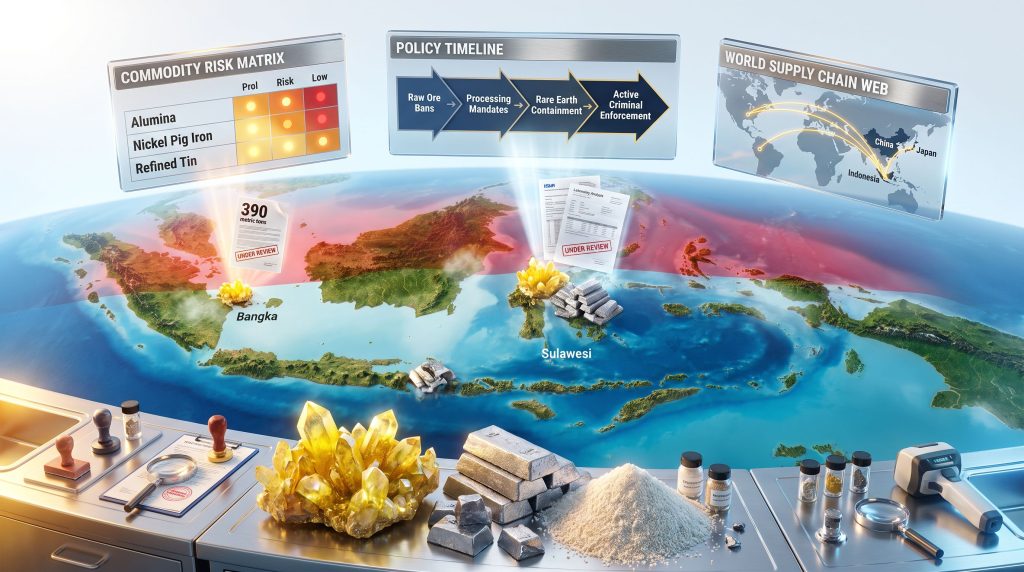
Indonesian prosecutors formally named three suspects in a case involving the alleged illegal export of approximately 390 metric tons of rare earth-bearing materials. The central allegation is that laboratory testing results submitted to obtain export permits were deliberately falsified to conceal the presence of restricted minerals within shipments. Indonesia's state news agency Antara reported on the prosecution, making the case a matter of public record.
The significance of this case extends well beyond the individuals charged. It revealed a specific vulnerability in Indonesia's export verification architecture: the system had been relying on exporter-submitted laboratory documentation, creating an obvious incentive for manipulation when the declared content of a shipment determines whether it can be exported at all.
Customs enforcement systems that depend on self-certified laboratory results are structurally vulnerable to manipulation whenever the commercial stakes are high enough. Indonesia's prosecution exposed exactly this weakness, and the response has been to shift toward independent verification as the new compliance standard.
The customs authority's response, requiring additional independent laboratory testing across a broader range of shipments, is a logical and predictable institutional reaction to that exposure. It is also a significant operational burden on exporters who previously operated within a less scrutinised compliance environment.
Indonesia's Resource Nationalism: A Four-Phase Evolution
To position the current disruption correctly, it is essential to view it within the longer arc of Indonesia's mineral export governance strategy rather than as an isolated regulatory event.
| Phase | Period | Key Policy Action | Primary Commodity |
|---|---|---|---|
| Phase 1: Raw Ore Bans | 2014-2020 | Export prohibition on unprocessed nickel ore and bauxite | Nickel, bauxite |
| Phase 2: Processing Mandates | 2017-2023 | Domestic smelting and refining requirements expanded | Nickel, copper, bauxite |
| Phase 3: REE Containment | 2025 | Domestic-use prioritisation regulation for rare earth elements | REEs across all mineral sectors |
| Phase 4: Active Enforcement | 2026 | Criminal prosecution and expanded customs testing | All critical mineral exports |
This progression reflects a deliberate and internally consistent policy logic. Indonesia used raw ore export bans to force investment in domestic smelting. It then extended processing requirements to capture additional value-adding steps. Now it is closing what it perceives as a loophole: the inadvertent export of strategic minerals embedded within the processed commodity streams that its earlier policies encouraged.
The Strategic Calculus Behind REE Containment
Indonesia is not currently a significant commercial producer of rare earth elements in the conventional sense. There are no large-scale operational rare earth mines producing and exporting REE concentrates or separated oxides at volumes that would register meaningfully in global supply statistics. Rare earth activity within the country remains concentrated at exploration and early-stage assessment phases.
However, policymakers appear to have concluded that this distinction between current production and latent resource potential is critical. The rare earth elements present as byproducts within Indonesia's tin, bauxite, and nickel sectors represent a future resource base. If those elements are permitted to exit the country embedded within alumina, nickel pig iron, or other processed commodity exports, the option to develop domestic rare earth processing capacity around those resources is progressively foreclosed.
This reasoning mirrors the logic applied to nickel a decade earlier: restrict the outflow of the raw resource first, then develop the domestic processing infrastructure that the restriction creates incentive to build. Indeed, Indonesian nickel trends over the past decade provide a clear template for how this regulatory sequencing plays out in practice.
Mapping the Supply Chain Exposure
The commodity categories currently confirmed as affected by Indonesia rare earth export checks sit at the centre of two major global industrial supply chains.
Alumina is the essential precursor to aluminium metal production. Indonesia has developed significant refining capacity following the bauxite export ban, and Indonesian alumina now flows primarily to aluminium smelters in China and, to a lesser extent, other Asian markets. Any sustained reduction in alumina export volumes creates feedstock tightening across downstream aluminium production.
Nickel pig iron is the cost-competitive alternative to refined nickel for stainless steel producers, particularly those operating in China's massive stainless steel manufacturing base. Indonesian nickel pig iron production expanded dramatically following the nickel ore export ban, as Chinese investment poured into Indonesian smelting capacity. Disruption to nickel pig iron exports therefore affects China steel demand more directly than almost any other national industry.
Three Scenarios for How This Disruption Resolves
-
Administrative backlog resolution: Customs laboratories process the accumulated testing backlog within weeks, export volumes normalise, and the disruption is absorbed as a one-time delay. This outcome is most likely if enforcement remains targeted at specific flagged shipments rather than becoming a systematic screen applied to all exports.
-
Compliance restructuring period: Exporters are required to retrofit their documentation and testing protocols to meet new independent verification standards. Delays extend across one to three months as industry adapts. Downstream buyers in China and Japan begin qualifying alternative supply sources as a precautionary measure, even if Indonesian supply eventually resumes.
-
Systematic expansion of restricted categories: Customs authorities broaden the range of commodity types subject to rare earth screening, potentially drawing in refined tin exports, cobalt byproducts, and other mineral streams. This would represent a structural shift in Indonesia's export governance posture, creating sustained supply chain disruption and accelerating sourcing diversification by international buyers.
What Exporters and Buyers Should Do Now
Immediate Steps for Indonesian Metal Exporters
-
Commission independent rare earth and radioactive element analysis on all export-bound shipments, regardless of whether those specific cargoes have been flagged by customs.
-
Engage certified laboratories with established capability in quantitative REE screening and radioactive element detection to the technical standards Indonesian customs is now applying.
-
Audit all existing export permit documentation for consistency between declared mineral content and updated testing results, particularly for shipments processed under the previous self-certification system.
-
Build buffer inventory positions or advance shipment scheduling to absorb potential inspection delays without triggering downstream delivery defaults.
-
Establish direct communication with customs liaison channels to obtain clarity on specific testing thresholds and the commodity categories currently within scope of expanded screening.
Risk Mitigation Priorities for International Buyers
-
Diversify alumina and nickel pig iron sourcing geographically, even where Indonesian supply has historically offered the most competitive pricing.
-
Review procurement contracts for existing force majeure language and consider whether regulatory-driven export delays are adequately captured within existing definitions.
-
Monitor Indonesian regulatory developments through trade associations and commodity industry bodies for early warning signals of category expansion. In addition, China's export controls on strategic minerals offer a useful parallel for understanding how rapidly such frameworks can expand in scope.
Buyers who treat the current disruption as a one-off administrative episode rather than a signal of Indonesia's evolving regulatory posture are likely to find themselves repeatedly exposed to similar events as Indonesia's rare earth containment framework matures.
The next major ASX story will hit our subscribers first
The Monazite Factor: Indonesia's Hidden REE Inventory
One dimension of this situation that receives insufficient attention in standard commodity market analysis is the sheer scale of Indonesia's monazite byproduct generation relative to its acknowledged rare earth profile.
Indonesia is one of the world's significant tin producers. The processing of tin-bearing mineral sands generates monazite as a co-product through the same gravity separation and mineral processing circuits used to concentrate cassiterite, the primary tin mineral. Monazite recovered from these circuits contains extractable concentrations of light rare earth elements, typically dominated by cerium and lanthanum with meaningful neodymium content, alongside thorium at concentrations that trigger radioactive material handling and export requirements.
Historically, much of this monazite was stockpiled, sold into opaque regional markets, or simply left in tailings storage due to the absence of domestic processing infrastructure and the regulatory complexity of handling thorium-bearing materials. The current enforcement environment suggests Indonesian authorities are now taking a more assertive posture toward ensuring this material remains within the domestic resource base rather than leaking out through informal or underdeclared export channels.
Analysts observing Indonesia's resource strategy note that the prosecution of suspects accused of concealing rare earth content in export documentation is almost certainly connected to exactly this material stream, even if the specific shipments involved have not been publicly identified by commodity type.
Frequently Asked Questions
What minerals are targeted by Indonesia's rare earth export checks?
Indonesian customs is requiring independent laboratory testing for rare earth elements and radioactive materials, specifically including uranium and thorium, within certain metal commodity shipments. Alumina and nickel pig iron are the confirmed affected categories as of July 2026.
Why would alumina or nickel pig iron contain rare earth elements?
Certain bauxite deposits carry trace rare earth concentrations that can persist through the Bayer refining process into alumina. Laterite nickel ores used to produce nickel pig iron can similarly contain trace mineral concentrations that become relevant under Indonesia's updated regulatory thresholds.
Is Indonesia a significant rare earth producer?
Not in the conventional commercial sense. Large-scale REE extraction and export operations do not currently exist at meaningful scale. However, rare earth elements occur as significant byproducts within Indonesia's tin sector through monazite co-production, and trace REE content is geologically present across parts of its bauxite and nickel laterite resource base.
How long will the disruption last?
No official timeline has been provided. Duration depends on how rapidly exporters can provide compliant independent testing documentation and whether Indonesian customs broadens or narrows the scope of commodities subject to enhanced screening.
Which countries face the greatest supply chain exposure?
China is the most significantly exposed, given its dominant role as the destination for Indonesian nickel pig iron and a major recipient of Indonesian alumina. Japan also imports Indonesian processed metals and would face secondary exposure from any sustained disruption.
Want to Stay Ahead of the Next Major Mineral Discovery?
Discovery Alert's proprietary Discovery IQ model scans ASX announcements in real time, instantly identifying significant mineral discoveries — including those tied to critical and rare earth commodities — and translating complex data into actionable investment opportunities. Explore how historic discoveries have generated extraordinary returns and begin your 14-day free trial today to position yourself ahead of the broader market.