August 26, 2026
When Geopolitics Forces Innovation: The Deep-Sea Race for Critical Minerals
The history of resource development has rarely followed a linear path. More often, it bends sharply at moments of geopolitical stress, when the cost of dependence suddenly becomes impossible to ignore. The global rare earth industry is experiencing exactly that kind of inflection point today, and nowhere is this more visible than in Japan's accelerating push to extract strategically vital minerals from the abyssal depths of the Pacific Ocean. Japan rare earths in deep-sea mud off Minamitori Island has rapidly moved from scientific curiosity to national strategic priority.
Japan's programme to recover rare-earth elements and yttrium (REY) from deep-sea mud deposits surrounding Minamitori Island represents one of the most technically ambitious mineral resource initiatives ever attempted. Understanding why it matters requires stepping back from the immediate headlines and examining the structural vulnerabilities that made sovereign deep-sea extraction not just appealing, but arguably necessary.
When big ASX news breaks, our subscribers know first
The Geopolitical Trigger: Why Japan Could No Longer Wait
For decades, Japan's rare earth supply chains operated on an implicit assumption: that commercial relationships and diplomatic channels would ensure access to the heavy rare earth elements its high-technology industries depend upon. That assumption was stress-tested in 2010 when China briefly restricted rare earth exports following a maritime dispute, and shattered far more definitively beginning in April 2025.
China's export restrictions introduced sweeping controls targeting heavy rare earths and associated magnet materials. What followed was a graduated escalation that exposed just how precisely China could calibrate economic pressure against a specific trading partner. Restrictions were tightened in January 2026, then twice more the following month, with measures increasingly targeting major Japanese industrial conglomerates by name.
The effect was to directly threaten supply chains for Japan's defence manufacturing sector and its electric vehicle industry simultaneously. The elements at the centre of this trade friction are not randomly selected. Heavy rare earths, particularly dysprosium and terbium, are essential inputs for neodymium-iron-boron (NdFeB) permanent magnets. These magnets are the enabling technology behind the high-torque electric motors used in EV traction systems and the generators used in wind turbines.
The sequential tightening of Chinese export controls across 2025 and early 2026 demonstrated that rare earth access is now a geopolitical instrument, not simply a commodity trade issue. For Japan, this transformed deep-sea rare earth development from an interesting scientific project into a strategic industrial priority.
Japan Rare Earths in Deep-Sea Mud off Minamitori Island: The Geological Case
The geological characteristics of REY-rich deep-sea muds are fundamentally different from any terrestrial rare earth deposit, and those differences matter enormously for understanding both the opportunity and the challenge Japan faces.
Terrestrial rare earth deposits typically form through igneous processes, hydrothermal activity, or lateritic weathering. The ionic clay deposits of southern China's Jiangxi and Guangdong provinces, which currently dominate global heavy rare earth production, formed through prolonged tropical weathering of granitic rocks. Deep-sea REY muds, by contrast, are pelagic sediments that accumulate through an entirely passive geochemical process.
How Deep-Sea REY Muds Form and Concentrate Rare Earths
At water depths exceeding 4,000 metres in the central Pacific, sedimentation rates slow to millimetres per thousand years. In this extraordinarily slow accumulation environment, rare earth elements adsorb onto two primary host phases: iron-manganese oxyhydroxide coatings on mineral grains, and biogenic calcium phosphate derived from fish teeth and bone fragments.
These fish-tooth apatite grains are particularly efficient concentrators of heavy rare earths, which is why deep-sea muds in the Pacific tend to have a heavy REE enrichment signature that differs markedly from most terrestrial deposits. This is a point that deserves emphasis. Most conventional rare earth mines, including the majority of currently producing operations in China, Australia, and the United States, are dominated by light rare earth elements such as cerium, lanthanum, and neodymium.
These lighter elements are less strategically constrained because they are more widely distributed across global production. The scarcity, and therefore the pricing power, lies with the heavy end of the rare earth series. The Minamitori zone's geology places it in a different category from most terrestrial deposits.
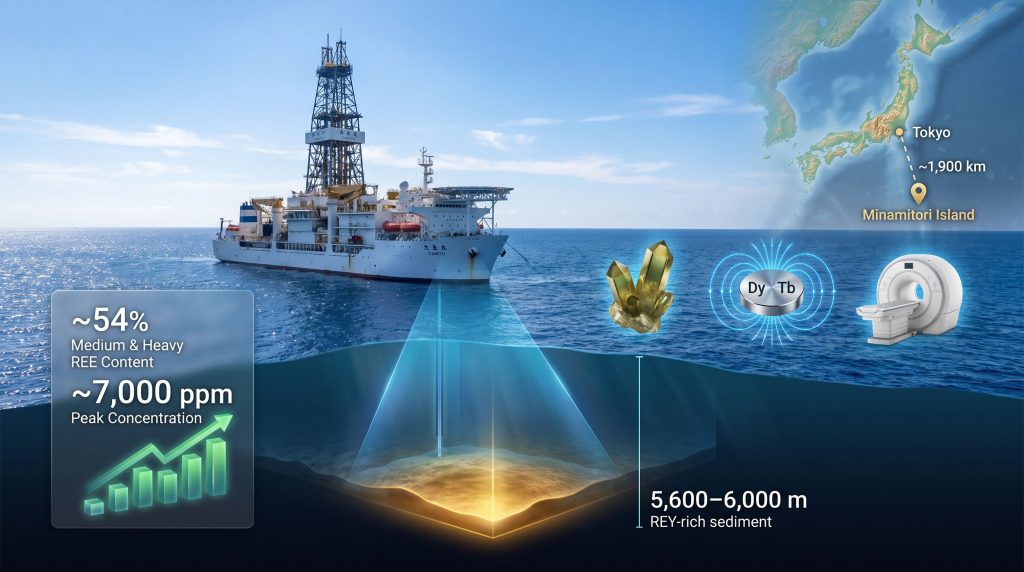
Prior research by the University of Tokyo estimated total resources in the broader zone at approximately 16 million tonnes of rare earth oxide equivalent, with concentrations in peak samples reaching around 7,000 parts per million. For context, typical deep-sea sediment contains between 100 and 200 ppm of rare earth elements. The Minamitori concentrations are not simply elevated; they represent a fundamentally different geological environment.
What the Chikyu Mission Actually Demonstrated
According to Reuters, the Japanese scientific drilling vessel Chikyu completed its February 2026 mission under the operational oversight of the Japan Agency for Marine-Earth Science and Technology. What it achieved was not commercial mining. It was something arguably more important at this stage: proof that continuous extraction of REY-bearing mud is physically achievable at depths of approximately six kilometres.
Roughly 50 tonnes of material were recovered during the month-long operation. That is a modest quantity by any commercial mining standard, but the significance lies entirely in the methodology, not the volume. Lifting a continuous column of water-saturated sediment from nearly 6,000 metres against hydrostatic pressure, without losing material coherence, represents an engineering achievement with no prior precedent in the deep-sea resource sector.
Compositional Analysis: The 54% Heavy and Medium REE Finding
The subsequent government analysis of recovered material produced the figure that has drawn significant international attention. Medium and heavy rare earth elements collectively account for approximately 54% of total rare earth content in the Minamitori mud samples. Three specific elements were confirmed in the recovered material with industrial relevance:
| Element | Symbol | Key Applications |
|---|---|---|
| Yttrium | Y | Aerospace alloys, LED phosphors, semiconductor doping, thermal barrier coatings |
| Gadolinium | Gd | MRI contrast agents, nuclear reactor neutron absorption, specialty magnets |
| Dysprosium | Dy | NdFeB permanent magnets for EV motors, wind turbine generators, defence systems |
The government notably declined to disclose total deposit size estimates, citing the limited geographic coverage and duration of the test sampling campaign. This scientific caution is appropriate given the constraints of a single test mission, but it has also created significant uncertainty about the economic magnitude of what lies beneath the Minamitori seabed.
Furthermore, University of Tokyo research, published independently of the 2026 government analysis, has suggested particularly significant quantities of dysprosium and terbium within the broader Minamitori deposit zone relative to known terrestrial reserves. Terbium, often overlooked in public discussion relative to dysprosium, has an even more extreme supply concentration than its better-known counterpart, with virtually no meaningful production outside China's ionic clay mining regions.
The Three-Phase Development Roadmap
Japan's programme operates on a structured timeline that reflects the technical and economic unknowns still to be resolved. Understanding where each phase sits in the development arc is essential for assessing the programme's realistic commercial trajectory.
Phase 1: Proof-of-Concept (Completed, February 2026)
- Chikyu vessel successfully completes world's first continuous deep-sea REY mud lift from approximately 6 km depth
- Approximately 50 tonnes of material recovered during a month-long operational window
- Compositional analysis confirms approximately 54% medium and heavy REE content
- Yttrium, gadolinium, and dysprosium identified as industrially significant elements present in recovered mud
- Full deposit size withheld pending additional sampling data
Phase 2: Large-Scale Mining Trial (Planned, February 2027)
- Month-long intensive extraction trial targeting 350 tonnes of mud per day
- Onsite dewatering operations to be conducted at Minamitori Island before mainland transport
- Processed material shipped to mainland Japan for separation, refining, and smelting technology verification
- Full pipeline from seabed extraction to processed intermediate products to be stress-tested under near-operational conditions
Phase 3: Industrialisation Assessment (Target, March 2028)
- Comprehensive economic feasibility evaluation incorporating extraction costs, processing yields, and prevailing market prices
- Environmental impact assessment of large-scale seabed disturbance at commercial scale
- Policy determination on whether to proceed toward full commercial production
The March 2028 industrialisation assessment represents Japan's critical decision gate. Everything before that point is cost and learning. Everything after it is commitment, or withdrawal.
The Processing Challenge: Why Lifting Mud Is Only Half the Problem
The rare earth processing challenges involved in deep-sea extraction are less widely understood than the extraction itself, yet they are arguably more commercially decisive. REY-rich mud recovered from the seabed is a water-saturated slurry. Before any rare earth content can be recovered, the material must be dewatered, concentrated, and subjected to hydrometallurgical separation processes.
Individual rare earth elements cannot be selectively extracted at the seabed; the recovered slurry contains a mixture of all REE present, along with silicate minerals, iron-manganese phases, and residual seawater. Separating individual rare earth elements from this mixed material requires solvent extraction or ion exchange processes, both of which are technically mature for terrestrial ore processing but have not been validated at scale for deep-sea mud feedstocks.
The chemical characteristics of REY mud, particularly the distribution of rare earths between iron-manganese phases and biogenic phosphate phases, may require process chemistry adaptations relative to established terrestrial practice. Japan's 2027 trial specifically incorporates onsite dewatering at Minamitori Island followed by mainland processing, with separation, refining, and smelting technologies all targeted for verification during that phase.
This integrated approach reflects the recognition that a viable commercial operation requires the entire chain from seabed to refined oxide to function reliably, not just the extraction component.
The next major ASX story will hit our subscribers first
Environmental Complexity: The Abyssal Ecosystem Question
The deep-sea mining concerns surrounding the Minamitori programme remain one of the most contested dimensions of the entire sector. The abyssal plain surrounding Minamitori Island, while remote and sparsely populated by biological standards, hosts communities of organisms adapted to extreme conditions that are still poorly characterised by science.
Physical disturbance of seabed sediment at commercial scale generates sediment plumes. Unlike surface mining runoff, which can be contained through conventional engineering, deep-sea sediment plumes can travel horizontally across significant distances at different water depths, potentially affecting filter-feeding organisms and deep-water coral communities far from the extraction zone.
Because the Minamitori operations fall within Japan's own Exclusive Economic Zone rather than international waters governed by the International Seabed Authority, regulatory authority rests with Japanese domestic law. Japan will consequently need to develop environmental assessment frameworks specifically calibrated for abyssal sediment extraction, a regulatory gap that the 2027 trial will begin to address through concurrent environmental monitoring programmes.
The tension between resource security imperatives and ecological stewardship is not unique to Japan, but Japan's phased approach provides an unusual opportunity to accumulate baseline environmental data before committing to commercial-scale operations.
Structural Comparison: Deep-Sea Extraction vs. Conventional Mining
| Dimension | Conventional Terrestrial Mining | Japan Deep-Sea Mud Extraction |
|---|---|---|
| Deposit Type | Hard rock, ionic clay, carbonatite | Pelagic abyssal sediment |
| Operating Depth | Surface to ~1,000m underground | ~5,600 to 6,000m below sea surface |
| Heavy REE Share | Variable; often light REE-dominant | ~54% medium/heavy REE (Minamitori) |
| Processing Maturity | Well-established globally | Pre-commercial; under active development |
| Environmental Footprint | Significant surface and hydrological disturbance | Deep-sea ecosystem and sediment plume concerns |
| Geopolitical Risk | Subject to host-country jurisdiction | Within Japan's own sovereign EEZ |
| Capital Intensity | Established cost benchmarks | No commercial precedent for cost modelling |
What This Means for the Global Critical Minerals Landscape
Japan's Minamitori programme carries implications that extend well beyond Japan's own supply chain. If the 2027 trial and 2028 assessment confirm technical and economic viability, the programme establishes the first credible proof-of-concept for sovereign deep-sea mineral extraction from abyssal REY mud deposits.
Several other nations hold EEZ rights over Pacific seabed areas with comparable geological characteristics. The United States, France, and New Zealand all administer Pacific territories potentially overlying REY-rich sediment zones. Japan's programme effectively functions as a global technology development effort, generating the engineering knowledge and processing methodologies that would underpin any future attempt by other jurisdictions to develop similar resources.
From a market structure perspective, even partial displacement of Chinese heavy rare earth supply by a new sovereign Japanese production source would alter the pricing dynamics and negotiating leverage that has characterised the rare earth market since China consolidated its dominance of heavy REE processing in the 1990s. This is not a near-term prospect, given that commercial production from Minamitori, if it proceeds at all, likely lies beyond 2030. However, the trajectory matters as much as the timeline in markets that price future supply availability.
As reported by Oceanographic Magazine, Japan's parallel strategies — including bilateral supply agreements with Australia, Canada, and mineral-producing African nations, investment in rare earth recycling from end-of-life electronics and magnets, and research into reduced-rare-earth motor technologies — reflect an understanding that no single solution resolves heavy REE supply concentration risk. The Minamitori programme is the sovereign production pillar of a multi-pronged strategy, not a standalone solution. Indeed, Japan rare earths in deep-sea mud off Minamitori Island represents the most ambitious component of this broader national resilience effort.
Key Programme Data at a Glance
| Parameter | Detail |
|---|---|
| Location | Minamitori Island EEZ, ~1,900 km southeast of Tokyo |
| Water Depth | ~5,600 to 6,000 metres |
| 2026 Test Recovery Volume | ~50 tonnes of REY-rich mud |
| Medium/Heavy REE Share | ~54% of total rare earth content |
| Peak Sample REE Concentration | ~7,000 ppm (prior University of Tokyo research) |
| Broader Resource Estimate | ~16 million tonnes REO equivalent (University of Tokyo) |
| Key Elements Confirmed | Yttrium, Gadolinium, Dysprosium |
| 2027 Trial Target Rate | 350 tonnes of mud per day |
| Industrialisation Assessment Target | March 2028 |
Disclaimer: Resource estimates cited in this article, including the University of Tokyo's 16 million tonne REO equivalent figure, are based on published academic research and have not been confirmed by the Japanese government as official deposit size declarations. Forecasts, programme timelines, and commercialisation assessments represent current plans and are subject to revision based on technical, environmental, and economic findings from ongoing trials. This article does not constitute financial advice.
Want to Track the Next Major Critical Minerals Discovery Before the Market Does?
Discovery Alert's proprietary Discovery IQ model scans ASX announcements in real time, instantly identifying significant mineral discoveries across more than 30 commodities — including the critical minerals driving the global energy transition — and delivering actionable alerts directly to subscribers. Explore how historic discoveries have generated extraordinary returns and begin your 14-day free trial today to position yourself ahead of the broader market.