August 25, 2026
The Supply Chain Vulnerability That Changed Everything
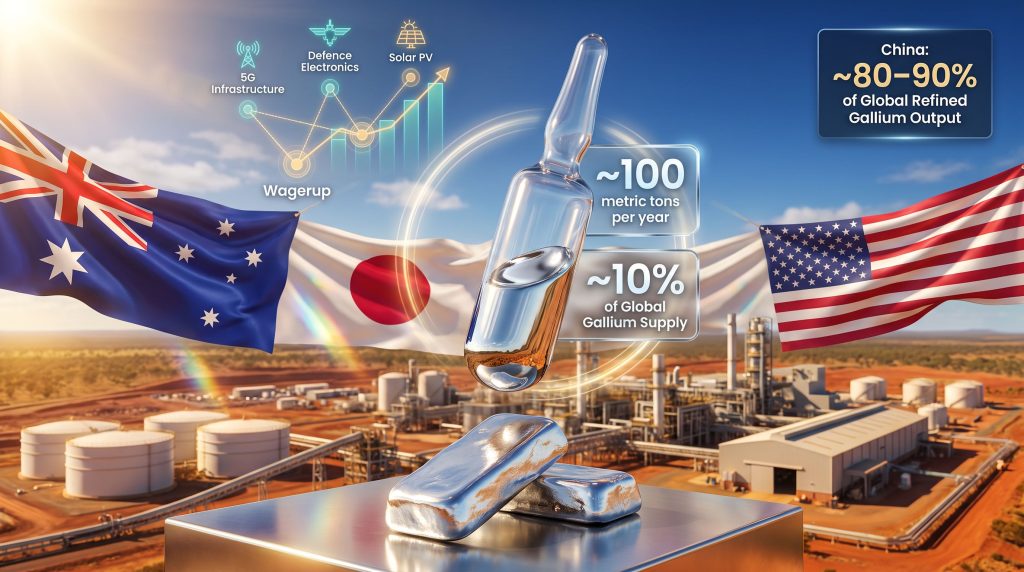
For decades, the global semiconductor and electronics industries operated with a quiet assumption baked into their supply chain models: that raw material access was stable, diversified, and geographically distributed. That assumption collapsed with a single policy move. When China tightened its grip on gallium exports in 2023, restricting outbound shipments of a metal that underpins everything from 5G base stations to military radar systems, it revealed just how structurally exposed Western industrial economies had become. A nation controlling roughly 80 to 90 percent of global refined gallium output had, in effect, become a chokepoint for an entire category of advanced technology manufacturing.
What followed was not panic, but a calculated, multi-year response from governments and corporations that had quietly recognised this vulnerability for years. The Alcoa Australian gallium project, now formally under construction at the Wagerup alumina refinery in Western Australia, is one of the most tangible outcomes of that response. It is not simply a mining venture. It is a geopolitical hedge, a proof-of-concept for allied industrial cooperation, and a signal that Australia's critical minerals push is evolving in ways that extend well beyond raw material extraction.
When big ASX news breaks, our subscribers know first
What Makes Gallium So Strategically Significant
A Metal You Cannot Mine Directly
Unlike copper, gold, or iron ore, gallium does not exist in concentrated ore deposits that can simply be dug out of the ground. It is what metallurgists call a byproduct metal, present in bauxite ore at concentrations typically ranging from 50 to 100 parts per million, and only recoverable in meaningful quantities during the industrial refining of aluminium. This characteristic is fundamental to understanding both gallium's strategic value and the logic behind projects like Wagerup.
Because gallium cannot be extracted through conventional mining, the world's gallium supply is structurally tied to the geography of aluminium refining infrastructure. China's dominance in global gallium production is not accidental. It reflects decades of investment in aluminium smelting and refining capacity, combined with the deliberate development of downstream byproduct recovery circuits at scale.
Where Gallium Actually Goes
The role of gallium in semiconductors and other advanced sectors is concentrated at the intersection of technological advancement and national security. Industrial applications include:
- Compound semiconductors: Gallium nitride (GaN) and gallium arsenide (GaAs) are the active materials in high-efficiency transistors used in 5G infrastructure, satellite communications, and power electronics for electric vehicles.
- Defence electronics: GaN-based devices are integral to phased-array radar systems, electronic warfare platforms, and military communications equipment. This gives gallium a direct role in modern defence capability.
- Solar photovoltaics: Gallium is used in copper indium gallium selenide (CIGS) thin-film solar cells, which offer performance advantages in certain low-light and high-temperature environments.
- LED and laser diodes: Gallium-based materials underpin visible-spectrum lighting and optical communication systems.
The common thread across these applications is that substitution is either technically difficult or economically prohibitive. There is no straightforward replacement for gallium in GaN transistors at the performance levels required by modern 5G and defence systems. This inelastic demand profile is precisely what makes supply concentration so dangerous.
How Concentrated Is the Problem?
| Metric | Current Estimate |
|---|---|
| Global annual gallium production | ~300 to 400 metric tons |
| China's share of global refined output | ~80 to 90% |
| Alcoa Wagerup target annual production | ~100 metric tons |
| Wagerup's projected share of global supply | ~10% |
| Construction jobs created | 150 to 200 |
| Permanent operational roles | 15 to 20 |
A single facility in Western Australia, once operational, would represent approximately one-tenth of total global gallium supply. That figure alone illustrates the scale of the supply gap that Western nations are scrambling to close. Furthermore, the critical minerals demand surge expected through the remainder of this decade makes closing that gap increasingly urgent.
The Architecture of a Three-Nation Partnership
How Australia, Japan, and the United States Aligned
The Alcoa Australian gallium project is structured as a joint venture between Alcoa Corporation and Japan Australia Gallium Associates, known as JAGA. The JAGA consortium includes Sojitz Corporation, a major Japanese trading company with deep roots in resource and industrial supply chains. Japan's Ministry of Economy, Trade and Industry has been an active participant in shaping the industrial logic of the partnership, reflecting Tokyo's long-standing strategic anxiety about resource security.
The United States' involvement reflects a parallel set of concerns, particularly around the vulnerability of domestic defence contractors and semiconductor manufacturers to supply chain disruptions originating from geopolitically adversarial nations. The U.S. Consul General in Perth, Colleen Altstock, attended the August 24 groundbreaking ceremony, a detail that signals the diplomatic weight attached to this project at the operational level.
The governance structure of the venture is centred on a special purpose vehicle arrangement designed to formalise ownership, risk allocation, and offtake arrangements among the three national partners. Crucially, Alcoa retains full responsibility for construction and ongoing operations, providing a single accountable operator for what is a technically complex integration of a new processing circuit into an existing world-scale alumina refinery.
Key Milestones in the Project's Development
| Date | Milestone |
|---|---|
| August 2025 | Joint Development Agreement signed between Alcoa and JAGA |
| October 2025 | Australia, Japan, and the U.S. announce coordinated project support |
| July 14, 2026 | Final Investment Decision reached by all partners |
| August 24, 2026 | Groundbreaking ceremony at Wagerup, Western Australia |
| Target (TBD) | Full operational capacity of ~100 metric tons per year |
Alcoa's own statements have been clear that the financial scale of the Wagerup gallium plant is not expected to have a material impact on the company's overall financial results or balance sheet position. This framing is important for investors. It indicates a project that is strategically significant to the broader alliance architecture but sized appropriately for integration into an existing industrial operation rather than as a standalone transformative investment.
The Technical Process: From Bauxite to Semiconductor-Grade Gallium
Inside the Bayer Process Gallium Recovery Circuit
The Bayer process, the industrial method used to refine alumina from bauxite ore, creates a highly alkaline sodium aluminate solution called the process liquor. Gallium, which substitutes chemically for aluminium in the bauxite crystal lattice, accumulates in this liquor stream during the digestion phase of refining. Over successive cycles of the Bayer process, gallium concentrations in the liquor build to levels that make recovery economically viable.
The extraction sequence from there follows a well-established industrial pathway:
- Liquor bleed: A controlled portion of the gallium-enriched process liquor is diverted into the recovery circuit.
- Precipitation and carbonation: The diverted liquor undergoes chemical treatment to selectively precipitate gallium compounds, separating them from the dominant aluminium chemistry.
- Electrolysis: The precipitated gallium compounds are dissolved in a sodium hydroxide solution and subjected to electrolytic reduction, producing crude gallium metal with purity levels typically around 99.9%.
- Further refining: Semiconductor applications require gallium purity of 99.9999% or higher, known as 6N grade. Achieving this standard requires additional zone-refining or fractional crystallisation steps to remove trace impurities that would degrade device performance.
Technical Note: The distinction between standard-grade and semiconductor-grade gallium is commercially significant. The price differential between 99.9% and 99.9999% purity gallium can be substantial, and a producer's ability to achieve 6N grade consistently determines which end markets it can serve and at what margin.
However, the processing challenges involved in reaching semiconductor-grade purity are not trivial. They require precise process control, specialist equipment, and rigorous quality assurance protocols that must be built into the facility's design from the outset.
Why Co-Location Is a Genuine Competitive Advantage
The most underappreciated aspect of the Wagerup project is what it does not require. It does not need a new mining licence or a new ore body. It does not require dedicated water rights, a separate tailings management facility, or greenfield infrastructure construction in a remote location. The feedstock stream — the Bayer process liquor — is already being produced at industrial scale as part of Alcoa's core alumina refining operations.
This fundamentally changes the risk profile compared to any standalone gallium project:
- Capital intensity is dramatically lower because the heavy infrastructure already exists.
- Permitting complexity is reduced because the facility is being integrated into an operating refinery environment.
- Time to first production is shortened because the project starts with a guaranteed, continuous feedstock supply from day one of operations.
- Operational synergies allow the gallium circuit to share labour, utilities, maintenance, and logistics infrastructure with the broader refinery.
Comparing this approach with greenfield gallium extraction illustrates the structural advantage clearly. A standalone gallium producer would need to source bauxite, construct a dedicated Bayer-type processing circuit, and manage the full suite of permitting, environmental, and community obligations before recovering a single gram of product. Co-location at Wagerup eliminates every one of those steps.
Geopolitical Scenarios and the Strategic Value of Wagerup
Scenario 1: Prolonged or Escalating Chinese Export Controls
China's export controls on gallium, introduced in August 2023, were framed as a response to Western semiconductor restrictions, but they exposed a vulnerability that had existed for far longer. If those restrictions are extended, tightened, or applied more selectively to specific customer nations, the Wagerup facility's 100 metric tons per year output would represent a meaningful, though partial, buffer for allied industrial consumers.
The sectors most exposed to this scenario include defence prime contractors in the United States, Australia, and Japan, as well as commercial 5G equipment manufacturers sourcing GaN transistors for next-generation network deployments. For these consumers, having a geopolitically aligned, transparent, and auditable source of gallium supply carries a premium that extends well beyond spot market pricing.
Scenario 2: Demand Acceleration from Clean Energy and Defence
The growth trajectory for gallium demand is being driven by forces that are largely independent of geopolitics. The electrification of transport is increasing demand for GaN-based power electronics, which offer higher switching efficiency than silicon alternatives at the voltage levels relevant to electric vehicle powertrains. Military modernisation programs across NATO nations and in Japan are increasing procurement of GaN radar and communications systems.
Even at full production capacity, the Wagerup facility will not close the gap between projected Western demand growth and non-Chinese supply. This is not a criticism of the project. It is an argument for replication. The Wagerup model, if successful, creates a documented technical and commercial pathway for expanding gallium recovery at other alumina refineries within Alcoa's Western Australian network, which also includes facilities at Pinjarra and Kwinana.
Scenario 3: The Partnership as a Diplomatic Template
The tri-national structure of the Wagerup joint venture carries implications that extend beyond gallium specifically. The involvement of Japan through JAGA and METI, combined with U.S. diplomatic engagement and Australian federal and state government participation, represents a working model for how Quad-aligned nations can coordinate industrial policy to address shared supply chain vulnerabilities.
Japan's motivation is particularly instructive. As a nation with minimal domestic critical mineral resources, Japan has historically managed resource security through long-term offtake agreements and equity stakes in overseas projects. The JAGA structure follows this logic while adding a layer of trilateral diplomatic architecture that elevates the partnership above a conventional commercial transaction.
Australia's Broader Critical Minerals Positioning
The Shift from Ore Exporter to Value-Added Producer
Australia has long supplied the world with raw materials while exporting the economic value embedded in processing and refining to other jurisdictions. The Alcoa Australian gallium project represents a departure from that model. By recovering gallium within Australia and supplying it as a refined critical mineral, Alcoa and its partners are demonstrating that downstream value capture is commercially and technically achievable within the Australian operating environment.
Australia's federal Resources Minister Madeleine King described the groundbreaking as "a demonstration of Australia's capacity to lead on critical minerals alongside trusted partners." Industry and Innovation Minister Tim Ayres and Western Australian Minister for State Development David Michael were also present, reflecting a rare convergence of federal and state political support around a single critical minerals initiative. Furthermore, Export Finance Australia's support for the Wagerup project underlines the extent to which government financing mechanisms are being actively deployed to accelerate this transition.
What Gaps Still Need to Be Addressed
The Wagerup project is an important step, but it does not resolve every structural challenge facing Australia's critical minerals ambitions. In addition to the progress made, several gaps remain:
- Workforce depth: Specialist skills in electrochemical processing, semiconductor-grade material handling, and critical mineral quality assurance are in short supply domestically.
- Downstream demand: Without domestic semiconductor fabrication or advanced electronics manufacturing, Australia remains a refined material exporter rather than a participant in the highest-value stages of the technology supply chain.
- Replication at scale: Extending the gallium recovery model to Pinjarra, Kwinana, and potentially third-party refineries will require sustained investment, regulatory clarity, and commercial offtake commitments from downstream buyers.
- Financing structures: Future projects of this type may require more complex financing arrangements, including concessional capital or export credit mechanisms, particularly if undertaken by smaller operators without Alcoa's balance sheet depth.
The next major ASX story will hit our subscribers first
Frequently Asked Questions: Alcoa Australian Gallium Project
What is the Alcoa Australian gallium project?
It is a gallium production facility being constructed at Alcoa's Wagerup alumina refinery in Western Australia, developed through a joint venture involving Alcoa, Japan Australia Gallium Associates, and partners from Australia, Japan, and the United States.
How much gallium will the Wagerup plant produce?
The facility is designed to produce approximately 100 metric tons of gallium per year, representing around 10% of current global gallium supply.
Why is gallium considered a critical mineral?
Gallium is an essential input for compound semiconductors used in 5G networks, defence electronics, solar photovoltaics, and electric vehicle power systems. Its supply is heavily concentrated in China, creating strategic exposure for Western technology supply chains.
When did construction begin on the Alcoa gallium plant?
A groundbreaking ceremony was held on August 24, 2026, following a Final Investment Decision reached by all project partners on July 14, 2026.
Who are the partners in the joint venture?
Alcoa serves as constructor and operator. Japan Australia Gallium Associates, which includes Sojitz Corporation, represents the Japanese industrial partner. Governments from Australia, Japan, and the United States are also involved in the partnership structure.
How is gallium extracted at Wagerup?
Gallium is recovered as a byproduct of the alumina refining process. It accumulates in the process liquor during the Bayer process and is isolated through precipitation and electrolysis to produce refined gallium metal.
Will this project materially affect Alcoa's financials?
Alcoa has stated that the project is not expected to have a material impact on its overall financial results or balance sheet, indicating it is a strategically significant but financially contained initiative relative to Alcoa's total operational scale.
What the Wagerup Project Tells Us About the Next Decade
The Alcoa Australian gallium project is most accurately understood not as a single facility, but as a proof-of-concept with geopolitical, industrial, and commercial dimensions that extend far beyond its nameplate capacity. At 100 metric tons per year, it will not single-handedly resolve Western gallium supply insecurity. However, it demonstrates, in concrete and operational terms, that allied nations can coordinate to build reliable critical mineral supply chains using existing industrial infrastructure.
The byproduct recovery model embedded in the Wagerup design is replicable. Western Australia's alumina refinery network processes enormous volumes of bauxite annually, and every tonne of that ore contains gallium that has historically been lost to process waste. Capturing that value at scale, across multiple facilities, and directing it toward allied technology supply chains represents one of the more pragmatic and capital-efficient pathways available for reducing the West's dependence on Chinese critical mineral refining.
Whether Australia can build on this foundation to develop a genuinely integrated critical minerals processing industry will depend on policy consistency, sustained investment, and a willingness to develop the downstream manufacturing capability needed to absorb refined output domestically. The Wagerup groundbreaking is a beginning, and a significant one. What comes next will define whether it becomes a template or a footnote.
This article is intended for informational purposes only and does not constitute financial or investment advice. Forward-looking statements regarding production timelines, market share projections, and demand forecasts involve inherent uncertainty and should not be relied upon as predictive of future outcomes. Readers should conduct their own independent research before making investment or business decisions.
Want to Stay Ahead of the Next Major Mineral Discovery on the ASX?
Discovery Alert's proprietary Discovery IQ model scans ASX announcements in real time, instantly identifying significant mineral discoveries across critical commodities — including those driving the global supply chain realignment described above — and delivering actionable insights to subscribers before the broader market reacts. Explore Discovery Alert's dedicated discoveries page to understand how historic mineral discoveries have generated substantial returns, and begin your 14-day free trial today to position yourself ahead of the market.