August 25, 2026
The Material Science Hidden Inside Every Electric Vessel
Spend time in any modern shipyard and the conversation inevitably turns to integration complexity. Naval architects are no longer simply routing shaft lines and sizing engine rooms. They are designing distributed power networks, specifying semiconductor-grade switching hardware, and sourcing permanent magnet assemblies whose performance characteristics are locked in at the atomic level, long before a vessel ever touches water.
That atomic-level story is the one rarely told in maritime trade coverage. The accelerating adoption of electric ship propulsion rare earth elements across ferry fleets, offshore support vessels, and specialised tonnage is fundamentally a materials story, and at the centre of that story sits a group of elements that most shipowners could not name but whose supply constraints can delay a newbuild by years.
Rare earth supply chains are not a peripheral input to marine electrification — they are structural to it. Understanding which elements do what, where the supply chain fractures, and how design teams are navigating those fractures is increasingly essential knowledge for anyone with a financial or operational stake in maritime decarbonisation.
When big ASX news breaks, our subscribers know first
From Shaft Lines to Distributed Power: Why the Engineering Shift Is Irreversible
For the better part of two centuries, marine propulsion operated on a straightforward mechanical principle. A prime mover, whether diesel or steam, turned a shaft. That shaft ran through the hull to a propeller. The system worked, but it imposed severe constraints on hull architecture, machinery placement, and part-load operation.
The arrangement forced engine rooms into specific locations to keep shaft runs geometrically manageable. At low propulsive loads, large engines ran well below their optimal efficiency point, burning disproportionate fuel and generating noise and vibration that degraded crew habitability and sensor performance on dynamic positioning platforms.
Electric propulsion dissolves the mechanical link entirely. Prime movers — whether diesel gensets, gas turbines, fuel cells, or some combination — generate electrical power. That power is conditioned through switchboards, power management systems, and variable-frequency drives before reaching propulsion motors. The result is architectural freedom that reshapes everything downstream.
Generators can be placed where the hull geometry suits them rather than where the shaft demands they go. Multiple units share load and can be dispatched to run near their optimal loading point, improving fuel burn across the entire duty cycle. Thrust control becomes finer and more responsive, and redundancy becomes a design parameter rather than an afterthought.
The Regulatory Accelerant
This engineering transition would be gaining momentum regardless of regulation, but IMO's 2023 Revised GHG Strategy has converted a long-term commercial trend into an immediate procurement consideration at the shipyard level. Two instruments are driving concrete decisions in 2025 and 2026.
The Carbon Intensity Indicator (CII) rates vessels on their actual operational carbon performance, creating sustained pressure to improve part-load efficiency across the entire service life of a ship. Electric architectures respond to this pressure well because generator dispatch optimisation directly reduces fuel consumption during the low-to-mid power operation that dominates many vessel duty cycles.
The Energy Efficiency Existing Ship Index (EEXI) imposes technical constraints on the existing fleet, making hybrid or electric retrofit a genuine financial calculation for vessels that would otherwise face engine power limitation orders. According to DNV's industry compliance summaries, many owners who had been evaluating electrification on a ten-year horizon are now moving those decisions into the current investment cycle.
Vessel segments leading adoption include battery-electric ferries on predictable short routes, hybrid offshore support vessels with variable DP demand cycles, and cruise tonnage where noise reduction and zero-emission berth operation carry both regulatory and commercial value. Furthermore, the critical minerals demand driven by the energy transition is placing additional pressure on procurement teams to secure long-term material access.
The Power System Stack: How Energy Actually Flows
Understanding where rare earth elements appear in electric propulsion hardware requires a clear picture of how the power system is structured. The architecture operates across four functional layers, each with distinct component sets and distinct material dependencies.
| System Layer | Key Components | REE Exposure |
|---|---|---|
| Generation | Gensets, fuel cells, shore connection | Indirect via some fuel cell catalyst materials |
| Conditioning | Switchboards, PMS/EMS, bus architecture | Minor via phosphors in indicators and optical sensors |
| Drive | Variable-frequency drives, IGBTs, SiC converters | No direct REE content |
| Motor and propulsor | PM motors, azimuth pods, thrusters | Primary exposure via NdFeB and SmCo permanent magnets |
The generation layer feeds the conditioning layer, which manages load sharing, protection coordination, and energy flow across the vessel's electrical network. Power management systems and energy management systems operate in this layer, optimising generator dispatch and integrating battery charge and discharge cycles where storage is fitted.
Variable-speed drives in the drive layer convert and control electrical energy delivered to propulsion motors. High-power semiconductor devices — particularly insulated-gate bipolar transistors and silicon carbide switches — enable precise motor control at multi-megawatt power levels. These components carry no direct rare earth content but are essential enablers of the entire architecture.
The motor and propulsor layer is where rare earth elements become indispensable. For further context on what rare earths are and how they are classified, established mineral industry sources provide a useful technical grounding.
Which Rare Earth Elements Power the Marine Motor, and Why Each One Matters
Neodymium and Praseodymium: Magnetic Strength at Scale
Neodymium and praseodymium form the foundational alloy in neodymium-iron-boron permanent magnets. NdFeB magnets carry the highest energy product of any commercially available permanent magnet type, a property confirmed across USGS mineral commodity documentation and technical literature from established magnet producers including Proterial, formerly operating as Hitachi Metals.
High remanence — the ability to sustain a strong magnetic field without continuous electrical excitation — is the property that makes PM motors competitive on vessels. For a given shaft power rating, a permanent magnet motor can weigh significantly less and occupy substantially less volume than an electrically excited equivalent. On ferries where passenger capacity and vehicle decks compete for every cubic metre, that size and weight advantage is commercially decisive.
Dysprosium and Terbium: Keeping Magnets Stable Under Heat
NdFeB magnets have a vulnerability that is not immediately obvious from their impressive energy product figures. Coercivity — the magnet's resistance to demagnetisation by opposing fields or rising temperature — falls as operating temperature climbs. Marine machinery spaces run warm under normal conditions, and transient overload events can push motor winding temperatures well beyond normal operating bands.
Without adequate coercivity margin at elevated temperature, magnets can partially or irreversibly demagnetise. This is not a recoverable situation through field adjustment. It represents permanent performance loss in a machine that may be deep within a vessel's hull with limited access for replacement. Fraunhofer Institute magnet research and IEC magnet materials literature document this failure pathway in detail and quantify the coercivity loss curves that drive magnet grade selection.
Small additions of dysprosium or terbium — typically a few percent by weight — raise the coercivity ceiling sufficiently to provide reliable operation under marine thermal conditions. This is not a conservative engineering preference. It is a functional requirement for motors that must perform reliably through overload events, tropical ambient temperatures, and the thermal cycling associated with varied duty profiles.
The coercivity requirement is what makes dysprosium and terbium genuinely irreplaceable in high-performance marine PM motors, not just economically preferred. Grain-boundary diffusion technology can reduce how much of each element is needed, but it cannot eliminate the functional requirement.
Samarium and the SmCo Alternative
Samarium paired with cobalt in SmCo permanent magnets offers a different performance profile. Thermal stability is inherently superior to standard NdFeB grades, and corrosion resistance is better suited to aggressive salt-laden environments without the elaborate protective coating systems that NdFeB magnets require in marine service.
The tradeoff is cost. SmCo magnets carry a higher price per unit of energy product. They are well suited to harsh-duty compact motors, precision auxiliary actuators, and sensor assemblies where temperature margins are non-negotiable. Naval applications and safety-critical offshore equipment frequently make this selection, accepting higher material cost in exchange for demonstrated reliability under extreme operating conditions.
The Supporting Cast: Europium, Yttrium, Cerium, and Lanthanum
Beyond the primary magnet applications, several other rare earth elements appear in the broader electric propulsion system in smaller but functionally relevant quantities.
- Europium, yttrium, and terbium contribute to phosphor materials in switchboard status indicators, display backlights, and optical sensing components used in monitoring and fault diagnostic systems. These are small mass quantities relative to motor magnets but support reliable real-time fault indication that underpins uptime in remote operations.
- Cerium and lanthanum appear indirectly through catalytic materials and optical polishing compounds used in upstream manufacturing of sensors, optical elements, and coatings. Their presence is in the supply chain supporting component manufacture rather than in the propulsion drivetrain itself.
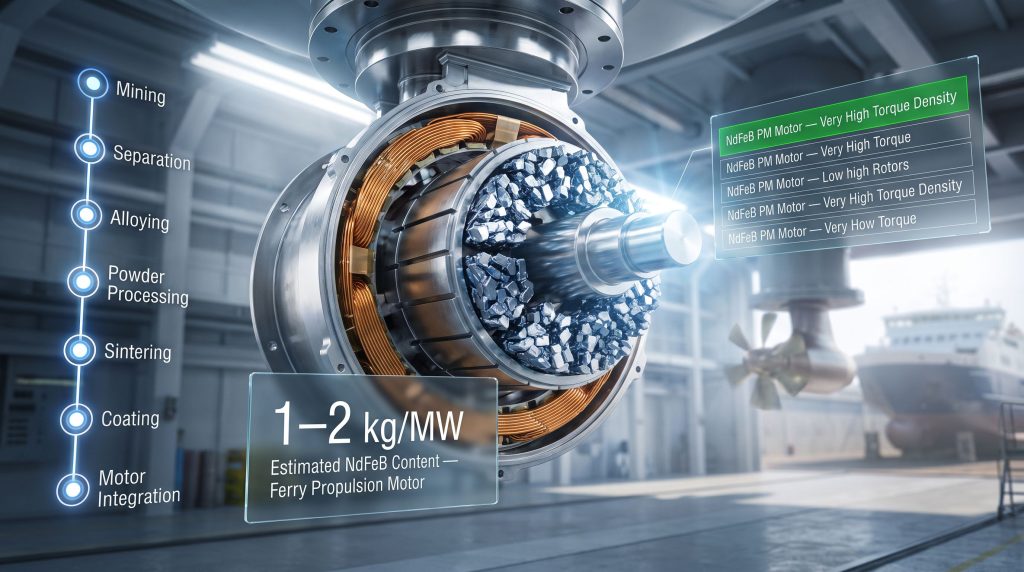
The Seven-Stage Journey from Ore to Operating Motor
The physical distance and processing complexity between a rare earth mine and a spinning propulsion motor is substantial, and each stage represents a potential constraint point.
- Mining and beneficiation of REE-bearing ores such as bastnäsite, monazite, or ion-adsorption clays into mineral concentrate
- Chemical separation of individual rare earth oxides from concentrate, where yield and purity directly influence downstream magnet economics
- Metal reduction and alloying, converting oxides to metals and combining them into master alloys, with NdFeB alloy typically produced via strip casting
- Powder processing through hydrogen decrepitation and jet milling to controlled particle size distributions
- Pressing, sintering, and machining, with magnets aligned in a magnetic field, pressed into green compacts, sintered at high temperature, and precision machined to final dimensions
- Coating and magnetisation, with corrosion-protective coatings applied before full magnetisation — a step that is particularly critical in salt-laden marine atmospheres
- Motor integration and factory acceptance testing, including thermal verification, vibration analysis, and insulation diagnostics aligned with classification society requirements
Where Bottlenecks Concentrate
Three areas create the tightest single-point constraints across this chain. First, heavy REE separation capacity for dysprosium and terbium is limited and geographically concentrated in a way that creates exposure to policy decisions and export control actions far beyond the direct control of motor OEMs or shipowners.
Second, sintering process quality varies meaningfully between magnet producers, and grain alignment precision and coating integrity directly determine long-term corrosion resistance in marine environments. Third, classification qualification cycles for new magnet grades, revised suppliers, or alternative coating systems can extend over years — meaning a supply disruption can stall motor procurement and complicate spare parts availability across the remaining service life of affected vessels.
The rare earth processing challenges associated with these bottlenecks are well documented and are increasingly informing newbuild procurement strategy at the design stage.
Performance Compared: Where Electric Propulsion Wins and Where Friction Remains
| Performance Dimension | Conventional Diesel-Mechanical | Diesel-Electric | Battery-Electric |
|---|---|---|---|
| Part-load fuel efficiency | Poor | Improved | Excellent at point of use |
| Machinery placement flexibility | Constrained by shaft geometry | High | Very high |
| Noise and vibration | High | Reduced | Minimal |
| Redundancy options | Limited | High | High with storage backup |
| Maintenance intervals | Shorter due to mechanical wear | Extended | Extended further |
| Emissions at berth | Continuous | Reduced with shore power | Zero if shore charged |
Quantified benefits from documented electrification projects include onboard noise reductions of 10 dB or more, measured in class-backed case studies from DNV and Lloyd's Register. Extended propulsion machinery maintenance intervals have been documented across ferry and OSV fleet operators.
Battery-electric ferry installations typically carry between 1 and 5 MWh of installed energy storage, with shore charging infrastructure operating at 2 to 10 MW depending on turnaround requirements, according to DNV and Bureau Veritas case reports. Hybrid-electric and fully electric propulsion accounts for a growing share of newbuild contracts in Northern Europe, with some estimates placing the proportion above 10 percent of applicable newbuild orders as of 2025.
The Five Friction Points That Slow Fleet Transition
Despite demonstrable performance advantages, several friction points slow adoption at scale.
Mass and volume budgets remain challenging. PM motors reduce the weight penalty of electrification relative to electrically excited alternatives, but battery systems, switchboards, and additional cabling add displacement that naval architects must carefully balance against cargo or passenger capacity.
Shore charging infrastructure alignment is uneven. Battery-electric viability depends entirely on adequate shore power at both ends of a route. Inconsistency in high-voltage marine charging standards across ports forces vessel designers to engineer for the lowest common denominator or accept route restrictions.
Safety engineering for lithium-ion storage requires classification-society-approved compartmentation, ventilation, gas detection, thermal runaway mitigation, and shutdown logic. These requirements add capital expenditure and engineering complexity but are non-negotiable for insurance and flag-state approval. In addition, the battery raw materials market dynamics in 2025 are adding further cost variability to storage system procurement.
Supply chain resilience for REE magnets, power converters, and switchgear represents procurement risk that can affect build schedules. Some operators and naval programmes are actively choosing electrically excited synchronous motors, which avoid REE permanent magnets entirely, to reduce supply-chain exposure and accept the weight and efficiency penalty as a deliberate strategic hedge.
Skilled commissioning capacity has not kept pace with the growth of installed electric ship propulsion rare earth element-intensive systems. Digital commissioning and remote testing tools are emerging as partial mitigations but have not yet closed the gap between installation rate and qualified engineering capacity.
The next major ASX story will hit our subscribers first
Rare Earth-Free Alternatives: A Selective Rather Than Wholesale Solution
| Motor Type | REE Content | Torque Density | Temperature Performance | Typical Marine Use Case |
|---|---|---|---|---|
| NdFeB PM motor | High: Nd, Pr, Dy, Tb | Very high | Good with Dy/Tb | Ferry, OSV, cruise pod drives |
| SmCo PM motor | High: Sm, Co | High | Excellent | Naval, harsh-duty auxiliary |
| Electrically excited synchronous | None | Moderate | Good | Large vessels, REE-risk-averse programmes |
| Synchronous reluctance | None | Lower | Moderate | Emerging, limited marine adoption |
| Induction motor | None | Moderate | Good | Legacy installations, some newbuilds |
Ferrite magnets can replace NdFeB in lower-torque-density applications but increase motor size and weight — a poor tradeoff on space-constrained vessels. Electrically excited synchronous motors eliminate rare earth magnet dependency entirely but require slip rings or brushless exciters, introduce rotor copper losses, and typically produce larger, heavier machines.
OEM technical comparisons from ABB and Wärtsilä and IEEE literature converge on the same conclusion: substitution is selective and application-specific, not a wholesale replacement for permanent magnet technology in high-performance marine propulsion. Consequently, recent development work — such as Ricardo's copper-free motor for electric ship propulsion rare earth element reduction — represents a significant step but remains at an early commercialisation stage.
Grain-Boundary Diffusion: The Less-Discussed Efficiency Breakthrough
One development that receives less mainstream coverage than it warrants is grain-boundary diffusion technology. This processing technique introduces dysprosium or terbium selectively at the boundaries between magnetic grains rather than distributing heavy REEs uniformly throughout the bulk magnet material. The result is high coercivity performance achieved with substantially less heavy REE content per kilogram of finished magnet.
DOE critical materials programmes and Fraunhofer Institute publications identify GBD as one of the most impactful near-term approaches to reducing heavy REE intensity in high-performance magnets. For the marine sector specifically, GBD-processed grades could reduce supply-chain exposure to dysprosium and terbium without compromising the thermal performance that marine applications require. Adoption in marine-qualified motor grades is still working through the classification qualification cycles described earlier, but the technology trajectory is well established.
The Geopolitical Layer That Motor OEMs Cannot Design Around
USGS data and IEA critical minerals reports updated through 2025 confirm that rare earth separation and sintered magnet manufacturing capacity remains heavily concentrated in a single geographic region. This concentration creates a category of risk that is qualitatively different from conventional supply chain disruption.
China rare earth export restrictions in particular have emerged as a material procurement variable that motor OEMs and vessel operators can no longer treat as a background risk. Export controls, sanctions exposure, and industrial policy interventions can simultaneously affect magnet availability, pricing, and the legal permissibility of particular procurement relationships for defence-adjacent programmes.
This dynamic is driving a visible bifurcation in motor selection strategy across the industry. Commercial operators optimising for propulsive efficiency and lifecycle cost tend toward PM motor architectures because the performance advantages are real and the supply risks can be partially managed through inventory strategy and dual-sourcing agreements. However, defence and security-sensitive programmes are increasingly evaluating REE-free motor topologies regardless of the efficiency penalty.
Recycling of NdFeB magnets from end-of-life equipment and production scrap is moving from pilot programmes toward early commercialisation. Nevertheless, marine assets have service lives of 25 to 30 years, meaning that meaningful closed-loop material flow from ship-sourced magnets will lag behind shorter-lifecycle industries like automotive and wind energy by a significant margin — limiting the near-term impact of circularity strategies on marine procurement decisions.
Disclaimer: This article contains forward-looking statements and analysis regarding market trends, regulatory developments, and technology trajectories. These reflect current understanding based on publicly available data and should not be construed as investment advice. Material conditions, policy outcomes, and supply chain dynamics may differ materially from projections. Readers should conduct independent research and consult qualified advisors before making investment or procurement decisions.
Want to Identify the Next Major Rare Earth Discovery Before the Market Does?
Discovery Alert's proprietary Discovery IQ model delivers real-time ASX alerts the moment significant rare earth and critical mineral discoveries are announced, translating complex geological data into clear, actionable insights for investors at every level — explore the historic returns major discoveries have generated and begin your 14-day free trial today to position yourself ahead of the broader market.