August 25, 2026
The Hidden Mineral Inside Every Alumina Refinery That Could Rewire Global Supply Chains
The story of critical mineral supply chain vulnerability rarely begins with the mineral itself. It begins with the industrial infrastructure that surrounds it, and the geopolitical decisions that determine who controls it. Gallium is a case study in precisely this dynamic. Invisible to most investors and policy makers until recently, this soft silvery metal sits at the intersection of semiconductor manufacturing, defence electronics, and the clean energy transition. Its scarcity is not geological. It is political.
Understanding why the Alcoa gallium project at Wagerup alumina refinery matters requires stepping back from the project itself and examining the structural forces that made it necessary in the first place.
When big ASX news breaks, our subscribers know first
Gallium's Quiet Dominance Over Modern Technology
Gallium does not appear on the periodic table with the fanfare of lithium or cobalt. Yet its role in the devices and systems that underpin modern civilisation is arguably more foundational. The compound gallium arsenide (GaAs) is the semiconductor material of choice for high-frequency applications including military radar arrays, satellite communication systems, and the radio frequency components that form the backbone of 5G networks.
Gallium nitride (GaN) has become the preferred material for next-generation power electronics, enabling the compact, high-efficiency inverters used in electric vehicle charging infrastructure and military-grade power conversion systems. Furthermore, understanding gallium in semiconductors highlights just how deeply embedded this material is across clean energy and defence applications alike.
Beyond defence and communications, gallium-based compounds are embedded in LED lighting technology and thin-film solar cell architectures. The United States, European Union, Japan, and Australia have each independently classified gallium as a critical mineral with national security implications, a designation that carries weight precisely because it reflects genuine scarcity of reliable supply, not scarcity of the material itself.
Why China's Export Controls Changed Everything
Global gallium production has historically ranged between 300 and 500 tonnes per year, with China accounting for an estimated 80 to 90 percent of refined output. This concentration was not accidental. China's dominance emerged from its position as the world's largest alumina and zinc refining nation, because gallium is recovered almost exclusively as a by-product of these refining processes rather than mined directly.
When China introduced export controls on gallium in August 2023, requiring export licences for shipments to foreign buyers, the response in Western markets was immediate. Spot gallium prices surged dramatically, swinging within historical ranges of USD $100 to $600 per kilogram depending on Chinese export posture, semiconductor demand cycles, and inventory speculation. The restrictions demonstrated with uncomfortable clarity that allied nations had effectively outsourced a material essential to their defence and semiconductor industries to a single geopolitical counterparty.
Consequently, the way these export controls impact prices has become a critical consideration for governments and investors seeking to understand the full strategic picture.
Critical context: China's 2023 gallium export controls were not an isolated policy action. They were introduced alongside similar restrictions on germanium, forming part of a broader strategy of leveraging mineral supply as geopolitical influence. Western governments took note, and the race to build alternative gallium supply chains accelerated sharply.
What the Alcoa Gallium Project at Wagerup Actually Does
The Alcoa gallium project at Wagerup alumina refinery is fundamentally different from a conventional mining development. No new resource is being drilled, delineated, or extracted from the ground. Instead, the facility captures gallium that already exists within the process streams of Alcoa's existing Wagerup alumina refinery, located approximately 120 kilometres south-east of Perth in Western Australia.
This distinction is more than semantic. It has profound implications for capital efficiency, development timelines, environmental footprint, and the scalability of the model to other facilities.
How Gallium Hides Inside Alumina Refining
Bauxite ore contains trace concentrations of gallium, typically in the range of 30 to 80 parts per million by weight, embedded within the aluminium-bearing minerals. During the Bayer process, the standard industrial method for refining alumina from bauxite, bauxite is dissolved in hot caustic soda (sodium hydroxide) under elevated temperature and pressure. Aluminium hydroxide precipitates out of the resulting liquor and is calcined to produce alumina. Gallium, however, does not precipitate under these conditions. It accumulates and concentrates in the circulating caustic liquor.
This concentration behaviour is the technical foundation of the entire project. The step-by-step recovery process at Wagerup works as follows:
- Bauxite dissolution: Raw ore is digested in hot caustic soda within the Bayer process circuit, releasing both aluminium and trace gallium into solution.
- Natural concentration: As aluminium hydroxide precipitates and is removed, gallium remains in the liquor, progressively building up in concentration across multiple processing cycles.
- Liquor diversion: A controlled portion of the gallium-enriched caustic liquor is diverted from the main Bayer circuit into a dedicated gallium recovery circuit.
- Electrochemical precipitation: Within the recovery circuit, gallium is selectively extracted from the caustic liquor through an electrochemical reduction process, producing a crude gallium product.
- Purification to specification: The crude product undergoes further refining, typically including acid dissolution, solvent extraction, and electrolytic deposition, to reach the high-purity specifications (commonly 6N, or 99.9999 percent purity) demanded by semiconductor manufacturers.
- Parallel operation: The entire recovery circuit operates alongside the existing Bayer process without interrupting alumina production, effectively converting a waste constituent into a valuable product.
Technical note: The energy intensity of gallium recovery via this by-product pathway is substantially lower than any hypothetical primary gallium mining scenario, because the host processing infrastructure, the refinery itself, is already operating. The incremental energy demand is confined to the recovery and purification circuits.
Project Snapshot
| Parameter | Detail |
|---|---|
| Location | Wagerup Alumina Refinery, ~120 km south-east of Perth, WA |
| Annual Production Target | ~100 tonnes of gallium |
| Estimated Global Supply Share | ~10% of global gallium demand |
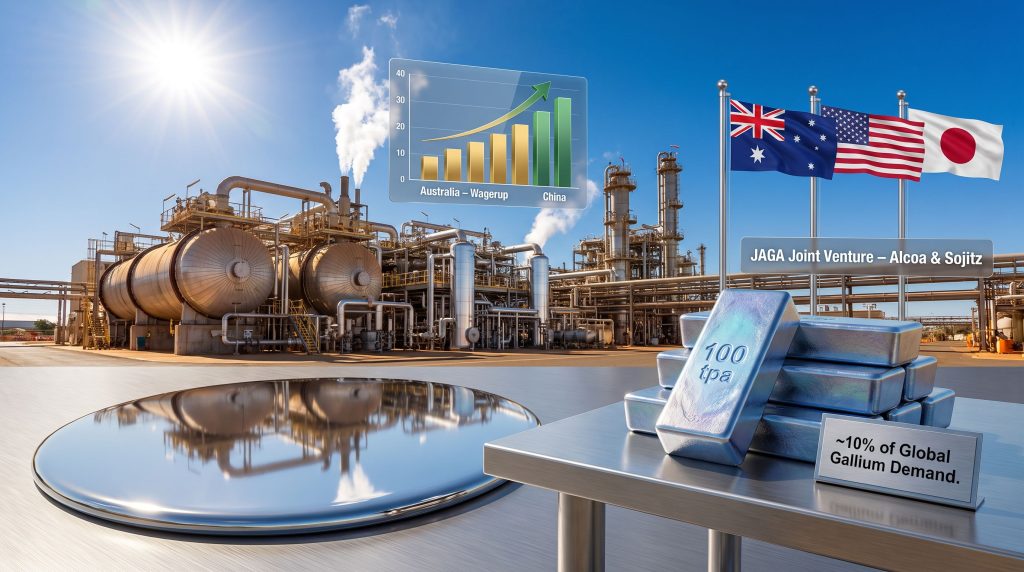
| Project Partners | Alcoa (ASX: AAI), Sojitz Corporation (JAGA joint venture) |
| Construction Workforce | ~150 to 200 jobs |
| Permanent Operational Roles | ~15 to 20 positions |
| Financing Mechanism | Export Finance Australia Critical Minerals Facility |
| Construction Commencement | August 2026 |
The Three-Nation Architecture Behind the Project
The Alcoa gallium project at Wagerup is not a bilateral commercial arrangement between a mining company and a trading house. It represents a three-government financing and strategic partnership structure that reflects the geopolitical weight being placed on gallium supply chain diversification. Australia's final investment decision for the project, announced jointly with Japan and the United States, underscores the seriousness with which all three governments are approaching gallium supply security.
Alcoa's Operational Role
Alcoa (ASX: AAI) serves as the project operator, leveraging its existing Wagerup refinery infrastructure, workforce, and operational expertise. Wagerup is one of three Alcoa alumina refineries in Western Australia, alongside Pinjarra and Kwinana, collectively forming one of the largest alumina refining complexes in the world. The gallium recovery facility represents a logical extension of Alcoa's existing asset base rather than a departure from its core business.
Sojitz and the JAGA Joint Venture
Sojitz Corporation, a major Japanese diversified trading house, participates through the Japan-Australia Gallium Alliance (JAGA) joint venture structure. Japan's involvement reflects its acute exposure to gallium supply risk. As a technology-intensive manufacturing economy with negligible domestic gallium resources and heavy dependence on semiconductor and electronics production, Japan is structurally vulnerable to any disruption in refined gallium availability.
JAGA represents Japan's strategic co-investment in diversifying gallium sourcing away from Chinese supply chains, consistent with broader Japan-Australia cooperation frameworks across critical and strategic minerals.
Government Financing Architecture
| Government | Financing and Strategic Role |
|---|---|
| Australia | Export Finance Australia Critical Minerals Facility provides project financing support |
| United States | Strategic backing aligned with allied supply chain diversification objectives |
| Japan | Government-industry co-investment through JAGA and Sojitz partnership |
This tri-government structure signals that the Wagerup gallium project is simultaneously a commercial venture and a geopolitically motivated infrastructure investment, designed to shift the geographic centre of gravity for gallium supply.
Contextualising 100 Tonnes: What This Output Actually Represents
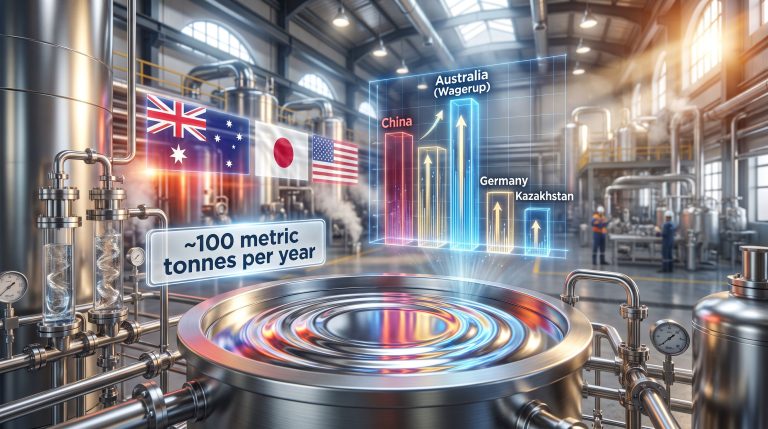
The project's target of approximately 100 tonnes of gallium per year deserves careful contextualisation. Against a global production base of 300 to 500 tonnes annually, a single facility contributing 100 tonnes represents a 20 to 33 percent addition to non-Chinese global supply, or roughly 10 percent of total worldwide demand.
That is not an incremental contribution. It is a structurally significant shift in global supply geography. In fact, the broader picture of critical minerals demand driven by the energy transition makes this output even more consequential over the coming decade.
How Wagerup Compares to Other Western Gallium Initiatives
| Project | Country | Estimated Output | Status |
|---|---|---|---|
| Wagerup (Alcoa-Sojitz JAGA) | Australia | ~100 tpa | Construction commenced August 2026 |
| Nyrstar Recovery Operations | Europe | Smaller, undisclosed | Operational |
| North American Gallium Projects | Canada and USA | Various, smaller scale | Development and feasibility stage |
Combined with emerging recovery projects in North America and Europe, Wagerup forms part of a coordinated, if loosely structured, effort by allied nations to rebuild non-Chinese gallium supply chains from the ground up.
Gallium and Australia's Critical Minerals Strategic Reserve
In January 2026, the Australian Federal Government confirmed that gallium had been designated as an early priority within its $1.2 billion Critical Minerals Strategic Reserve (CMSR), alongside antimony and rare earth elements. The CMSR is designed to enable the Australian government to stockpile or facilitate the stockpiling of critical minerals with strategic value, providing a buffer against supply disruptions and a mechanism for underpinning offtake for domestic producers.
Australia's critical minerals strategic reserve designation for gallium reflects the policy community's recognition that by-product gallium recovery from Australia's existing alumina refinery network represents one of the fastest and most capital-efficient pathways to building meaningful non-Chinese supply.
Western Australia's Refinery Network as a National Strategic Asset
A less widely appreciated dimension of this project is the scalability question. Wagerup is one of three major Alcoa refineries in WA. If the gallium recovery model proves technically and commercially viable at Wagerup, there is a credible argument that analogous circuits could be developed at Pinjarra and Kwinana, potentially tripling Western Australia's gallium output from the same bauxite processing infrastructure.
This is speculative at this stage, and no such expansion has been announced. However, the technical logic is straightforward. All three refineries process the same Darling Range bauxite, which carries consistent gallium concentrations, and all three operate the Bayer process with circulating caustic liquor. The engineering template being established at Wagerup could, in principle, be replicated. For those interested in the broader resource picture, a comprehensive gallium deposits guide provides useful context on where recoverable concentrations exist across Australia's bauxite systems.
Speculative perspective: If the Wagerup template were applied across all three WA Alcoa refineries, combined output could approach or exceed 250 to 300 tonnes per year, potentially repositioning Australia as the world's second largest gallium producer outside China. This remains a projection without formal company endorsement, but it illustrates the strategic optionality embedded in the Wagerup model.
The next major ASX story will hit our subscribers first
Economic and Employment Dimensions
The direct employment figures associated with the Alcoa gallium project at Wagerup alumina refinery are modest in the context of major resource developments: approximately 150 to 200 construction positions during the build phase, and an estimated 15 to 20 permanent operational roles once commissioned.
These numbers understate the project's economic significance in two important ways.
- Supply chain multiplier effects: Construction at a co-located industrial facility generates procurement opportunities for WA-based engineering, instrumentation, fabrication, and project management firms, with a supply chain footprint extending beyond the direct employment count.
- Revenue diversification value: For Alcoa, gallium sales represent a new product revenue stream layered on top of existing alumina production, improving the economic resilience of the Wagerup refinery and potentially strengthening the commercial case for continued investment in the facility.
- Precedent value: Perhaps most significantly, the project establishes a documented, operational proof-of-concept for by-product gallium recovery at Australian alumina scale, with implications for future investment decisions across the sector.
Risk Factors Investors and Policymakers Should Understand
No project of this nature is without material risks. Several warrant specific attention.
Gallium Price Volatility
Gallium's price history is characterised by extreme swings, driven by Chinese export policy shifts, semiconductor demand cycles, and speculative inventory behaviour. Prices have moved within a range of USD $100 to $600 per kilogram over recent cycles. At the lower end of this range, the economics of by-product recovery can compress significantly. Long-term offtake agreements with allied government stockpiling programs or semiconductor manufacturers may be essential to underpin project-level returns.
Technical Scaling Risks
While the science of gallium recovery from Bayer process liquors is well established at laboratory and pilot scale, achieving consistent 100-tonne annual production at commercial scale introduces engineering challenges around circuit stability, gallium concentration management, and purification yield optimisation. Commissioning delays or below-target recovery rates are genuine technical risks.
Geopolitical Countermeasures
China retains the ability to adjust its gallium export controls in ways that affect global prices. A significant relaxation of Chinese export restrictions could depress gallium prices and erode the economic case for Western production. Conversely, further tightening could accelerate allied demand for Wagerup's output. The project is structurally exposed to this binary dynamic.
Regulatory and Environmental Considerations
As a co-located industrial project within an existing permitted refinery, the Wagerup gallium facility benefits from a significantly less complex regulatory pathway than a greenfield mining development. However, modifications to existing refinery operations still require approvals, and the management of additional chemical reagents within the recovery circuit introduces incremental environmental compliance obligations.
The Blueprint Question: Can This Model Scale Beyond Wagerup?
Perhaps the most important analytical question surrounding the project is not what it produces, but what it proves. The by-product recovery model it demonstrates has potential applicability far beyond a single refinery.
Zinc smelters, for instance, also carry gallium in their process streams. Copper refineries and certain lead processing operations similarly contain trace critical minerals that are currently lost to waste. The Wagerup project, if successful, may provide the engineering template, financial precedent, and regulatory framework that enables analogous recovery projects at other industrial facilities across Australia and allied nations.
Forward-looking insight: The critical mineral supply chain challenge facing allied governments is partly a problem of new mine development, but it is also, and perhaps more immediately, a problem of industrial chemistry. Billions of tonnes of ore are processed through existing industrial infrastructure every year, carrying trace quantities of gallium, indium, germanium, tellurium, and other technology-critical materials that are currently discarded. The Wagerup model is an early proof of concept that these invisible resources can be unlocked without a single additional metre of drilling.
Disclaimer: This article contains forward-looking statements, projections, and speculative analysis regarding gallium markets, project outcomes, and supply chain developments. These do not constitute financial advice. Past performance of commodity markets is not indicative of future results. Readers should conduct independent research and consult qualified financial advisers before making any investment decisions.
For ongoing coverage of Australia's critical minerals sector, project updates, and resource industry news, visit the Australian Mining Review.
Want to Stay Ahead of the Next Major Critical Minerals Discovery?
Discovery Alert's proprietary Discovery IQ model scans ASX announcements in real time, instantly identifying significant mineral discoveries across gallium, rare earths, and more than 30 other commodities — turning complex data into actionable investment insights before the broader market catches on. Explore historic discoveries and their returns, then start your 14-day free trial to position yourself at the forefront of Australia's critical minerals opportunity.