August 25, 2026
The Invisible Ingredient That Could Define America's Magnet Future
The global race to secure permanent magnet supply chains has generated enormous investment in rare earth mining, separation facilities, and magnet manufacturing. Yet buried inside every neodymium-iron-boron (NdFeB) magnet is a material that commands almost none of that attention: iron. Representing roughly 70% of finished magnet weight, iron is simultaneously the most abundant input and one of the most technically constrained. Hertha magnet-grade iron purity is now forcing that reality into sharp focus across the industry.
Without ultra-high-purity iron produced domestically, a genuinely self-sufficient U.S. magnet supply chain remains structurally incomplete, regardless of how much progress is made at the rare earth mining or processing end. Furthermore, this challenge directly intersects with broader rare earth supply chains that are increasingly scrutinised for strategic vulnerabilities.
That reality is now forcing a reckoning. With defence procurement rules taking effect in early 2027 that extend domestic sourcing requirements upstream to cover magnet constituent materials, the absence of commercial-scale domestic iron refining at magnet-grade specification has shifted from a background concern to an active supply chain vulnerability. Into that gap, Texas-based Hertha Metals has stepped with a process milestone that carries significant implications for how the industry approaches this problem.
When big ASX news breaks, our subscribers know first
Why Iron Purity Is So Technically Demanding
The 3N5 Standard: What It Means and Why It Exists
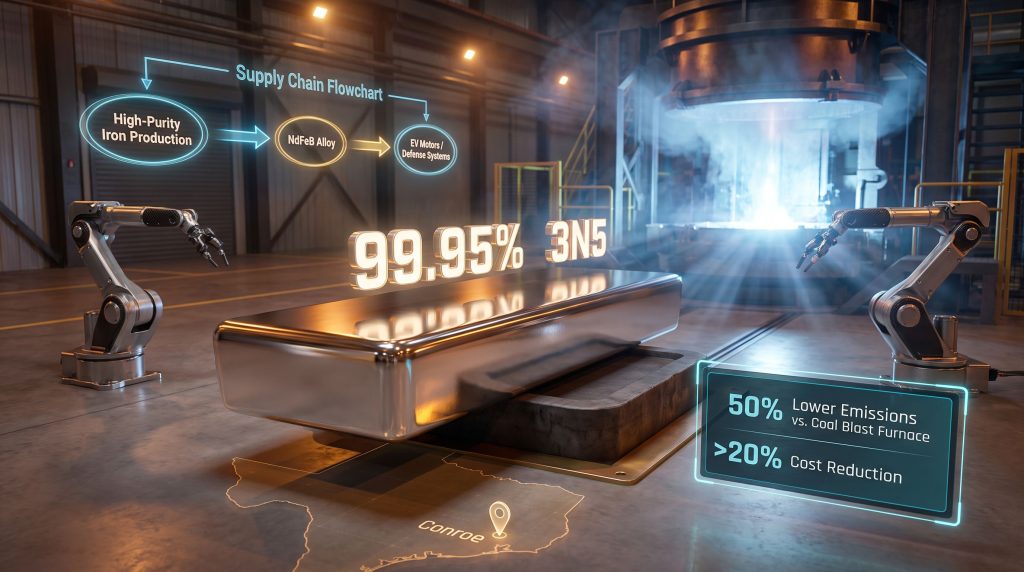
Magnet-grade iron refers to iron refined to a minimum purity of 99.95%, expressed in metallurgical notation as 3N5. This designation follows a standard shorthand: three nines indicate 99.9% purity, with the additional "5" stepping the specification up to 99.95%. At this threshold, total impurity content from all sources must remain below 0.05% by weight.
What makes this specification technically demanding is not just the headline purity figure. Magnet manufacturers typically layer element-specific tolerances on top of the overall 99.95% requirement, imposing maximum allowable concentrations for individual contaminants including:
- Carbon: Disrupts the crystalline grain boundary phase in sintered NdFeB, reducing coercivity
- Oxygen: Forms oxide inclusions that interrupt magnetic domain alignment
- Nitrogen: Interferes with the Nd2Fe14B tetragonal crystal structure that gives the alloy its magnetic properties
- Sulfur and phosphorus: Degrade grain boundary integrity during sintering
- Residual metallic impurities: Can alter the alloy's intrinsic magnetic properties even at parts-per-million concentrations
The critical insight here is that passing the 99.95% headline test is necessary but not sufficient. A material could technically sit at 3N5 purity while still failing an individual element tolerance set by a specific magnet manufacturer. This is why qualification processes are distinct from demonstration milestones.
Conventional steel production, even at relatively high quality grades used in engineering applications, does not approach this specification without dedicated additional refining. The traditional pathway to 3N5 iron runs through electrolytic refining, a process that dissolves impure iron in an electrolyte solution and redeposits purified iron at a cathode. The technique works, but it adds processing stages, energy consumption, and cost, and the infrastructure to do it at commercial scale simply does not exist in the United States today.
How Hertha's Flex-HERS Platform Rethinks the Process
Consolidating a Multi-Stage Problem Into a Single Continuous System
Founded in 2022 and headquartered in Conroe, Texas, Hertha Metals has developed an approach that challenges the conventional assumption that ultra-high-purity iron requires a cascade of sequential processing stages. The company's Flex-HERS platform is built around an electric arc furnace (EAF) that performs iron oxide melting, reduction, and chemistry control within a single continuous system.
The reduction chemistry uses reductive gases, either natural gas or hydrogen, to strip oxygen from iron oxide feedstock as it melts. This eliminates the need for coal-based coke making, which is the first stage in conventional blast furnace routes. By controlling the gas composition and furnace conditions dynamically, the system can adjust iron chemistry in real time as molten metal moves through the process. In addition, this approach to hydrogen iron reduction represents a significant departure from legacy production methods.
The process architecture comparison against conventional methods illustrates the structural difference clearly:
| Process Stage | Conventional Route | Flex-HERS Approach |
|---|---|---|
| Carbon source | Coal-based coke | Eliminated |
| Reduction method | Blast furnace | In-furnace reductive gas |
| Oxygen removal | Sequential BOF/EAF stages | Integrated within single system |
| High-purity finishing | Electrolytic refining | Pyrometallurgical chemistry control |
| Feedstock flexibility | Narrow (high-grade imported concentrates) | Broader domestic input range |
| Estimated cost versus conventional | Baseline | More than 20% reduction claimed |
| Estimated emissions versus conventional | Baseline | Approximately 50% reduction claimed |
A less-discussed strategic advantage of Flex-HERS is its product flexibility. The same furnace platform can produce either commercial-grade steel or 3N5 magnet-grade iron without physical retooling. This dual-product capability is commercially meaningful: it allows the facility to serve steel markets during periods when magnet-grade iron demand is lower, and shift output toward the higher-purity specification as magnet manufacturer qualification proceeds and contracted volumes develop. Few single-process platforms in ferrous metallurgy offer that kind of optionality. Moreover, this aligns closely with emerging interest in green iron production as an industrial decarbonisation pathway.
From Laboratory to Commercial-Grade Demonstration
Hertha's demonstration facility in Conroe operates at approximately one metric ton per day of continuous production. The distinction between laboratory-scale and commercial-grade equipment matters enormously here. Laboratory demonstrations can achieve exceptional chemistry control in small batches under conditions that cannot be replicated at scale. Demonstrating the same result using commercial-grade furnace equipment running continuously is a fundamentally different technical statement.
The company reports that its most recent demonstration simultaneously controlled carbon, oxygen, nitrogen, phosphorus, sulfur, and metallic impurities through the pyrometallurgical process itself, with minimal post-processing intervention. The output: iron at 99.95% purity from fully domestic U.S. feedstocks.
Hertha characterises this as the first U.S. demonstration of magnet-grade iron at the 3N5 specification produced entirely from domestic inputs. Hertha Metals has produced magnet-grade iron at this specification, with CEO Laureen Meroueh noting that high-purity iron remains one of the least visible materials in the magnet supply chain. She has further emphasised that demonstrating domestic production capability represents a new pathway for building a self-sufficient U.S. supply chain at this critical node.
The January 2027 Deadline and Its Upstream Reach
Defence Procurement Rules That Extend Beyond Finished Magnets
The urgency around domestic high-purity iron production is not purely technical. U.S. defence procurement restrictions taking effect on January 1, 2027, extend domestic sourcing requirements for covered NdFeB magnets beyond the finished magnet itself to encompass the constituent materials used in production. That explicitly includes iron, neodymium, and boron.
This upstream reach is the policy detail that transforms the iron purity question from a long-term industrial development issue into a near-term commercial necessity. Defence contractors and their magnet suppliers cannot simply purchase domestically manufactured magnets; they must verify that the iron, rare earth oxides, and boron feedstocks used to produce those magnets also meet domestic origin requirements.
The challenge this creates is compounded by the current state of the supply chain:
- The United States imports nearly all of its commercial high-purity iron requirements for magnet applications
- Domestic rare earth separation capacity remains very limited, though new projects are advancing
- Domestic NdFeB magnet manufacturing capacity is minimal
- Qualification timelines with magnet manufacturers typically run from several months to over a year
This means that any producer seeking to supply domestically sourced magnet-grade iron into defence-adjacent supply chains before the January 2027 deadline must already be deep into the qualification process, or risk missing the initial compliance window entirely.
For Hertha, demonstrating 3N5 purity in mid-2026 is not simply a technical milestone. It is the earliest viable starting point for a qualification timeline that needs to conclude before or concurrent with the commercial-scale Chalyx facility becoming operational.
Mapping Iron's Position in the NdFeB Supply Chain
A Mid-Chain Gap That Mining Investment Cannot Fill
Policy attention and venture capital in the U.S. critical materials space has concentrated heavily on two nodes: upstream rare earth mining and downstream magnet manufacturing. The middle of the chain, including rare earth separation, alloy production, and high-purity iron refining, has received comparatively less focus despite being equally essential. Consequently, understanding the full scope of critical minerals demand across the energy transition helps contextualise where iron purity fits strategically.
The supply chain structure clarifies where high-purity iron fits and why it cannot be bypassed:
Rare Earth Mining (Nd, Pr, Dy oxide production)
        ↓
Rare Earth Separation and Oxide Refining
        ↓
High-Purity Iron Production [3N5 specification] ← Hertha's target position
        ↓
Boron Sourcing
        ↓
NdFeB Alloy Production (Nd2Fe14B master alloy)
        ↓
Magnet Sintering and Magnetization
        ↓
End-Use Integration: EV motors, wind turbines, defence systems
Even if rare earth mining and separation capacity were fully established domestically, magnet manufacturers would still require a domestic source of 3N5 iron to complete the domestic content qualification under the 2027 rules. The two supply chain problems are parallel, not sequential, meaning both must be solved simultaneously.
Demand Drivers Across End Markets
The commercial case for domestic magnet-grade iron extends well beyond defence procurement compliance. Structural demand growth across multiple sectors underpins long-term requirements:
| End Market | NdFeB Magnet Application | Iron Volume Implication |
|---|---|---|
| Electric vehicles | Traction motor permanent magnets | High volume per vehicle; scales with EV adoption |
| Offshore wind | Permanent magnet generators (direct-drive turbines) | Very large format magnets; high iron content per unit |
| Defence systems | Guided munitions, radar, electric drives, UAVs | Subject to 2027 domestic sourcing rules |
| Industrial motors | High-efficiency permanent magnet motors | Broad installed base replacement cycle |
| Consumer electronics | Hard drives, speakers, miniature actuators | Lower volume per unit but extremely high aggregate |
The electric vehicle segment is particularly relevant. A single EV traction motor typically contains between 1 and 3 kilograms of NdFeB magnets, with iron representing approximately 70% of that mass. At projected EV production volumes through the late 2020s, the aggregate iron demand flowing through magnet supply chains represents a substantial and growing market for any domestic supplier capable of meeting the 3N5 specification consistently.
The next major ASX story will hit our subscribers first
What Comes Next: From Demonstration to Commercial Supply
The Chalyx Facility and the Remaining Qualification Gates
Hertha's planned commercial-scale facility, named Chalyx, is also located in Conroe, Texas, and is designed to produce 3N5-grade iron at commercial volumes for rare earth magnet manufacturers. Groundbreaking is expected before the end of 2026, using the demonstration plant's continuous production record as the technical foundation for the commercial process design.
However, several critical milestones sit between the demonstration result and contracted commercial supply:
- Element-specific impurity certification: Magnet manufacturers will test Hertha's iron against their own tolerance specifications, which go beyond the headline 3N5 figure
- Magnet performance validation: Manufacturers typically produce trial batches of finished magnets using a new iron source and evaluate magnetic properties including remanence, coercivity, and energy product (BHmax)
- Production consistency verification: Demonstration-scale chemistry control must be replicated at commercial throughput; batch-to-batch variability is a key qualification criterion
- Supply agreement execution: Commercial-scale purchase commitments typically follow successful completion of technical qualification and trial production runs
- Defence-specific certification: Materials entering defence procurement chains may require additional documentation and traceability standards beyond commercial magnet manufacturer requirements
Important note for readers and investors: The achievement of 3N5 purity at demonstration scale is a genuine technical milestone, but it does not constitute regulatory approval, defence procurement certification, or confirmed commercial supply agreements. Forecasts about Chalyx production timelines, qualification outcomes, and commercial revenues involve material uncertainty and should not be interpreted as guaranteed results.
The Broader Significance for U.S. Critical Materials Strategy
What Hertha's demonstration establishes is proof of concept at a node in the NdFeB supply chain that has received almost no domestic investment or technical attention. The company's pyrometallurgical approach, if it scales successfully, addresses the iron dependency without requiring the multi-stage processing infrastructure that made conventional 3N5 production uneconomical in the United States. Furthermore, this development reinforces the importance of a comprehensive critical minerals strategy that addresses mid-chain vulnerabilities, not only upstream extraction.
Whether Flex-HERS and Chalyx ultimately deliver on their commercial promise will depend on qualification outcomes, scale-up execution, and the competitive dynamics of a magnet-grade iron market that currently has no established domestic benchmark. However, as researchers and industry analysts have highlighted, Hertha magnet-grade iron purity at 3N5 fills a gap in the strategic materials conversation that has been conspicuously absent from most supply chain discussions.
The U.S. critical materials ecosystem is developing the upstream rare earth capacity and downstream magnet manufacturing capability it needs. The mid-chain problem of high-purity iron, long overlooked, is now in sharper focus than at any previous point in the domestic supply chain development timeline. Hertha magnet-grade iron purity, demonstrated at commercial-grade equipment scale, represents a meaningful step toward closing that gap.
Want to Track the Next Major Mineral Discovery Before the Market Does?
Discovery Alert's proprietary Discovery IQ model delivers real-time alerts on significant ASX mineral discoveries across critical minerals, rare earths, and the commodities powering tomorrow's supply chains — instantly translating complex data into actionable investment insights. Explore historic discoveries and their returns, then begin your 14-day free trial at Discovery Alert to position yourself ahead of the broader market.