August 24, 2026
The Hidden Mineral Inside Every Alumina Refinery That Could Reshape Global Tech Supply Chains
Buried within the industrial chemistry of alumina production lies a substance that chip manufacturers, defence contractors, and solar panel producers cannot function without. Gallium, a soft bluish-grey metal recovered as a trace by-product of bauxite refining, has quietly become one of the most strategically consequential materials in modern industrial economies. For decades, its production has been overwhelmingly concentrated in a single region, a vulnerability that governments across the Western world have monitored with growing unease. Now, a project unfolding in Western Australia's Peel region is turning that concern into concrete infrastructure.
The Alcoa gallium plant in Western Australia represents something genuinely rare in critical minerals policy: a commercially structured project with real output targets, existing host infrastructure, environmental approvals in hand, and construction already underway. Understanding why this matters requires looking beyond the headline figures to the underlying geology, chemistry, and geopolitics that make gallium so difficult to produce outside of a handful of existing industrial facilities.
When big ASX news breaks, our subscribers know first
Why Gallium Is Harder to Produce Than Most People Realise
Gallium does not form ore deposits in the traditional sense. It does not concentrate into veins or pods that miners can target directly. Instead, it disperses at trace levels through bauxite and zinc ores, typically appearing at concentrations between 10 and 80 parts per million in bauxite feedstock. This means that producing gallium in commercially meaningful quantities requires either an alumina refinery or a zinc smelter as the host facility, because only the high-volume throughput of those industrial processes can aggregate enough trace gallium to make recovery economically viable.
This geological reality has a profound implication: gallium supply is structurally linked to alumina and zinc production capacity. You cannot simply build a gallium mine. You must either retrofit an existing refinery with recovery infrastructure or construct a new refinery at enormous capital cost. This is precisely why global bauxite supply chains have historically shaped gallium production geography, following the footprint of large-scale bauxite and alumina processing rather than independent mineral endowment.
The Concentration Problem and Its Strategic Consequences
For years, one country has dominated primary gallium output to a degree that has few parallels in any other critical mineral. Western governments, semiconductor manufacturers, and defence procurement agencies have increasingly identified this single-source dependency as a structural vulnerability in technology supply chains.
Gallium's end-use profile makes this concentration especially alarming. Furthermore, gallium's role in semiconductors extends across a remarkably wide range of critical applications. The metal is a foundational input across:
- Gallium arsenide (GaAs) semiconductors, used in radar systems, satellite communications, and high-frequency electronics
- Gallium nitride (GaN) power devices, critical for electric vehicle charging systems, 5G base stations, and advanced radar
- Light-emitting diodes (LEDs), where gallium is indispensable for producing blue and white light
- Solar photovoltaic cells, particularly high-efficiency concentrator cells used in aerospace applications
- Integrated circuits for defence electronics and missile guidance systems
The critical insight here is that gallium is not merely commercially important. For several defence and advanced technology applications, there is currently no viable substitute material that performs the same function at equivalent efficiency. This elevates supply security from a cost management issue to a genuine operational risk.
What the Wagerup Site Offers That Most Locations Cannot
The selection of Alcoa's Wagerup alumina refinery as the host site for the gallium recovery facility was not arbitrary. Wagerup processes large volumes of bauxite sourced from the Darling Range, a geological formation in southwestern Western Australia that has been mined for decades and contains the infrastructure, workforce, regulatory history, and operational continuity that greenfield sites cannot replicate.
The project's physical parameters establish its scale clearly:
| Project Attribute | Detail |
|---|---|
| Facility Location | Wagerup Alumina Refinery, approx. 120 km south-east of Perth, WA |
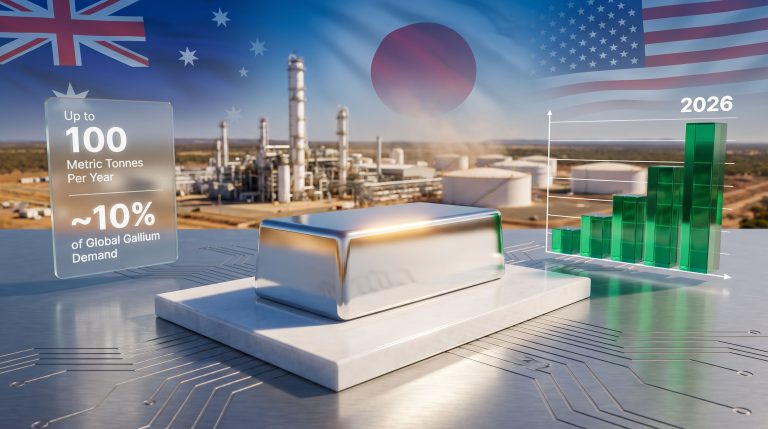
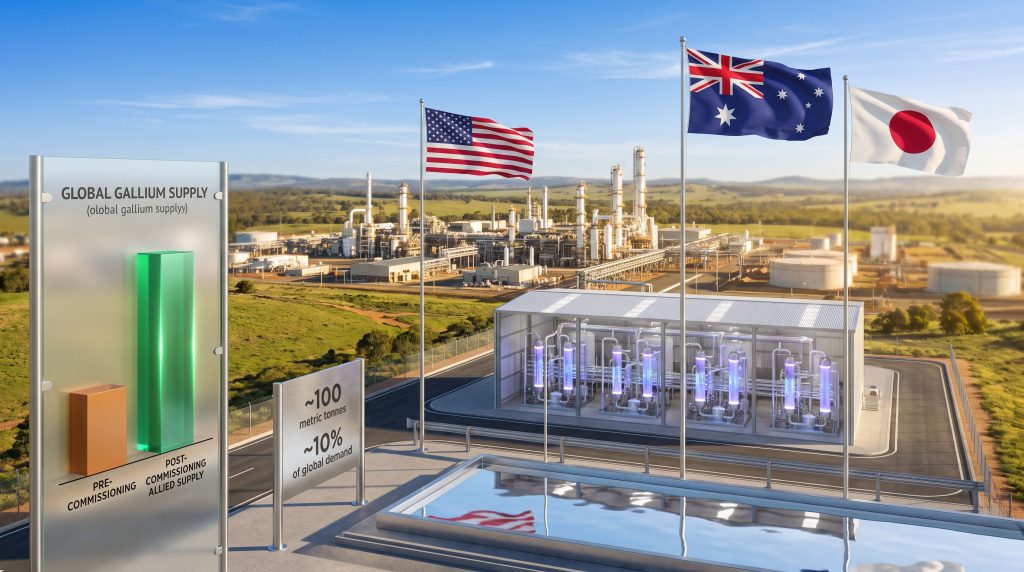
| Annual Production Target | ~100 metric tonnes of gallium |
| Share of Global Demand Targeted | Approximately 10% |
| Site Footprint | ~3 hectares of pre-cleared land within existing refinery |
| Site Share of Wagerup Refinery | Less than 2% of total refinery area |
| Production Configuration | Five phased production trains within an enclosed shed |
| Construction Employment | ~200 jobs |
| Permanent Operational Jobs | ~15 to 20 direct roles |
What the numbers do not fully capture is the economic elegance of the by-product recovery model. Because gallium already exists in Wagerup's liquor stream as a consequence of alumina production, the gallium plant does not require new bauxite mining, new ore transport, or new refining infrastructure beyond the dedicated recovery circuit. The host process does the heavy lifting. The gallium facility essentially monetises a mineral that would otherwise pass through the system unrecovered.
How Ion-Exchange Recovery Works in Practice
The extraction methodology at the core of the Wagerup gallium facility is ion-exchange technology, a selective separation process that has been used in industrial chemistry for decades but is relatively new to gallium recovery at this scale. The process unfolds in a logical sequence:
- Bauxite ore is processed through Wagerup's existing Bayer process circuit to produce alumina
- During refining, gallium concentrates naturally within the caustic liquor that circulates through the refinery
- A designated portion of this liquor stream is diverted to the gallium recovery circuit
- Ion-exchange resins selectively bind gallium ions from the liquor while allowing other dissolved species to pass through
- The resin is then stripped to release concentrated gallium, which is further processed into a refined commercial product
- The depleted liquor is returned to the alumina refining circuit, maintaining the refinery's overall water and chemical balance
This closed-loop approach is technically important because it means the gallium plant adds negligible additional waste streams to the refinery's existing environmental profile. The Western Australian environmental regulator has already granted a works approval, with expected emissions limited to water vapour, hydrogen, and oxygen, all benign outputs that reflect the electrochemical nature of the final refining steps.
A lesser-known technical point worth understanding is that not all bauxite is equally gallium-rich. The Darling Range bauxite processed at Wagerup is a gibbsite-dominant ore, which processes relatively efficiently through the Bayer circuit and tends to carry recoverable gallium concentrations. The specific gallium content of Wagerup's liquor stream will govern the practical throughput ceiling of the recovery plant, making feedstock characterisation a quietly important factor in the project's long-term performance.
The Trilateral Financing Structure and What It Signals
The financial architecture behind the Alcoa gallium plant in Western Australia is notable because it reflects a deliberate strategic decision by three governments to treat this facility as something closer to shared industrial infrastructure than a conventional commercial investment.
Australia's contribution flows through Export Finance Australia's Critical Minerals Facility, a financing mechanism designed specifically to support projects that address supply chain vulnerabilities in materials deemed strategically important. Japan's involvement is structured through Japan Australia Gallium Associates, a purpose-built vehicle incorporating Sojitz Corporation alongside Japanese government participation. This reflects Tokyo's acute sensitivity to critical mineral supply given its position as a major semiconductor and electronics manufacturer with essentially no domestic gallium production.
The United States' strategic interest in the project was formalised through the US-Australia Framework for Securing Supply in the Mining and Processing of Critical Minerals and Rare Earths, under which the project was identified as a priority. This framework elevates the facility's status within bilateral policy architecture, though it is important to note this classification reflects strategic alignment rather than constituting a direct US financial commitment to the project itself. The final investment decision announced by all three governments marks a pivotal milestone for allied-nation critical mineral strategy.
Why Japan's Involvement Is Particularly Significant
Japan's participation deserves closer attention than it typically receives in coverage of this project. Japanese industry is among the world's most intensive consumers of gallium compounds, particularly for GaN semiconductor production and LED manufacturing. Japanese firms have historically sourced gallium through commercial channels that ultimately trace back to heavily concentrated primary production.
The establishment of Japan Australia Gallium Associates as a formal joint venture vehicle suggests Tokyo views the Wagerup facility not merely as a supply diversification exercise but as a long-term structural reorientation of a critical procurement dependency. For investors and policymakers tracking the broader critical minerals demand surge, the trilateral structure is a meaningful signal. Projects with this level of multi-government financial backing and formal strategic designation tend to proceed through construction and commissioning with greater resource certainty than purely commercial critical minerals ventures.
How 100 Tonnes Per Year Moves the Global Market
To contextualise the Wagerup plant's output ambition, it is useful to understand current global gallium market dynamics:
| Market Scenario | Projected Impact |
|---|---|
| Baseline annual gallium demand (primary use) | The 100t target represents approximately 10% of estimated global demand |
| Western allied supply share pre-project | Near zero from dedicated allied-nation primary production |
| Western allied supply share post-commissioning | Materially increased, with Wagerup becoming the most significant allied-nation facility |
| Price volatility effect | New non-concentrated supply could reduce spikes driven by single-source disruption |
| Strategic procurement benefit | Semiconductor and defence manufacturers gain access to a verifiable allied-source supply chain |
Ten per cent of global demand is a strategically meaningful threshold for a specific reason: it is large enough to absorb a portion of the demand from allied-nation manufacturers who are willing to pay a modest premium for supply chain certainty, but not so large that it would immediately destabilise existing commercial pricing structures. This positioning allows the facility to establish itself commercially while serving its strategic diversification purpose.
A speculative but analytically credible scenario worth considering is that the Wagerup facility's success could accelerate similar by-product recovery projects at other alumina refineries globally. Alcoa operates additional refineries in Western Australia, and if the ion-exchange recovery model proves economically robust at Wagerup, the replication case across the company's broader refinery network becomes compelling. This would represent a compounding allied supply response rather than a single point-source intervention.
Western Australia's Structural Advantage in the Critical Minerals Race
The broader context for the Alcoa gallium plant in Western Australia is a state whose industrial base was built around raw material extraction and primary processing, and which is now actively seeking to capture more value from the minerals it produces before they leave its shores.
Western Australia hosts the world's largest lithium production operations, significant rare earth projects, and now what will be the most significant gallium recovery facility in the allied world. Australia's critical minerals push has a common thread across these developments: the state's existing industrial infrastructure, its established refining and processing workforce, its relatively mature regulatory environment for major resource projects, and its deep connectivity to Asian manufacturing markets that require the materials produced.
The Wagerup gallium project fits this pattern precisely. It adds a high-value output stream to existing infrastructure rather than requiring greenfield capital expenditure, it creates skilled operational employment in a regional industrial community, and it positions Western Australia within a supply chain that connects directly to allied-nation semiconductor and defence manufacturing. In addition, green metals leadership across the state is increasingly reinforced by projects such as this, which demonstrate that strategic mineral recovery and environmental responsibility are not mutually exclusive.
The Broader Replication Potential Across Global Alumina Infrastructure
One of the least-discussed aspects of the Wagerup project is what its success could mean for other alumina refiners globally. There are dozens of large-scale alumina refineries operating across Australia, Brazil, India, Guinea, and other jurisdictions. Each of these facilities processes gallium-bearing bauxite and currently allows that gallium to remain unrecovered, passing through the circuit without capture.
If Wagerup demonstrates that ion-exchange gallium recovery can be retrofitted to an existing refinery at manageable capital cost and operated profitably within an allied-nation supply chain framework, it creates a replication template that other refinery operators may find compelling. The economic case strengthens further if gallium prices remain elevated due to sustained supply concentration, as that price environment expands the margin available for by-product recovery operations. Furthermore, government support for Alcoa's project has demonstrated the kind of policy confidence that could encourage other jurisdictions to pursue comparable frameworks.
The next major ASX story will hit our subscribers first
Frequently Asked Questions: Alcoa Gallium Plant in Western Australia
What is the Alcoa gallium plant in Western Australia?
It is a purpose-built gallium recovery facility co-located at Alcoa's Wagerup alumina refinery, approximately 120 kilometres south-east of Perth. The plant is designed to produce around 100 metric tonnes of gallium annually using ion-exchange technology applied to the existing refinery's caustic liquor stream.
Does the gallium plant require new mining operations?
No. The facility recovers gallium as a by-product of bauxite already being processed for alumina production. No additional bauxite mining is required, and the gallium recovery circuit returns processed liquor back into the alumina refining process.
Which governments are involved in the project?
The governments of Australia, the United States, and Japan are all formally involved. Australia is providing financing through Export Finance Australia's Critical Minerals Facility, while Japan's participation is structured through Japan Australia Gallium Associates, a venture incorporating Sojitz Corporation and Japanese government backing.
How many jobs will the gallium plant create?
Approximately 200 construction-phase jobs and between 15 and 20 permanent operational roles are expected to be generated by the project.
What is gallium actually used for?
Gallium is a critical input in semiconductors, LEDs, advanced electronics, solar photovoltaic cells, telecommunications infrastructure including 5G systems, and a broad range of defence technologies including radar, missile guidance, and electronic warfare systems.
What technology does the plant use to extract gallium?
The plant uses ion-exchange technology to selectively separate gallium from a portion of Wagerup's alumina refinery liquor stream. The processed liquor is then returned to the refining circuit for continued use, making the process effectively closed-loop with minimal additional waste output.
Has the plant received environmental approval?
Yes. The Western Australian environmental regulator has granted a works approval for both the construction and operation of the facility. Expected emissions are limited to water vapour, hydrogen, and oxygen.
Key Strategic Takeaways for Industry Observers and Policymakers
The Wagerup gallium project is best understood not as a single isolated facility but as a proof-of-concept for a new class of critical mineral recovery operation, one that leverages existing industrial infrastructure, by-product stream chemistry, and multilateral government financing to address supply chain vulnerabilities that conventional mining projects cannot solve at equivalent speed or capital efficiency.
Five implications stand out for those tracking the evolving critical minerals landscape:
- Allied supply diversification moves from aspiration to infrastructure as physical construction begins at a facility with verified environmental clearance and committed financing
- By-product recovery economics offer a capital-efficient model with a faster path to production than greenfield mining, a structural advantage that policymakers are beginning to explicitly value
- Trilateral government co-financing signals that critical mineral recovery projects meeting strategic supply chain criteria can access non-commercial capital on terms that improve project viability and execution certainty
- Western Australia's industrial depth continues to differentiate it from other critical mineral jurisdictions, with existing refinery infrastructure providing a platform that cannot be replicated quickly elsewhere
- Semiconductor and defence supply chains gain a verifiable, allied-nation gallium source at meaningful scale for the first time, reducing the operational risk embedded in single-source procurement for high-consequence applications
Important Disclaimer: This article contains forward-looking analysis and scenario projections regarding project outputs, market impacts, and supply chain dynamics. Actual outcomes will depend on project execution, commodity markets, and policy developments that cannot be predicted with certainty. Readers should consult official disclosures from Alcoa and relevant government agencies for current project status before making any decisions informed by this analysis.
Readers interested in the broader dynamics of aluminium refining and critical mineral recovery can explore related industry analysis through AL Circle, which provides ongoing coverage of developments across the global aluminium and critical minerals ecosystem.
Want to Stay Ahead of the Next Major ASX Critical Minerals Discovery?
Discovery Alert's proprietary Discovery IQ model scans ASX announcements in real time, instantly identifying significant mineral discoveries across gallium, lithium, rare earths, and more than 30 other commodities — turning complex data into actionable investment insights. Explore how historic mineral discoveries have generated exceptional returns, and begin your 14-day free trial today to position yourself ahead of the broader market.