August 25, 2026
The Invisible Metal at the Centre of a Global Supply Chain Reckoning
Semiconductor manufacturing has a dependency problem that most people outside the industry rarely consider. The compound semiconductors powering radar arrays, 5G base stations, military communications systems, and high-efficiency solar cells are not built from silicon alone. Many of the most demanding applications rely on gallium-based compounds, specifically gallium arsenide and gallium nitride, which offer electron mobility and thermal performance that silicon cannot match at the frequencies modern defence and communications hardware requires.
The problem is not that gallium is geologically rare. With average crustal concentrations estimated at roughly 10 to 30 parts per million, gallium is present in the Earth's crust at levels comparable to lead. However, it almost never appears in economically mineable concentrations on its own. It has no primary ore. It exists as a dispersed trace element within other mineral systems, most importantly within the bauxite formations processed during aluminium production. This geochemical reality means that the world's gallium supply is structurally dependent on a narrow category of industrial infrastructure: high-throughput alumina refineries operating the Bayer process at scale.
That dependency has created an extraordinary vulnerability for Western technology supply chains, and it is the foundational logic behind the Alcoa-Sojitz gallium recovery project now under construction at Wagerup in Western Australia. Understanding gallium deposits and supply is, furthermore, essential context for grasping why this project carries such strategic weight.
When big ASX news breaks, our subscribers know first
Why China's Dominance Over Gallium Is So Difficult to Displace
For decades, China built a vertically integrated bauxite-to-gallium industrial ecosystem that no other nation chose to replicate. By combining large-scale alumina refinery throughput with deliberate investment in gallium recovery and purification circuits, China captured an estimated 80 to 90 percent of global primary gallium production during the years preceding its 2023 export restrictions.
Global annual gallium production is estimated at roughly 300 to 400 metric tonnes per year, according to United States Geological Survey data. Against that baseline, China's share is so dominant that the remaining non-Chinese producers, spread across Germany, Kazakhstan, Ukraine, Russia, and a handful of other countries, collectively represent a fragmented and geopolitically constrained alternative supply base.
The August 2023 decision by Chinese authorities to impose export licensing requirements on gallium and germanium forced governments across the democratic world to confront how exposed their technology and defence industrial bases had become. China's export controls on critical minerals have since become a defining feature of the global supply chain debate. Japan, as one of the world's most sophisticated semiconductor equipment manufacturing nations, faced acute exposure. The United States, already mobilising through the CHIPS Act to rebuild domestic semiconductor capacity, recognised that critical mineral supply chain gaps could undermine that entire industrial policy effort.
The structural lesson from China's gallium position is that supply concentration of this magnitude does not happen through market forces alone. It requires sustained, deliberate industrial policy investment over many years, which is precisely what Western nations are now being forced to replicate at speed.
How the Wagerup Facility Actually Recovers Gallium
The Bayer Process Connection
Understanding why the Alcoa-Sojitz gallium recovery project is technically credible requires a basic grasp of how gallium moves through an alumina refinery. The Bayer process dissolves bauxite ore in concentrated caustic soda at elevated temperatures and pressures, producing a sodium aluminate liquor from which aluminium hydroxide is eventually precipitated. Gallium, which shares some chemical similarities with aluminium, dissolves into this liquor and accumulates over successive processing cycles.
The concentration of gallium in Bayer process liquor is typically measured in the low parts-per-million range. A figure of approximately 100 to 150 ppm is considered reasonable for a gallium recovery circuit to be commercially viable, though this varies significantly depending on the bauxite ore source. This is precisely why large-scale refinery throughput is non-negotiable: only by processing millions of tonnes of bauxite annually can a facility accumulate enough gallium in its liquor streams to justify recovery investment. The broader bauxite production landscape is consequently central to understanding where future gallium recovery opportunities may emerge globally.
The Step-by-Step Recovery Pathway
The recovery process at a facility of this type generally proceeds as follows:
- Bayer process integration – Bauxite ore is dissolved in caustic soda to produce aluminate liquor containing trace gallium concentrations in the ppm range.
- Bleed stream diversion – A portion of the recirculating aluminate liquor is diverted as a bleed stream into the gallium recovery circuit, preventing gallium from building up to levels that interfere with alumina product quality.
- Concentration and selective separation – Ion exchange resins or solvent extraction circuits selectively capture gallium ions from the liquor, concentrating them into a smaller volume solution.
- Stripping and purification – The gallium-loaded resin or solvent is stripped to produce a concentrated gallium solution, which then undergoes electrolytic reduction or chemical precipitation to yield crude gallium metal.
- Final refining – Crude gallium is refined through zone melting or distillation-based processes to reach semiconductor-grade purity, typically expressed as 6N (99.9999 percent) purity for compound semiconductor applications.
The Wagerup refinery, located approximately 120 kilometres southeast of Perth, was selected as the host site because its existing alumina production infrastructure provides the feedstock stream without requiring any new mining or ore extraction operations. The gallium recovery facility is effectively parasitic on the refinery in the most economically efficient sense: it converts a previously unmonetised trace component of the process stream into a high-value product.
Alcoa's feasibility study for gallium production in Western Australia confirmed that the Wagerup site's infrastructure, ore characteristics, and throughput volumes make it a commercially sound foundation for recovery operations at scale.
The JAGA Partnership Structure and What It Reveals About Strategic Intent
The Japan Australia Gallium Associates (JAGA) joint venture that operates the Alcoa-Sojitz gallium recovery project is not a conventional commercial partnership. Its composition reflects deliberate geopolitical architecture.
| Partner | Primary Role | National Affiliation |
|---|---|---|
| Alcoa | Host site operator; refinery infrastructure and aluminate liquor feedstock provision | United States / Australia |
| Sojitz Corporation | Japanese trading house; commercial structuring and offtake coordination | Japan |
| JOGMEC | Government-backed resource security agency; co-investor in strategic mineral supply | Japan |
JOGMEC, the Japan Oil, Gas and Metals National Corporation, is not a private entity. It is a Japanese government agency whose mandate specifically includes securing offshore resource supply for Japanese industry. Its participation signals that the Japanese government considers reliable gallium access to be a matter of national industrial security, not merely a commercial preference.
The involvement of the Australian and United States governments alongside Japan creates a trilateral alignment reflecting the broader AUKUS and Quad-oriented critical minerals cooperation agenda. Federal Resources Minister Madeleine King publicly endorsed the groundbreaking, framing it as evidence of how Australia and its trusted partners are working together to strengthen their position in critical minerals and rare earths. Industry and Science Minister Tim Ayres described the investment as foundational to building Australia's long-term industrial strength through domestic capability development and allied partnerships.
Furthermore, the broader critical minerals demand surge across allied nations has reinforced why trilateral arrangements of this kind are gaining momentum beyond any single project. Government support for the project was formally announced following bilateral commitments between the US and Australian governments, underscoring the strategic rather than purely commercial framing of the investment.
Disclaimer: Ministerial statements reflect policy positions at the time of announcement. Readers should not interpret political endorsements as guarantees of project completion timelines or commercial outcomes.
Project Milestones and Production Targets
The timeline for the Alcoa-Sojitz gallium recovery project reflects a project that has moved through its development phases with deliberate speed given the strategic urgency surrounding gallium supply security.
| Milestone | Date |
|---|---|
| Final Investment Decision (FID) | July 2026 |
| Construction commencement (groundbreaking) | August 2026 |
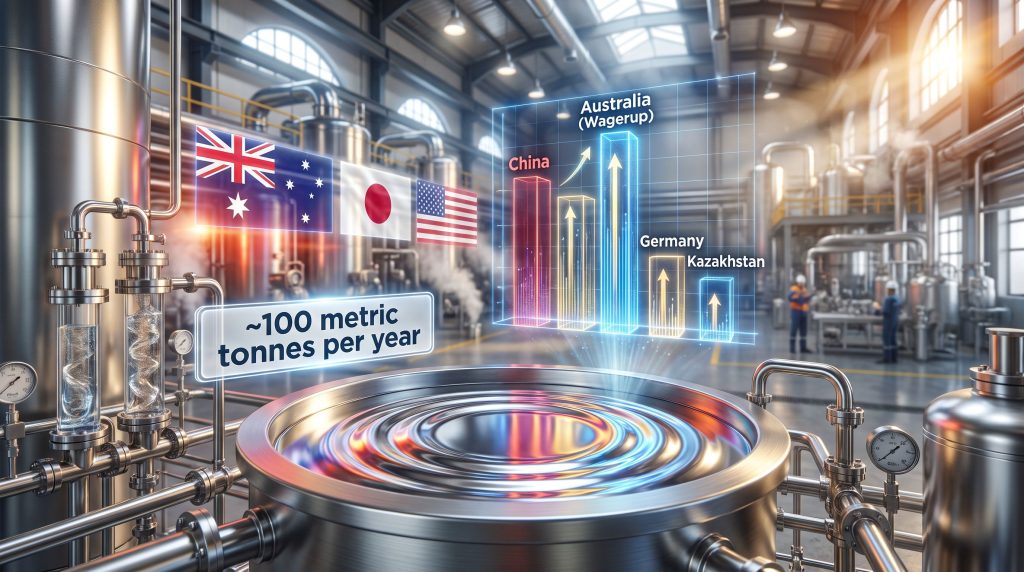
| Target production capacity | ~100 metric tonnes per annum |
| Estimated share of global gallium supply at target | ~10 percent |
If the facility achieves its target output of 100 metric tonnes per annum, it would represent a single-facility gallium production level that exceeds any existing non-Chinese producer. Germany, currently the largest ex-China gallium producer, recovers approximately 30 to 40 tonnes per year as a byproduct of zinc smelting operations.
How Australia Compares to Other Non-Chinese Gallium Producers
The global ex-China gallium production landscape is fragmented and constrained by geopolitical factors as much as technical ones.
| Country / Region | Recovery Method | Estimated Annual Capacity | Current Status |
|---|---|---|---|
| Australia (Wagerup, at target) | Alumina refinery byproduct | ~100 tpa | Under construction |
| Germany | Zinc smelting byproduct | ~30 to 40 tpa | Operational |
| Kazakhstan | Alumina refinery byproduct | ~10 to 20 tpa | Operational |
| Ukraine | Alumina refinery byproduct | Limited | Conflict-disrupted |
| Russia | Alumina refinery byproduct | Uncertain | Geopolitically isolated |
| China | Integrated bauxite processing | ~200 to 300 tpa | Dominant; export-restricted |
One aspect of this comparison that receives insufficient attention is the qualitative difference between zinc-smelting-derived gallium and alumina-refinery-derived gallium. Both are valid recovery pathways, however the alumina refinery route, which Wagerup employs, can in principle achieve higher throughput volumes because global alumina production is substantially larger than zinc smelting by mass. This gives the Wagerup model a structural advantage in terms of potential gallium recovery volume relative to the zinc-smelting pathway dominant in European production.
The next major ASX story will hit our subscribers first
Scenario Analysis: What Full Capacity Production Would Mean
Scenario A: Successful Ramp-Up to 100 tpa
- Australia becomes the largest single non-Chinese gallium producer globally by a substantial margin.
- Japan secures a treaty-aligned, geopolitically stable gallium supply corridor outside Chinese export licensing jurisdiction.
- Western defence and semiconductor manufacturers gain access to a meaningful alternative supply source that reduces single-source dependency.
- The Wagerup model creates a demonstrable template for gallium recovery at other large alumina refineries in Australia and allied nations.
Scenario B: Partial Production of 50 to 70 tpa
- Meaningful supply diversification is achieved but insufficient to fully substitute Chinese gallium for the combined needs of allied semiconductor industries.
- This would likely trigger parallel investment in European gallium recovery expansion and North American recovery initiatives.
Scenario C: Significant Delays or Technical Underperformance
- Reinforces the engineering difficulty of scaling gallium recovery from aluminate liquor at commercial production rates.
- Intensifies pressure on governments to pursue gallium stockpiling programmes as a bridge strategy.
- May accelerate research investment in gallium-free compound semiconductor alternatives.
These scenarios are speculative projections intended for analytical purposes. Actual outcomes will depend on engineering execution, bauxite feedstock quality, market conditions, and broader geopolitical developments. Nothing in this analysis constitutes investment advice.
Risk Factors Investors and Industry Observers Should Understand
Technical and Operational Risks
Gallium recovery from aluminate liquor is technically demanding in ways that are not always apparent from high-level project descriptions. Several risk factors deserve careful consideration:
- Feedstock variability: The gallium content of Bayer process liquor varies depending on the origin and grade of the bauxite ore being processed. If Wagerup's bauxite supply shifts toward lower-gallium-content ore sources, recovery economics could be affected without any change to the facility itself.
- Scale-up complexity: Moving from a feasibility or pilot scale recovery circuit to a 100 tpa commercial operation involves significant process engineering challenges, particularly in maintaining consistent product purity across higher throughputs.
- Refinery integration risk: The gallium recovery circuit's output is entirely dependent on the Wagerup alumina refinery maintaining normal production. Any unplanned shutdown of the refinery directly eliminates the gallium feedstock stream.
In addition, the processing challenges in critical minerals more broadly illustrate that technical underperformance at the refining stage is a recurring risk across the sector, not unique to gallium recovery.
Commercial and Market Risks
Gallium spot prices have historically been volatile. Prior to China's 2023 export restrictions, prices were frequently below USD $200 per kilogram. Following the announcement of export licensing requirements, prices spiked significantly, with some market reports indicating levels exceeding USD $600 per kilogram in the immediate aftermath. However, price trajectories at elevated levels are not guaranteed to persist, particularly if Chinese export licensing proves selective rather than broadly restrictive, or if diplomatic conditions change.
The project's commercial structure, with Sojitz providing the primary offtake coordination channel toward Japanese end-users, creates concentration risk on the demand side. Consequently, a diversified customer base across multiple allied nations would reduce this exposure over time.
One longer-term consideration that is often underweighted in gallium supply chain analysis is the accelerating development of silicon carbide (SiC) as a substrate material for power electronics applications. SiC does not require gallium, and its cost-performance trajectory has improved substantially over the past decade. While gallium nitride retains specific performance advantages in high-frequency radio frequency applications, any significant expansion of SiC adoption into broader power electronics markets could reduce the total addressable market for gallium over a 10 to 15 year horizon.
Australia's Broader Industrial Positioning: Beyond Raw Material Export
The Alcoa-Sojitz gallium recovery project is best understood not as an isolated industrial facility but as a proof-of-concept for a fundamentally different approach to Australian minerals development. For most of its modern industrial history, Australia has captured value at the extraction and primary processing stage, exporting bauxite, alumina, and other bulk commodities while the downstream value in trace critical minerals embedded within those commodity streams passed through unrecovered.
The byproduct recovery model demonstrated at Wagerup has potential applicability across other commodity processing streams operating in Australia. Scandium can be recovered from titanium and zirconium processing residues. Vanadium appears in certain steel production waste streams. Germanium, which China also restricted in August 2023 alongside gallium, occurs as a trace component in some coal fly ash and zinc processing residues. Each of these represents a potential future application of the same refinery-integrated critical mineral extraction logic.
The deepening of Australia's strategic minerals processing relationship with Japan is also significant from a bilateral trade architecture perspective. Japan's semiconductor equipment manufacturing ecosystem requires reliable access to materials like gallium at standards of purity and supply continuity that only geopolitically stable, treaty-aligned suppliers can credibly guarantee.
The Wagerup gallium facility may ultimately be remembered not for the volume of gallium it produces, but for demonstrating that democratic, resource-rich nations can rebuild supply chain sovereignty in critical technology minerals by leveraging existing industrial infrastructure rather than waiting for greenfield mining solutions to mature.
Frequently Asked Questions
What Is the Alcoa-Sojitz Gallium Recovery Project?
It is a joint venture facility under construction at Alcoa's Wagerup Alumina Refinery in Western Australia, designed to extract and refine gallium as a byproduct of the existing alumina refining operation. The project entity is Japan Australia Gallium Associates (JAGA), comprising Alcoa, Sojitz Corporation, and JOGMEC.
How Much Gallium Will the Wagerup Facility Produce?
The target production capacity is approximately 100 metric tonnes per annum, which at current global production estimates would represent roughly 10 percent of total world gallium supply.
Why Is Gallium Classified as a Critical Mineral?
Gallium is essential to compound semiconductor production, specifically gallium arsenide and gallium nitride materials used in defence electronics, 5G infrastructure, radar systems, LEDs, and solar photovoltaic cells. Its supply is heavily concentrated in China, creating a strategic vulnerability for Western technology and defence sectors.
When Did Construction Begin?
The Final Investment Decision was reached in July 2026. Construction commenced with a formal groundbreaking in August 2026. Commercial production will follow the completion of construction and relevant approvals.
Why Is Gallium So Difficult to Source Outside China?
Gallium has no primary ore and occurs only as a trace element in bauxite and zinc processing streams. China built an integrated industrial ecosystem over decades that captures gallium efficiently at scale. Replicating this outside China requires both the right industrial host infrastructure and deliberate investment in recovery circuits, which most non-Chinese alumina refineries historically chose not to make.
What Makes the Wagerup Site Suitable for Gallium Recovery?
Wagerup is a large-scale alumina refinery operating the Bayer process at high throughput volumes, which generates aluminate liquor streams containing recoverable gallium concentrations. Its existing infrastructure eliminates the need for new mining operations, making co-located gallium recovery economically more straightforward than building standalone facilities.
This article is intended for informational purposes only and does not constitute financial or investment advice. Forward-looking statements, scenario projections, and price references involve inherent uncertainty and should not be relied upon as predictions of future performance or outcomes. Readers should conduct independent research before making any investment decisions.
Want to Stay Ahead of the Next Major Critical Mineral Discovery?
Discovery Alert's proprietary Discovery IQ model scans ASX announcements in real time, instantly identifying significant mineral discoveries across gallium, rare earths, and over 30 other commodities — turning complex data into clear, actionable opportunities for investors at every level. Explore why historic mineral discoveries have generated substantial returns and begin your 14-day free trial today to position yourself ahead of the broader market.